A DUNGAN BOOKS PUBLICATION
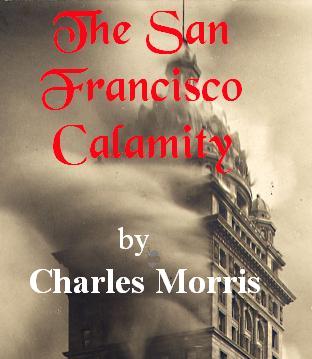
A Complete and Accurate Account of the Fearful Disaster which Visited the Great City and the Pacific Coast, the Reign of Panic and Lawlessness, the Plight of 300,000 Homeless People and the World-wide Rush to the Rescue.TOLD BY EYE WITNESSESINCLUDING GRAPHIC AND RELIABLE ACCOUNTS OF ALL GREAT EARTHQUAKES AND VOLCANIC ERUPTIONS IN THE WORLD'S HISTORY, AND SCIENTIFIC EXPLANATIONS OF THEIR CAUSES.EDITED BYCHARLES MORRIS, LL. D.PUBLISHER'S INTRODUCTION TO 2005 EDITIONThe 1906 San Francisco earthquake and subsequent fire was, up to its time, the greatest disaster to ever befall a city in the United States. What is truly amazing is the speed in which municipal officials, the United States Army and the federal government acted to restore order. Within days there was sufficient food and shelter on hand to provide for the 300,000 people that had lost their homes.
As I read through Charles Morris' manuscript, I was struck by how much more humane and efficient disaster relief was following the 1906 San Francisco earthquake than it was following the havoc wreaked by Hurricane Katrina upon New Orleans in September 2005. Although the funds made available to FEMA were much greater in 2005, they were administered in a less efficient manner. As you read through these pages, I invite you to note the superior caliber of the elected officials who acted swiftly to bring aid and comfort to their fellow citizens in their time of need. Truly, there is something to be learned from this story.PREFACEEarthquake and famine, fire and sudden death—these are the destroyers that men fear when they come singly; but upon the unhappy people of California they came together, a hideous quartette, to slay human beings, to blot from existence the wealth that represented prolonged and strenuous effort, to bring hunger and speechless misery to three hundred thousand homeless and terror-stricken people.The full measure of the catastrophe can probably never be taken. The summary cannot be made amid the panic, the confusion, the removal of ancient landmarks, the complete subversion of the ordinary machinery of society. When chaos comes, as it did in San Francisco, and all the channels of familiar life are closed, and human anguish grows to be intolerable, compilation of statistics is impossible, even if it were not repugnant to the feelings. And when order is once more restored, after the lapse of many weeks, months and perhaps years, the details of the calamity have merged into one undecipherable mass of misery which defies the analyst and the historian. It is the purpose of this book faithfully to record the story of these awful days when years were lived in a moment and to preserve an accurate chronicle of them, not only for the people whose hearts yearn in sympathy today, but for their posterity.Other frightful catastrophes the world has known. The earthquake which dropped Lisbon into the sea in 1755, and in a moment swallowed up twenty-five thousand people, was perhaps more awful than the convulsion which has brought woe to San Francisco. When Krakatoa Mountain, in the Straits of Sunda, in 1883, split asunder and poured across the land a mighty wave, in which thirty-six thousand human beings perished, the results also were more terrible.The whirlwind of fire which consumed St. Pierre, in the Island of Martinique, and the devastation wrought by Vesuvius a few days previous to that at San Francisco, need not be used for comparison with the latter tragedy, but they may be referred to, that we may recall the fact that this land of ours is not the only one which has suffered.But since the western hemisphere was discovered there has been in this quarter of the globe no violence of natural forces at all comparable in destructive fury with that which was manifested upon the Pacific coast. The only other calamity at all equalling it, or surpassing it, was the Civil War, and that was the work of the evil passions of man inciting him to slay his brother, while Nature would have had him live in peace.The earthquake in San Francisco, which crumbled strong buildings as if they were made of paper, would have been terrible enough; but afterward came the horror of fire and of imprisoned men and women burned alive, and now to it was added the suffering of multitudes from hunger and exposure.Public attention is fixed on the great city; but smaller cities had their days and nights of destruction, horror and misery. Some were almost destroyed. Others were partly ruined, and beyond their borders, over a wide area, the trembling of the earth toppled houses, annihilated property and transformed riches into poverty. The cost in life can be reckoned. The money loss will never be computed, for the appraised value of the wrecked property conveys no notion of the consequences of the almost complete paralysis, for a time, of the commercial operations by means of which men and women earn their bread.When the weakness and the folly and the sin of men bring woe upon other men, there are plenty of texts for the preacher and no scarcity of earnest preachers. But here is a vast and awful catastrophe that befell from an act of Nature apparently no more extraordinary than the shrinkage of hot metal in the process of cooling. The consequences are terrifying in this case because they involve the habitations of half a million people; but, no doubt, the process goes on somewhere within the earth almost continuously, and it no more involves the theory of malignant Nature than that of an angry God.If we contemplate it, possibly we may be helped to a profitable estimate of our own relative insignificance. We think, with some notion of our importance, of the thousand million men who live upon the earth; but they are a mere handful of animate atoms in comparison with the surface, to say nothing of the solid contents, of the globe itself.We are fond of boasting in this latter day of man's marvelous success in subduing the forces of Nature; and, while we are in the midst of exultation over our victories, Nature tumbles the rocks about somewhere within the bowels of the earth, and we have to learn the old lesson that our triumphs have not penetrated farther than to the very outermost rim of the realms of Nature.A few weak, almost helpless, creatures, we millions of men stand upon the deck of a great ship, which goes rolling through space that is itself incomprehensible, and usually we are so busy with our paltry ambitions, our transgressions, our righteous labors, our prides and hopes and entanglements that we forget where we are and what is our destiny. A direct interposition from a Superior Power, even if it be hurtful to the body, might be required to persuade us to stop and consider and take anew our bearings, so that we may comprehend in some larger degree our precise relations to things. The wisest men have been the most ready to recognize the beneficence of the discipline of affliction. If there were no sorrow, we should be likely to find the school of life unprofitable.For one thing, the school wherein sorrow is a part of the discipline is that in which is developed human sympathy, one of the finest and most ennobling manifestations of the Love which is, in its essence, divine. In human life there is much that is ignoble, and the race has almost contemptible weakness and insignificance in comparison with the physical forces of the universe.But man is superior to all these forces in his possession of the power of affection; and in almost the lowest and basest of the race this power, if latent and half lost, may be found and evoked by the spectacle of the suffering of a fellow-creature.The human family looks on with pity while the homeless and hungry and impoverished Californians endure pangs. Wherever the news went, by the swift processes of electricity, there men and women, some of them, perhaps, hardly knowing where California is, were sorry and willing and eager to help. There are quarrels within the family sometimes, when nation wars with nation, and all love seems to have vanished; but the world is, in truth, akin. "God hath made of one blood all the nations of the earth," and the blood "tells" when suffering comes.THE PUBLISHERS.TABLE OF CONTENTSSAN FRANCISCO AND ITS TERRIFIC EARTHQUAKETHE DEMON OF FIRE INVADES THE STRICKEN CITYFIGHTING FLAMES WITH DYNAMITETHE REIGN OF DESTRUCTION AND DEVASTATIONTHE PANIC FLIGHT OF A HOMELESS HOSTFACING FAMINE AND PRAYING FOR RELIEFTHE FRIGHTFUL LOSS OF LIFE AND WEALTHWONDERFUL RECORD OF THRILLING ESCAPESDISASTER SPREADS OVER THE GOLDEN STATEALL AMERICA AND CANADA TO THE RESCUETHE SAN FRANCISCO OF THE PASTLIFE IN THE METROPOLIS OF THE PACIFICPLANS TO REBUILD SAN FRANCISCOTHE EARTHQUAKE WAVE FELT AROUND THE WORLDVESUVIUS DEVASTATES THE REGION OF NAPLESTHE GREAT LISBON AND CALABRIAN EARTHQUAKESTHE CHARLESTON AND OTHER EARTHQUAKES OF THE UNITED STATESTHE VOLCANO AND THE EARTHQUAKE, EARTH'S DEMONS OF DESTRUCTIONTHE THEORIES OF VOLCANIC AND EARTHQUAKE ACTIONTHE ACTIVE VOLCANOES OF THE EARTHTHE FAMOUS VESUVIUS AND THE DESTRUCTION OF POMPEIIERUPTIONS OF VESUVIUS, ETNA AND STROMBOLISKAPTER JOKULL AND HECLA, THE GREAT ICELANDIC VOLCANOESVOLCANOES OF THE PHILIPPINES AND OTHER PACIFIC ISLANDSTHE WONDERFUL HAWAIIAN CRATERS AND KILAUEA'S LAKE OF FIREPOPOCATEPETL AND OTHER VOLCANOES OF MEXICO AND CENTRAL AMERICATHE TERRIBLE ERUPTION OF KRAKATOAMONT PELEE AND ITS HARVEST OF DEATH IN 1902ST. VINCENT ISLAND AND MONT SOUFRIERE IN 1812SUBMARINE VOLCANOES AND THEIR WORK OF ISLAND-BUILDINGMUD VOLCANOES, GEYSERS AND HOT SPRINGSTHE SAN FRANCISCO CALAMITY BY EARTHQUAKE AND FIRESan Francisco and Its Terrific Earthquake.On the splendid Bay of San Francisco, one of the noblest harbors on the whole vast range of the Pacific Ocean, long has stood, like a Queen of the West on its seven hills, the beautiful city of San Francisco, the youngest and in its own way one of the most beautiful and attractive of the large cities of the United States. Born less than sixty years ago, it has grown with the healthy rapidity of a young giant, outvieing many cities of much earlier origin, until it has won rank as the eighth city of the United States, and as the unquestioned metropolis of our far Western States.It is on this great and rich city that the dark demon of destruction has now descended, as it fell on the next younger of our cities, Chicago, in 1872. It was the rage of the fire-fiend that desolated the metropolis of the lakes. Upon the Queen City of the West the twin terrors of earthquake and conflagration have descended at once, careening through its thronged streets, its marts of trade, and its abodes alike of poverty and wealth, and with the red hand of devastation sweeping one of the noblest centres of human industry and enterprise from the face of the earth. It is this story of almost irremediable ruin which it is our unwelcome duty to chronicle. But before entering upon this sorrowful task some description of the city that has fallen a prey to two of the earth's chief agents of destruction must be given.San Francisco is built on the end of a peninsula or tongue of land lying between the Pacific Ocean and the broad San Francisco Bay, a noble body of inland water extending southward for about forty miles and with a width varying from six to twelve miles. Northward this splendid body of water is connected with San Pablo Bay, ten miles long, and the latter with Suisun Bay, eight miles long, the whole forming a grand range of navigable waters only surpassed by the great northern inlet of Puget Sound. The Golden Gate, a channel five miles long, connects this great harbor with the sea, the whole giving San Francisco the greatest commercial advantages to be found on the Pacific coast.THE EARLY DAYS OF SAN FRANCISCO.The original site of the city was a grant made by the King of Spain of four square leagues of land. Congress afterwards confirmed this grant. It was an uninviting region, with its two lofty hills and its various lower ones, a barren expanse of shifting sand dunes extending from their feet. The population in 1830 was about 200 souls, about equal to that of Chicago at the same date. It was not much larger in 1848, when California fell into American hands and the discovery of gold set in train the famous rush of treasure seekers to that far land. When 1849 dawned the town contained about 2,000 people. They had increased to 20,000 before the year ended. The place, with its steep and barren hills and its sandy stretches, was not inviting, but its ease of access to the sea and its sheltered harbor were important features, and people settled there, making it a depot of mining supplies and a point of departure for the mines.The place grew rapidly and has continued to grow. At first a city of flimsy frame buildings, it became early a prey to the flames, fire sweeping through it three times in 1850 and taking toll of the young city to the value of $7,500,000. These conflagrations swept away most of the wooden houses, and business men began to build more substantially of brick, stone and iron. Yet today, for climatic reasons, most of the residences continue to be built of wood. But the slow-burning redwood of the California hillsides is used instead of the inflammable pine, the result being that since 1850 the loss by fire in the residence section of the city has been remarkably small. In 1900 the city contained 50,494 frame and only 3,881 stone and brick buildings, though the tendency to use more durable materials was then growing rapidly.Before describing the terrible calamity which fell upon this beautiful city on that dread morning of April 18, 1906, some account of the character of the place is very desirable, that readers may know what San Francisco was before the rage of earthquake and fire reduced it to what it is today.THE CHARACTER OF THE CITY.The site of the city of San Francisco is very uneven, embracing a series of hills, of which the highest ones, known as the Twin Peaks, reach to an elevation of 925 feet, and form the crown of an amphitheatre of lower altitudes. Several of the latter are covered with handsome residences, and afford a magnificent view of the surrounding country, with its bordering bay and ocean, and the noble Golden Gate channel, a river-like passage from ocean to bay of five miles in length and one in width. This waterway is very deep except on the bar at its mouth, where the depth of water is thirty feet.Since its early days the growth of the city has been very rapid. In 1900 it held 342,782 people, and the census estimate made from figures of the city directory in 1904 gave it then a population of 485,000, probably a considerable exaggeration. In it are mingled inhabitants from most of the nations of the earth, and it may claim the unenviable honor of possessing the largest population of Chinese outside of China itself, the colony numbering over 20,000.Of the pioneer San Francisco few traces remain, the old buildings having nearly all disappeared. Large and costly business houses and splendid residences have taken their place in the central portion of the city, marble, granite, terra-cotta, iron and steel being largely used as building material. The great prevalence of frame buildings in the residence sections is largely due to the popular belief that they are safer in a locality subject to earthquakes, while the frequent occurrence of earth tremors long restrained the inclination to erect lofty buildings. Not until 1890 was a high structure built, and few skyscrapers had invaded the city up to its day of ruin. They will probably be introduced more frequently in the future, recent experience having demonstrated that they are in considerable measure earthquake proof.The city before the fire contained numerous handsome structures, including the famous old Palace Hotel, built at a cost of $3,000,000 and with accommodations for 1,200 guests; the nearly finished and splendid Fairmount Hotel; the City Hall, with its lofty dome, on which $7,000,000 is said to have been spent, much of it, doubtless, political plunder; a costly United States Mint and Post Office, an Academy of Science, and many churches, colleges, libraries and other public edifices. The city had 220 miles of paved streets, 180 miles of electric and 77 of cable railway, 62 hotels, 16 theatres, 4 large libraries, 5 daily newspapers, etc., together with 28 public parks.Sitting, like Rome of old, on its seven hills, San Francisco has long been noted for its beautiful site, clasped in, as it is, between the Pacific Ocean and its own splendid bay, on a peninsula of some five miles in width. Where this juts into the bay at its northernmost point rises a great promontory known as Telegraph Hill, from whose height homeless thousands have recently gazed on the smoke rising from their ruined homes. In the early days of golden promise a watchman was stationed on this hill to look out for coming ships entering the Golden Gate from their long voyage around the Horn and signal the welcome news to the town below. From this came its name.Cliffs rise on either side of the Golden Gate, and on one is perched the Cliff House, long a famous hostelry. This stands so low that in storms the surf is flung over its lower porticos, though its force is broken by the Seal Rocks. A chief attraction to this house was to see the seals play on these rocks, their favorite place of resort. The Cliff House was at first said to have been swept bodily by the earthquake into the sea, but it proved to be very little injured, and stands erect in its old picturesque location.In the vicinity of Telegraph Hill are Russian and Nob Hills, the latter getting its peculiar title from the fact that the wealthy "nobs," or mining magnates, of bonanza days built their homes on its summit level. Farther to the east are Mount Olympus and Strawberry Hill, and beyond these the Twin Peaks, which really embrace three hills, the third being named Bernal Heights. Farther to the south and east is Rincan Hill, the last in the half moon crescent of hills, within which is a spread of flat ground extending to the bay. Behind the hills on the Pacific side stretches a vast sweep of sand, at some places level, but often gathered into great round dunes. Part of this has been transformed into the beautiful Golden Gate Park, a splendid expanse of green verdure which has long been one of San Francisco's chief attractions.Beneath the whole of San Francisco is a rock formation, but everywhere on top of this extends the sand, the gift of the winds. This is of such a character that a hole dug in the street anywhere, even if only to the depth of a few feet, must be shored up with planking or it will fill as fast as it is excavated, the sand running as dry as the contents of an hour glass. When there is an earthquake—or a "temblor," to use the Spanish name—it is the rock foundation that is disturbed, not the sand, which, indeed, serves to lessen the effect of the earth tremor.THE FOUNDATIONS OF THE CITY.Leaving the region of the hills and descending from their crescent-shaped expanse, we find a broad extent of low ground, sloping gently toward the bay. On this low-lying flat was built all of San Francisco's business houses, all its principal hotels and a large part of its tenements and poorer dwellings. It was here that the earthquake was felt most severely and that the fire started which laid waste the city.Rarely has a city been built on such doubtful foundations. The greater part of the low ground was a bay in 1849, but it has since been filled in by the drifting sands blown from the ocean side by the prevailing west winds and by earth dumped into it. Much of this land was "made ground." Forty-niners still alive say that when they first saw San Francisco the waters of the bay came up to Montgomery Street. The Palace Hotel was in Montgomery Street, and from there to the ferry docks—a long walk for any man—the water had been driven back by a "filling-in" process.This is the district that especially suffered, that south of Market and east of Montgomery Streets. Nearly all the large buildings in this section are either built on piles driven into the sand and mud or were raised upon wooden foundations. It is on such ground as this that the costly Post Office building was erected, despite the protests of nearly the entire community, who asserted that the ground was nothing but a filled-in bog.In none of the earthquakes that San Francisco has had was any serious damage except to houses in this filled-in territory, and to houses built along the line of some of the many streams which ran from the hills down to the bay, and which were filled in as the town grew—for instance, the Grand Opera House was built over the bed of St. Anne's Creek. A bog, slough and marsh, known as the Pipeville Slough, was the ground on which the City Hall was built, and which was originally a burying ground. Sand from the western shore had blown over and drifted into the marsh and hardened its surface.When the final grading scheme of the city was adopted in 1853, and work went on, the water front of the city was where Clay Street now is, between Montgomery and Sansome Streets. The present level area of San Francisco of about three thousand acres is an average of nine feet above or below the natural surface of the ground and the changes made necessitated the transfer of 21,000,000 cubic yards from hills to hollows. Houses to the number of thousands were raised or lowered, street floors became subcellars or third stories and the whole natural face of the ground was altered.Through this infirm material all the pipes of the water and sewer system of San Francisco in its business districts and in most of the region south of Market street were laid. When the earthquake came, the filled-in ground shook like the jelly it is. The only firm and rigid material in its millions of cubic yards of surface area and depth were the iron pipes. Naturally they broke, as they would not bend, and San Francisco's water system was therefore instantly disabled, with the result that the fire became complete master of the situation and raged uncontrolled for three days and nights.Although the earthquake wrecked the business and residential portions of the city alike, on the hills the land did not sink. All "made ground" sank in consequence of the quaking, but on the high ground the upper parts of the buildings were about the only portions of the structures wrecked. Most of the damage on the hills was done by falling chimneys. On Montgomery Street, half a block from the main office of the Western Union Company, the middle of the street was cracked and blown up, but during the shocks which struck the Western Union building only the top stories were cracked. Similar phenomena were experienced in other localities, and the bulk of the disaster, so far as the earthquake was concerned, was confined to the low-lying region above described.THE BANE OF THE EARTHQUAKE.From the origin of San Francisco the earthquake has been its bane. During the past fifty years fully 250 shocks have been recorded, while all California has been subject to them. But frequency rather than violence of shocks has been the characteristic of the seismic history of the State, there having been few shocks that caused serious damage, and none since 1872 that led to loss of life.There was a violent shock in 1856, when the city was only a mining town of small frame buildings. Several shanties were overthrown and a few persons killed by falling walls and chimneys. There was a severe shock also in 1865, in which many buildings were shattered. Next in violence was the shock of 1872, which cracked the walls of some of the public buildings and caused a panic. There was no great loss of life. In April, 1898, just before midnight, there was a lively shakeup which caused the tall buildings to shake like the snapping of a whip and drove the tourists out of the hotels into the streets in their nightclothes. Three or four old houses fell, and the Benicia Navy Yard, which is on made ground across the bay, was damaged to the extent of about $100,000. The last severe shock was in January, 1900, when the St. Nicholas Hotel was badly damaged.These were the heaviest shocks. On the other hand, light shocks, as above said, have been frequent. Probably the sensible quakes have averaged three or four a year. These are usually tremblings lasting from ten seconds to a minute and just heavy enough to wake light sleepers or to shake dishes about on the shelves. Tourists and newcomers are generally alarmed by these phenomena, but old Californians have learned to take them philosophically. To one who is not afraid of them, the sensation of one of these little tremblers is rather pleasant than otherwise, and the inhabitants grew so accustomed to them as rarely to let them disturb their equanimity.After 1900 the forces beneath the earth seemed to fall asleep. As it proved, they were only biding their time. The era was at hand when they were to declare themselves in all their mighty power and fall upon the devoted city with ruin in their grasp. But all this lay hidden in the secret casket of time, and the city kept up to its record as one of the liveliest and in many respects the most reckless and pleasure-loving on the continent, its people squandering their money with thoughtless improvidence and enjoying to the full all the good that life held out to them.On the 17th of April, 1906, the city was, as usual, gay, careless, busy, its people attending to business or pleasure with their ordinary vim as inclination led them, and not a soul dreaming of the horrors that lay in wait. They were as heedless of coming peril and death as the inhabitants of Sodom and Gomorrah before the rain of fire from heaven descended upon their devoted heads. This is not to say that they were doomed by God to destruction like these "cities of the plains." We should more wisely say that the forces of ruin within the earth take no heed of persons or places. They come and go as the conditions of nature demand, and if man has built one of his cities across their destined track, its doom comes from its situation, not from the moral state of its inhabitants.THE GREAT DISASTER OF 1906.That night the people went, with their wonted equanimity, to their beds, rich and poor, sick and well alike. Did any of them dream of disaster in the air? It may be so, for often, as the poet tells us, "Coming events cast their shadows before." But, forewarned by dreams or not, doubtless not a soul in the great city was prepared for the terrible event so near at hand, when, at thirteen minutes past five o'clock on the dread morning of the 18th, they felt their beds lifted beneath them as if by a Titan hand, heard the crash of falling walls and ceilings, and saw everything in their rooms tossed madly about, while through their windows came the roar of an awful disaster from the city without.It was a matter not of minutes, but of seconds, yet on all that coast, long the prey of the earthquake, no shock like it had ever been felt, no such sudden terror awakened, no such terrible loss occasioned as in those few fearful seconds. Again and again the trembling of the earth passed by, three quickly repeated shocks, and the work of the demon of ruin was done. People woke with a start to find themselves flung from their beds to the floor, many of them covered with the fragments of broken ceilings, many lost among the ruins of falling floors and walls, many pinned in agonizing suffering under the ruins of their houses, which had been utterly wrecked in those fatal seconds. Many there were, indeed, who had been flung to quick if not to instant death under their ruined homes.Those seconds of the reign of the elemental forces had turned the gayest, most careless city on the continent into a wreck which no words can fitly describe. Those able to move stumbled in wild panic across the floors of their heaving houses, regardless of clothing, of treasures, of everything but the mad instinct for safety, and rushed headlong into the streets, to find that the earth itself had yielded to the energy of its frightful interior forces and had in places been torn and rent like the houses themselves. New terrors assailed the fugitives as fresh tremors shook the solid ground, some of them strong enough to bring down shattered walls and chimneys, and bring back much of the mad terror of the first fearful quake. The heaviest of these came at eight o'clock. While less forcible than that which had caused the work of destruction, it added immensely to the panic and dread of the people and put many of the wanderers to flight, some toward the ferry, the great mass in the direction of the sand dunes and Golden Gate Park.The spectacle of the entire population of a great city thus roused suddenly from slumber by a fierce earthquake shock and sent flying into the streets in utter panic, where not buried under falling walls or tumbling debris, is one that can scarcely be pictured in words, and can be given in any approach to exact realization only in the narratives of those who passed through its horrors and experienced the sensations to which it gave rise. Some of the more vivid of these personal accounts will be presented later, but at present we must confine ourselves to a general statement of the succession of events.The earthquake proved but the beginning and much the least destructive part of the disaster. In many of the buildings there were fires, banked for the night, but ready to kindle the inflammable material hurled down upon them by the shock. In others were live electric wires which the shock brought in contact with woodwork. The terror-stricken fugitives saw, here and there, in all directions around them, the alarming vision of red flames curling upward and outward, in gleaming contrast to the white light of dawn just showing in the eastern sky. Those lurid gleams climbed upward in devouring haste, and before the sun had fairly risen a dozen or more conflagrations were visible in all sections of the business part of the city, and in places great buildings broke with startling suddenness into flame, which shot hotly high into the air.While the mass of the people were stunned by the awful suddenness of the disaster and stood rooted to the ground or wandered helplessly about in blank dismay, there were many alert and self- possessed among them who roused themselves quickly from their dismay and put their energies to useful work. Some of these gave themselves to the work of rescue, seeking to save the injured from their perilous situation and draw the bodies of the dead from the ruins under which they lay. Those base wretches to whom plunder is always the first thought were as quickly engaged in seeking for spoil in edifices laid open to their plundering hands by the shock. Meanwhile the glare of the flames brought the fire-fighters out in hot haste with their engines, and up from the military station at the Presidio, on the Golden Gate side of the city, came at double quick a force of soldiers, under the efficient command of General Funston, of Cuban and Philippine fame. These trained troops were at once put on guard over the city, with directions to keep the best order possible, and with strict command to shoot all looters at sight. Funston recognized at the start the necessity of keeping the lawless element under control in such an exigency as that which he had to face. Later in the day the First Regiment of California National Guards was called out and put on duty, with similar orders.RESCUERS AND FIRE-FIGHTERS.The work of fighting the fire was the first and greatest duty to be performed, but from the start it proved a very difficult, almost a hopeless, task. With fierce fires burning at once in a dozen or more separate places, the fire department of the city would have been inadequate to cope with the demon of flame even under the best of circumstances. As it was, they found themselves handicapped at the start by a nearly total lack of water. The earthquake had disarranged and broken the water mains and there was scarcely a drop of water to be had, so that the engines proved next to useless. Water might be drawn from the bay, but the centre of the conflagration was a mile or more away, and this great body of water was rendered useless in the stringent exigency.The only hope that remained to the authorities was to endeavor to check the progress of the flames by the use of dynamite, blowing up buildings in the line of progress of the conflagration. This was put in practice without loss of time, and soon the thunder-like roar of the explosions began, blasts being heard every few minutes, each signifying that some building had been blown to atoms. But over the gaps thus made the flames leaped, and though the brave fellows worked with a desperation and energy of the most heroic type, it seemed as if all their labors were to be without avail, the terrible fire marching on as steadily as if a colony of ants had sought to stay its devastating progress.THE HORROR OF THE PEOPLE.It was with grief and horror that the mass of the people gazed on this steady march of the army of ruin. They were seemingly half dazed by the magnitude of the disaster, strangely passive in the face of the ruin that surrounded them, as if stunned by despair and not yet awakened to a realization of the horrors of the situation. Among these was the possibility of famine. No city at any time carries more than a few days' supply of provisions, and with the wholesale districts and warehouse regions invaded by the flames the shortage of food made itself apparent from the start. Water was even more difficult to obtain, the supply being nearly all cut off. Those who possessed supplies of food and liquids of any kind in many cases took advantage of the opportunity to advance their prices. Thus an Associated Press man was obliged to pay twenty-five cents for a small glass of mineral water, the only kind of drink that at first was to be had, while food went up at the same rate, bakers frequently charging as much as a dollar for a loaf. As for the expressmen and cabmen, their charges were often practically prohibitory, as much as fifty dollars being asked for the conveyance of a passenger to the ferry. Policemen were early stationed at some of the retail shops, regulating the sale and the price of food, and permitting only a small portion to be sold to each purchaser, so as to prevent a few persons from exhausting the supply.The fire, the swaying and tottering walls, the frequent dynamite explosions, each followed by a crashing shower of stones and bricks, rendered the streets very unsafe for pedestrians, and all day long the flight of residents from the city went on, growing quickly to the dimensions of a panic. The ferryboats were crowded with those who wished to leave the city, and a constant stream of the homeless, carrying such articles as they had rescued from their homes, was kept up all day long, seeking the sand dunes, the parks and every place uninvaded by the flames. Before night Golden Gate Park and the unbuilt districts adjoining on the ocean side presented the appearance of a tented city, shelter of many kinds being improvised from bedding and blankets, and the people settling into such sparse comfort as these inadequate means provided.A strange feature of the disaster was a rush to the banks by people who wished to get their money and flee from the seemingly doomed city. The fire front was yet distant from these institutions, which were destined to fall a prey to the flames, and all that morning lines of dishevelled and half-frantic men stood before the banks on Montgomery and Sansome Streets, braving in their thirst for money the smoke and falling embers and beating in wild anxiety upon the doors. Their effort was vain; the doors remained closed; finally the police drove these people away, and the banks went on with the work of saving their valuables. As for the people who wildly fled toward the ferries, in spite of the fact that ten blocks of fire, as the day went on, stopped all egress in that direction, it became necessary for them to be driven back by the police and the troops, and they were finally forced to seek safety in the sands. And thus, with incident manifold, went on that fatal Wednesday, the first day of the dread disaster.OFFICIAL RECORD OF THE EARTHQUAKE.It is important here to give the official record of the earthquake shocks, as given by the scientists. Professor George Davidson, of the University of California, says of them:"The earthquake came from north to south, and the only description I am able to give of its effect is that it seemed like a terrier shaking a rat. I was in bed, but was awakened by the first shock. I began to count the seconds as I went towards the table where my watch was, being able through much practice closely to approximate the time in that manner. The shock came at 5.12 o'clock. The first sixty seconds were the most severe. From that time on it decreased gradually for about thirty seconds. There was then the slightest perceptible lull. Then the shock continued for sixty seconds longer, being slighter in degree in this minute than in any part of the preceding minute and a half. There were two slight shocks afterwards which I did not time. At 8.14 o'clock I recorded a shock of five seconds' duration, and one at 4.15 of two seconds. There were slight shocks which I did not record at 5.17 and at 5.27. At 6.50 P. M. there was a sharp shock of several seconds."Professor A. O. Louschner, of the students' observatory of the University of California, thus records his observations:"The principal part of the earthquake came in two sections, the first series of vibrations lasting about forty seconds. The vibrations diminished gradually during the following ten seconds, and then occurred with renewed vigor for about twenty-five seconds more. But even at noon the disturbance had not subsided, as slight shocks are recorded at frequent intervals on the seismograph. The motion was from south-southeast to north-northwest."The remarkable feature of this earthquake, aside from its intensity, was its rotary motion. As seen from the print, the sum total of all displacements represents a very regular ellipse, and some of the lines representing the earth's motion can be traced along the whole circumference. The result of observation indicates that our heaviest shocks are in the direction south-southeast to north-northwest. In that respect the records of the three heaviest earthquakes agree entirely. But they have several other features in common. One of these is that while the displacements are very large the vibration period is comparatively slow, amounting to about one second in the last two big earthquakes."If we seek to discover the actual damage done by the earthquake, the fact stands out that the fire followed so close upon it that the traces of its ravages were in many cases obliterated. So many buildings in the territory of the severest shock fell a prey to the flames or to dynamite that the actual work of the earth forces was made difficult and in many places impossible to discover. This fact is likely to lead to considerable dispute and delay when the question of insurance adjustment comes up, many of the insurance companies confining their risk to fire damage and claiming exemption from liability in the case of damage due to earthquake.Among the chief victims of the earth-shake was the costly and showy City Hall, with its picturesque dome standing loftily above the structure. This dome was left still erect, but only as a skeleton might stand, with its flesh gone and its bare ribs exposed to the searching air. Its roof, its smaller towers came tumbling down in frightful disarray, and the once proud edifice is today a miserable wreck, fire having aided earthquake in its ruin. The new Post Office, a handsome government building, also suffered severely from the shock, its walls being badly cracked and injury done by earthquake and fire that it is estimated will need half a million dollars to repair.FREAKS OF THE EARTHQUAKE.One observer states that the earthquake appeared to be very irregular in its course. He tells us that "there are gas reservoirs with frames all twisted and big factories thrown to the ground, while a few yards away are miserable shanties with not a board out of place. Wooden, steel and brick structures hardly felt the earthquake in some parts of the city, while in other places all were wrecked."Skirting the shore northwest from the big ferry building—which was so seriously injured that it will have to be rebuilt—the first thing observed was the extraordinary irregularity of the earthquake's course. Pier No. 5, for instance, is nothing but a mass of ruins, while Pier No. 3, on one side of it and Pier No. 7, on the other side, similar in size and construction, are undamaged. Farther on, the Kosmos Line pier is a complete wreck."The big forts at the entrance to the Golden Gate also suffered seriously from the great shake-up, and the emplacements of the big guns were cracked and damaged. The same is the case with the fortifications back of Old Fort Point, the great guns in these being for the present rendered useless. It will take much time and labor to restore their delicate adjustment upon their carriages.The buildings that collapsed in the city were all flimsy wooden buildings and old brick structures, the steel frame buildings, even the score or more in course of construction, escaping injury from the earthquake shock. Of the former, one of the most complete wrecks was the Valencia Hotel, a four-story wooden building, which collapsed into a heap of ruins, pinning many persons under its splintered timbers.SKYSCRAPERS EARTHQUAKE PROOF.In fact, as the reports of damage wrought by the earthquake came in, the conviction grew that one of the safest places during the earthquake shock was on one of the upper floors of the skyscraper office buildings or hotels. As a matter of fact, not a single person, so far as can be learned, lost his or her life or was seriously injured in any of the tall, steel frame structures in the city, although they rocked during the quake like a ship in a gale.The loss of life was caused in almost every case by the collapse of frame structures, which the native San Franciscan believed was the safest of all in an earthquake, or by the shaking down of portions of brick or stone buildings which did not possess an iron framework. The manner in which the tall steel structures withstood the shock is a complete vindication of the strongest claims yet made for them, and it is made doubly interesting from the fact that this is the first occasion on which the effect of an earthquake of any proportions on a tall steel structure could be studied.The St. Francis Hotel, a sixteen-story structure, can be repaired at an expenditure of about $400,000, its damage being almost wholly by fire. The steel shell and the floors are intact. Although the building rocked like a ship in a gale while the quake lasted, its foundations are undamaged. Other steel buildings which are so little damaged as to admit of repairs more or less extensive are the James Flood, the Union Trust, the CALL building, the Mutual Savings Bank, the Crocker-Woolworth building and the Postal building. All of these are modern buildings of steel construction, from sixteen to twenty stories.A peculiar feature of the effect of the earthquake on structures of this kind is reported in the case of the Fairmount Hotel, a fourteen-story structure. The first two stories of the Fairmount are found to be so seriously damaged that they will have to be rebuilt, while the other twelve stories are uninjured.Various explanations are being made of the surprising resistance shown by the skyscrapers. The great strength and binding power of the steel frame, combined with a deep-seated foundation and great lightness as compared with buildings of stone, are the main reasons given. The iron, it is said, unlike stone, responded to the vibratory force and passed it along to be expended in other directions, while brick or stone offered a solid and impenetrable front, with the result that the seismic force tended to expend itself by shaking the building to pieces.Whether there is any scientific basis for the latter theory or not, it seems reasonable enough, in view of the descriptions given us of the manner in which the steel buildings received the shock. All things considered, the modern steel building has afforded in the San Francisco earthquake the most convincing evidence of its strength.From Golden Gate Park came news of the total destruction of the large building covering a portion of the children's playground. The walls were shattered beyond repair, the roof fell in, and the destruction was complete. The pillars of the new stone gates at the park entrance were twisted and torn from their foundations, some of them, weighing nearly four tons, being shifted as though they were made of cork. It is a little singular that the monuments and statues in the city escaped without damage except in the case of the imposing Dewey Monument, in Union Square Park, which suffered what appears to be a minor injury.In this connection an incident of extraordinary character is narrated. Among the statues on the buildings of the Leland Stanford, Jr., University, all of which were overthrown, was a marble statue of Carrara in a niche on the building devoted to zoology and physiology. This in falling broke through a hard cement pavement and buried itself in the ground below, from which it was dug. The singular fact is that when recovered it proved to be without a crack or scratch. This university seemed to be a central point in the disturbance, the destruction of its buildings being almost total, though they had been built with the especial design of resisting earthquake shocks.Such was the general character of the earthquake at San Francisco and in its vicinity. It may be said farther that all, or very nearly all, the deaths and injuries were due to it directly or indirectly, even those who perished by fire owing their deaths to the fact of their being pinned in buildings ruined by the earthquake shock, while others were killed by falling walls weakened by the same cause.On the night of April 23d the earth tremor returned with a slight shock, only sufficient to cause a temporary alarm. On the afternoon of the 25th came another and severer one, strong enough to shake down some tottering walls and add another to the list of victims. This was a woman named Annie Whitaker, who was at work in the kitchen of her home at the time. The chimney, which had been weakened by the great shock, now fell, crashing through the roof and fracturing her skull. Thus the earth powers claimed a final human sacrifice before their dread visitation ended.The Demon of Fire Invades the Stricken City.The terrors of the earthquake are momentary. One fierce, levelling shock and usually all is over. The torment within the earth has passed on and the awakened forces of the earth's crust sink into rest again, after having shaken the surface for many leagues. Rarely does the dread agent of ruin leave behind it such a terrible follower to complete its work as was the case in the doomed city of San Francisco. All seemed to lead towards such a carnival of ruin as the earth has rarely seen. The demon of fire followed close upon the heels of the unseen fiend of the earth's hidden caverns, and ran red-handed through the metropolis of the West, kindling a thousand unhurt buildings, while the horror-stricken people stood aghast in terror, as helpless to combat this new enemy as they were to check the ravages of the earthquake itself.Why not quench the fire at its start with water? Alas! there was no water, and this expedient was a hopeless one. The iron mains which carried the precious fluid under the city streets were broken or injured so that no quenching streams were to be had. In some cases the engine houses had been so damaged that the fire-fighting apparatus could not be taken out, though even if it had it would have been useless. A sweeping conflagration and not an ounce of water to throw upon it! The situation of the people was a maddening one. They were forced helplessly and hopelessly to gaze upon the destruction of their all, and it is no marvel if many of them grew frantic and lost their reason at the sight. Thousands gathered and looked on in blank and pitiful misery, their strong hands, their iron wills of no avail, while the red-lipped fire devoured the hopes of their lives.In a dozen, a hundred, places the flames shot up redly. Huge, strong buildings which the earthquake had spared fell an unresisting prey to the flames. The great, iron-bound, towering Spreckles building, a steeple-like structure, of eighteen stories in height, the tallest skyscraper in the city, had resisted the earthquake and remained proudly erect. But now the flames gathered round and assailed it. From both sides came their attack. A broad district near by, containing many large hotels and lodging houses, was being fiercely burnt out, and soon the windows of the lofty building cracked and splintered, the flames shot triumphantly within, and almost in an instant the vast interior was a seething furnace, the wild flames rushing and leaping within until only the blackened walls remained.THE RESISTLESS MARCH OF THE FLAMES.This was the region of the newspaper offices, and they quickly succumbed. The Examiner, standing across Third Street from Spreckles, collapsed from the earthquake shock. A flimsy edifice, it had long been looked upon as dangerous. Another building in the rear of this alone resisted both flames and smoke. Across Market Street from the Examiner stood the Chronicle building, a dozen stories high. Firmly built, it had borne the earthquake assault unharmed, but the flames were an enemy against which it had no defense, and it was quickly added to the victims of the fire-fiend.Farther down Market Street, the chief business thoroughfare of the city, stood that great caravansary, the Palace Hotel, which for thirty years had been a favorite hostelry, housing the bulk of the visitors to the Californian metropolis. Its time had come. Doom hovered over it. Its guests had fled in good season, as they saw the irresistible approach of the conquering flames. Soon it was ablaze; quickly from every window of its broad front the tongues of flame curled hotly in the air; it became a thrice-heated furnace, like so many of the neighboring structures, adding its quota to the vast cloud of smoke that hung over the burning city, and rapidly sinking in red ruin to the earth.All day Wednesday the fire spread unchecked, all efforts to stay its devouring fury proving futile. In the business section of the city everything was in ruins. Not a business house was left standing. Theatres crumbled into smouldering heaps. Factories and commission houses sank to red ruin before the devouring flames. The scene was like that of ancient Babylon in its fall, or old Rome when set on fire by Nero's command, as tradition tells. In modern times there has been nothing to equal it except the conflagration at Chicago, when the flames swept to ruin that queen city of the Great Lakes.When night fell and the sun withdrew his beams the spectacle was one at once magnificent and awe-inspiring. The city resembled one vast blazing furnace. Looking over it from a high hill in the western section, the flames could be seen ascending skyward for miles upon miles, while in the midst of the red spirals of flame could be seen at intervals the black skeletons and falling towers of doomed buildings. Above all this hung a dense pall of smoke, showing lurid where the flames were reflected from its dark and threatening surface. To those nearer the scene presented many pathetic and distressing features, the fire glare throwing weird shadows over the worn and panic-stricken faces of the woe-begone fugitives, driven from their homes and wandering the streets in helpless misery. Many of them lay sleeping on piles of blankets and clothing which they had brought with them, or on the hard sidewalks, or the grass of the open parks.THE CARE OF THE WOUNDED.Through all the streets ambulances and express wagons were hurrying, carrying dead and injured to morgues and hospitals. But these refuges for the wounded or receptacles for the dead were no safer than the remainder of the city. In the morgue at the Hall of Justice fifty bodies lay, but the approach of the flames rendered it necessary to remove to Jackson Square these mutilated remnants of what had once been men. Hospitals were also abandoned at intervals, doctors and nurses being forced to remove their patients in haste from the approaching flames.There is an open park opposite City Hall. Here the Board of Supervisors met, and, with fifty substantial citizens who joined them, formed a Committee of Safety, to take in hand the direction of affairs and to seek safe quarters for the dying and the dead. Strangely enough, Mechanics' Pavilion, opposite City Hall, had escaped injury from the earthquake, though it was only a wooden building. It had the largest floor in San Francisco, and was pressed into service at once. The police and the troops, working in harmony together, passed the word that the dead and injured should be brought there, the hospitals and morgue having become choked, and the order was quickly obeyed, until about 400 of the hurt, many of them terribly mangled, were laid in improvised cots, attended by all the physicians and trained nurses who could be obtained.The corpses were much fewer, the workers being too busy in fighting the fire and caring for the wounded to give time and attention as yet to the dead. But one of the first wagons to arrive brought a whole family—father, mother and three children—all dead except the baby, which had a broken arm and a terrible cut across the forehead. They had been dragged from the ruins of their house on the water front. A large consignment of bodies, mostly of workingmen, came from a small hotel on Eddy Street, through the roof of which the upper part of a tall building next door had fallen, crushing all below.FIRE ATTACKS THE MINT.To return to the story of the conflagration, the escape of the United States Mint was one of the most remarkable incidents. Within the vaults of this fine structure was the vast sum of $300,000,000 in gold and silver coin and a value of $8,000,000 in bullion, and toward this mighty sum of wealth the flames swept on all sides, as if eager to add the reservoir of the precious metals to their spoils. The Mint building passed through the earthquake with little damage, though its big smokestacks were badly shaken. The fire seemed bent on making it its prey, every building around it being burned to the ground, and it remaining the only building for blocks that escaped destruction.Its safety was due to the energy and activity of its employees. Superintendent Leach reached it shortly after the shock and found a number of men already there, whom he stationed at points of vantage from roof to basement. The fire apparatus of the Mint was brought into service and help given by the fire department, and after a period of strenuous labor the flames were driven back. The peril for a time was critical, the windows on Mint Avenue taking fire and also those on the rear three stories, and the flames for a time pouring in and driving back the workers. The roof also caught fire, but the men within fought like Titans, and efficient aid was given by a squad of soldiers sent to them. In the end the fire fiend was vanquished, though considerable damage was done to the adjusting rooms and the refinery, while the heavy stone cornice on that side of the building was destroyed. The total loss to the Mint was later estimated at $15,000.Late on Wednesday evening the fire front crept close up to Mechanics' Pavilion, where a corps of fifty physicians and numerous nurses were active in the work of relief to the wounded. Ambulances and automobiles were busy unloading new patients rescued from the ruins when word came that the building would have to be vacated in haste. Every available vehicle was at once pressed into service and the patients removed as rapidly as possible, being taken to hospitals and private houses in the safer parts of the city. Hardly had the last of the injured been carried through the door when the roof was seen to be in a blaze, and shortly afterward the whole building burst into a whirlwind of flame.At midnight the fire was raging and roaring with unslacked rage, and at dawn of Thursday its fury was undiminished. The work of destruction was already immense. In much of the Hayes Valley district, south of McAllister and north of Market Street, the destruction was complete. From the Mechanics' Pavilion and St. Nicholas Hotel opposite down to Oakland Ferry the journey was heartrending, the scene appalling. On each side was ruin, nothing but ruin, and hillocks of masonry and heaps of rubbish of every description filled to its middle the city's greatest thoroughfare.Across an alley from the Post Office stood the Grant Building, one of the headquarters of the army. Of this only the smoke-darkened walls were left. On Market Street opposite this building the beautiful front of the Hibernian Savings Bank, the favorite institution of the middle and poorer classes, presented a hideous aspect of ruin. At eleven o'clock of Wednesday night the north side of Market Street stood untouched, and hopes were entertained that the great Flood, Crocker, Phelan and other buildings would be spared, but the hunger of the fire fiend was not yet satiated, and the following day these proud structures had only their blackened ruins to show. On both sides of Market Street, down to the ferry, the tale was the same. The handsome and gigantic St. Francis Hotel, on Powell Street, fronting on Union Square, was left a ruined shell. This was one of the lofty steel structures that bore unharmed the earthquake shock, but quickly succumbed to the flames. Among the other skyscrapers north of Market Street that perished were the fourteen-story Merchants' Exchange, and the great Mills Building, occupying almost an entire block.One section of the city that went without pity, as it had long stood with reprobation, was that group of disreputable buildings known as Chinatown, the place of residence of many thousands of Celestials. The flames made their way unchecked in this direction, and by noon on Thursday the whole section was a raging furnace, the denizens escaping with what they could carry of their simple possessions. On the farther western side the flames cut a wide swath to Van Ness Avenue, a wide thoroughfare, at which it was hoped the march of the fire in this direction might be checked, especially as the water mains here furnished a weak supply.In the Missouri district, to the south of Market Street, the zone of ruin extended westward toward the extreme southern portion, but was checked at Fourteenth and Missouri Streets by the wholesale use of dynamite. At this point were located the Southern Pacific Hospital, the St. Francis Hospital and the College of Physicians and Surgeons. In order to save these institutions, buildings were blown up all around them, and by noon the danger was averted. It later became necessary to destroy the Southern Pacific Hospital with dynamite, the patients having been removed to places of safety.THE PALACES ON NOB'S HILL.In the centre of San Francisco rises the aristocratic elevation known as Nob's Hill, on which the early millionaires built their homes, and on which stood the city's most palatial residences. It ascends so abruptly from Kearney Street that it is inaccessible to any kind of vehicle, the slope being at any angle little short of forty-five degrees. It is as steep on the south side, and the only approach by carriage is from the north. To this hill is due the pioneer cable railway, built in the early '70's.Here the "big four" of the railroad magnates—Stanford, Hopkins, Huntington and Crocker—had put millions in their mansions, the Mark Hopkins residence being said to have cost $2,500,000. These men are all dead, and the last named edifice has been converted into the Hopkins Art Institute, and at the time of the fire was well filled with costly art treasures. The Stanford Museum, which also contains valuable objects of art, is now the property of the Leland Stanford University. The Flood mansion, which cost more than $1,000,000, was one of the showy residences on this hill, west of it being the Huntington home and farther west the Crocker residence, with its broad lawns and magnificent stables. Many other beautiful and costly houses stood on this hill, and opposite the Stanford and Hopkins edifices the great Fairmount Hotel had for two years past been in process of construction and was practically completed. On the northeastern slope of this hill stood the famous Chinatown, through which it was necessary to pass to ascend Nob's Hill from the principal section of the wholesale district.This region of palaces was the next to fall a prey to the insatiable flames. Early Thursday morning a change in the wind sent the fire westward, eating its way from the water front north of Market Street toward Nob's Hill. Steadily but surely it climbed the slope, and the Stanford and Hopkins edifices fell victims to its fury. Others of the palaces of millionairedom followed. Huge clouds of smoke enveloped the beautiful white stone Fairmount Hotel, and there was a general feeling of horror when this magnificent structure seemed doomed. To it the Committe of Safety had retreated, but the flames from the burning buildings opposite reached it, and the committee once more migrated in search of safe quarters. Fortunately, it escaped with little damage, its walls remaining intact and much of the interior being left in a state of preservation, warranting its managers to offer space within it to the committees whose aim it was to help the homeless or to store supplies. Some of the woodwork of the building was destroyed by the fire, but the structure was in such good condition that work on it was quickly resumed, with the statement that its completion would not be delayed more than three months beyond the date set, which was November, 19O6.In the district extending northwestwardly from Kearney Street and Montgomery Avenue, untouched during the first day, the fire spread freely on the second. This district embraces the Latin quarter, peopled by various nationalities, the houses being of the flimsiest construction. Once it had gained a foothold there, the fire swept onward as though making its way through a forest in the driest summer season.An apochryphal incident is told of the fire in this quarter, which may be repeated as one example of the fables set afloat. It is stated that water to fight the fire here was sadly lacking, the only available supply being from an old well. At a critical moment the pump sucked dry, the water in the well being exhausted. The residents were not yet conquered. Some of them threw open their cellar doors and, calling for assistance, began to roll out barrels of red wine. Barrel after barrel appeared, until fully five hundred gallons were ready for use. Then the barrel heads were smashed in and the bucket brigade turned from water to wine. Sacks were dipped in the wine and used for fighting the fire. Beds were stripped of their blankets and these soaked in the wine and hung over exposed portions of the cottages, while men on the roofs drenched the shingles and sides of the houses with wine. The postscript to this queer story is that the wine won and the firefighters saved their homes. The story is worth retelling, though it may be added that wine, if it contained much alcohol, would serve as a feeder rather than as an extinguisher of flame.A striking description of the aspect of the city on that terrible Wednesday is told by Jerome B. Clark, whose home was in Berkeley, but who did business in San Francisco. He left for the city early Wednesday morning, after a minor shake-up at home, which he thus describes:A VIVID FIRE PICTURE."I was asleep and was awakened by the house rocking. With the exception of water in vases, and milk in pans being spilled, and one of our chimneys badly cracked, we escaped with nothing but a bad scare, but I can assure you it was a terrific and terrifying experience to feel that old house rocking, jolting and jumping under us, with the most terrible roar, dull, deep and nerve-racking. It calmed down after that and we went back to bed, only to get up at six o'clock to find that neighbors had suffered by having vases knocked from tables, bric-a-brac knocked around, tiles knocked out of grates and scarcely a chimney left standing. We thought that we had had the worst of it, so I started over to the city as usual, reaching there about eight o'clock, and it is just impossible to describe the scenes that met my eyes."In every direction from the ferry building flames were seething, and as I stood there, a five-story building half a block away fell with a crash, and the flames swept clear across Market Street and caught a new fireproof building recently erected. The streets in places had sunk three or four feet, in others great humps had appeared four or five feet high. The street car tracks were bent and twisted out of shape. Electric wires lay in every direction. Streets on all sides were filled with brick and mortar, buildings either completely collapsed or brick fronts had just dropped completely off. Wagons with horses hitched to them, drivers and all, lying on the streets, all dead, struck and killed by the falling bricks, these mostly the wagons of the produce dealers, who do the greater part of their work at that hour of the morning. Warehouses and large wholesale houses of all descriptions either down, or walls bulging, or else twisted, buildings moved bodily two or three feet out of a line and still standing with walls all cracked."The Call building, a twelve-story skyscraper, stood, and looked all right at first glance, but had moved at the base two feet at one end out into the sidewalk, and the elevators refused to work, all the interior being just twisted out of shape. It afterward burned as I watched it. I worked my way in from the ferry, climbing over piles of brick and mortar and keeping to the centre of the street and avoiding live wires that lay around on every side, trying to get to my office. I got within two blocks of it and was stopped by the police on account of falling walls. I saw that the block in which I was located was on fire, and seemed doomed, so turned back and went up into the city."Not knowing San Francisco, you would not know the various buildings, but fires were blazing in all directions, and all of the finest and best of the office and business buildings were either burning or surrounded. They pumped water from the bay, but the fire was soon too far away from the water front to make any efforts in this direction of much avail. The water mains had been broken by the earthquake, and so there was no supply for the fire engines and they were helpless. The only way out of it was to dynamite, and I saw some of the finest and most beautiful buildings in the city, new modern palaces, blown to atoms. First they blew up one or two buildings at a time. Finding that of no avail, they took half a block; that was no use; then they took a block; but in spite of them all the fire kept on spreading."The City Hall, which, while old, was quite a magnificent building, occupying a large square block of land, was completely wrecked by the earthquake, and to look upon reminded one of the pictures of ancient ruins of Rome or Athens. The Palace Hotel stood for a long time after everything near it had gone, but finally went up in smoke as the rest. You could not look in any direction in the city but what mass after mass of flame stared you in the face. To get about one had to dodge from one street to another, back and forth in zigzag fashion, and half an hour after going through a street, it would be impassable. One after another of the magnificent business blocks went down. The newer buildings seemed to have withstood the shock better than any others, except well-built frame buildings. The former lost some of the outside shell, but the frame stood all right, and in some cases after fire had eaten them all to pieces, the steel skeleton, although badly twisted and warped, still stood."When I finally left the city, it was all in flames as far as Eighth Street, which is about a mile and a quarter or half from the water front. I had to walk at least two miles around in order to get to the ferry building, and when I got there you could see no buildings standing in any direction. Nearly all the docks caved in or sheds were knocked down, and all the streets along the water front were a mass of seams, upheavals and depressions, car tracks twisted in all shapes. Cars that had stood on sidings were all in ashes and still burning."Wednesday's conflagration continued unabated throughout Thursday, and it was not until late on Friday that the fire-fighters got it safely under control. They worked like heroes, struggling almost without rest, keeping up the nearly hopeless conflict until they fairly fell in their tracks from fatigue. Handicapped by the lack of water, they in one case brought it from the bay through lines of hose well on to a mile in length. Yet despite all they could do block after block of San Francisco's greatest buildings succumbed to the flames and sank in red ruin before their eyes.THE LANDMARKS CONSUMED.On all sides famous landmarks yielded to the fury of the flames. For three miles along the water front the ground was swept clean of buildings, the blackened beams and great skeletons of factories, warehouses and business edifices standing silhouetted against a background of flames, while the whole commercial and office quarter of Market Street suffered a similar fate. We may briefly instance some of these victims of the flames.Among them were the Occidental Hotel, on Montgomery Street, for years the headquarters for army officers; the old Lick House, built by James Lick, the philanthropist; the California Hotel and Theatre, on Bush Street; and of theatres, the Orpheum, the Alcazar, the Majestic, the Columbia, the Magic, the Central, Fisher's and the Grand Opera House, on Missouri Street, where the Conried Opera Company had just opened for a two weeks' opera season.The banks that fell were numerous, including the Nevada National Bank, the California, the Canadian Bank of Commerce, the First National, the London and San Francisco, the London, Paris and American, the Bank of British North America, the German-American Savings Bank and the Crocker-Woolworth Bank building. A large number of splendid apartment houses were also destroyed, and the tide of destruction swept away a host of noble buildings far too numerous to mention.At Post Street and Grant Avenue stood the Bohemian Club, one of the widest known social organizations in the world. Its membership included many men famous in art, literature and commerce. Its rooms were decorated with the works of members, many of whose names are known wherever paintings are discussed and many of them priceless in their associations. Most of these were saved. There were on special exhibition in the "Jinks" room of the Bohemian Club a dozen paintings by old masters, including a Rembrandt, a Diaz, a Murillo and others, probably worth $100,000. These paintings were lost with the building, which went down in the flames.One of the great losses was that of St. Ignatius' Church and College, at Van Ness Avenue and Hayes Street, the greatest Jesuitical institution in the west, which cost a couple of millions of dollars. The Merchants' Exchange building, a twelve-story structure, eleven of whose floors were occupied as offices by the Southern Pacific Railroad Company, was added to the sum of losses.THE FIRE UNDER CONTROL.For three long days the terrible fire fiend kept up his work, and the fight went on until late on Friday, when the sweep of the flames was at length checked and the fire brought under control. The principal agent in this victory was dynamite, which was freely used. To its work a separate chapter will be devoted. When at length the area of the conflagration was limited the wealthiest part of the city lay in embers and ashes, one of the principal localities to escape being Pacific Heights, a mile west from Nob's Hill, on which stood many costly homes of recent construction.On Friday night the fire that had worked its way from Nob's Hill to North Beach Street, sweeping that quarter clean of buildings, veered before a fierce wind and made its way southerly to the great sea wall, with its docks and grain warehouses. The flames reached the tanks of the San Francisco Gas Company, which had previously been pumped out, and on Saturday morning the grain sheds on the water front, about half a mile north of the ferry station, were fiercely burning. But the fire here was confined to a small area, and, with the work of fireboats in the bay and of the firemen on shore, who used salt water pumped into their engines, it was prevented from reaching the ferry building and the docks in that vicinity.The buildings on a high slope between Van Ness and Polk Streets, Union and Filbert Streets, were blazing fiercely, fanned by a high wind, but the blocks here were so thinly settled that the fire had little chance of spreading widely from this point. In fact, it was at length practically under control, and the entire western addition of the city west of Van Ness Avenue was safe from the flames. The great struggle was fairly at an end, and the brave force of workers were at length given some respite from their strenuous labors.During the height of the struggle and the days of exhaustion and depression that followed, exaggerated accounts of the losses and of the area swept by the flames were current, some estimate making the extent of the fire fifteen square miles out of the total of twenty-five square miles of the city's area. It was not until Friday, the 27th, that an official survey of the burned district, made by City Surveyor Woodward, was completed, and the total area burned over found to be 2,500 acres, a trifle less than four square miles. This, however, embraced the heart of the business section and many of the principal residence streets, much of the saved area being occupied by the dwellings of the poorer people, so that the money loss was immensely greater than the percentage of ground burned over would indicate.Fighting the Flames With Dynamite.Shaken by earthquake, swept by flames, the water supply cut off by the breaking of the mains, the authorities of the doomed city for a time stood appalled. What could be done to stay the fierce march of the flames which were sweeping resistlessly over palace and hovel alike, over stately hall and miserable hut? Water was not to be had; what was to take its place? Nothing remained but to meet ruin with ruin, to make a desert in the path of the fire and thus seek to stop its march. They had dynamite, gunpowder and other explosives, and in the frightful exigency there was nothing else to be used. Only for a brief interval did the authorities yield to the general feeling of helplessness. Then they aroused themselves to the demands of the occasion and prepared to do all in the power of man in the effort to arrest the conflagration.While the soldiers under General Funston took military charge of the city, squads of cavalry and troops of infantry patrolling the streets and guarding the sections that had not yet been touched by the flames, Mayor Schmitz and Chief of Police Dinan sprang into the breach and prepared to make a desperate charge against the platoons of the fire. This was not all that was needed to be done. From the "Barbary Coast," as the resort of the vicious and criminal classes was called, hordes of wretches poured out as soon as night fell, seeking to slip through the guards and loot stores and rob the dead in the burning section. Orders were given to the soldiers to kill all who were engaged in such work, and these orders were carried out. An associated Press reporter saw three of these thieves shot and fatally wounded, and doubtless others of them were similarly dealt with elsewhere.A band of fire-fighters was quickly organized by the Mayor and Chief of Police, and the devoted firemen put themselves in the face of the flames, determined to do their utmost to stay them in their course. Cut off from the use of their accustomed engines and water streams, which might have been effective if brought into play at the beginning of the struggle, there was nothing to work with but the dynamite cartridge and the gunpowder mine, and they set bravely to work to do what they could with these. On every side the roar of explosions could be heard, and the crash of falling walls came to the ear, while people were forced to leave buildings which still stood, but which it was decided must be felled. Frequently a crash of stone and brick, followed by a cloud of dust, gave warning to pedestrians that destruction was going on in the forefront of the flames, and that travel in such localities was unsafe.FIGHTING THE FLAMES.All through the night of Wednesday and the morning of Thursday this work went on, hopelessly but resolutely. During the following day blasts could be heard in different sections at intervals of a few minutes, and buildings not destroyed by fire were blown to atoms, but over the gaps jumped the live flames, and the disheartened fire-fighters were driven back step by step; but they continued the work with little regard for their own safety and with unflinching desperation.One instance of the peril they ran may be given. Lieutenant Charles O. Pulis, commanding the Twenty-fourth Company of Light Artillery, had placed a heavy charge of dynamite in a building at Sixth and Jesse Streets. For some reason it did not explode, and he returned to relight the fuse, thinking it had become extinguished. While he was in the building the explosion took place, and he received injuries that seemed likely to prove fatal, his skull being fractured and several bones broken, while he was injured internally. In the early morning, when the fire reached the municipal building on Portsmouth Square, the nurses, with the aid of soldiers, got out fifty bodies which were in the temporary morgue and a number of patients from the receiving hospital. Just after they reached the street with their gruesome charge a building was blown up, and the flying bricks and splinters came falling upon them. The nurses fortunately escaped harm, but several of the soldiers were hurt, and had to be taken with the other patients to the out-of-doors Presidio hospital.The Southern Pacific Hospital, at Fourteenth and Missouri Streets, was among the buildings destroyed by dynamite, the patients having been removed to places of safety, and the Linda Vista and the Pleasanton, two large family hotels on Jones Street, in the better part of the city, were also among those blown up to stay the progress of the conflagration.THE STRUGGLE AGAINST THE FIRE.The fire had continued to creep onward and upward until it reached the summit of Nob Hill, a district of splendid residences, and threatened the handsome Fairmount Hotel, then the headquarters of the Municipal Council, acting as a Committee of Public Safety. As day broke the flames seized upon this beautiful structure, and the Council was forced to retreat to new quarters. They finally met in the North End Police Station, on Sacramento Street, and there entered actively upon their duties of seeking to check the progress of the flames, maintain order in the city and control and direct the host of fugitives, many of whom, still in a state of semi-panic, were moving helplessly to and fro and sadly needed wise counsels and a helping hand.The fire-fighters meanwhile kept up their indefatigable work under the direction of the Mayor and the chief of their department. The engines almost from the start had proved useless from lack of water, and were either abandoned or moved to the outlying districts, in the vain hope that the water mains might be repaired in time to permit of a final stand against the whirlwind march of the flames. The cloud of despair grew darker still as the report spread that the city's supply of dynamite had given out."No more dynamite! No more dynamite!" screamed a fireman as he ran up Ellis Street past the doomed Flood building at two o'clock on Friday morning, tears standing in his smoke-smirched eyes."No more dynamite! O God! no more dynamite! We are lost!" moaned the throng that heard his despairing words.A NEW SUPPLY OF EXPLOSIVES.So, at that hour, the supply of the explosive exhausted, and not a dozen streams of water being thrown in the entire fire zone, the stunned firemen and the stupefied people stood helpless with their eyes fixed in despair upon the swiftly creeping flames.Had all been like these the entire city would have been doomed, but there were those at the head of affairs who never for a moment gave up their resolution. Dynamite and giant powder were to be had in the Presidio military reservation, and a requisition upon the army authorities was made. The louder reverberations as the day advanced and night came on showed that a fresh supply had been obtained, and that a new and determined campaign against the conflagration had been entered upon. Hitherto much of the work had been ignorantly and carelessly done, and by the hasty and premature use of explosives more harm than good had been occasioned.As the fire continued to spread in spite of the heroic work of the fighting corps, the Committee of Safety called a meeting at noon on Friday and decided to blow up all the residences on the east side of Van Ness Avenue, between Golden Gate and Pacific Avenues, a distance of one mile. Van Ness Avenue is one of the most fashionable streets of the city and has a width of 125 feet, a fact which led to the idea that a safety line might be made here too broad for the flames to cross.The firemen, therefore, although exhausted from over twenty-four hours' work and lack of food, determined to make a desperate stand at this point. They declared that should the fire cross Van Ness Avenue and the wind continue its earlier direction toward the west, the destruction of San Francisco would be virtually complete. The district west of Van Ness Avenue and north of McAllister constitutes the finest part of the metropolis. Here are located all of the finer homes of the well-to-do and wealthier classes, and the resolution to destroy them was the last resort of desperation.Hundreds of police, regiments of soldiers and scores of volunteers were sent into the doomed district to warn the people to flee. They heroically responded to the demand of law and went bravely on their way, leaving their loved homes and trudging painfully over the pavements with the little they could carry away of their treasured possessions.The reply of a grizzled fire engineer standing at O'Farrell Street and Van Ness Avenue, beside a blackened engine, may not have been as terse as that of Hugo's guardsman at Waterloo, but the pathos of it must have been as great. In answer to the question of what they proposed to do, he said:"We are waiting for it to come. When it gets here we will make one more stand. If it crosses Van Ness Avenue the city is gone."THE SAVERS OF THE CITY.Yet the work now to be done was much too important to be left to the hands of untrained volunteers. Skilled engineers were needed, men used to the scientific handling of explosives, and it was men of this kind who finally saved what is left today of the city. Three men saved San Francisco, so far as any San Francisco existed after the fire had worked its will, these three constituting the dynamite squad who faced and defied the demon at Van Ness Avenue.When the burning city seemed doomed and the flames lit the sky farther and farther to the west, Admiral McCalla sent a trio of his most trusted men from Mare Island with orders to check the conflagration at any cost of property. With them they brought a ton and a half of guncotton. The terrific power of the explosive was equal to the maniac determination of the fire. Captain MacBride was in charge of the squad, Chief Gunner Adamson placed the charges and the third gunner set them off.Stationing themselves on Van Ness Avenue, which the conflagration was approaching with leaps and bounds from the burning business section of the city, they went systematically to work, and when they had ended a broad open space, occupied only by the dismantled ruins of buildings, remained of what had been a long row of handsome and costly residences, which, with all their treasures of furniture and articles of decoration, had been consigned to hideous ruin.The thunderous detonations, to which the terrified city listened all that dreadful Friday night, meant much to those whose ears were deafened by them. A million dollars' worth of property, noble residences and worthless shacks alike, were blown to drifting dust, but that destruction broke the fire and sent the raging flames back over their own charred path. The whole east side of Van Ness Avenue, from the Golden Gate to Greenwich, a distance of twenty-two blocks, or a mile and a half, was dynamited a block deep, though most of the structures as yet had stood untouched by spark or cinder. Not one charge failed. Not one building stood upon its foundation.Unless some second malicious miracle of nature should reverse the direction of the west wind, by nine o'clock it was felt that the populous district to the west, blocked with fleeing refugees and unilluminated except by the disastrous glare on the water front, was safe. Every pound of guncotton did its work, and though the ruins burned, it was but feebly. From Golden Gate Avenue north the fire crossed the wide street in but one place. That was at the Claus Spreckels place, on the corner of California Street.There the flames were writhing up the walls before the dynamiters could reach the spot. Yet they made their way to the foundations, carrying their explosives, despite the furnace-like heat. The charge had to be placed so swiftly and the fuse lit in such a hurry that the explosion was not quite successful from the trained viewpoint of the gunners. But though the walls still stood, it was only an empty victory for the fire, as bare brick and smoking ruins are poor food for flames.Captain MacBride's dynamiting squad had realized that a stand was hopeless except on Van Ness Avenue, their decision thus coinciding with that of the authorities. They could have forced their explosives farther in the burning section, but not a pound of guncotton could be or was wasted. The ruined blocks of the wide thoroughfare formed a trench through the clustered structures that the conflagration, wild as it was, could not leap. Engines pumping brine through Fort Mason from the bay completed the little work that the guncotton had left, but for three days the haggard-eyed firemen guarded the flickering ruins.The desolate waste straight through the heart of the city remained a mute witness to the most heroic and effective work of the whole calamity. Three men did this, and when their work was over and what stood of the city rested quietly for the first time, they departed as modestly as they had come. They were ordered to save San Francisco, and they obeyed orders, and Captain MacBride and his two gunners made history on that dreadful night.They stayed the march of the conflagration at that critical point, leaving it no channel to spread except along the wharf region, in which its final force was spent. One side of Van Ness Avenue was gone; the other remained, the fire leaping the broad open space only feebly in a few places, where it was easily extinguished.In this connection it is well to put on record an interesting circumstance. This is that there is one place within pistol shot of San Francisco that the earthquake did not touch, that did not lose a chimney or feel a tremor. That spot is Alcatraz Island. Despite the fact that the island is covered with brick buildings, brick forts and brick chimneys, not a brick was loosened nor a crack made nor a quiver felt. When the scientist comes to write he will have his hands full explaining why Alcatraz did not have any physical knowledge of the event. It was as if New York were to be shaken to its foundation, and Governor's Island, quietly pursuing its military routine, should escape without a qualm.The Reign of Destruction and DevastationRarely, in the whole history of mankind, has a great city been overwhelmed by destruction so suddenly and awfully as was San Francisco. One minute its inhabitants slept in seeming safety and security. Another minute passed and the whole great city seemed tumbling around them, while sights of terror met the eyes of the awakened multitude and sounds of horror came to their ears. The roar of destruction filled the air as the solid crust of the earth lifted and fell and the rocks rose and sank in billowing waves like those of the open sea.Not all, it is true, were asleep. There was the corps of night workers, whose duties keep them abroad till day dawns. There were those whose work calls them from their homes in the early morn. People of this kind were in the streets and saw the advent of the reign of devastation in its full extent. From the story of one of these, P. Barrett, an editor on the Examiner, we select a thrilling account of his experience on that morning of awe.AN EDITOR'S NARRATIVE."I have seen this whole, great horror. I stood with two other members of the Examiner staff on the corner of Market Street, waiting for a car. Newspaper duties had kept us working until five o'clock in the morning. Sunlight was coming out of the early morning mist. It spread its brightness on the roofs of the skyscrapers, on the domes and spires of churches, and blazed along up the wide street with its countless banks and stores, its restaurants and cafes. In the early morning the city was almost noiseless. Occasionally a newspaper wagon clattered up the street or a milk wagon rumbled along. One of my companions had told a funny story. We were laughing at it. We stopped—the laugh unfinished on our lips."Of a sudden we had found ourselves staggering and reeling. It was as if the earth was slipping gently from under our feet. Then came a sickening swaying of the earth that threw us flat upon our faces. We struggled in the street. We could not get on our feet."I looked in a dazed fashion around me. I saw for an instant the big buildings in what looked like a crazy dance. Then it seemed as though my head were split with the roar that crashed into my ears. Big buildings were crumbling as one might crush a biscuit in one's hand. Great gray clouds of dust shot up with flying timbers, and storms of masonry rained into the street. Wild, high jangles of smashing glass cut a sharp note into the frightful roaring. Ahead of me a great cornice crushed a man as if he were a maggot—a laborer in overalls on his way to the Union Iron Works, with a dinner pail on his arm."Everywhere men were on all fours in the street, like crawling bugs. Still the sickening, dreadful swaying of the earth continued. It seemed a quarter of an hour before it stopped. As a matter of fact, it lasted about three minutes. Footing grew firm again, but hardly were we on our feet before we were sent reeling again by repeated shocks, but they were milder. Clinging to something, one could stand."The dust clouds were gone. It was quite dark, like twilight. But I saw trolley tracks uprooted, twisted fantastically. I saw wide wounds in the street. Water flooded out of one. A deadly odor of gas from a broken main swept out of the other. Telegraph poles were rocked like matches. A wild tangle of wires was in the street. Some of the wires wriggled and shot blue sparks."From the south of us, faint, but all too clear, came a horrible chorus of human cries of agony. Down there in a ramshackle section of the city the wretched houses had fallen in upon the sleeping families. Down there throughout the day a fire burned the great part of whose fuel it is too gruesome a thing to contemplate."That was what came next—the fire. It shot up everywhere. The fierce wave of destruction had carried a flaming torch with it—agony, death and a flaming torch. It was just as if some fire demon was rushing from place to place with such a torch."WRECK AND RUIN.The magnitude of the calamity became fully apparent after the sun had risen and began to shine warmly and brightly from the east over the ruined city. Old Sol, who had risen and looked down upon this city for thousands of times, had never before seen such a spectacle as that of this fateful morning. Where once rose noble buildings were now to be seen cracked and tottering walls, fallen chimneys, here and there fallen heaps of brick and mortar, and out of and above all the red light of the mounting flames. From the middle of the city's greatest thoroughfare ruin, only ruin, was to be seen on all sides. To the south, in hundreds of blocks, hardly a building had escaped unscathed. The cracked walls of the new Post Office showed the rending power of the earthquake. A part of the splendid and costly City Hall collapsed, the roof falling to the courtyard and the smaller towers tumbling down. Some of the wharves, laden with goods of every sort, slid into the bay. With them went thousands of tons of coal. On the harbor front the earth sank from six to eight inches, and great cracks opened in the streets.San Francisco's famous Chinatown, the greatest settlement of the Celestials on this continent, went down like a house of cards. When the earthquake had passed this den of squalor and infamy was no more. The Chinese theatres and joss-houses tumbled into ruins, rookery after rookery collapsed, and hundreds of their inhabitants were buried alive. Panic reigned supreme among the fugitives, who filled the streets in frightened multitudes, dragging from the wreck whatever they could save of their treasured possessions. Much the same was the case with the Japanese quarter, which fire quickly invaded, the people fleeing in terror, carrying on their backs what few of their household effects they were able to rescue.As for the people of Chinatown, however, no one knows or will ever know the extent of the dread fate that overcame them, for no one knows the secrets of that dark abode of infamy and crime, whose inhabitants burrowed underground like so many ants; and hid their secrets deep in the earth.THE RUIN OF CHINATOWN.W. W. Overton, of Los Angeles, thus describes the Chinatown dens and the revelations made by the earthquake and the flames:"Strange is the scene where San Francisco's Chinatown stood. No heap of smoking ruins marks the site of the wooden warrens where the Orientals dwelt in thousands. Only a cavern remains, pitted with deep holes and lined with dark passageways, from whose depths come smoke wreaths. White men never knew the depth of Chinatown's underground city. Many had gone beneath the street level two and three stories, but now that the place had been unmasked, men may see where its inner secrets lay. In places one can see passages a hundred feet deep."The fire swept this Mongolian quarter clean. It left no shred of the painted wooden fabric. It ate down to the bare ground, and this lies stark, for the breezes have taken away the light ashes. Joss houses and mission schools, groceries and opium dens, gambling resorts and theatres, all of them went. These buildings blazed up like tissue paper."From this place I saw hundreds of crazed yellow men flee. In their arms they bore opium pipes, money bags, silks and children. Beside them ran the trousered women and some hobbled painfully. These were the men and women of the surface. Far beneath the street levels in those cellars and passageways were other lives. Women, who never saw the day from their darkened prisons, and their blinking jailors were caught and eaten by the flames."Devastation spread widely on all sides, ruining the homes of the rich as well as of the poor, of Americans as well as of Europeans and Asiatics, the marts of trade, the haunts of pleasure, the realms of science and art, the resorts of thousands of the gay population of the Golden State metropolis. To attempt to tell the whole story of destruction and ruin would be to describe all for which San Francisco stood. Science suffered in the loss of the San Francisco Academy of Sciences, which was destroyed with its invaluable contents. This building, erected fifteen years ago at a cost of $500,000, was a seven-story building with a rich collection of objects of science. Much of the academy's contents can never be replaced. It represented the work of many years. There was a rare collection of Pacific Sea birds which was the most valuable of its kind in the world. In fact, the entire collection of birds ranked very high, was visited by ornithologists from every country, and was the pride of the city. The academy was founded in 1850, James Lick, the same man who endowed the Lick Observatory, giving it $1,000,000, so it was on a prosperous footing. It will take many years of active labor to replace the losses of an hour or two of the reign of fire in this institution, while much that it held is gone beyond restoration.LOSS TO ART AND SCIENCE.Art suffered as severely as science, the valuable collections in private and public buildings being nearly all destroyed. We have spoken of the rare paintings burned in the Bohemian Club building. The collections on Nob's Hill suffered as severely. When the mansions here, the Fairmount Hotel and Mark Hopkins Institute were approached by the flames, many attempts were made to remove some of the priceless works of art from the buildings. A crowd of soldiers was sent to the Flood and the Huntington mansions and the Hopkins Institute to rescue the paintings. From the Huntington home and the Flood mansion canvases were cut from the framework with knives. The collections in the three buildings, valued in the hundreds of thousands, in great part were destroyed, few being saved from the ravages of the fire.The destruction of the libraries, with their valuable collections of books, was also a very serious loss to the city and its people. Of these there were nine of some prominence, the Sutro Library containing many rare books among its 200,000 volumes, while that of the Mechanics Institute possessed property valued at $2,000,000. The Public Library occupied a part of the City Hall, the new building proposed by the city, with aid to the extent of $750,000 by Andrew Carnegie, being fortunately still in embryo.In the burning of the banks the losses were limited to the buildings, their money and other valuables being securely locked in fireproof vaults. But these became so heated by the flames that it was necessary to leave them to a gradual cooling for days, during which their treasures were unavailable, and those with deposits, small or large, were obliged to depend on the benevolence of the nation for food, such wealth as was left to them being locked up beyond their reach. It was the same with the United States Sub-Treasury, which was entirely destroyed by fire, its vaults, which contained all the cash on hand, being alone preserved. Guards were put over these to protect their contents against possible loss by theft.One serious effect of the conflagration was the general disorganization of the telegraph system. News items were sent over the wires, but private messages inquiring about missing friends for days failed to reach the parties concerned or to bring any return.That the world received news of the San Francisco disaster during the dread day after the earthquake is due in part to the courage of the telegraph operators, who stuck to their posts and, continued to send news and other messages in spite of great personal danger.The operators and officials of the Postal Telegraph Company remained in the main office of the company, at the corner of Market and Montgomery Streets, opposite the Palace Hotel, until they were ordered out of it because of the danger of the dynamite explosions in the immediate vicinity. The men proceeded to Oakland, across the bay, and took possession of the office there. That night the company operated seven wires from Oakland, all messages from the city being taken across the bay in boats. As the days passed on the service gradually improved, but a week or more passed away before the general service of the company became satisfactory.THE DANGER FROM THIRST.Such news as came from the city was full of tales of horror. For a number of days one of the chief sources of trouble was from thirst. Although the earthquake shocks had broken water mains in probably hundreds of places, strange to say, no water, or very little at least, appeared on the surface of the ground. Public fountains on Market Street gave out no relief to the thirsty thousands. At Powell and Market Streets a small stream of water spurted up through the cobblestones and formed a muddy pool, at which the thirsty were glad enough to drink. The soldiers, disregarding the order not to let people move about, permitted bucket brigades to go forth and bring back water to relieve the women and the crying children. To reach the water it was necessary sometimes to go a mile to one of the four reservoirs which top the hills.Here is a story told by one observer of incidents in the city during the fire:"I talked to one man who slept in Alta Plaza. The fire was going on in the district south of them, and at intervals all night exhausted fire-fighters made their way to the plaza and dropped, with the breath out of them, among the huddled people and the bundles of household goods. The soldiers, who are administering affairs with all the justice of judges and all the devotion of heroes, kept three or four buckets of water, even from the women, for these men, who kept coming all night long. There was a little food, also kept by the soldiers for these emergencies, and the sergeant had in his charge one precious bottle of whisky, from which he doled out drinks to those who were utterly exhausted."Over in a corner of the plaza a band of men and women were praying, and one fanatic, driven crazy by horror, was crying out at the top of his voice:"'The Lord sent it, the Lord!'"His hysterical crying got in the nerves of the soldiers and bade fair to start a panic among the women and children, so the sergeant went over and stopped it by force. All night they huddled together in this hell, with the fire making it bright as day on all sides; and in the morning the soldiers, using their sense again, commandeered a supply of bread from a bakery, sent out another water squad, and fed the refugees with a semblance of breakfast."There was one woman in the crowd who had been separated from her husband in a rush of the smoke and did not know whether he was living. The women attended to her all night and in the morning the soldiers passed her through the lines in her search. A few Chinese made their way into the crowd. They were trembling, pitifully scared and willing to stop wherever the soldiers placed them. This is only a glimpse of the horrible night in the parks and open places."We learn here that many of the well-to-do people in the upper residence district have gathered in the strangers from the highways and byways and given them shelter and comfort for the night in their living rooms and drawing rooms. Shelter seems to have come more easily than food. Not an ounce of supplies, of course, has come in for two days, and most of the permanent stores are in the hands of the soldiers, who dole them out to all comers alike. But the hungry cannot always find the military stores and the news has not gotten about, since there are no newspapers and no regular means of communication."An Italian tells me that he was taken in by a family living in a three-story house in the fashionable Pacific Avenue. There were twenty refugees who passed the night in the drawing room of that house, whose mistress took down hangings to make them comfortable. In the morning all the food that was left over in that home of wealth was enough flour and baking powder to shake together a breakfast for the refugees. They were hardly ready to leave that house when the fire came their way, and the people of the house, together with the refugees, who included two Chinese, made their way to the open ground of the Presidio. With them streamed a procession of folks carrying valuables in bundles."There came out, too, tales of both heroism and crime. The firemen had been at it for thirty-six hours under such conditions as firemen never before faced, and they do little more than give directions, while the volunteers, thousands of young Western men who have remained to see it through, do the work. The troops have all that they can do to handle the crowds in the streets and prevent panics. The work of dynamiting, tearing down and rescuing is in the hands of the volunteers."This morning an eddy of flame from the edge of the burning wholesale district ran up the slope of Russian Hill, the highest eminence in the city. All along the edge of that hill and up the slopes are little frame houses which hold Italians and Mexicans. A corps of volunteer aides ran along the edge of the fire, warning people out of the houses. But the flames ran too fast and three women were caught in the upper story of an old frame house. A young man tore a rail from a fence, managed to climb it, and reached the window. He bundled one woman out and slid her down the rail; then the roof caught fire. He seized another woman and managed to drop her on the rail, down which she slid without hurting herself a great deal. But the roof fell while he was struggling with another woman and they fell together into the flames. There must have been hundreds of such heroisms and dozens of such catastrophes. We are so drunken and dulled by horror that we take such stories calmly now. We are saturated."HOW LOOTING WAS HINDERED.One thing to be strictly guarded against in those days of destruction was the outbreak of lawlessness. A city as large as San Francisco is sure to hold a large number of the brigands of civilization, a horde who need to be kept under strict discipline at all times, and especially when calamity lets down for the time being the bars of the law, at which time many of the usually law- abiding would join their ranks if any license were allowed. The authorities made haste to guard against this and certain other dangers, Mayor Schmitz issuing on Wednesday the following proclamation:"The Federal troops, the members of the regular police force and special police officers have been authorized to kill any and all persons engaged in looting or in the commission of any other crime."I have directed all the gas and electric lighting companies not to turn on gas or electricity until I order them to do so. You may, therefore, expect the city to remain in darkness for an indefinite time."I request all citizens to remain at home from darkness until daylight every night until order is restored."I warn all citizens of the danger of fire from damaged or destroyed chimneys, broken or leaking gas pipes or fixtures or any like causes."He also ordered that no lights should be used in the houses and no fires built in the houses until the chimneys had been inspected and repaired.There was need of vigilance in this direction, for the vandals were quickly at work. Routed out from their dens along the wharves, the rats of the waterfront, the drifters on the back eddy of civilization, crawled out intent on plunder. Early in the day a policeman caught one of these men creeping through the window of a small bank on Montgomery Street and shot him dead. But the police were kept too busy at other necessary duties to devote much time to these wretches, and for a time many of them plundered at will, though some of them met with quick and sure retribution.STORIES BY SIGHTSEERS.One onlooker says: "Were it not for the fact that the soldiers in charge of the city do not hesitate in shooting down the ghouls the lawless element would predominate. Not alone do the soldiers execute the law. On Wednesday afternoon, in front of the Palace Hotel, a crowd of workers in the mines discovered a miscreant in the act of robbing a corpse of its jewels. Without delay he was seized, a rope obtained, and he was strung up to a beam that was left standing in the ruined entrance of the hotel. No sooner had he been hoisted up and a hitch taken in the rope than one of his fellow-criminals was captured. Stopping only to obtain a few yards of hemp, a knot was quickly tied, and the wretch was soon adorning the hotel entrance by the side of the other dastard."These are the only two instances I saw, but I heard of many that were seen by others. The soldiers do all they can, and while the unspeakable crime of robbing the dead is undoubtedly being practiced, it would be many times as prevalent were it not for the constant vigilance on all sides, as well as the summary justice."Another observer tells of an instance of this summary justice that came under his eyes:"At the corner of Market and Third Streets on Wednesday I saw a man attempting to cut the fingers from the hand of a dead woman in order to secure the rings which adorned the stiffened fingers. Three soldiers witnessed the deed at the same time and ordered the man to throw up his hands. Instead of obeying the command he drew a revolver from his pocket and began to fire at his pursuer without warning. The three soldiers, reinforced by half a dozen uniformed patrolmen, raised their rifles to their shoulders and fired. With the first shots the man fell, and when the soldiers went to the body to dump it into an alley nine bullets were found to have entered it."The warning this severity gave was accentuated in one instance in a most effective manner. On a pile of bricks, stones and rubbish was thrown the body of a man shot through the heart, and on his chest was pinned this placard:"Take warning!"Those of the ghouls who saw this were likely to desist from their detestable work, unless they valued spoils more than life.Willis Ames, a Salt Lake City man, tells of the kind of justice done to thieves, as it came under his observation:"I saw man after man shot down by the troops. Most of these were ghouls. One man made the trooper believe that one of the dead bodies lying on a pile of rocks was his mother, and he was permitted to go up to the body. Apparently overcome by grief, he threw himself across the corpse. In another instant the soldiers discovered that he was chewing the diamond earrings from the ears of the dead woman. 'Here is where you get what is coming to you,' said one of the soldiers, and with that he put a bullet through the ghoul. The diamonds were found in the man's mouth afterward."Others were shot to save them from the horror of being burned alive. Max Fast, a garment worker, tells of such an instance. He says:"When the fire caught the Windsor Hotel at Fifth and Market Streets there were three men on the roof, and it was impossible to get them down. Rather than see the crazed men fall in with the roof and be roasted alive the military officer directed his men to shoot them, which they did in the presence of 5,000 people."He further states: "At Jefferson Square I saw a fatal clash between the military and the police. A policeman ordered a soldier to take up a dead body to put it in the wagon, and the soldier ordered the policeman to do it. Words followed, and the soldier shot the policeman dead."Among the many stories of this character on record is that of a concerted effort to break into and rob the Mint, which led to the death of fourteen men, who were shot down by the guard in charge. They had disregarded the command of the officer in charge to desist. They disobeyed, and the death of nearly the whole of them followed.DEATH FOR SLIGHT OFFENSE.As may well be imagined, the privilege given to fire at will was very likely to lead to examples of unjustifiable haste in the use of the rifle. Such haste is not charged against the United States troops, but the militia and volunteer guards showed less judgment in the use of their weapons. Thus we are told that one man was shot for the minor offense of washing his hands in drinking water which had been brought with great trouble for the thirsty people gathered in Columbia Park. It is also said that a bank clerk, searching the ruins of his bank under orders, was killed by a soldier who thought he was looting. More than one seems to have been shot as looters for entering their own homes.Among the reports there is one that two men were shot through the windows of their houses because they disobeyed the general orders and lit candles, and one woman because she lighted a fire in her cook stove. Yet, if such unwarranted acts existed, there were others better deserved. It is said that three men were lined up and shot before ten thousand people. One was caught taking the rings from a woman who had fainted, another had stolen a piece of bread from a hungry child, and the third, little more than a boy, was found in the act of robbing tents. One thief who escaped the bullet richly deserved it. He came upon a Miss Logan when lying unconscious on the floor of the St. Francis Hotel after the earthquake, and, rather than take the time to wrench some valuable rings from her hand, cut off the finger bearing them, and left her to the horrors of the coming fire.The climax in the too free use of the rifle came on the 23d, when Major H. C. Tilden, a prominent member of the General Relief Committee, was shot and killed in his automobile by members of the citizens' patrol. Two others in the car were struck by bullets. The automobile had been used as an ambulance and the Red Cross flag was displayed on it. The excuse of the shooters was that they did not see the flag and that the car did not stop when challenged. This act led to an order forbidding the carrying of firearms by the citizens' committees and to stricter regulation of the soldiers in the use of their weapons.Later on looting took a new form different from that at first shown and was practiced by a different class of people. These were the sightseers, many of them people of prominence, who entered upon a crusade of relic hunting in Chinatown, gathering and carrying off from the ashes of this quarter valuable pieces of chinaware, bronze ornaments, etc. It became necessary to put a stop to this, and on April 30th four militiamen were arrested while digging in the ruins of the Chinese bazaars, and others were frightened away by shots fired over their heads. A strong military line was then drawn around the district, and this last resource of the looter came to an end.The Panic Flight of a Homeless Host.The scene that was visible in the streets of San Francisco on that dread Wednesday morning was one to make the strongest shudder with horror. Those three minutes of devastating earth tremors were moments never to be forgotten. In such a time it is the human instinct to get into the open air, and the people stumbled from their heaving and quivering houses to find even the solid earth was swaying and rising and falling, so that here and there great rents opened in the streets. To the panic-stricken people the minutes that followed seemed years of terror. Doubtless some among them died of sheer fright and more went mad with terror. There was a roar in the air like a burst of thunder, and from all directions came the crash of falling walls. They would run forward, then stop, as another shock seemed to take the earth from under their feet, and many of them flung themselves face downward on the ground in an agony of fear.Two or three minutes seemed to pass before the fugitives found their voices. Then the screams of women and the wild cries of men rent the air, and with one impulse the terror-stricken host fled toward the parks, to get themselves as far as possible from the tottering and falling walls. These speedily became packed with people, most of them in the night clothes in which they had leaped or been flung from their beds, screaming and moaning at the little shocks that at intervals followed the great one. The dawn was just breaking. The gas and electric mains were gone and the street lamps were all out. The sky was growing white in the east, but before the sun could fling his early rays from the horizon there came another light, a lurid and threatening one, that of the flames that had begun to rise in the warehouse district.The braver men and those without families to watch over set out for this endangered region, half dressed as they were. In the early morning light they could see the business district below them, many of the buildings in ruins and the flames showing redly in five or six places. Through the streets came the fire engines, called from the outlying districts by a general alarm. The firemen were not aware as yet that no water was to be had.THE PANIC IN THE SLUMS.On Portsmouth Square the panic was indescribable. This old tree plaza, about which the early city was built, is now in the centre of Chinatown, of the Italian district and of the "Barbary Coast," the "Tenderloin" of the Western metropolis. It is the chief slum district of the city. The tremor here ran up the Chinatown hill and shook down part of the crazy buildings on its southern edge. It brought ruin also to some of the Italian tenements. Portsmouth Square became the refuge of the terrified inhabitants. Out from their underground burrows like so many rats fled the Chinese, trembling in terror into the square, and seeking by beating gongs and other noise-making instruments to scare off the underground demons. Into the square from the other side came the Italian refugees. The panic became a madness, knives were drawn in the insanity of the moment, and two Chinamen were taken to the morgue, stabbed to death for no other reason than pure madness. Here on one side dwelt 20,000 Chinese, and on the other thousands of Italians, Spaniards and Mexicans, while close at hand lived the riff-raff of the "Barbary Coast."Seemingly the whole of these rushed for that one square of open ground, the two streams meeting in the centre of the square and heaping up on its edges. There they squabbled and fought in the madness of panic and despair, as so many mad wolves might have fought when caught in the red whirl of a prairie fire, until the soldiers broke in and at the bayonet's point brought some semblance of order out of the confusion of panic terror.This scene in Portsmouth Square but illustrated the madness of fear everywhere prevailing. On every side thousands were fleeing from the roaring furnace that minute by minute seemed to extend its boundaries.THE FLIGHT FOR SAFETY.In the awful scramble for safety the half-crazed survivors disregarded everything but the thought of themselves and their property. In every excavation and hole throughout the north beach householders buried household effects, throwing them into ditches and covering the holes. Attempts were made to mark the graves of the property so that it could be recovered after the flames were appeased.The streets were filled with struggling people, some crying and weeping and calling for missing loved ones. Crowding the sidewalks were thousands of householders attempting to drag some of their effects to places of safety. In some instances men with ropes were dragging trunks, tandem style, while others had sewing machines strapped to the trunks. Again, women were rushing for the hills, carrying on their arms only the family cat or a bird cage.There were two ideas in the minds of the fugitives, and in many cases these two only. One of these was to escape to the open ground of Golden Gate Park and the Presidio reservation; the other was to reach the ferry and make their way out of the seemingly doomed city.At the ferry building a crowd numbering thousands gathered, begging for food and transportation across the bay. Hundreds had not even the ten cents fare to Oakland. Most of the refugees at this point were Chinamen and Italians, who had fled from their burned tenements with little or no personal property.Residents of the hillsides in the central portion of the city seemingly were safe from the inferno of flames that was consuming the business section. They watched the towering mounds of flames, and speculated as to the extent of the territory that was doomed. Suddenly there was whispered alarm up and down the long line of watchers, and they hurried away to drag clothing, cooking utensils and scant provisions through the streets. From Grant Avenue the procession moved westward. Men and women dragged trunks, packed huge bundles of blankets, boxes of provisions—everything. Wagons could not be hired except by paying the most extortionate rates."Thank Heaven for the open space of the Presidio and for Golden Gate Park!" was the unspoken thank-offering of many hearts. The great park, with its thousand and more acres of area, extending from the thinly populated part of the city across the sand dunes to the Pacific, seemed in that awful hour a God-given place of refuge. Near it and extending to the Golden Gate channel is the Presidio military reservation, containing 1,480 acres, and with only a few houses on its broad extent. Here also was a place of safety, provided that the forests which form a part of its area did not burn.THE EXODUS FROM THE BURNING CITY.To these open spaces, to the suburbs, in every available direction, the fugitives streamed, in thousands, in tens of thousands, finally in hundreds of thousands, safety from those towering flames, from the tottering walls of their dwellings, from a possible return of the earthquake, their one overmastering thought. There were many persons with scanty clothing, women in underskirts and thin waists and men in shirt sleeves. Many women carried children, while others wheeled baby carriages. It was a strange and weird procession, that kept up unceasingly all that dreadful day and through the night that followed, as the all-conquering flames spread the area of terror.At intervals news came of what was doing behind the smoke cloud. The area of the flames spread all night. People who had decided that their houses were outside of the dangerous area and had decided to pass the night, even after the terrible experience of the shake-up, under their roofs, hourly gave up the idea and struggled to the parks. There they lay in blankets, their choicest valuables by their sides, and the soldiers kept watch and order. Many lay on the bare grass of the park, with nothing between them and the chill night air. Fortunately, the weather was clear and mild, but among those who lay under the open sky were men and women who were delicately reared, accustomed all their lives to luxurious surroundings, and these must have suffered severely during that night of terror.The fire was going on in the district south of them, and at intervals all night exhausted fire-fighters made their way to the plaza and dropped, with the breath out of them, among the huddled people and the bundles of household goods. The soldiers, who were administering affairs with all the justice of judges and all the devotion of heroes, kept three or four buckets of water, even from the women, for these men, who continued to come all the night long. There was a little food, also kept by the soldiers for these emergencies, and the sergeant had in his charge one precious bottle of whisky, from which he doled out drinks to those who were utterly exhausted.But there was no panic. The people were calm, stunned. They did not seem to realize the extent of the calamity. They heard that the city was being destroyed; they told each other in the most natural tone that their residences were destroyed by the flames, but there was no hysteria, no outcry, no criticism.The trip to the hills and to the water front was one of terrible hardship. Famishing women and children and exhausted men were compelled to walk seven miles around the north shore in order to avoid the flames and reach the ferries. Many dropped to the street under the weight of their loads, and willing fathers and husbands, their strength almost gone, strove to pick up and urge them forward again.In the panic many mad things were done. Even soldiers were obliged in many instances to prevent men and women, made insane from the misfortune that had engulfed them, from rushing into doomed buildings in the hope of saving valuables from the ruins. In nearly every instance such action resulted in death to those who tried it. At Larkin and Sutter Streets, two men and a woman broke from the police and rushed into a burning apartment house, never to reappear.The rush to the parks and the dunes was followed in the days that followed by as wild a rush to the ferries, due to the mad desire to escape anywhere, in any way, from the burning city.THE WILD RUSH TO THE FERRIES.At the ferry station on Wednesday night there was much confusion. Mingled in an inextricable mass were people of every race and class on earth. A common misfortune and hunger obliterated all distinctions. Chinese, lying on pallets of rags, slept near exhausted white women with babies in their arms. Bedding, household furniture of every description, pet animals and trinkets, luggage and packages of every sort packed almost every foot of space near the ferry building. Men spread bedding on the pavement and calmly slept the sleep of exhaustion, while all around a bedlam of confusion reigned.Many of those who sought the ferry on that fatal Wednesday met a solid wall of flames extending for squares in length and utterly impassable. In their half insane eagerness to escape some of them would have rushed into fatal danger but for the soldiers, who guarded the fire line and forced them back. Only those reached the ferry who had come in precedence of the flames, or who made a long detour to reach that avenue of flight. When the news came to the camps of refugees that it was safe to cross the burned area a procession began from the Golden Gate Park across the city and down Market Street, the thoroughfare which had long been the pride of the citizens, and a second from the Presidio, along the curving shore line of the north bay, thence southward along the water front. Throughout these routes, eight miles long, a continuous flow of humanity dragged its weary way all day and far into the night amidst hundreds of vehicles, from the clumsy garbage cart to the modern automobile. Almost every person and every vehicle carried luggage. Drivers of vehicles were disregardful of these exhausted, hungry refugees and drove straight through the crowd. So dazed and deadened to all feeling were some of them that they were bumped aside by carriage wheels or bumped out of the way by persons.SCENES OF HUMOR AND PATHOS.As already stated, the scene had its humorous as well as its pathetic side, and various amusing stories are told by those who were in a frame of mind to notice ludicrous incidents in the horrors of the situation. Two race track men met in the drive."Hello, Bill; where are you living now?" asked one."You see that tree over there—that big one?" said Bill. "Well, you climb that. My room is on the third branch to the left," and they went away laughing.Another observer tells these incidents of the flight: "I saw one big fat man calmly walking up Market Street, carrying a huge bird cage, and the cage was empty. He seemed to enjoy looking at the wrecked buildings. Another man was leading a huge Newfoundland dog and carrying a kitten in his arms. He kept talking to the kitten. On Fell Street I noticed an old woman, half dressed, pushing a sewing machine up the hill. A drawer fell out, and she stopped to gather the fallen spools. Poor little seamstress, it was now her all."A more amusing instance of the spirit of saving is that told by another narrator, who says that he saw a lone woman patiently pushing an upright piano along the pavement a few inches at a time. Evidently in this case, too, it was the poor soul's one great treasure on earth.He also tells of a guest berating the proprietor of a hotel, a few minutes after the shock, because he had not obeyed orders to call him at five o'clock. He vowed he would never stop at that house again, a vow he might well keep, as the house is no more.In one room where two girls were dressing the floor gave way and one of them disappeared."Where are you, Mary?" screamed her companion."Oh, I'm in the parlor," said Mary calmly, as she wriggled out of the mass of plaster and mortar below.At the handsome residence of Rudolph Spreckels, the wealthy financier, the lawn was riven from end to end in great gashes, while the ornamental Italian rail leading to the imposing entrance was a battered heap. But the family, with a philosophy notable for the occasion, calmly set up housekeeping on the sidewalk, the women seated in armchairs taken from the mansion and wrapped in rugs and coverlets, the silver breakfast service was laid out on the stone coping and their morning meal spread out on the sidewalk. This, scene was repeated at other houses of the wealthy, the families too fearful of another shock to venture within doors.Another story of much interest in this connection is told. On Friday afternoon, two days and some hours after the scene just narrated, Mrs. Rudolph Spreckels presented her husband with an heir on the lawn in front of their mansion, while the family were awaiting the coming of the dynamite squad to blow up their magnificent residence. An Irish woman who had been called in to play the part of midwife at a birth elsewhere on Saturday, made a pertinent comment after the wee one's eyes were opened to the walls of its tent home."God sends earthquakes and babies," she said, "but He might, in His mercy, cut out sending them both together."There were many pathetic incidents. Families had been sadly separated in the confusion of the flight. Husbands had lost their wives—wives had lost their husbands, and anxious mothers sought some word of their children—the stories were very much the same. One pretty looking woman in an expensive tailor-made costume badly torn, had lost her little girl."I don't think anything has happened to her," said she, hopefully. "She is almost eleven years old, and some one will be sure to take her in and care for her; I only want to know where she is. That is all I care about now."A well-known young lady of good social position, when asked where she had spent the night, replied: "On a grave.""I thank God, I thank Uncle Sam and the people of this nation," said a woman, clad in a red woolen wrapper, seated in front of a tent at the Presidio nursing one child and feeding three others from a board propped on two bricks. "We have lost our home and all we had, but we have never been hungry nor without shelter."The spirit of '49 was vital in many of the refugees. One man wanted to know whether the fire had reached his home. He was informed that there was not a house standing in that section of the city. He shrugged his shoulders and whistled."There's lots of others in the same boat," as he turned away."Going to build?" repeated one man, who had lost family and home inside of two hours. "Of course, I am. They tell me that the money in the banks is still all right, and I have some insurance. Fifteen years ago I began with these," showing his hands, "and I guess I'm game to do it over again. Build again, well I wonder."Among the many pathetic incidents of the disaster was that of a woman who sat at the foot of Van Ness Avenue on the hot sands on the hillside overlooking the bay east of Fort Mason, with four little children, the youngest a girl of three, the eldest a boy of ten years. They were destitute of water, food and money.The woman had fled, with her children, from a home in flames in the Mission Street district, and tramped to the bay in the hope of sighting the ship which she said was about due, of which her husband was the captain."He would know me anywhere," she said. And she would not move, although a young fellow gallantly offered his tent, back on a vacant lot, in which to shelter her children.THE GOLDEN GATE CAMP.In the Golden Gate Park there was the most woefully grotesque camp of sufferers imaginable. There was no caste, no distinction of rich and poor, social lines had been obliterated by the common misfortune, and the late owners of property and wealth were glad to camp by the side of the day laborer. As for shelter, there were a few army tents and some others which afforded a fair degree of comfort, but nine out of ten are the poorest suggestions of tents made out of bedclothes, rugs, raincoats and in some cases of lace curtains. None of the tents or huts has a floor, and it is impossible to see how a large number of women and children can escape the most disastrous physical effects.The unspeakable chaos that prevailed was apparent in no way more than in the system, or lack of system, of registration and location. At the entrance to Golden Gate Park stands a billboard, twenty feet high and a hundred feet long. Originally it bore the praises of somebody's beer. Covering this billboard, to a height of ten or twelve feet, were slips of paper, business cards, letter heads and other notices, addressed to "Those interested," "Friends and relatives," or to some individual, telling of the whereabouts of refugees.One notice read: "Mrs. Rogers will find her husband in Isidora Park, Oakland. W. H. Rogers." Another style was this: "Sue, Harry and Will Sollenberger all safe. Call at No. 250 Twenty-seventh Avenue."There were thousands of these dramatic notices on this billboard, and one larger than the others read: "Death notices can be left here; get as many as possible."Another method of finding friends and relatives was by printing notices on vehicles. On the side curtains of a buggy being driven to Golden Gate Park was the following sign: "I am looking for I. E. Hall."That searchers for lost ones might have the least trouble, all the tents, here known as camps, were tagged with the names or numbers. For instance, one tent of bed quilts carried this sign: "No. 40 Bush Street camp."Most of the tents were merely named for the family name of the occupants, the former streets number usually being given. But these tent tags told a wonderful story of human nature. A small army tent bore the name, "Camp Thankful," the one next to it was placarded "Camp Glory" and a few feet farther on an Irishman had posted the sign "Camp Hell."The cooking was all done on a dozen bricks for a stove, with such utensils as may usually be picked up in the ordinary residential alley. But in all of the camps the badge of the eternal feminine was to be found in the form of small pieces of broken mirrors, or hand mirrors fastened to trees or tent walls, in some cases the polished bottom of a tomato can serving the purposes of the feminine toilet.One woman, in whose improvised tent screeched a parrot, sat ministering to the wounds of the other family pet, a badly singed cat. The number of canaries, parrots, dogs and cats was one of the amusing features of the disaster.Among the interesting and thrilling incidents of the disaster is that connected with the telegraph service. For many hours virtually all the news from San Francisco came over the wires of the Postal Telegraph Company. The Postal has about fifteen wires running into San Francisco. They go under the bay in cables from Oakland, and thence run underground for several blocks down Market Street to the Postal building. About forty operators are employed to handle the business, but evidently there was only about one on duty when the earthquake began.What became of him nobody knows. But he seems to have sent the first word of the disaster. It came over the Postal wires about nine o'clock, just when the day's business had started in the East. It will long be preserved in the records of the company. This was the dispatch:"There was an earthquake hit us at 5.13 this morning, wrecking several buildings and wrecking our offices. They are carting dead from the fallen buildings. Fire all over town. There is no water and we lost our power. I'm going to get out of office, as we have had a little shake every few minutes, and it's me for the simple life.""R., San Francisco, 5.50 A. M.""Mr. R." evidently got out, for there was nothing doing for a brief interval after that. The operator in the East pounded and pounded at his key, but San Francisco was silent. The Postal people were wondering if it was all the dream of some crazy operator or a calamity, when the wire woke up again. It was the superintendent of the San Francisco force this time."We're on the job, and are going to try and stick," was the way the first message came from him.This was what came over the wire a little later:"Terrific earthquake occurred here at 5.13 this morning. A number of people were killed in the city. None of the Postal people were killed. They are now carting the dead from the fallen buildings. There are many fires, with no one to fight them. Postal building roof wrecked, but not entire building."The fire got nearer and nearer to the Postal building. All of the water mains had been destroyed around the building, the operators said, and there was no hope if the fire came on. They also said that they could hear the sound of dynamite blowing up buildings. All this time the operators were sticking to their posts and sending and receiving all the business the wires could stand. At 12.45 the wire began to click again with a message for the little group of waiting officials.This message came in jerks: "Fire still coming up Market Street. It's one block from the Post Office now; back of the Palace Hotel is a furnace. I am afraid that the Grand Hotel and the Palace Hotel will get it soon. The Southern Pacific offices on California Street are safe, so far, but can't tell what will happen. California Street is on fire. Almost everything east of Montgomery Street and north of Market Street is on fire now."There was a pause, then: "We are beginning to pack up our instruments.""Instruments are all packed up, and we are ready to run," was another message. It was evident that just one instrument had been left connected with the world outside. In about ten minutes it began to click. Those who knew the telegraphers' language caught the word "Good-bye," and then the ticks stopped.At the end of an hour the instrument in the office began to click again. It was from an electrician by the name of Swain."I'm back in the building, but they are dynamiting the building next door, and I've got to get out," was the way his message was translated. Dynamite ended the story, and the Postal's domicile in San Francisco ceased to exist.Facing Famine and Praying for Relief.Frightful was the emergency of the vast host of fugitives who fled in terror from the blazing city of San Francisco to the open gates of Golden Gate Park and the military reservation of the Presidio. Food was wanting, scarcely any water was to be had, death by hunger and thirst threatened more than a quarter million of souls thus driven without warning from their comfortable and happy homes and left without food or shelter. Provisions, shelter tents, means of relief of various kinds were being hurried forward in all haste, but for several days the host of fugitives had no beds but the bare ground, no shelter but the open heavens, scarcely a crumb of bread to eat, scarcely a gill of water to drink. Those first days that followed the disaster were days of horror and dread. Rich and poor were mingled together, the delicately reared with the rough sons of toil to whom privation was no new experience.Those who had food to sell sought to take advantage of the necessities of the suffering by charging famine prices for their supplies, but the soldiers put a quick stop to this. When Thursday morning broke, lines of buyers formed before the stores whose supplies had not been commandeered. In one of these, the first man was charged 75 cents for a loaf of bread. The corporal in charge at that point brought his gun down with a slam."Bread is 10 cents a loaf in this shop," he said.It went. The soldier fixed the schedule of prices a little higher than in ordinary times, and to make up for that he forced the storekeeper to give free food to several hungry people in line who had no money to pay. In several other places the soldiers used the same brand of horse sense.A man with a loaf of bread in his hand ran up to a policeman on Washington Street. "Here," he said, "this man is trying to charge me a dollar for this loaf of bread. Is that fair?""Give it to me," said the policeman. He broke off one end of it and stuck it in his mouth. "I am hungry myself," he said when he had his mouth clear. "Take the rest of it. It's appropriated."As an example of the prices charged for food and service by the unscrupulous, we may quote the experience of a Los Angeles millionaire named John Singleton, who had been staying a day or two at the Palace Hotel. On Wednesday he had to pay $25 for an express wagon to carry himself, his wife and her sister to the Casino, near Golden Gate Park, and on Thursday was charged a dollar apiece for eggs and a dollar for a loaf of bread. Others tell of having to pay $50 for a ride to the ferry.One of the refugees on the shores of Lake Herced Thursday morning spied a flock of ducks and swans which the city maintained there for the decoration of the lake. He plunged into the lake, swam out to them and captured a fat drake. Other men and boys saw the point and followed. The municipal ducks were all cooking in five minutes.The soldiers were prompt to take charge of the famine situation, acting on their own responsibility in clearing out the supplies of the little grocery stores left standing and distributing them among the people in need. The principal food of those who remained in the city was composed of canned goods and crackers. The refugees who succeeded in getting out of San Francisco were met as soon as they entered the neighboring towns by representatives of bakers who had made large supplies of bread, and who immediately dealt them out to the hungry people.THE FOOD QUESTION URGENT.But the needs of the three hundred thousand homeless and hungry people in the city could not be met in this way, and immediate supplies in large quantities were necessary to prevent a reign of famine from succeeding the ravages of the fire. Danger from thirst was still more insistent than that from hunger. There was some food to be had, bakeries were quickly built within the military reservation there, and General Funston announced that rations would soon reach the city and the people would be supplied from the Presidio. But there was scarcely any water to relieve the thirst of the suffering. Water became the incessant cry of firemen and people alike, the one wanting it to fight the fire, the other to drink, but even for the latter the supply was very scant. There was water in plenty in the reservoirs, but they were distant and difficult to reach, and all night of the day succeeding the earth shock wagons mounted with barrels and guarded by soldiers drove through the park doling out water. There was a steady crush around these wagons, but only one drink was allowed to a person.Toward midnight a black, staggering body of men began to weave through the entrance. They were volunteer fire-fighters, looking for a place to throw themselves down and sleep. These men dropped out all along the line, and were rolled out of the driveways by the troops. There was much splendid unselfishness here. Women gave up their blankets and sat up or walked about all night to cover the exhausted men who had fought fire until there was no more fight in them.The common destitution and suffering had, as we have said, wiped out all social, financial and racial distinctions. The man who last Tuesday was a prosperous merchant was obliged to occupy with his family a little plot of ground that adjoined the open-air home of a laborer. The white man of California forgot his antipathy to the Asiatic race, and maintained friendly relations with his new Chinese and Japanese neighbors. The society belle who Tuesday night was a butterfly of fashion at the grand opera performance now assisted some factory girl in the preparation of humble daily meals. Money had little value. The family that had had foresight to lay in the largest stock of foodstuffs on the first day of disaster was rated highest in the scale of wealth.A few of the families that could secure wagons were possessors of cook stoves, but over 95 percent of the refugees did their cooking on little campfires made of brick or stone. Battered kitchen utensils that the week before would have been regarded as useless had become articles of high value. In fact, man had come back to nature and all lines of caste had been obliterated, while the very thought of luxury had disappeared. It was, in the exigency of the moment, considered good fortune to have a scant supply of the barest necessaries of life.As for clothing, it was in many cases of the scantiest, while numbers of the people had brought comfortable clothing and bedding. Many others had fled in their night garbs, and comparatively few of these had had the self-possession to return and don their daytime clothes. As a result there had been much improvisation of garments suitable for life in the open air, and as the days went on many of the women arrayed themselves in home-made bloomer costumes, a sensible innovation under the circumstances and in view of the active outdoor work they were obliged to perform.The grave question to be faced at this early stage was: How soon would an adequate supply of food arrive from outside points to avert famine? Little remained in San Francisco beyond the area swept by the fire, and the available supply could not last more than a few days. Fresh meat disappeared early on Wednesday and only canned foods and breadstuffs were left. All the foodstuffs coming in on the cars were at once seized by order of the Mayor and added to the scanty supply, the names of the consignees being taken that this material might eventually be paid for. The bakers agreed to work their plants to their utmost capacity and to send all their surplus output to the relief committee. By working night and day thousands of loaves could be provided daily. A big bakery in the saved district started its ovens and arranged to bake 50,000 loaves before night. The provisions were taken charge of by a committee and sent to the various depots from which the people were being fed. Instructions were issued by Mayor Schmitz on Thursday to break open every store containing provisions and to distribute them to the thousands under police supervision. A policeman reported that two grocery stores in the neighborhood were closed, although the clerks were present. "Smash the stores open," ordered the Mayor, "and guard them." In towns across the bay the master bakers have met and fixed the price of bread at 5 cents the loaf, with the understanding that they will refuse to sell to retailers who attempt to charge famine prices. The committee of citizens in charge of the situation in the stricken city proposed to use every effort to keep food down to the ordinary price and check the efforts of speculators, who in one instance charged as much as $3.50 for two loaves of bread and a can of sardines. Orders were issued by the War Department to army officers to purchase at Los Angeles immediately 200,000 rations and at Seattle 300,000 rations and hurry them to San Francisco. The department was informed that there were 120,000 rations at the Presidio, that thousands of refugees were being sheltered there and that the army was feeding them. One million rations already had been started to San Francisco by the department. But in view of the fact that there were 300,000 fugitives to be fed the supply available was likely to be soon exhausted.FOOD FOR THE HUNGRY.Such was the state of affairs at the end of the second day of the great disaster. But meanwhile the entire country had been aroused by the tidings of the awful calamity, the sympathetic instinct of Americans everywhere was awakened, and it was quickly made evident that the people of the stricken city would not be allowed to suffer for the necessaries of life. On all sides money was contributed in large sums, the United States Government setting the example by an immediate appropriation of $1,000,000, and in the briefest possible interval relief trains were speeding toward the stricken city from all quarters, carrying supplies of food, shelter tents and other necessaries of a kind that could not await deliberate action.Shelter was needed almost as badly as food, for a host of the refugees had nothing but their thin clothing to cover them, and, though the weather at first was fine and mild, a storm might come at any time. In fact, a rain did come, a severe one, early in the week after the disaster, pouring nearly all night long on the shivering campers in the parks, wetting them to the skin and soaking through the rudely improvised shelters which many of the refugees had put up. A few days afterward came a second shower, rendering still more evident the need of haste in providing suitable shelter.All this was foreseen by those in charge, and the most strenuous efforts were made to provide the absolute necessities of life. Huge quantities of supplies were poured into the city. From all parts of California trainloads of food were rushed there in all haste. A steamer from the Orient laden with food reached the city in its hour of need; another was dispatched in all haste from Tacoma bearing $25,000 worth of food and medical supplies, ordered by Mayor Weaver, of Philadelphia, as a first installment of that city's contribution. Money was telegraphed from all quarters to the Governor of California, to be expended for food and other supplies, and so prompt was the response to the insistent demand that by Saturday all danger of famine was at an end; the people were being fed.WATER FOR THE THIRSTY.The broken waterpipes were also repaired with all possible haste, the Spring Valley Water Company putting about one thousand men at work upon their shattered mains, and in a very brief time water began to flow freely in many parts of the residence section and the great difficulty of obtaining food and water was practically at an end. Never in the history of the country has there been a more rapid and complete demonstration of the resourcefulness of Americans than in the way this frightful disaster was met.Food, water and shelter were not the only urgent needs. At first there was absolutely no sanitary provision, and the danger of an epidemic was great. This was a peril which the Board of Health addressed itself vigorously to meet, and steps for improving the sanitary conditions were hastily taken. Quick provision for sheltering the unfortunates was also made. Eight temporary structures, 150 feet in length by 28 feet wide and 13 feet high, were erected in Golden Gate Park, and in these sheds thousands found reasonably comfortable quarters. This was but a beginning. More of these buildings were rapidly erected, and by their aid the question of shelter was in part solved. The buildings were divided into compartments large enough to house a family, each compartment having an entrance from the outside. This work was done under the control of the engineering department of the United States army, which had taken steps to obtain a full supply of lumber and had put 135 carpenters to work. Those of the refugees who were without tents were the first to be provided for in these temporary buildings.THE CAMPS IN THE PARKS.To those who made an inspection of the situation a few days after the earthquake, the hills and beaches of San Francisco looked like an immense tented city. For miles through the park and along the beaches from Ingleside to the sea wall at North Beach the homeless were camped in tents—makeshifts rigged up from a few sticks of wood and a blanket or sheet. Some few of the more fortunate secured vehicles on which they loaded regulation tents and were, therefore, more comfortably housed than the great majority. Golden Gate Park and the Panhandle looked like one vast campaign ground. It is said that fully 100,000 persons, rich and poor alike, sought refuge in Golden Gate Park alone, and 200,000 more homeless ones located at the other places of refuge.At the Presidio military reservation, where probably 50,000 persons were camped, affairs were conducted with military precision. Water was plentiful and rations were dealt out all day long. The refugees stood patiently in line and there was not a murmur. This characteristic was observable all over the city. The people were brave and patient, and the wonderful order preserved by them proved of great assistance. In Golden Gate Park a huge supply station had been established and provisions were dealt out.Six hundred men from the Ocean Shore Railway arrived on Saturday night with wagons and implements to work on the sewer system. Inspectors were kept going from house to house, examining chimneys and issuing permits to build fires. In fact, activity manifested itself in all quarters in the attempt to bring order out of confusion, and in an astonishingly short time the tented city was converted from a scene of wretched disorder into one of order and system.At Jefferson Park were camped thousands of people of every class in life. On the western edge of this park is the old Scott house, where Mrs. McKinley lay sick for two weeks in 1901. Three times a day the people all gathered in line before the provision wagons for their little handouts. "Yesterday," says an observer, "I saw, in order before the wagons, a Lascar sailor in his turban, about as low a Chinatown bum as I ever set eyes on, a woman of refined appearance, a barefooted child, two Chinamen, and a pretty girl. They were squeezed up together by the line, which extended for a quarter of a mile. It is civilization in the bare bones."The great and rich are on a level with the poor in the struggle for bare existence, and over them all is the perfect, unbroken discipline of the soldiery. They came into the city and took charge on an hour's notice, they saved the city from itself in the three days of hell, and but for them the city, even with enough provisions to feed them in the stores and warehouses, must have gone hungry for lack of distributive organization."COMEDY AND PATHOS IN THE BREAD LINE.At one of the parks on Tuesday morning a handsomely dressed woman with two children at her skirts stood in a line of many hundreds where supplies were being given out. She took some uncooked bacon, and as she reached for it jewels sparkled on her fingers. One of the tots took a can of condensed milk, the other a bag of cakes."I have money," she said, "'if I could get it and use it. I have property, if I could realize on it. I have friends, if I could get to them. Meantime I am going to cook this piece of bacon on bricks and be happy."She was only one of thousands like her.In a walk through the city this note of cheerfulness of the people in the face of an almost incredible week of horror was to a correspondent the mitigating element to the awfulness of disaster.In the streets of the residential district in the western addition, which the fire did not reach, women of the houses were cooking meals on the pavement. In most cases they had moved out the family ranges, and were preparing the food which they had secured from the Relief Committee.Out on Broderick street, near the Panhandle, a piano sounded. It was nigh ten o'clock and the stars were shining after the rain. Fires gleamed up and down through the shrubbery and the refugees sat huddled together about the flames, with their blankets about their heads, Apache-like, in an effort to dry out after the wetting of the afternoon. The piano, dripping with moisture, stood on the curb, near the front of a cottage which had been wrecked by the earthquake.A youth with a shock of red hair sat on a cracker box and pecked at the ivories. "Home Ain't Nothing Like This" was thrummed from the rusting wires with true vaudeville dash and syncopation. "Bill Bailey," "Good Old Summer Time," "Dixie" and "In Toyland" followed. Three young men with handkerchiefs wrapped about their throats in lieu of collars stood near the pianist and with him lifted up their voices in melody. The harmony was execrable, the time without excuse, but the songs ran through the trees of the Panhandle, and the crows, forgetting their misery for a time, joined the strange chorus.The people had their tales of comedy, one being that on the morning of the fire a richly dressed woman who lived in one of the aristocratic Sutter Street apartments came hurrying down the street, faultlessly gowned as to silks and sables, save that one dainty foot was shod with a high-heeled French slipper and the other was incased in a laborer's brogan. They say that as she walked she careened like a bark-rigged ship before a typhoon.An hour spent behind the counter of the food supply depot in the park tennis court yielded rich reward to the seeker after the outlandish. The tennis court was piled high with the plunder of several grocery stores and the cargoes of many relief cars. A square cut in the wire screen permitted of the insertion of a counter, behind which stood members of the militia acting as food dispensers. Before the improvised window passed the line of refugees, a line which stretched back fully 300 yards to Speedway track."I want a can of condensed cream, so I can feed my baby and my dog," said a large, florid-faced woman in a gaudy kimono, "and I don't care for crackers, but you can throw in some potted chicken if you have it.""What's in that bottle over there?" queried the next applicant. "Tomato ketchup? Well, of all the luck! Say, young man, just give me three."A little gray-haired woman in an India shawl peered timorously through the window. "Just a little bit of anything you may have handy, please," she whispered, and she cast a careful eye about to see of any of her neighbors had recognized her standing there in the "bread line.""Yesterday, at the Western Union office," says one writer, "I saw a woman drive up in a large motor car and beg that the telegram on which a boy had asked a delivery fee of twenty-five cents be handed to her. She said she had not a penny and did not know when she would have any money, but that as soon as she had any she would pay for the message. It was given to her, and the manager told me that there were hundreds of similar cases."Many weddings resulted from the disaster. Women driven out of their homes and left destitute, appealed to the men to whom they were engaged, and immediate marriages took place. After the first day of the disaster an increase in the marriage licenses issued was noticed by County Clerk Cook. This increase grew until seven marriage licenses were issued in an hour."I don't live anywhere," was the answer given in many cases when the applicant for a license was asked the locality of his residence. "I used to live in San Francisco."Births seem to have been about as common as marriages, in one night five children being born in Golden Gate Park. In Buena Vista Park eight births were recorded and others elsewhere, the population being thus increased at a rate hardly in accordance with the exigencies of the situation.THE EXODUS FROM SAN FRANCISCO.We have spoken only of the camps of refugees within the municipal limits of San Francisco. But in addition to these was the multitude of fugitives who made all haste to escape from that city. This was with the full consent of the authorities, who felt that every one gone lessened the immediate weight upon themselves, and who issued a strict edict that those who went must stay, that there could be no return until a counter edict should be made public.From the start this was one of the features of the situation. Down Market Street, once San Francisco's pride, now leading through piles of tottering walls, piles of still hot bricks and twisted iron and heaps of smouldering debris, poured a huge stream of pedestrians. Men bending under the weight of great bundles pushed baby carriages loaded with bric-a-brac and children. Women toiled along with their arms full, but a large proportion were able to ride, for the relief corps had been thoroughly organized and wagons were being pressed into service from all sides.In constant procession they moved toward the ferry, whence the Southern Pacific was transporting them with baggage free wherever they wished to go. Automobiles meanwhile shot in all directions, carrying the Red Cross flag and usually with a soldier carrying a rifle in the front seat. They had the right of way everywhere, carrying messages and transporting the ill to temporary hospitals and bearing succor to those in distress.Oakland, the nearest place of resort, on the bay shore opposite San Francisco, soon became a great city of refuge, fugitives gathering there until 50,000 or more were sheltered within its charitable limits. Having suffered very slightly from the earthquake that had wrecked the great city across the bay, it was in condition to offer shelter to the unfortunate. All day Wednesday and Thursday a stream of humanity poured from the ferries, every one carrying personal baggage and articles saved from the conflagration. Hundreds of Chinese men, women and children, all carrying baggage to the limit of their strength, made their way into the limited Chinatown of Oakland.Multitudes of persons besieged the telegraph offices, and the crush became so great that soldiers were stationed at the doors to keep them in line and allow as many as possible to find standing room at the counters. Messages were stacked yards high in the offices waiting to be sent throughout the world. Every boat from San Francisco brought hundreds of refugees, carrying luggage and bedding in large quantities. Many women were bareheaded and all showed fatigue as the result of sleeplessness and exposure to the chill air. Hundreds of these persons lined the streets of Oakland, waiting for some one to provide them with shelter, for which the utmost possible provision was quickly made. No one was allowed to go hungry in Oakland and few lacked shelter. At the Oakland First Presbyterian Church 1,800 were fed and 1,000 people were provided with sleeping accommodations. Pews were turned into beds. Cots stood in the aisles, in the gallery and in the Sunday school room. Every available inch of space was occupied by some substitute for a bed.As the days wore on the number of refugees somewhat decreased. Although they still came in large numbers, many left on every train for different points. Requests for free transportation were investigated as closely as possible and all the deserving were sent away. Women and children and married men who wished to join their families in different parts of the State were given preference. The transportation bureau was on a street corner, where a man stood on a box and called the names of those entitled to passes.Along the principal streets of Oakland there was a picturesque pilgrimage of former householders, who dragged or carried the meagre effects they had been able to save. The refugees who could not be cared for in Oakland made an exodus to Berkeley and other surrounding cities, where relief committees were actively at work. Utter despair was pictured on many faces, which showed the effects of sleepless days and nights, and the want of proper food.Oakland was only one of the outside camps of refuge. At Berkeley over 6,000 refugees sought quarters, the big gymnasium of the State University being turned into a lodging house, while hundreds were provided with blankets to sleep in the open air under the University oaks. The students and professors of the University did all they could for their relief, and the Citizens' Relief Committee supplied them with food.The same benevolent sympathy was manifested at all the places near the ruined city which had escaped disaster, this aid materially reducing that needed within San Francisco itself.WORSHIP IN THE OPEN AIR.Sunday dawned in San Francisco; Sunday in the camp of the refugees. On a green knoll in Golden Gate Park, between the conservatory and the tennis courts, a white-haired minister of the Gospel gathered his flock. It was the Sabbath day and in the turmoil and confusion the minister did not forget his duty. Two upright stakes and a cross-piece gave him a rude pulpit, and beside him stood a young man with a battered brass cornet. Far over the park stole a melody that drew hundreds of men and women from their tents. Of all denominations and all creeds, they gathered on that green knoll, and the men uncovered while the solemn voice repeated the words of a grand old hymn, known wherever men and women meet to worship the Lord:"Other refuge have I none, hangs my helpless soul on Thee; Leave, oh, leave me not alone, still support and comfort me!"A moment before there had been shouting and confusion in the driveway where some red-striped artillerymen were herding a squad of gesticulating Chinamen as men herd sheep. The shouting died away as the minister's voice rose and fell and out of the stillness came the sobs of women. One little woman in blue was making no sound, but the tears were streaming down her cheeks. Her husband, a sturdy young fellow in his shirt sleeves, put his arm about her shoulders and tried to comfort her as the reading went on."All my trust on Thee is stayed; all my help from Thee I bring; Cover my defenseless head with the shadow of Thy wing."Then the cornet took up the air again and those helpless persons followed it in quivering tones, the white-haired man of God leading them with closed eyes. When the last verse was over, the minister raised his hands."Let us pray," said he, and his congregation sank down in the grass before him. It was a simple prayer, such a prayer as might be offered by a man without a home or a shelter over his head—and nothing left to him but an unshaken faith in his Creator."Oh, Lord, Thy ways are past finding out, but we still have faith in Thee. We know not why Thou hast visited these people and left them homeless. Thou knowest the reason of this desolation and of our utter helplessness. We call on Thee for help in the hour of our great need. Bless the people of this city, the sorrowing ones, the bereaved, gather them under Thy mighty wing and soothe aching hearts this day."The women were crying again, and one big man dug his knuckles into his eyes without shame. The man who could have listened to such a prayer unmoved was not in Golden Gate Park that day.The Frightful Loss of Life and Wealth.While multitudes escaped from toppling buildings and crashing walls in the dread disaster of that fatal Wednesday morning of April 18th in San Francisco, hundreds of the less fortunate met their death in the ruins, and horrifying scenes were witnessed by the survivors. Many of those who escaped had tales of terror to tell. Mr. J. P. Anthony, as he fled from the Ramona Hotel, saw a score or more of people crushed to death, and as he walked the streets at a later hour saw bodies of the dead being carried in garbage wagons and all kinds of vehicles to the improvised morgues, while hospitals and storerooms were already filled with the injured. Mr. G. A. Raymond, of Tomales, Cal., gives evidence to the same effect. As he rushed into the street, he says that the air was filled with falling stones and people around him were crushed to death on all sides.Others gave testimony to the same effect. Samuel Wolf, of Salt Lake City, tells us that he saved one woman from death in the hotel. She was rushing blindly toward an open window, from which she would have fallen fifty feet to the stone pavement below. "On my way down Market Street," he says, "the whole side of a building fell out and came so near me that I was covered and blinded by the dust. Then I saw the first dead come by. They were piled up in an automobile like carcasses in a butcher's wagon, all bloody, with crushed skulls, broken limbs and bloody faces."These are frightful stories, exaggerated probably from the nervous excitement of those terrible moments, as are also the following statements, which form part of the early accounts of the disaster. Thus we are told that "from a three-story lodging house at Fifth and Minna Streets, which collapsed Wednesday morning, more than seventy-five bodies were taken today. There are fifty other bodies in sight in the ruins. This building was one of the first to take fire on Fifth Street. At least 100 persons are said to have been killed in the Cosmopolitan, on Fourth Street. More than 150 persons are reported dead in the Brunswick Hotel, at Seventh and Mission Streets."Another statement is to the effect that "at Seventh and Howard Streets a great lodging house took fire after the first shock, before the guests had escaped. There were few exits and nearly all the lodgers perished. Mrs. J. J. Munson, one of those in the building, leaped with her child in her arms from the second floor to the pavement below and escaped unhurt. She says she was the only one who escaped from the house. Such horrors as this were repeated at many points. B. Baker was killed while trying to get a body from the ruins. Other rescuers heard the pitiful wail of a little child, but were unable to get near the point from which the cry issued. Soon the onrushing fire ended the cry and the men turned to other tasks."ESTIMATES OF THE DEATH LIST.The questionable point in those statements is that the numbers of dead spoken of in these few instances exceed the whole number given in the official records issued two weeks after the disaster. Yet they go to illustrate the actual horrors of the case, and are of importance for this reason. As regards the whole number killed, in fact, there is not, and probably never will be, a full and accurate statement. While about 350 bodies had been recovered at the end of the second week, it was impossible to estimate how many lay buried under the ruins, to be discovered only as the work of excavation went on, and how many more had been utterly consumed by the flames, leaving no trace of their existence. The estimates of the probable loss of life ran up to 1,500 and more, while the injured were very numerous.The shock of the earthquake, the pulse of deep horror to which it gave rise, the first wild impulse to flee for life, gave way in the minds of many to a feeling of intense sympathy as agonized cries came from those pinned down to the ruins of buildings or felled by falling bricks or stones, and as the sight of dead bodies incrimsoned with blood met the eyes of the survivors in the streets. From wandering aimlessly about, many of these went earnestly to work to rescue the wounded and recover the bodies of the slain. In this merciful work the police and the soldiers lent their aid, and soon there was a large corps of rescuers actively engaged.BURYING THE DEAD.Soon numbers were taken, alive or dead, from the ruins, passing vehicles were pressed into the service, and the labor of mercy went on rapidly, several buildings being quickly converted into temporary hospitals, while the dead were conveyed to the Mechanics' Pavilion and other available places. Portsmouth Square became for a time a public morgue. Between twenty and thirty corpses were laid side by side upon the trodden grass in the absence of more suitable accommodations. It is said that when the flames threatened to reach the square, the dead, mostly unknown, were removed to Columbia Square, where they were buried when danger threatened that quarter. Others were taken to the Presidio, and here the soldiers pressed into service all men who came near and forced them to labor at burying the dead, a temporary cemetery being opened there. So thick were the corpses piled up that they were becoming a menace, and early in the day the order was issued to bury them at any cost. The soldiers were needed for other work, so, at the point of rifles, the citizens were compelled to take to the work of burying. Some objected at first, but the troops stood no trifling, and every man who came within reach was forced to work. Rich men, unused to physical exertion, labored by the side of the workingmen digging trenches in which to bury the dead. The able-bodied being engaged in fighting the flames, General Funston ordered that the old men and the weaklings should take the work in hand. They did it willingly enough, but had they refused the troops on guard would have forced them. It was ruled that every man physically capable of handling a spade or a pick should dig for an hour. When the first shallow graves were ready the men, under the direction of the troops, lowered the bodies, several in a grave, and a strange burial began. The women gathered about crying. Many of them knelt while a Catholic priest read the burial service and pronounced absolution. All Thursday afternoon this went on.In this connection the following stories are told:Dr. George V. Schramm, a young medical graduate, said:"As I was passing down Market Street with a new-found friend, an automobile came rushing along with two soldiers in it. My doctor's badge protected me, but the soldiers invited my companion, a husky six-footer, to get into the automobile. He said:"'I don't want to ride, and have plenty of business to attend to.'"Once more they invited him, and he refused. One of the soldiers pointed a gun at him and said:"'We need such men as you to save women and children and to help fight the fire.'"The man was on his way to find his sister, but he yielded to the inevitable. He worked all day with the soldiers, and when released to get lunch he felt that he could conscientiously desert to go and find his own loved ones.""Half a block down the street the soldiers were stopping all pedestrians without the official pass which showed that they were on relief business, and putting them to work heaving bricks off the pavement. Two dapper men with canes, the only clean people I saw, were caught at the corner by a sergeant, who showed great joy as he said:"'I give you time to git off those kid gloves, and then hustle, damn you, hustle!' The soldiers took delight in picking out the best dressed men and keeping them at the brick piles for long terms. I passed them in the shelter of a provision wagon, afraid that even my pass would not save me. Two men are reported shot because they refused to turn in and help."Many of the dead, of course, will never be identified, though the names were taken of all who were known and descriptions written of the others. A story comes to us of one young girl who had followed for two days the body of her father, her only relative. It had been taken from a house on Mission Street to an undertaker's shop just after the quake. The fire drove her out with her charge, and it was placed in Mechanics' Pavilion. That went, and the body rested for a day at the Presidio, waiting burial. With many others, she wept on the border of the burned area, while the women cared for her.VICTIMS TAKEN FROM THE RUINS.On Friday eleven postal clerks, all alive, were taken from the debris of the Post Office. All at first were thought to be dead, but it was found that, although they were buried under the stone and timber, every one was alive. They had been for three days without food or water.Two theatrical people were in a hotel in Santa Rosa when the shock came. The room was on the fourth floor. The roof collapsed. One of them was thrown from the bed and both were caught by the descending timbers and pinned helplessly beneath the debris. They could speak to each other and could touch one another's hands, but the weight was so great that they could do nothing to liberate themselves. After three hours rescuers came, cut a hole in the roof and both were released uninjured.Even the docks were converted into hospitals in the stringent exigency of the occasion, about 100 patients being stretched on Folsom street dock at one time. In the evening tugs conveyed them to Goat Island, where they were lodged in the hospital. The docks from Howard Street to Folsom Street had been saved, the fire at this point not being permitted to creep farther east than Main Street. Another series of fatalities occurred, caused by the stampeding of a herd of cattle at Sixth and Folsom Streets. Three hundred of the panic-stricken animals ran amuck when they saw and felt the flames and charged wildly down the street, trampling under foot all who were in the way. One man was gored through and through by a maddened bull. At least a dozen persons', it is said, were killed, though probably this is an overestimate. One observer tells us that "the first sight I saw was a man with blood streaming from his wounds, carrying a dead woman in his arms. He placed the body on the floor of the court at the Palace Hotel, and then told me he was the janitor of a big building. The first he knew of the catastrophe he found himself in the basement, his dead wife beside him. The building had simply split in two, and thrown them down."In the camps of refuge the deaths came frequently. Physicians were everywhere in evidence, but, without medicine or instruments, were fearfully handicapped. Men staggered in from their herculean efforts at the fire lines, only to fall gasping on the grass. There was nothing to be done. Injured lay groaning. Tender hands were willing, but of water there was none. "Water, water, for God's sake get me some water," was the cry that struck into thousands of souls of San Francisco.The list of dead was not confined to San Francisco, but extended to many of the neighboring towns, especially to Santa Rosa, where sixty were reported dead and a large number missing, and to the insane asylum in its vicinity, from the ruins of which a hundred or more of dead bodies were taken.THE FREE USE OF RIFLES.A citizen tells us that "in the early part of the evening, and while the twilight lasts, there is a good deal of trafficking up and down the sidewalks. Having finished their dinners of government provisions, cooked on the street or in the parks, the people promenade for half an hour or so. By half-past eight the town is closed tight. A rat scurrying in the street will bring a soldier's rifle to his shoulder. Any one not wearing a uniform or a Red Cross badge is a suspicious character and may be shot unless he halts at command. Even the men in uniform do well to stop still, for it is hard to tell a uniform in the half light thrown up by the burning town and the great shadows."Last night two of us ventured out on Van Ness Avenue a little late. There came up the noise of some kind of a shooting scrape far down the street. We hurried in that direction to see what was doing. An eighteen-year-old boy in a uniform barred the way, levelled his rifle and said in a peremptory way:"'Go home.'"We took a course down the block, where an older soldier, more communicative but equally peremptory, informed us that we were trifling with our lives, news or no news."'We've shot about 300 people for one thing or another,' he said. 'Now, dodge trouble. Git!' That ended the expedition."THE LOSS IN WEALTH.If we pass now from the record of the loss of lives to that of the destruction of wealth, the estimates exceed by far any fire losses recorded in history.The truth is that when flames eat out the heart of a great city, devour its vast business establishments, storehouses and warehouses, sweep through its centres of opulence, destroy its wharves with their accumulation of goods, spread ruin and havoc everywhere, it is impossible at first to estimate the loss. Only gradually, as time goes on, is the true loss discovered, and never perhaps very accurately, since the owners and the records of riches often disappear with the wealth itself. In regard to San Francisco, the early estimate was that three-fourths of the city, valued at $500,000,000, was destroyed.But early estimates are apt to be exaggerated, and on Friday, two days after the disaster, we find this estimate reduced to $250,000,000. A few more days passed and these figures shrunk still further, though it was still largely conjectural, the means of making a trustworthy estimate being very restricted. Later on the pendulum swung upward again, and two weeks after the fire the closest estimates that could be made fixed the property loss at close to $350,000,000, or double that of the Chicago fire. But as the actual loss in the latter case proved considerably below the early estimates, the same may prove to be the case with San Francisco.Special personal losses were in many cases great. Thus the Palace Hotel was built at a cost of $6,000,000, and the St. Francis, which originally cost $4,000,000, was being enlarged at great expense. Several of the great mansions on Nob's Hill cost a million or more, the City Hall was built at a cost of $7,000,000, the new Post Office was injured to the extent of half a million, while a large number of other buildings might be named whose value, with their contents, was measured in the millions.It was not until May 3d that news came over the wires of another serious item of loss. The merchants had waited until then for their fire-proof safes and vaults to cool off before attempting to open them. When this was at length done the results proved disheartening. Out of 576 vaults and safes opened in the district east of Powell and north of Market Street, where the flames had raged with the greatest fury, it was found that fully forty percent had not performed their duty. When opened they were found to contain nothing but heaps of ashes. The valuable account books, papers and in some cases large sums of money had vanished, the loss of the accounts being a severe calamity in a business sense. As all the banks were equipped with the best fire-proof vaults, no fear was felt for the safety of their contents.LOOTERS IN CHINATOWN.Chinatown suffered severely, the merchants of that locality possessing large stocks of valuable goods, many of which were looted by seemingly respectable sightseers after the ruins had cooled off, bronze, porcelain and other valuable goods being taken from the ruins. One example consisted in a mass of gold and silver valued at $2,500, which had been melted by the fire in the store of Tai Sing, a Chinese merchant. This was found by the police on May 3d in a place where it had been hidden by looters.But with all its losses San Francisco does not despair. The spirit of its citizens is heroic, and there are some hopeful signs in the air. The insurances due are estimated to approximate $175,000,000, and there are other moneys likely to be spent on building during the coming year, making a total of over $200,000,000. Eastern capitalists also talk of investing $100,000,000 of new capital in the rebuilding of the city, while the San Francisco authorities have a project of issuing $200,000,000 of municipal bonds, the payment to be guaranteed by the United States Government. Thus, two weeks after the earthquake, daylight was already showing strongly ahead and hope was fast beginning to replace despair.Wonderful Record of Thrilling Escapes.Shuddering under the memories of what seems more like a nightmare than actual reality to the survivors of this frightful calamity, they have tried to picture in words far from adequate the days of terror and the nights of horror that fell to the lot of the people of the Golden Gate city and their guests.They recount the roar of falling structures and the groans and pitiful cries of those pinned beneath the timbers of collapsing buildings. They speak of their climbing over dead bodies heaped in the streets, and of following tortuous ways to find the only avenue of escape—the ferry, where men and women fought like infuriated animals, bent on escape from a fiery furnace.These refugees tell of the great caravan composed of homeless persons in its wild flight to the hills for safety, and in that great procession women, harnessed to vehicles, trudging along and tugging at the shafts, hauling all that was left of their earthly belongings, and a little food that foresight told them would be necessary to stay the pangs of hunger in the hours of misery that must follow.We give below an especially accurate picture from the description of the well-known writer, Jane Tingley, who, an eye-witness of it all, did so much to help the sufferers, and who, with all the unselfishness of true American womanhood, sacrificed her own comfort and needs for those of others."May God be merciful to the women and children in this land of desolation and despair!" she wrote on April 21st."Men have done, are doing such deeds of sublime self-sacrifice, of magnificent heroism, that deserve to make the title of American manhood immortal in the pages of history. The rest lies with the Almighty."I spent all of last night and today in that horror city across the bay. I went from this unharmed city of plenty, blooming with abounding health, thronged with happy mothers and joyous children, and spent hours among the blackened ruins and out on the windswept slopes of the sand hills by the sea, and I heard the voice of Rachel weeping for her children in the wilderness and mourning because she found them not."I climbed to the top of Strawberry Hill, in Golden Gate Park, and saw a woman, half naked, almost starving, her hair dishevelled and an unnatural lustre in her eyes, her gaze fixed upon the waters in the distance, and her voice repeating over and over again: 'Here I am, my pretties; come here, come here.'"I took her by the hand and led her down to the grass at the foot of the hill. A man—her husband—received her from me and wept as he said: 'She is calling our three little children. She thinks the sounds of the ocean waves are the voices of our lost darlings.'"Ever since they became separated from their children in that first terrific onrush of the multitude when the fire swept along Mission Street these two had been tramping over the hills and parks without food or rest, searching for their little ones. To all whom they have met they have addressed the same pitiful question: 'Have you seen anything of our lost babies?' They will not know what has become of them until order has been brought out of chaos; until the registration headquarters of the military authorities has secured the names of all who are among the straggling wanderers around the camps of the homeless. Perhaps then it will be found that these children are in a trench among the corpses of the weaklings who have succumbed to the frightful rigors of the last three days."Last night a soldier seized me by the arm and cried: 'If you are a woman with a woman's heart, go in there and do whatever you can.'"'In there' meant behind a barricade of brush, covered with a blanket that had been hastily thrown together to form a rude shelter. I went in and saw one of my own sex lying on the bare grass naked, her clothing torn to shreds; scattered over the green beside her. She was moaning pitifully, and it needed no words to tell a woman what the matter was, I bade my man escort to find a doctor, or at least send more women at once. He ran off and soon two sympathetic ladies hastened into the shelter. In an hour my escort returned with a young medical student. Under the best ministrations we could find, a new life was ushered into this hell, which, a few hours before, was the fairest among cities."'There have been many such cases,' said the medical student. "Many of the mothers have died—few of the babies have lived. I, personally, know of nine babies that have been born in the park to- day. There must have been many others here, among the sand hills, and at the Presidio.""Think of it, you happy women who have become mothers in comfortable homes, attended with every care that loving hands can bestow. Think of the dreadful plight of these poor members of your sex. The very thought of it is enough to make the hearts of women burst with pity."today I walked among the people crowded on the Panhandle. Opposite the Lyon Street entrance, on the north side, I saw a young woman sitting tailor-fashion in the roadway, which, in happier days, was the carriage boulevard. She held a dishpan and was looking at her reflection in the polished bottom, while another girl was arranging her hair. I recognized a young wife, whose marriage to a prominent young lawyer eight months ago was a gala event among that little handful of people who clung to the old-time fashionable district of Valencia Street, like the Phelan and Dent families, and refused to move from that aristocratic section when the new-made, millionaires began to build their palaces on Nob Hill and Pacific Heights. I spoke to the young woman about the disadvantages of making her toilet under such untoward circumstances."'Ah, Julia, dear, you must stay to luncheon,' she said, extending her fingers just as though she stood in her own drawing-room.MISERY DRIVES SOME INSANE."I looked at the maid in astonishment, for I had never met the young society woman before. The maid shook her head and whispered when she got the chance:"'My mistress is not in her right mind.'"'Where is her husband?' I asked."'He has gone to try to get some food,' said the girl. 'She imagines that she is in her own home, before her dressing table, and is having me do up her hair against some of her friends dropping in.'"'She must have suffered,' I said, 'to cause such a mental derangement.'"The girl's eyes filled with tears. She told me that her mistress had seen her brother killed by falling timbers while they were hurrying to a place of safety. A little farther on I saw two women concealed as best they might be behind a tuft of sand brush, one lying face down on the ground, while the other vigorously massaged her bare back. I asked if I might help, and learned that the ministering angel was the unmarried daughter of one of the city's richest merchants, and that the girl whom she succored had been employed as a servant in her father's household. The girl's back had been injured by a fall, and her mistress' fair hands were trying to make her well again."Thus has this overwhelming common woe levelled all barriers of caste and placed the suffering multitude on a basis of democracy. On a rock behind a manzanita bush near the edge of Stow Lake I saw a Chinaman making a pile of broken twigs in the early morning. The man felt inside his blouse and swore a gibbering, unintelligible Asiatic oath as his hand came forth empty. Observing my escort, the Chinaman approached and said:"'Bosse, alle same, catchee match?'"My escort gave him the desired article, and the Chinaman made a fire of his pile of twigs. 'Why are you making a fire, John?' I asked."'Bleakfast,' he replied laconically."I asked him where his food might be, and he gave us a quick glance of suspicion as he said briefly, 'No sabbe.'"We stood watching him, evidently to his great distress, and finally he made bold to say, 'You no stand lound, bosse. You go 'way.'"We left him, but after making the tour around the lake came back to the same place. There sat four people on the ground eating fried pork, potatoes and Chinese cakes. In a young woman of the group I recognized one whom I had seen dancing at one of Mr. Greenway's Friday Night Cotillion balls in the Palace Hotel's maple room during the winter. They offered to share their meal with us, but we told them that we had just come from breakfast in Oakland. I told them about the strange conduct of their Chinaman, who was traveling back and forth from his fire to the 'table' with the food as it became ready to serve."The father of the family laughed.SOCIETY FOLKS COMPELLED TO CAMP.'Yes,' he said, 'that is Charlie's way. He has been with us many years, and when our home was destroyed he came out here with us in preference to seeking refuge among his countrymen in Chinatown. Yesterday we were without food, and Charlie disappeared. I thought he had deserted us, but toward dark he came back with a bamboo pole over his shoulder and a Chinese market gardener's basket suspended from either end. In one of the baskets he had a pile of blankets and a lot of canvas. In the other was an assortment of pork, flour, Chinese cakes and vegetables, besides a half-dozen chickens and a couple of bagfuls of rice."'Charlie had been foraging in Chinatown for us before the fire reached that quarter. He made a tent and improvised beds for us, and he has the food concealed somewhere in the vicinity, but where he will not tell us, for fear that we will give some of it to others and reduce our own supply. Charlie boils rice for himself. He will not touch the other food. Without him we should have been starving.'"G. A. Raymond, who was in the Palace Hotel when the earthquake occurred, says:"I had $600 in gold under my pillow. I awoke as I was thrown out of bed. Attempting to walk, the floor shook so that I fell. I grabbed my clothing and rushed down into the office, where dozens were already congregated. Suddenly the lights went out, and every one rushed for the door."Outside I witnessed a sight I never want to see again. It was dawn and light. I looked up. The air was filled with falling stones. People around me were crushed to death on all sides. All around the huge buildings were shaking and waving. Every moment there were reports like 100 cannon going off at one time. Then streams of fire would shoot out, and other reports followed."I asked a man standing by me what had happened. Before he could answer a thousand bricks fell on him and he was killed. A woman threw her arms around my neck. I pushed her away and fled. All around me buildings were rocking and flames shooting. As I ran people on all sides were crying, praying and calling for help. I thought the end of the world had come."I met a Catholic priest, and he said: 'We must get to the ferry.' He knew the way, and we rushed down Market Street. Men, women and children were crawling from the debris. Hundreds were rushing down the street, and every minute people were felled by falling debris."At places the streets had cracked and opened. Chasms extended in all directions. I saw a drove of cattle, wild with fright, rushing up Market Street. I crouched beside a swaying building. As they came nearer they disappeared, seeming to drop into the earth. When the last had gone I went nearer and found they had indeed been precipitated into the earth, a wide fissure having swallowed them. I worked my way around them and ran out to the ferry. I was crazy with fear and the horrible sights."How I reached the ferry I cannot say. It was bedlam, pandemonium and hell rolled into one. There must have been 10,000 people trying to get on that boat. Men and women fought like wild cats to push their way aboard. Clothes were torn from the backs of men and women and children indiscriminately. Women fainted, and there was no water at hand with which to revive them. Men lost their reason at those awful moments. One big, strong man, beat his head against one of the iron pillars on the dock, and cried out in a loud voice: 'This fire must be put out! The city must be saved!' It was awful.TERRIBLE SCENE AT THE FERRY."When the gates were opened the mad rush began. All were swept aboard in an irresistible tide. We were jammed on the deck like sardines in a box. No one cared. At last the boat pulled out. Men and women were still jumping for it, only to fall into the water and probably drown."The members of the Metropolitan Opera Company, of New York, were in San Francisco at this time, and nearly all of these famous singers, known all over the world, suffered from the great disaster.All of the splendid scenery, stage fittings, costumes and musical instruments were lost in the fire, which destroyed the Grand Opera House, where the season had just opened to splendid audiences.Many of the operatic stars have given very interesting accounts of their experiences. Signor Caruso, the famous tenor and one of the principals of the company, had one of the most thrilling experiences. He and Signor Rossi, a favorite basso, and his inseparable companion, had a suite on the seventh floor and were awakened by the terrific shaking of the building. The shock nearly threw Caruso out of bed. He said:"I threw open the window, and I think I let out the grandest notes I ever hit in all my life. I do not know why I did this. I presume I was too excited to do anything else.GREAT SINGERS ESCAPE."Looking out of the window, I saw buildings all around rocking like the devil had hold of them. I wondered what was going on. Then I heard Rossi come scampering into my room. 'My God, it's an earthquake!' he yelled. 'Get your things and run!' I grabbed what I could lay my hands on and raced like a madman for the office. On the way down I shouted as loud as I could so the others would wake up."When I got to the office I thought of my costumes and sent my valet, Martino, back after them. He packed things up and carried the trunks down on his back. I helped him take them to Union Square."It is said that ten minutes later he was seen seated on his valise in the middle of the street. But to continue his story:"I walked a few feet away to see how to get out, and when I came back four Chinamen were lugging my trunks away. I grabbed one of them by the ears, and the others jumped on me. I took out my revolver and pointed it at them. They spit at me. I was mad, but I hated to kill them, so I found a soldier, and he made them give up the trunks."Ah, that soldier was a fine fellow. He went up to the Chinamen and slapped them upon the face, once, twice, three times. They all howled like the devil and ran away. I put my revolver back into my pocket, and then I thanked the soldier. He said: "'Don't mention it. Them Chinks would steal the money off a dead man's eyes.'"They say that Rossi, though almost in tears, was heard trying his voice at a corner near the Palace Hotel.TEDDY'S PICTURE PROVES "OPEN SESAME.""I went to Lafayette Square and slept on the grass. When I tried to get into the square the soldiers pushed me back. I pleaded with them, but they would not listen. I had under my arm a large photograph of Theodore Roosevelt, upon which was written: 'With kindest regards from Theodore Roosevelt.' I showed them this, and one of them said: 'If you are a friend of Teddy, come in and make yourself at home.'"I put my trunks in the cellar of the Hotel St. Francis and thought they would be safe. The hotel caught fire, and my trunks were all burned up. To think I took so much trouble to save them!"In spite of the news of all the woe and suffering which we hear, it is cheering to learn also of the many thousands of heroic deeds by brave men during the terrible scenes enacted through the four days passing since the eventful morning when the earth began to demolish splendid buildings of business and residence and fire sprang up to complete the city's destruction. The Mayor and his forces of police, the troops under command of General Funston, volunteer aids to all these, and the husbands of terrified wives, and the sons, brothers and other relatives who toiled for many consecutive hours through smoke and falling walls and an inferno of flames and explosions and traps of danger of all kinds, often without food or water—toiling as men never toiled before to save life and relieve distress of all kinds—all these were examples of heroism and devotion to duty seldom witnessed in any scenes of terror in all time. There are brave, unselfish men and heroic women yet in the world, and all of the best of human nature has been exhibited in large dimensions in the terrible disaster at San Francisco.Disaster Spreads Over the Golden StateThe first news that the world received of the earthquake came direct from San Francisco and was confined largely to descriptions of the disaster which had overwhelmed that city. It was so sudden, so appalling, so tragic in its nature, that for the time being it quite overshadowed the havoc and misery wrought in a number of other California towns of lesser note.As the truth, however, became gradually sifted out of the tangle of rumors, the horror, instead of being diminished, was vastly increased. It became evident that instead of this being a local catastrophe, the full force of the seismic waves had travelled from Ukiah in the north to Monterey in the south, a distance of about 180 miles, and had made itself felt for a considerable distance from the Pacific westward, wrecking the larger buildings of every town in its path, rending and ruining as it went, and doing millions of dollars worth of damage.THE DESTRUCTION OF SANTA ROSA.In Santa Rosa, sixty miles to the north of San Francisco, and one of the most beautiful towns of California, practically every building was destroyed or badly damaged. The brick and stone business blocks, together with the public buildings, were thrown down. The Court House, Hall of Records, the Occidental and Santa Rosa Hotels, the Athenaeum Theatre, the new Masonic Temple, Odd Fellows' Block, all the banks, everything went, and in all the city not one brick or stone building was left standing, except the California Northwestern Depot.In the residential portion of the city the foundations receded from under the houses, badly wrecking about twenty of the largest and damaging every one more or less; and here, as in San Francisco, flames followed the earthquake, breaking out in a dozen different places at once and completing the work of devastation. From the ruins of the fallen houses fifty-eight bodies were taken out and interred during the first few days, and the total of dead and injured was close to a hundred. The money loss at this small city is estimated at $3,000,000.The destruction of Santa Rosa gave rise to general sorrow among the residents of the interior of the State. It was one of the show towns of California, and not only one of the most prosperous cities in the fine county of Sonoma, but one of the most picturesque in the State. Surrounding it there were miles of orchards, vineyards and corn fields. The beautiful drives of the city were adorned with bowers of roses, which everywhere were seen growing about the homes of the people. In its vicinity are the famous gardens of Luther Burbank, the "California wizard," but these fortunately escaped injury.At San Jose, another very beautiful city of over 20,000 population, not a single brick or stone building of two stories or over was left standing. Among those wrecked were the Hall of justice, just completed at a cost of $300,000; the new High School, the Presbyterian Church and St. Patrick's Cathedral. Numbers of people were caught in the ruins and maimed or killed. The death list appears to have been small, but the property damage was not less than $5,000,000. The Agnew State Insane Asylum, in the vicinity of San Jose, was entirely destroyed, more than half the inmates being killed or injured.THE STANFORD UNIVERSITY.The Leland Stanford, Jr., University, at Palo Alto (about thirty miles south of San Francisco), felt the full force of the earthquake and was badly wrecked. Only two lives were lost as a result of the earthquake, one of a student, the other of a fireman, but eight students were injured more or less seriously. The damage to the buildings is estimated by President Jordan to amount to about $4,000,000.The memorial church, with its twelve marble figures of the apostles, each weighing two tons, was badly injured by the fall of its Gothic spire, which crashed through the roof and demolished much of the interior; the great entrance archway was split in twain and wrecked; so, too, were the library, the gymnasium and the power house. A number of other buildings in the outer quadrangle and some of the small workshops were seriously damaged.Encina Hall and the inner quadrangle were practically uninjured, and the bulk of the books, collections and apparatus escaped damage.Sacramento, together with all the smaller cities and towns that dot the great Sacramento Valley for a distance fifty miles south and 150 miles north of the capital, escaped without injury, not a single pane of glass being broken or a brick displaced in Sacramento and no injury done in the other places, they lying eastward of the seat of serious earthquake activity.Los Angeles and Santa Barbara escaped with a slight trembling; Stockton, 103 miles north of San Francisco, felt a severe shock and the Santa Fe bridge over the San Joaquin River at this point settled several inches. The only place in Southern California that suffered was Brawley, a small town lying 120 miles south of Los Angeles, about 100 buildings in the town and the surrounding valley being injured, though none of them were destroyed.THE EARTHQUAKE AT OTHER CITIES.At Alameda, on the bay opposite San Francisco, a score of chimneys were shaken down and other injuries done. Railroad tracks were twisted, and over 600 feet of track of the Oakland Transit Company's railway sank four feet. The total damage done amounted to probably $200,000, but no lives were lost. Tomales, a place of 350 inhabitants, was left a pile of ruins.At Los Panos several buildings were wrecked, causing damage to the extent of $75,000, but no lives were lost.At Loma Prieta the earthquake caused a mine house to slip down the side of a mountain, ten men being buried in the ruins.Fort Bragg, one of the principal lumbering towns in Mendocino County, was practically wiped out by fire following the earthquake, but out of a population of 5,000 only one was killed, though scores were injured.The town of Berkeley, across the bay from San Francisco, suffered considerable damage from twisted structures, fallen walls and broken chimneys, the greatest injury being in the collapse of the town hall and the ruin of the deaf and dumb asylum. The University of California, situated here, was fortunate in escaping injury, it being reported that not a building was harmed in the slightest degree. Another public edifice of importance and interest, in a different section of the State, the famous Lick Astronomical Observatory, was equally fortunate, no damage being done to the buildings or the instruments.AT THE STATE UNIVERSITY.Salinas, a town down the coast near Monterey, suffered severely, the place being to a large extent destroyed, with an estimated loss of over $1,000,000. The Spreckels' sugar factory and a score of other buildings were reported ruined and a number of lives lost. During the succeeding week several other shocks of some strength were reported from this town.Thus the ruinous work of the earthquake stretched over a broad track of prosperous, peaceful and happy country, embracing one of the best sections of California, laying waste not only the towns in its path, but doing much damage to ranch houses and country residences. Strange manifestations of nature were reported from the interior, where the ground was opened in many places like a ploughed field. Great rents in the earth were reported, and for many miles north from Los Angeles miniature geysers are said to have spouted volcano-like streams of hot mud.Railroad tracks in some localities were badly injured, sinking or lifting, and being put out of service until repaired. In fact, the ruinous effects of the earthquake immensely exceeded those of any similar catastrophe ever before known in the United States, and when the destruction done by the succeeding conflagration in San Francisco is taken into account the California earthquake of 1906 takes rank with the most destructive of those recorded in history.All America and Canada to the RescueDuring the first three days after the terrible news had been flashed over the world the relief fund from the nation had leaped beyond the $5,000,000 mark. New York took the lead in the most generous giving that the world has ever seen. From every town and country village the people hastened to the Town Halls, the newspaper offices and wherever help was to be found most quickly, to add their savings and to sacrifice all but necessities for their stricken fellow-countrymen. Never has there been such a practical illustration of brotherly love. A perfect shower of gold and food was poured out to the sufferers to give them immediate assistance and to help them to a new start in life. All relief records were broken within two days of the disaster, but still the purses of the rich and poor alike continued to add to the huge contributions. Though the relief records were broken, every succeeding dispatch from the West told too plainly the terrible fact that all records of necessity were also broken.Over the entire globe Americans wherever they were hastened to cable or telegraph their bankers to add their share to the great work. A large fund was at once started in London, and with contributions of from $2,000 to $12,000 the sum was soon raised to hundreds of thousands of dollars.Individual contributions of $100,000 were common. In addition to John D. Rockefeller's gift of this sum, his company, the Standard Oil, gave another $100,000. The Steel Corporation and Andrew Carnegie each gave $100,000. From London William Waldorf Astor cabled his American representative, Charles A. Peabody, to place $100,000 at once at the disposal of Mayor Schmitz, of San Francisco, which was done. The Dominion Government of Canada made a special appropriation of $100,000 and the Canadian Bank of Commerce, at Toronto, gave $10,000. And two of the great steamship companies owned in Germany sent $25,000 each.RIGHT OF WAY FOR FOOD TRAINS.On nearly a dozen roads, two days before the fire was over, great trains of freight cars loaded with foodstuffs were hastening at express speed to San Francisco. They had the right of way on every line. E. H. Harriman, in addition to giving $200,000 for the Union Pacific, Southern Pacific and other Harriman roads, issued orders that all relief trains bound for the desolated city should have Precedence over all other business of the roads.Advices from many points indicated that at least 150 freight cars loaded with the necessaries so eagerly awaited in San Francisco were speeding there as fast as steam could drive them. In addition, several steamers from other Pacific coast points, all food-laden, were rushing toward the stricken city.The rapidity with which the various relief funds in every city grew was almost magical.From corporations, firms, labor unions, religious societies, individuals, rich and poor, money flowed. Even the children in the schools gave their pennies. Every grade of society, every branch of trade and commerce seemed inspired by a spirit of emulation in giving.The United States Government at once voted a contribution of $1,000,000, and government supplies were rushed from every post in the West.The $1,000,000 government gift, which formed the nucleus of the relief fund, was doubled on Saturday by a resolution appropriating another, and a vote was taken on Monday to increase this sum to $1,500,000, making a total government contribution of $2,500,000. This was largely expended in supplies of absolute necessaries, furnished from the stores of the War Department, and those first sent being five carloads of army medical supplies from St. Louis. A cargo of evaporated cream was also sent to use in the care of little children, while the Red Cross Society shipped a carload of eggs from Chicago. Dr. Edward Devine, special Red Cross agent in San Francisco, was appointed to distribute these supplies.CARGOES OF SUPPLIES.Trainloads of other supplies were dispatched in all haste from various points in the West and East, carrying provisions of all kinds, tents, cots, clothing, bedding and a great variety of other articles. A special train of twenty-six cars was dispatched from Portland, Oregon, on Thursday night, conveying ten doctors, twenty trained nurses and 800,000 pounds of provisions. Chicago sent meat. Minneapolis sent flour, and, in fact, every part of the country moved in the greatest haste for the relief of the stricken city.There was urgent need of haste. On Friday, while the flames were still making their way onward, General Funston telegraphed: "Famine seems inevitable." The people of the country took a more hopeful view of it, and by Saturday night the spectre of famine was definitely driven from the field and food for all the fugitives was within reach.THE SYMPATHY OF THE PEOPLE AWAKES.On all sides the people were awake and doing. In all the great cities agencies to receive contributions were opened, and many of the newspapers undertook the task of collecting and forwarding supplies. The smaller towns were equally alert in furnishing their quota to the good work, and from countryside and village contributions were forwarded until the fund accumulated to an unprecedented amount. Collections were made in factories, in stores, in offices, in the public schools; cash boxes or globes stood in all frequented places and were rapidly filled with bank notes; theatrical and musical entertainments were given for the benefit of the earthquake sufferers; never had there been such an awakening. As an instance of the spirit displayed, one man came running into a banking house and threw a thousand dollar bill on the counter."For San Francisco," he said, as he turned toward the door."What name?" asked the teller."Put it down to 'cash,'" he answered, as he vanished.Rapidly the fund accumulated. A few days brought it up tothe $5,000,000 mark. Then it grew to $10,000,000. Within ten days' time the relief fund was estimated at $18,000,000, and the good work was still going on—in less profusion, it is true, but still the spirit was alive.FOREIGN OFFERS OF AID.The generous impulse was not confined to the United States. From all countries came offers of aid. Canada was promptly in the field, and the chief nations of Europe were quick to follow, while Japan made a generous offer, and in far Australia funds were started at the various cities for the sufferers. No doubt a large sum from foreign lands would have been available had not President Roosevelt declined to accept contributions from abroad, as not needed in view of America's abundant response. To the Hamburg-Line which offered $25,000, the following letter was sent:"The President deeply appreciates your message of sympathy, and desires me to thank you heartily for the kind offer of outside aid. Although declining, the President earnestly wishes you to understand how much he appreciates your cordial and generous sympathy."All other offerings from abroad were in the same thankful spirit declined, even those from our immediate neighbors, Canada and Mexico. Some feeling was aroused by this, especially in the relief committee at San Francisco, which felt that the need of that city was so great and urgent that no offer of relief should have been declined. In response the President explained that he only spoke for the government, in his official capacity, and that San Francisco was in no sense debarred from accepting any contributions made directly to it.It may justly be said for the people of this country that their spontaneous generosity in the presence of a great calamity, either at home or abroad, is always magnificent. It never waits for solicitation. It does not delay even until the necessity is demonstrated, but it assumes that where there is great destruction of property and homes are swept away there must be distress which calls for immediate relief.There is one ray of light in the gloom caused by the calamity at San Francisco. A truly splendid display of brotherly love and sympathy has been shown by the people of this country, and a similar display was ready to be shown by the people of the civilized world had it been felt that the occasion demanded it and that the exigency surpassed the power of our people to meet it.ENTERPRISE IN SAN FRANCISCO.In the face of an appalling and death-dealing disaster, rendering an entire community dependent for the bare necessities of life and putting it in imminent danger of greater horrors, the nation has been stirred as it has rarely been before, and there have been awakened those deeper feelings of brotherhood which are referred to in the oft-quoted passage that "one touch of nature makes the whole world akin."The nature indicated in this instance is human nature in its highest manifestation, the sympathetic sentiment that stirs deeply in all our hearts and needs but the occasion to make itself warmly manifested. There is something incomparably splendid in the spectacle of an entire nation straining every nerve to send succor to the helpless and the suffering, and this spectacle has warmed the hearts of our people to the uttermost and inspired them to make the most strenuous efforts to drive away the gaunt wolf of famine from the ruined homes of our far Pacific brethren.It may be said that San Francisco will be willing to accept this relief only so long as stern necessity demands it. At this writing only two weeks have passed since the dread calamity, and already active steps are being taken to provide for themselves. As an example of their enterprise, it may be said that their newspapers hardly suspended at all, the Evening Post alone suspending publication for a time from being unable to acquire a plant in the vicinity of the city. When the conflagration made it apparent that all plants would be destroyed, the Bulletin put at work a force in its composing rooms, a hand-bill was set and some hundreds of copies run off on the proof-press, giving the salient features of the day's news.The morning papers, the Call, Chronicle and Examiner, retired to Oakland, on the other side of the bay, and there, on Thursday morning, issued a joint paper from the office of the Oakland Tribune. On Friday morning they split forces again, the Examiner retaining the use of the Tribune plant and the Call and Chronicle issuing from the office of the Oakland Herald. Two days later the Call secured the service of the Oakland Enquirer plant. Meantime, on Friday, the Bulletin, after a suspension of one day, made arrangements for the use in the afternoon of the Oakland Herald equipment, and from these sources and under such circumstances the San Francisco papers have been issuing.Offices were hurriedly opened on Fillmore Street, which today is the main thoroughfare of San Francisco, and from these headquarters the news of the day as it is gathered is transmitted by means of automobiles and ferry service to the Oakland shore.There also were accepted such advertisements as had been offered. The number of these was, perhaps, the best visual sign of the resurrection of the new city. It was noted that in a fourteen-page paper printed within two weeks after the fire by the Examiner there were over nine pages of advertisements, and in a sixteen-page paper published by the Chronicle at least fifty percent of its space was devoted to the same end.Many of the larger factories left unharmed were also quick to start work. At the Union Iron Works 2,300 men were promptly employed, and the management expected within a fortnight to have the full complement of its force, nearly 4,000 men, engaged. No damage was done to the three new warships being built at these works for the government, the cruisers California and Milwaukee and the battleship South Dakota. The steamer City of Puebla, which was sunk in the bay, has been raised and is being repaired. Workmen are also engaged fixing the steamship Columbia, which was turned on her side. The hulls of the new Hawaiian-American Steamship Company's liners were pitched about four feet to the south, but were uninjured and only need to be replaced in position.As for the working people at large, those without funds for their own support, abundant employment will quickly be provided for them in the necessary work of clearing away the debris, thus opening the way to a resumption of business and reducing the number requiring relief. The ukase has already been issued that all able-bodied men needing aid must go to work or leave the city.This dictum of Chief of Police Dinan's will be strictly enforced. The relief work and distribution of food and clothing are attracting a certain element to the city which does not desire to labor, while some already here prefer to live on the generosity of others. Chief Dinan has determined that those who apply for relief and refuse work when it is offered them shall leave the city or be arrested for vagrancy. The police judges have suggested establishing a chain gang and putting all vagrants and petty offenders at work clearing up the ruins.Perhaps never in the history of the city has there been so little crime in San Francisco. With the saloons closed, Chinatown, the Barbary Coast, and other haunts of criminals wiped out, and soldiers and marines on almost every block in the residence districts, there have been few crimes of any kind. It is the opinion of the police that most of the criminal element has left the city. The saloons, in all probability will remain closed for two more months.THE PROBLEM OF THE CHINESE.In conclusion of this chapter it is advisable to refer to the situation of one of the elements of San Francisco's population, the people of Chinatown. One of the problems facing the relief committees on both sides of the bay is the sheltering of the Chinese. Many of them are destitute. It has long been a question in San Francisco what should be done with Chinatown, and moving the Chinese in the direction of Colma has been agitated. Now they are without homes and without prospects of procuring any. They can get no land. The limits of Oakland's Chinatown have already been extended, and the strictest police regulations are in force to prevent further enlargement. On this side of the bay they are camping in open lots. Unless the government undertakes their relief, they are in grave danger. Those who have money cannot purchase property, as no one will sell to them. Few, however, even of the wealthiest merchants in Chinatown, saved anything of value, for their wealth was invested in the Oriental village which had sprung up in the heart of the area burned.Yet it is the desire of the municipality not to harass this portion of its foreign population, and the vexatious problem of placing the new Chinatown will probably be settled to the satisfaction of the Chinese colony. This colony diverts an important part of the trade of San Francisco to that city, and if its members are dealt with unjustly there is danger of losing this trade. The question is one that must be left for the future to decide, but no doubt care will be taken that a new Chinatown with the unsavory conditions of the old shall not arise.San Francisco of the PastThe story of San Francisco's history and tragedy appeal with extraordinary force to the imagination of all civilized men. For several generations the city was looked upon as an Arabian Night's dream—a place where gold lay in the streets and joy and happiness were unlimited. Its settlement, or, rather, its real rise as a city, was as by magic. It was first a city of tents, of shanties, of "shacks," lying on the rim of a great, spacious bay. Ships of all sizes and rigs brought gold-seekers and provisions from the East, all the way round Cape Horn, after voyages of weary months, and at San Francisco their crews deserted and hundreds of these craft were left at their moorings to rot. Ashore was a riot of money, prodigious extravagance, mean, shabby appointments, sudden riches, great disappointment, revelry, improvidence and suicide.The streets that now lay squares from the water were then at the water's edge and batteaus brought cargoes ashore. Long wharves—one was for years called the Long Wharf even after there were others built much longer—led out over the shallow water. These shallows were later filled and streets built upon them, and upon them arose warehouses, hotels, factories, lodging houses and business places.The city grew rapidly in the direction away from the bay. But in its early days it was a city with no confidence in its own stability, and its buildings were accordingly unstable. A few minor earthquakes shook some of these down years ago and established in the minds of the people a horror of earthquakes. Frame houses became the rule.In its ensuing life San Francisco developed the attributes of a city of gayety tempered by business. The population, for the most part, affected light-hearted scorn of money, or, rather, of saving money. It made mirth of life, habituated itself to expect windfalls such as miners and prospectors dream of, developed a moderate amount of business, and enjoyed the day while there was sunlight and the night when there was artificial light. The windfalls grew less frequent, mining became a costly and scientific process, and agriculture succeeded it. But, though it was only necessary to tickle the land with a hoe and pour water upon the tickled spot, to have it laugh with two, three or even four harvests a year, agriculturists continued scarce. The Chinese truck farms, some of which lay within the city's lines, supplied the small fruits and vegetables. Across the bay white men farmed, and grapes, fruits, vegetables and flowers of prodigious variety and monstrous dimensions were grown. But Eastern men came to do the farming. The Californian who himself was an "Argonaut," or whose father was an Argonaut, found no attractions in the steady labor of farming.There followed a period of depression, ascribed by many to the influx of the Chinese and their effect upon the labor market, though the army of the unemployed were as a rule unwilling to do the work their Celestial rivals engaged in, that of truck farming, fruit raising, manual household labor, wood cutting and the like. A heavy weight settled on the city; business grew slack; the army of the unemployed, of ruined speculators and moneyless newcomers grew steadily greater, and for an era San Francisco saw its dark side.But this was not a long duration. There was fast developing a new and important business, resulting from the development of the real resources of the State—the fruits, particularly the citrous fruits that grew abundantly in the warm valley. Fortunes were made in oranges, lemons, limes, grapes, almonds and pears. Raisins, whose size defied anything heretofore known, were made from the huge grapes that grew in the San Joaquin Valley. Sonoma sent its grapes to be made into wine. Capital flowed in from every side. Eastern men in search of health, others in search of wealth, came to the Golden State. No matter who came, where they came from, or where they were going, they spent a few days, or many, and some money, or much, in "Frisco." The enterprise of the second edition pioneers quickly transformed the State and city.AGRICULTURE BRINGS NEW WEALTH.Luxury was startling. San Francisco's mercantile community equaled the best, the stores and shops were as beautiful as anywhere in the world and proportionately as well patronized. Theatres, music halls, restaurants, hotel bars and the like were ablaze with lights at night, and patronized by a gay throng. Sutro's bath, near the Cliff House, was a species of entertainment unequaled anywhere. The Presidio, as the army post is still known, as in the Spanish nomenclature, gave its drills, regarded as free exhibitions for the people. Golden Gate Park was an endless daily picnic ground.The crowds in the streets of San Francisco were noticeably well dressed and usually gay, without that fixed, drawn, saturnine look noticeable among the people of the East. It is doubtful whether, upon the whole, the earnings of the San Francisco man equaled those of his Eastern brother, but his holidays were frequent and his joys greater. The grind of life was not yet steady—men had not become mere machines.The climate of California is peculiar; it is hard to give an impression of it. In the first place, all the forces of nature work on laws of their own in that part of California. There is no thunder or lightning; there is no snow, except a flurry once in five or six years; there are perhaps half a dozen nights in the winter when the thermometer drops low enough so that there is a little film of ice on exposed water in the morning. Neither is there any hot weather. Yet most Easterners remaining in San Francisco for a few days remember that they were always chilly.A PECULIAR YET DELIGHTFUL CLIMATE.For the Gate is a big funnel, drawing in the winds and the mists which cool off the great, hot interior valley of San Joaquin and Sacramento. So the west wind blows steadily ten months of the year and almost all the mornings are foggy. This keeps the temperature steady at about 55 degrees—a little cool for comfort of an unacclimated person, especially indoors. Californians, used to it, hardly ever think of making fires in their houses except in the few exceptional days of the winter season, and then they rely mainly upon fireplaces. This is like the custom of the Venetians and the Florentines.But give an Easterner six months of it, and he, too, learns to exist without a chill in a steady temperature a little lower than that to which he is accustomed at home. After that one goes about with perfect indifference to the temperature. Summer and winter San Francisco women wear light tailor-made clothes, and men wear the same fall-weight suits all the year around.Except for the modern buildings, the fruit of the last ten years, the town presented at first sight to the newcomer a disreputable appearance. Most of the buildings were low and of wood. In the middle period of the 70's, when a great part of San Francisco was building, there was some atrocious architecture perpetrated. In that time, too, every one put bow windows on his house, to catch all of the morning sunlight that was coming through the fog, and those little houses, with bow windows and fancy work all down their fronts, were characteristic of the middle class residence districts.Then the Italians, who tumbled over Telegraph Hill, had built as they listed and with little regard for streets, and their houses hung crazily on a side hill which was little less than a precipice. For the most part the Chinese, although they occupied an abandoned business district, had remade the houses Chinese fashion, and the Mexicans and Spaniards had added to their houses those little balconies without which life is not life to a Spaniard.The hills are steep beyond conception. Where Vallejo Street ran up Russian Hill it progressed for four blocks by regular steps like a flight of stairs.With these hills, with the strangeness of the architecture, and with the green gray tinge over everything, the city fell always into vistas and pictures, a setting for the romance which hung over everything, which has always hung over life in San Francisco since the padres came and gathered the Indians about Mission Dolores.And it was a city of romance and a gateway to adventure. It opened out on the mysterious Pacific, the untamed ocean, and most of China, Japan, the South Sea Islands, Lower California, the west coast of Central America, Australia that came to this country passed in through the Golden Gate. There was a sprinkling, too, of Alaska and Siberia. From his windows on Russian Hill one saw always something strange and suggestive creeping through the mists of the bay. It would be a South Sea Island brig, bringing in copra, to take out cottons and idols; a Chinese junk with fan-like sails, back from an expedition after sharks' livers; an old whaler, which seemed to drip oil, back from a year of cruising in the Arctic. Even, the tramp windjammers were deep-chested craft, capable of rounding the Horn or of circumnavigating the globe; and they came in streaked and picturesque from their long voyaging.A MIXTURE OF RACES.In the orange colored dawn which always comes through the mists of that bay, the fishing fleet would crawl in under triangular lateen sails, for the fishermen of San Francisco Bay are all Neapolitans, who have brought their costumes and sail with lateen rigs shaped like the ear of a horse when the wind fills them and stained an orange brown.The "smelting pot of the races" Stevenson called the region along the water front, for here the people of all these craft met, Italians, Greeks, Russians, Lascars, Kanakas, Alaska Indians, black Gilbert Islanders, Spanish-Americans, wanderers and sailors from all the world, who came in and out from among the queer craft to lose themselves in the disreputable shanties and saloons. The Barbary Coast was a veritable bit of Satan's realm. The place was made up of three solid blocks of dance halls, for the delectation of the sailors of the world. Within those streets of peril the respectable never set foot; behind the swinging doors of those saloons anything might be happening, crime was as common here as drink, and much went on of which the law was blankly ignorant.Not far removed from this haunt of crime was the world-famous Chinatown, a district six blocks long and two wide, and housing when at its fullest some 30,000 Chinese. Old business houses at first, the new inmates added to them, rebuilt them, ran out their own balconies and entrances, and gave them that feeling of huddled irregularity which makes all Chinese built dwellings fall naturally into pictures. Not only this, they burrowed to a depth equal to three stories under the ground, and through this ran passages in which the Chinese transacted their dark and devious affairs—as the smuggling of opium, the traffic in slave girls and the settlement of their difficulties, by murder if they saw fit. The law was powerless to prevent or discover and convict the murderers.Chinatown is gone; the Barbary Coast is gone; the haunts of crime have been swept by the devouring flames, and if the citizens can prevent they will never be restored. The old San Francisco is dead. The gayest, lightest-hearted, most pleasure-loving city of this continent, and in many ways the most interesting and romantic, is a horde of huddled refugees living among ruins. It may rebuild; it probably will; but those who have known that peculiar city by the Golden Gate and have caught its flavor of the Arabian Nights feel that it can never be the same. When it rises out of its ashes it will probably doubtless resemble other modern cities and have lost its old strange flavor.Life in the Metropolis of the PacificBrought up in a bountiful country, where no one really has to work very hard to live, nurtured on adventure, scion of a free and merry stock, the real, native Californian is a distinctive type; as far from the Easterner in psychology as the extreme Southern is from the Yankee. He is easy going, witty, hospitable, lovable, inclined to be unmoral rather than immoral in his personal habits, and above all easy to meet and to know.Above all there is an art sense all through the populace which sets it off from any other part of the country. This sense is almost Latin in its strength, and the Californian owes it to the leaven of Latin blood.THE 'FRISCO RESTAURANTS.With such a people life was always gay. If they did not show it on the streets, as do the people of Paris, it was because the winds made open cafes disagreeable at all seasons of the year. The gayety went on indoors or out on the hundreds of estates that fringed the city. It was noted for its restaurants. Perhaps people who cared not how they spent their money could get the best they wished, but for a dollar down to as low as fifteen cents the restaurants furnished the best fare to be had anywhere at the price.The country all about produced everything that a cook needs, and that in abundance—the bay was an almost untapped fish-pond, the fruit farms came up to the very edge of the town, and the surrounding country produced in abundance fine meats, all cereals and all vegetables.But the chefs who came from France in the early days and liked this land of plenty were the head and front of it. They passed their art to other Frenchmen or to the clever Chinese. Most of the French chefs at the biggest restaurants were born in Canton, China. Later the Italians, learning of this country where good food is appreciated, came and brought their own style. Householders always dined out one or two nights of the week, and boarding houses were scarce, for the unattached preferred the restaurants. The eating was usually better than the surroundings.THE FAMOUS POODLE DOG.Meals that were marvels were served in tumbledown little hotels. Most famous of all the restaurants was the Poodle Dog. There have been no less than four restaurants of this name, beginning with a frame shanty where, in the early days, a prince of French cooks used to exchange recipes for gold dust. Each succeeding restaurant of the name has moved farther downtown; and the recent Poodle Dog stands—or stood—on the edge of the Tenderloin in a modern five-story building. And it typified a certain spirit that there was in San Francisco.On the ground floor was a public restaurant where there was served the best dollar dinner on earth. It ranked with the best and the others were in San Francisco. Here, especially on Sunday night, almost everybody went to vary the monotony of home cooking. Every one who was any one in the town could be seen there off and on. It was perfectly respectable. A man might take his wife and daughter there.On the second floor there were private dining rooms, and to dine there, with one or more of the opposite sex, was risque but not especially terrible. But the third floor—and the fourth floor—and the fifth! The elevator man of the Poodle Dog, who had held the job for many years and never spoke unless spoken to, wore diamonds and was a heavy investor in real estate.There were others as famous in their way—Zinkaud's, where, at one time, every one went after the theatre, and Tate's, which has lately bitten into that trade; the Palace Grill, much like the grills of Eastern hotels, except for the price; Delmonico's, which ran the Poodle Dog neck and neck in its own line, and many others, humbler, but great at the price.THE BOHEMIAN CLUB.To the visitor who came to see the city and who put himself in the hands of one of its well-to-do citizens for the purpose, the few days that followed were apt to be a whirl of mirth and sight-seeing, made up of breakfasts, luncheons, dinners, drives, little trips across the bay, dashes down the peninsula to the polo and country clubs, hours spent in Bohemia, trips around the world among all the races of the habitable globe, all of whom had their colonies in this most cosmopolitan of American cities.In club life the Bohemian stood first and foremost, the famous club whose meeting place, with all its art treasures, is now a heap of ashes, but which was formerly 'Frisco's head-centre of mirth. Founded by Henry George, the world-famous single tax advocate, when he was an impecunious scribbler on the San Francisco Post, it grew to be the choicest place of resort in the Pacific metropolis.Within its walls the possession of dollars was a bar rather than an "open sesame," the master key to its circles being the knack of telling a good story or the possession of quick and telling wit. Fun-making was the rule there, and the only way to escape being made its victim was the power to deliver a ready and witty retort. In this home of good fellowship all the artists, actors, wits, literati, fiddlers, pianists and bon vivants were members. Here an impoverished painter could square his grill and buffet account by giving the club a daub to hang on its walls. Here in days of old the Sheriff used to camp regularly once a month until the members rustled up the money to replevin the furniture. But these days of poverty passed away, and in later years the club came to know prosperity beyond the dreams of the good fellows who founded it.THE WICKEDEST AND GAYEST.The Bohemian is gone, but the spirit that founded and made it still exists, and we may look to see it rise, like the phoenix, from its ashes.San Francisco was often called the wickedest city in America. It was hardly that, it was simply the gayest. It was not the home of purity; neither is any other city. What other cities do behind closed doors San Francisco did not hesitate to do in the open.In Eastern cities the police have driven vice into tenements, lodging houses and apartments. San Francisco did not do that. She had certain quarters where, according to unwritten law, vice was allowed to abide, and she did not try to hide the fact that it could be found there. She was not secretly immoral; she was frankly unmoral.She did not believe in driving her vice from the open where it could be recognized and controlled—prevented from doing any more harm than it was possible to stop—into districts of the city where good people dwell and purity would feel its contaminating influence. There were regions in which the respectable never set foot, haunts of acknowledged vice which for virtue to enter would be to lose caste.As for its gayety, San Francisco was proud of the reputation of being the Paris of America. Its women were beautiful, and they knew it. They liked to adorn their beauty with fine clothes and peacock along the streets on matinee days. If you asked a San Francisco girl why she wore such expensive clothes, she would say, frankly, "Because I like to have the men admire me," and she would see no harm in saying it. There was very little sham about the San Francisco women. Their men understood them and worshiped them. They bore themselves with the freedom that was theirs by right of their heritage of open-air living, the Bohemian atmosphere they breathed, the unconventional character of their surroundings. Their figures were strong and well moulded, their faces bloomed with health like the roses in their gardens. They drew the wine of laughter from their balmy California air. Sorrow and trouble sat lightly on their shoulders.There was no end of enjoyments. After the theatre they would go to Zinkaud's, Tate's, the Palace or some other of the many places of resort, for a snack to eat and a spell under the music, which was to be heard everywhere.Another part of the gay life of the city was for a private dance to keep going all night in a fashionable residence, and at daylight, instead of everybody going to bed, to jump into automobiles or carriages or take the trolley cars and whizz off to the beach for a dip in the cold salt water pool at Sutro's baths, and then, with ravenous appetites, sit down on the Cliff House balcony to an open- air breakfast while watching the ships sail in and out at the Golden Gate and hearing the seals barking on the rocks. After that home and to rest.AN ALL-NIGHT TOWN.The city never went to sleep altogether. It was "an all-night" town. Few of the restaurants ever closed, none of the saloons did. Always during the whole twenty-four hours of the day there was "something doing" in the Tenderloin. No hour of the night was ever free of revelry. It was marvelous how they kept it up. The average San Franciscon could stay awake all night at a card game, take a cold wash and a good breakfast in the morning, and go straight downtown to business and feel none the worse for it.It was a gay town, a captivating, piquant, audacious, but not especially wicked city. A Frenchy, a risque city it might justly have been called, but it was not wicked in the sense that sordid vice, vulgar crime and wretched squalor constitute wickedness.It was a lovable place that everybody longed to get back to, once having been there. A woman, leaving it for years, watched it from the ferryboat, and, weeping, said, "San Francisco, oh, my San Francisco, I am leaving thee."Will those who left it after the fire ever get back to their old city again? We have already expressed our doubt of this. The old San Francisco is probably gone, never to return. The new San Francisco will be a cleaner, saner and safer city, destitute of its rookeries, its tenements and its Chinatown. It will be a greater and more sightly city than that of the past, but to those who knew and loved the old San Francisco—San Francisco the captivating, the maddest, gayest, liveliest and most rollicking in the country—there must be something impressibly sad to its old inhabitants in the reflection that the new city of the Golden Gate can never be quite the same as the haven of their early affections.Plans to Rebuild San Francisco.Almost as soon as the terrible conflagration had been checked and gotten under control by the heroic efforts of the soldiers and firemen, a little group of the leading citizens of the desolated city had met in the office of Mayor Eugene E. Schmitz and had begun to plan the restoration of their municipality. It was an admirable courage, bred in the stock of those men who in 1849 left comfortable homes in the East to seek their fortune in the Golden State, that inspired the loyal leaders of the present day citizens to provide with far-seeing eyes for the rebuilding of their homes and business houses with more orderly precision after the fire than had been possible during the hustle of early days in a new city.The old San Francisco was no more, and never could be recalled save as a memory. The local color, atmosphere, that which might be termed the feeling of the old city, vanished with the clustered houses, as rich in tradition as the ancient missions in whose cloisters worshiped the Spanish padre "before the Gringo came." Heartrending as it was to the citizens who loved their homes and haunts to see them disappear into smoke, there was an attraction about the city of the Golden Gate which endeared it to all Americans.One of San Francisco's charms was in its defiance of precedent. There were hills to be conquered, and San Francisco' s expanding traffic hurled itself at the face of them. It went up and up, with no thought of finding a way around. So it happened that on some of the streets the steepness was too great for horses. In the centre there are cable roads, and on either side of the rails grass grows through the cobbles. The earlier structures on the level were put together in haste. For the most part they remained essentially unchanged until they fell with a crash. True, they had become stained by time, unkempt, dwarfed by new neighbors, but nobody desired to efface them. Away from the business section houses appeared on the various hills, perched precariously near the brink; houses reached by long flights and grown over with roses. The bathing fogs touched them with gray. Moss grew on their roofs. In the little, lofty yards calla lilies bloomed with the profusion of weeds. The natural beauty of the site, the quaintness of the commercial and social development of which it became the centre, attracted the poet and the artist. It incited them to paint the attractions and to sing the praises of their chosen home.But the loyal sons of those brave pioneers who founded the metropolis were not in the least daunted by the problem of raising from its ruins the whole vast number of dwellings and business houses. The leaders of the people, the men who had been identified with San Francisco since its early days, and whose great fortunes were almost swept away by the cataclysm, lent courage to all the wearied thousands by firm statements of their optimism.James D. Phelan, former Mayor of the city and one of its richest capitalists, immediately announced his intention of rebuilding his properties at Market and O'Farrell Streets, in the heart of the ruined business district. William H. Crocker, one of the heaviest losers, a nephew of Charles Crocker, who founded the Central Pacific Railroad with Collis P. Huntington, Leland Stanford and others, stated emphatically that he would put his shoulder to the wheel. On receiving the first news of the disaster, and before he knew what his losses would amount to, he said:"Mark my words, San Francisco will arise from these ashes a greater and more beautiful city than ever. I don't take any stock in the belief of some people that investors and residents will be panicky and afraid to build up again. This calamity, terrible as it is, will mean nothing less than a new and grander San Francisco. It is preposterous to suggest the abandonment of the city. It is the natural metropolis of the Pacific coast. God made it so. D. O. Mills, the Spreckels family, everybody I know, have determined to rebuild and to invest more than ever before. Burnham, the great Chicago architect, has been at work for a year or more on plans to beautify San Francisco. Terrible as this destruction has been, it serves to clear the way for the carrying out of these plans. Why, even now we are figuring on rebuilding. More than that, I am confident that, except for what fire has absolutely laid waste, it will be found that the buildings are less injured than was supposed. Plastering, ornamental work, glass and more or less loose material has been shaken down, but the framework, I am sure, will be found intact in many big buildings."D. Ogden Mills, of New York, who owned enormous properties in the stricken city, was equally confident."We will go ahead," said he, "and build the city, and build it so that earthquakes will not shake it down and so fire will not destroy it, and we will have a water system which will enable us to draw water from the sea for fire extinguishing service and other municipal purposes. We will thus have less to fear from the destruction of the land mains. The whole point with all of us who own property down there is that we have to build. To let it lie idle, piled with its ruins, would mean the throwing away of money, and I am sure none of us intends to do that. The city will go up like Baltimore did, and Galveston, and Charleston, and Chicago, and there will be no lack of capital. California spirit and California enterprise, which are always associated with the State of California, will rise superior to this calamity."George Crocker, elder brother of William H. Crocker; Archer M. Huntington, son of Collis P. Huntington; Mrs. Herman Oelrichs, Mrs. W. K. Vanderbilt, Jr., members of the wealthy Spreckels family and others all expressed, before the great conflagration had ceased burning, the confident expectation that the city would rise, Phoenix-like, from its ashes and become more beautiful and prosperous than it had ever been in the past.So complete was the calamity that the Government of the United States lent a hand in the earliest work of restoration. On April 20th, two days after the earthquake, Congress took immediate steps to repair or replace all the public buildings damaged or destroyed in San Francisco. The willingness of Congress to assist those in need of work by immediately beginning the reconstruction of the Federal buildings was indicated when Senator Scott, chairman of the Committee on Public Buildings and Grounds, introduced a resolution calling upon the Secretary of the Treasury for full information as to the exact condition of the various government buildings in San Francisco, and instructing him to submit an estimate showing the aggregate sum needed to repair or rebuild them. The resolution suggested that steel frames be used in any new buildings. This resolution was adopted. It was soon learned that the new Post Office, the Mint and the old Customs House were practically undamaged. The branch of the United States Mint, on Fifth Street, and the new Post Office at Seventh and Mission Streets, were striking examples of the superiority of workmanship put into Federal buildings. The old Mint building, surrounded by a wide space of pavement, was absolutely unharmed. The Mint made preparations to resume business at once. The Post Office building also was virtually undamaged by fire. The earthquake shock did some damage to the different entrances to the building, but the walls were left standing in good condition. President Roosevelt also sent a message to Congress asking that $300,000 be at once appropriated to finish the Mare Island Navy Yard, in order that employment might be given to the many workmen who were in extreme need of money for the necessities of life.It was a most fortunate circumstance that the property records in the Hall of Records were unharmed either by earthquake or fire. Endless disputes and litigation over the questions of ownerships would undoubtedly have otherwise impeded the work of those sincerely anxious to repair their shattered fortunes and opened the way for the unscrupulous to take unfair advantage of the general chaos.But the temper of the people was such that only the boldest would have dared to use trickery for his own ends. Every man stood at the side of his neighbor working for himself and for the good of all. Before the embers were cool the owners of some of the damaged skyscrapers gave commands to proceed instantly with their reconstruction. The Spreckels Building, the Hayward Building, the St. Francis Hotel, the Merchants' Exchange and structures that permitted it were ordered rushed into shape as quickly as possible. And already contracts had been drawn up for other steel-frame buildings to be erected with all speed. Many substantial business men and property owners of San Francisco were in consultation with the architects within a few days. While the work of clearing away the debris went forward, a corps of draughtsmen was busily occupied preparing plans for the new buildings to adorn the city.Mayor Schmitz telegraphed to the Mayors of all leading cities, inquiring how many architects or architectural draughtsmen could be induced to leave for San Francisco at once, and hundreds of young men immediately responded to the call. Experts of the several great contracting companies hurried to the scene and were ready to deposit material and labor on the ground for the work of restoration. Daniel H. Burnham, a leading architect of Chicago, who had previously drawn plans for beautifying the city, was summoned to superintend the work.All the horses, mules and wagons obtainable were immediately pressed into service to remove the debris and clear the streets so that traffic could be resumed. Within a week after the first earthquake shock trolley cars were running in the principal streets, telephone communication had been re-established in the most needed quarters, electric lights were available and business had begun again on a limited scale.Yet, in spite of the indomitable courage of the citizens and the efficient labor of the public officers and the utility companies, an enormous amount of work remained. Virtually every bank in San Francisco had to be rebuilt. Only the Market Street National Bank was left nearly undamaged. An official list of the condition of the school buildings throughout the city showed that twenty-nine school buildings were destroyed and that forty-four were partially, at least, spared. Many of the latter were so damaged that they had to be either pulled down or thoroughly repaired, and arrangements were made to resume the short term in tents erected in the parks, where thousands of the homeless had already found temporary shelter. With these two vital classes of public institutions prepared to care for the demands about to be made on them, confidence was not lacking in other parts. Most of the foundries and factories near the water front and south of Market Street immediately called in all their employees and began to clear away the wreckage and make ready for continuing business. Great credit is due to the newspapers, nearly all of which continued their daily issues without interruption, although their buildings, with offices and printing plants, were entirely destroyed by the flames which followed the earthquake. Those whose premises were early threatened with destruction betook themselves to Oakland, seven miles distant across the bay, and published their sheets from the establishments of the Oakland papers. A thorough inspection shows that comparatively little damage was done in the vicinity of the Cliff. The Cliff House, which was at first reported to have been hurled into the sea, not only stood, but the damage sustained by it from the earthquake was slight. The famous Sutro baths, located near the Cliff House, with the hundreds of thousands of square feet of glass roofing, also were practically unharmed. Only a few of the windows in the Sutro baths and the Cliff House were broken, and the lofty chimney of the pumping plant of the former establishment was cracked only a trifle. When the situation was finally summed up, however, nearly three-fourths of the city had to be rebuilt or remodeled, and the cost of doing this was enough to appal the strongest hearts.Financially the prospect was encouraging. Not a bank lost the contents of its fireproof vaults and remained practically unharmed, so far as credit was concerned.For a number of days it was impossible to open any strong boxes on account of the great heat which the thick walls retained, and this naturally caused some embarrassment and lack of ready money. Nearly all of them, however, had strong connections in Eastern cities and large balances to their credit in other banks of America and Europe. They were also favored by the fact that the United States Mint and the Sub-Treasury held between them some $245,000,000 in ready money. The Secretary of the Treasury immediately deposited $10,000,000 to the credit of the local banks, and financiers of the great business centres of the country added to public confidence by prompt statements that they would facilitate the reconstruction of the city by a liberal advancement of funds.One prominent Eastern capitalist expressed the general conviction in the following words:"No great city, unless it dried up entirely from lack of commercial life blood, was ever annihilated by such a disaster as that of San Francisco. Pompeii and Herculaneum were not great cities in the first place, and in the second, they were completely covered, smothered as it were, with the ashes and molten lava of the adjoining volcano, and nearly all of their inhabitants perished. If it be admitted that three-fourths of the superstructures, so to speak, of San Francisco, estimated according to valuation, is destroyed, we have yet the fact remaining that the lives of only about one four-hundredth of its population have been lost."San Francisco was not merely land and the buildings erected upon it, but it was people, and one of the most active, most hopeful, most vivacious human communities on the face of the earth. You cannot long discourage such a community, unless you wipe out three-fourths of its members. Will San Francisco rise again? Most certainly it will. Galveston and Baltimore, not to mention Charleston, Boston and Chicago, showed the spirit of material resurrection in American communities, sore-smitten by calamity. After Galveston had been made a desert of sand and debris, there were predictions that it would never rise again. What was the outcome? A finer Galveston than before, and finer than many years of slow improvement in the natural course would have made it. Baltimore is busier commercially than it was before the great fire."San Francisco is exceedingly fortunate in the fact that its moneyed institutions remain strong, with abundant supplies of funds. It is true that many of them undoubtedly hold large numbers of real estate mortgages as securities for loans, and that much of the property thus represented is now in ashes. But with care and an accommodating spirit practically all of those mortgaged can be so nursed that they will be made absolutely good. The banks will be found to be only too eager to afford new loans which will enable realty owners to rebuild. You will see San Francisco rise a more splendid city than ever, and better prepared to resist future earthquake shocks. Because it has had this dreadful visitation is no reason for apprehension that another like it will come within the life of the present generation, or two or three after. The destruction of Lisbon in the middle of the eighteenth century and its subsequent immunity from seismic damage is a reassuring example."The municipality was in excellent financial condition to meet and rise above the extraordinary needs of the situation. It had a bonded debt of only $4,245,100, while its realty valuation was $402,127,261 and its personalty $122,258,406. The question of issuing further amounts of bonds was therefore one of the first measures considered by Mayor Schmitz and his co-workers, and an appeal was made to the Federal Government to guarantee the proposed loans, so that the most urgent work which lay in the city's province could be undertaken at once and without an excessive burden of interest.The vast insurance loss was divided among 107 companies, and, though only a little more than half the damage was covered by policies, the total swelled toward the colossal sum of $150,000,000. Several of the largest companies were seriously crippled by the disaster and some were forced into liquidation. To the great relief of the entire country, nevertheless, the financial situation was not severely affected, and there was every reason to believe that the great bulk of the insurance would be paid.The Earthquake Wave Felt Round the Earth.The outbreak of earth forces at San Francisco did not stand alone. There were others elsewhere at nearly the same time, the whole seeming to indicate a general disturbance in the interior of the earth's crust. Some scientists, indeed, declared that no possible connection could exist between the eruption of Mount Vesuvius and the earthquake at San Francisco, but others were inclined to view certain facts in regard to recent seismic and volcanic activity as, to say the least, suggestive.As to the actual cause of the California earthquake, the wisest confession we can make is that of ignorance, there being almost as little known as to the origin, period and coming of earthquakes as when Pliny wrote 1,800 years ago. The Roman observer knew that the tremor passed like a wave through the surface of the earth; he knew that it had a given direction, and he knew that certain regions were rife with seismic disturbance. More he could not say, and when this is said all has been said that is known today.Setting aside these general considerations, let us return to the question of the disaster at San Francisco on that fatal morning of April 18th. The shock did not come unexpectedly. A month previous there had been a severe earthquake in the Island of Formosa, and many lives were lost there, while an enormous amount of damage was done. Only a few days before the event in San Francisco there was another earthquake in the same island. Still greater havoc was caused by it than by the earthquake in March, but fewer lives were lost, the reason being that the people were warned in time. Early in April the eruption of Mount Vesuvius reached its height and devastated the country around the volcano, covering an enormous territory with ashes, and caused the loss of hundreds of lives.On Tuesday night, April 17th, word was received from Piatigorsk, Circassia, that there had been two severe earthquake shocks the previous day in Northern Caucasia. The same night a telegram from Madrid said that the newspapers there reported that the long-dormant volcano on Palma, the largest of the Canary Islands, was showing signs of eruption, columns of smoke issuing from the crater.WIDESPREAD EARTH TREMORS.While scientists as a rule doubt that there was any connection between these volcanic phenomena and the earthquake at San Francisco, yet reports from the Mount Weather observation station in Virginia, a few miles from Washington, show that the eruptions of Vesuvius acted on the magnetic instruments by electro-magnetic waves in such a way as to disturb the electrical potentials at that place. Be this as it may, there is one remarkable circumstance in regard to all this activity. All the places mentioned—Formosa, Southern Italy, Caucasia, and the Canary Islands—lie within a belt bounded by lines a little north of the fortieth parallel and a little south of the thirtieth parallel. San Francisco is just south of the fortieth parallel, while Naples is just north of it. The latitude of Calabria, where the terrible earthquakes occurred in 1905, is the same as that of the territory affected by the recent earthquake in the United States. This may or may not have some bearing on the question.Whatever be thought of all this, one thing is certain, the earthquake which laid San Francisco in ruins was felt the world over, wherever there were instruments in position to detect and record it. The seismograph in the government observatory at Washington showed that the first wave, on April 18th, came at 8:19—equivalent to 5:19 at San Francisco; that at 8:25 there was a stronger wave motion, and that from 8:32 to 8:35 the recording pen was carried off the paper. The vibrations did not entirely cease until 12:35 P. M., during this period there having been nearly half an inch of to and fro motion in the surface of the earth.RECORDS OF FOREIGN OBSERVATIONS.From far away New Zealand, on the same date, the government seismograph at the capital, Wellington, recorded seismic waves that apparently passed round the earth five times at intervals of about four hours each.Across the Atlantic, at Heidelberg, in Germany, the records showed vibrations lasting one hour. At Sarayevo, in Bosnia, there was a sharp shock at 11 A. M., undulating from west to east. At Funfkirchen, in Hungary, at Laibach, in Austria, in the Isle of Wight, off the coast of England, and all through Italy, from north to south, the shocks were felt.At Hancock, Mich., a shock was felt on April 19th a mile below the surface in the Quincy mine of such severity that one man was killed and four injured by a fall of rock loosened by the trembling of the earth. There is no evidence, however, that this had any connection with the California disaster, the dates not coinciding.Turning to the Far East, across the Pacific, seismographs in the Imperial University of Tokio showed that the earthquake was felt there eleven minutes later than in San Francisco, and similar instruments in Manila detected the arrival of the seismic waves twenty minutes after the San Francisco shock. In this there was a slight difference in time compared with Tokio, but, considering the distance, near enough to prove that the disturbances came from the same source.Not until the day following was any noticeable disturbance felt in Honolulu, but on April 19th shocks were plainly felt for six minutes and the water in the harbor rose rapidly. Panic seemed imminent just before the shocks subsided. While earthquakes are by no means infrequent in these islands, this was more severe than any recorded in recent years, causing buildings to sway to and fro and partly demolishing some of frail construction.If, as the majority of men qualified to discuss earthquakes seem to think, the San Francisco earthquake had no connection with volcanic action, but was caused by what is technically known as a "fault" in the formation of the crust of the earth, it seems easy enough to account for these wave motions travelling round the earth. How widely this may really have made itself felt it is not possible to say. Several of the great earthquakes in Japan have been recorded in the seismographs of the observatories on every continent and in Australia, showing that in severe disturbances of this kind the whole surface strata quiver, alike under the oceans and over the continents and islands. At the time of a shock, of course, half of the world is in darkness and asleep. This is taken to account for the fact that so far only a few observatories have reported catching the San Francisco vibrations.The instruments invented for the recording of the motions of the earth's crust are looked upon by scientists as the most delicate of all machines. So highly sensitive are they, indeed, that the very slightest vibratory motion is recorded perfectly. Even the tread of feet cannot escape this instrument if sufficient to cause a vibration.There are three classes of instruments for the automatic recording of earth tremors, each with its own particular function. First is the seismoscope, which will merely detect and record the fact that there has been such a tremor. Some of these are so equipped as to indicate the time of the disturbance.Second, is the seismometer, the function of which is to measure the maximum force of the shock, either with or without an indication of its direction. The third instrument is the seismograph, which is so arranged that it will accurately record the number, succession, direction, amplitude and period of successive oscillations. This last instrument is by far the most delicate of the three.In the construction of this earthquake recording machine the maker must so suspend a heavy body that when its normal position is disturbed in the most infinitesimal degree no reactionary force will be developed tending to restore it to its original position. The inventor has never been found who could accomplish this suspension of a body to perfection. The seismograph of today, however, has reached a stage of perfection where close approximations are obtained in the records made.Vesuvius Devastates the Region of Naples.We have in other chapters described the terrible work of Mount Vesuvius in the past, from the far-off era of the destruction of Pompeii down to the end of the last century. There comes before us now another frightful eruption, one of the greatest in its history, that of 1906. For thirty years before this outbreak the mighty volcano had been comparatively quiet, rarely ceasing, indeed, to smoke and fume, but giving little indication of the vast forces buried in its heart. It showed some sympathy with Mont Pelee in 1902, and continued restless after that time, but it was not until about the middle of February, 1906, that it became threatening, lava beginning to overflow from the crater and make its lurid way down the mountain's side.It was in the middle of the first week of April that these indications rose to the danger point, the flow of lava suddenly swelling from a rivulet to a river, pouring in a gleaming flood over the crater's rim, and meeting the other streams that came streaming down the volcano's rugged flank. While this went on the mountain remained comparatively quiet, there being no explosions, though a huge cloud of volcanic ash and cinders rose high in the air until it hung over the crater in the shape of an enormous pine tree, while from it a shower of dust and sand, soon to become terrible, began to descend upon the surrounding fields and towns.Dangerous as is Vesuvius at any time, the people of the vicinity dare its perils for the allurement of its fertile soil. A ring of populous villages encircles it, flourishing vineyards and olive groves extend on all sides, and the hand of industry does not hesitate to attack its threatening flanks. The intervals between its death-dealing throes are so long that the peasants are always ready to dare destruction for the hope of winning the means of life from its soil.THE RIVERS OF LAVA.All this locality was now a field of terror and death. Down on the vineyards and villages poured the smothering ashes in an ever increasing rain; toward them slowly and threateningly crawled the fiery serpents of the lava streams; and from their homes fled thousands of the terror-stricken people, frantic with horror and dismay. A number of populous villages were threatened by the lurid lava streams, the most endangered being Bosco Trecase, with its 10,000 inhabitants. Toward this devoted town poured steadily the irresistible flood of molten rock. The soldiers who had been hurried to the front sought to divert its flow by digging a wide ditch across its course and throwing up a high bank of earth, but they worked in vain. The demon of destruction was not to be robbed of its prey. The liquid stream advanced like a colossal serpent of fire, turning its head like a crawling snake to the right and left, but keeping steadily on toward the fated town. The ditch was filled; the bank gave way; the first house was reached and burst into flames; the creeping stream of fire pushed on to the next houses in its way; only then did the despairing people desert their homes and flee for their lives, carrying with them the little they could snatch of their treasured possessions.F. Marion Crawford, the novelist, who was present at this scene, thus describes the flight of the terrified people:"I saw men, women and children and infants, whose mothers carried them at the breast or in their aprons, fleeing in an endless procession. Dogs, too, and cats were on the carts, and sometimes even chickens, tied together by the legs, and piles of mattresses and pillows and shapeless bundles of clothes. All were white with dust. Under the lurid glare I saw one old woman lying on her back across a cart, ghastly white and, if not dead already of fear and heat and suffocation, certainly almost gone. We ourselves could hardly breathe."It was on Saturday, the 7th, that Bosco Trecase became the prey of the river of molten rock. During that night and the following day the crisis of the eruption came. The observatory on the mountain side was occupied by Professor Matteucci, his assistant, Professor Perret, of New York, and two domestics, all others having been sent away. Their description of the scene in which they found themselves is vividly picturesque. At midnight the situation in the observatory was terrible. The forces of the earthquake were let loose and the ground rocked so that it was almost impossible to stand. The roaring of the main crater was deafening, while the volcano poured forth its contents like a fountain, and the electric display was terrifying, constant claps of thunder following the lurid flashes of lightning, which gave the sky a blood-red hue.Shortly after three o'clock in the morning the explosive energy of the mighty mass culminated. The whole cone burst open with a tremendous earthquake shock, from the heart of the recently silent mountain came a deafening roar, and red-hot rocks, like the balls from nature's mighty artillery, were hurled a half mile into the air, while a dense mass of ashes and sand was flung to three or four times this height. All the next day the terrible detonation kept up, and a hail of bullet-like stones poured downward from the skies. Rarely has a more terrible Sunday been seen. It was as if the demons of earth and air were let loose and were seeking to destroy man and his puny works.THE CRISIS OF THE ERUPTION.This frightful explosion of the 8th of April was the worst of the dreadful display of volcanic forces, but the work kept up with diminishing intensity much of the following week. The ashes and cinders continued to pour down in suffocating showers, covering the ground to a depth of four or five feet in the vicinity of the volcano and to a considerable depth at Naples, ten miles away. The sun disappeared behind the thick cloud that filled the air, and the scene resembled that described by Pliny more than eighteen hundred years before.Of Bosco Trecase nothing was left but the large stone church and a few houses. Another river of lava reached the outskirts of Torre del Greco, and a third stopped at the cemetery of Torre Annunziata. Those towns escaped, but thousands of acres of fertile cultivated land, with farm houses and stock, were destroyed. The peninsular railway up the mountain was ruined and the large hotel burned. One writer tells the following tale of what he saw on that fatal Saturday and Sunday:"On the road I met hundreds of families in flight, carrying their few miserable possessions. The spectacle of collapsing carts and fainting women was frequently seen. When one reached the lava stream a stupefying spectacle presented itself. From a point on the mountain between the towns I saw four rivers of molten fire, one of which, 200 feet wide and over 40 deep, was moving slowly and majestically onward, devouring vineyards and olive groves. I witnessed the destruction of a farm house enveloped on three sides by lava. Immediately overhead the great crater was belching incandescent rock and scoria for an incredible distance. The whole scene was wreathed with flames, and a perpetual roar was heard. Ever and anon the cone of the volcano was encircled with vivid electric phenomena, amid which a downpour of liquid fire on all sides of the crater was revealed in magnificent awfulness. In the evening there was a frightful shock of earthquake, which was repeated at two o'clock on Sunday morning. Simultaneously the lava streams redoubled their onrush, and men, women and children fled precipitately toward the sea. The lava had invaded the road behind them."A REIGN OF TERROR.The great loss of life was due to the vast fall of ashes, which crushed in hundreds of roofs and buried the occupants within the ruins of their homes. In all the neighboring towns buildings were destroyed in great numbers, an early estimate being that fully 5,000 houses had been partly crushed or utterly destroyed. On the Ottajano side of the mountain, where the ashes fell in greatest profusion, all the houses of the villages were damaged, and Ottajano itself was left a wreck, several hundred dead bodies being taken from its ruins. In Naples the ash fall was so incessant that those who could afford it wore automobile coats, caps and goggles, while the people generally sought to save their eyes and faces by the aid of paper masks and umbrellas. The drivers of trolley cars were obliged to wear masks of some transparent material under the vizors of their caps.DISASTERS AT SAN GIUSEPPE AND NAPLES.There were two special disasters attended by serious loss of life. On the 9th, while a congregation of two hundred or more were attending mass in the church at San Giuseppe, the roof crushed in from the weight of ashes upon it and fell upon the worshippers below, few or none of whom escaped unhurt. Fifty-four dead bodies were taken from the ruins and a large number were severely injured. The Mayor of the town was dismissed from his office for leaving his post of duty in the face of danger.The second disaster, one of the same character, took place at Naples. This was on Tuesday, April 10th. Just previous to it the people had been marching in religious processions through the streets, to render thanks for the apparent cessation of the activity of Vesuvius. Motley but picturesque processions were these, headed by boys carrying candles, which burned simply in the full sunshine and bearing aloft images of the Madonna or saints, clad in gorgeous robes of cheap blue or yellow satin. Their joy was suddenly changed to grief by tidings of a frightful disaster. The roof of the Monte Oliveto market, fronting on the Toledo, the main thoroughfare, had suddenly crushed in, burying more than 200 people beneath its heavy fall.The market had been crowded with buyers and their children, and it was the busiest hours of the day in the great roofed courtyard, covering a space 600 feet square, when, with scarcely a tremor of warning, there came a frightful crash and a dense cloud of dust covered the scene, from out of which came heartrending screams of agony. The volcanic ash which, unnoticed, had gathered thickly on the roof, had broken it in by its weight.The news set the people frantic with grief and indignation. They insisted that the authorities knew that the roof was unsafe and had neglected their duty. Cursing and screaming in their intense excitement, they surrounded the market, endeavoring with frantic haste to remove the heavy beams from beneath which came the appealing calls for help, many of the rescuers sobbing aloud as they worked. It required a large force of police and soldiers to keep them back and permit the firemen and other trained workers to carry on more systematically the work of relief. Twelve persons proved to have been killed, two fatally injured, twenty-four seriously hurt and over a hundred badly bruised and cut. Among these were many children, whose parents had sent them to do the marketing without a dream of danger, and the grief of the parents was intense. The Duke of Aosta, Prefect of Naples, directed the work of rescue, while his wife assisted in the care of the injured. As the Duchess bent in the hospital to give a cooling drink to a badly bruised little girl she felt a kiss upon her hand. Looking down, she saw a woman kneeling at her feet, who gratefully said: "Your Excellency, she is all I have. I am a widow. May God reward you."While this scene of horror was taking place in Naples the fate of the town and villages grouped around the foot of the volcano seemed as hopeless as ever. Early on the 10th the showers of ashes and streams of lava diminished and almost ceased, but later the same day they began again, and the terrified inhabitants feared that a catastrophe like that which buried Pompeii and Herculaneum was about to visit them. The lava which reached the cemetery of Torre Annunziata turned in the direction of Pompeii as if to freshly entomb that exhumed city of the past. A violent storm of sulphurous rain fell at San Giuseppe, Vesuviana and Sariano, and on all sides the fall of sand and ashes came on again in full strength. Even with the sun shining high in the heavens the light was a dim yellow, in the midst of which the few persons who still haunted the stricken towns moved about in the awful stillness of desolation like gray ghosts, their clothing, hair and beards covered with ashes.THE ERUPTION RESUMED.A typical case was that of Torre del Greco. Though for thirty hours the place had been deserted, a few ghostly figures could be seen at intervals when the vivid flashes of lightning illuminated the gloom-covered scene, wandering desolately about, hungry and thirsty, their throats parched by smoke and dust, yet unable to tear themselves away from the ruins of their late comfortable homes.So deep was the ash fall that railway or tramway travel to the inner circle of towns was impossible, and the great depth of fallen dust choked the roads so as to render travel by carriage or on foot very difficult. A party of officials made a tour of inspection by automobile, visiting a number of the town, but were prevented by the state of the roads from reaching others. Ottajano was thus cut off from travel, and a heavy fall of ashes followed the officials in their retreat. At Bosco Trecase the lava had gathered into a lake, already growing solid on top, but a mass of liquid rock beneath.The lava carried vast masses of burnt stone and sulphur on its surface, like dross on melted lead, and nothing was visible toward Bosco Trecase but endless acres of dark scoriae, broken here and there by the greenish, curling smoke of sulphur. At one point a great cone pine tree, torn up by its roots and turned to black charcoal, stuck out of the mass at a sharp angle. The air was almost unbearable, the heat intense, and few could long bear the dangers and discomfort of the situation.SCENES OF HORROR.The greatest depth of ashes encountered was in the vicinity of Ottajano. Here large areas were buried to a depth of several feet. Soldiers had been sent there with military carts, carrying provisions and surgical appliances, with orders to lend their aid in the work of relief. They found it almost impossible to make their way through the deep fine dust, and the tales of horror and heroism they had to tell resembled those that must of old have been borne to Rome by the fleeing inhabitants of Pompeii.Efforts were made to remove the children and old persons in the carts, but when these had gone a few hundred feet it was found that, although there were four horses harnessed to each vehicle, they could not pull their loads through the ashes. This caused a panic among the children, who expected to be buried in the incessant fall from the volcano, and they fled in all directions in the darkness and blinding rain. Searching parties went after them, but in spite of continuous shouting and calling no trace was found of the little ones, and numbers of the children were undoubtedly smothered by the ashes and sand.Many of the inhabitants had been buried in the ruins of their houses, and the scenes when the victims were unearthed were often piteous and terrible. The positions of the bodies showed that the victims had died while in a state of great terror, the faces being convulsed with fear. Three bodies were found in a confessional of one of the fallen churches. One body was that of an old woman who was sitting with her right arm raised as though to ward off the advancing danger. The second was that of a child about eight years old. It was found dead in a position, which would indicate that the child had fallen with a little dog close to it and had died with one arm raised across its face, to protect itself and pet from the crumbling ruins. The third body, that of a woman, was reduced to an unrecognizable mass. These three victims were reverently laid side by side while a procession of friends and relatives offered up prayers beside them.One soldier rode his horse through the ashes reaching up to its flanks, calling out, "Who wants help?" He was rewarded by hearing a woman's voice reply in weak tones and, springing from his horse, he floundered through the ashes to the ruined walls of a house from which the voice seemed to come. As he made his way through the soft, treacherous layer of scoriae which surrounded the destroyed habitation, and with difficulty worked his way toward the building the soldier shouted words of encouragement and, climbing over a heap of ruins and braving a toppling wall, entered the building. In the cellar he found the bodies of three children. Near them was a woman, barely alive, who by almost superhuman efforts for hours had succeeded in freeing herself from a mass of debris which had fallen upon her. The soldier picked the woman up in his arms and carried her to a place of safety. It was found that both legs were broken and that she had been badly crushed about the body.Some extraordinary escapes from death took place. A man and his four children were rescued after having been lost in the ash-covered wilderness for fifty-six hours. They were terribly exhausted, and were reduced almost to skeletons.Robert Underwood Johnson, one of the editors of the "Century Magazine, who happened to be in Rome at the time of the eruption, made one of a party who ventured as near the scene of destruction as they could safely approach. From his graphic story of his experiences we copy some of the most interesting details.AN AMERICAN OBSERVER."We caught a train for Torre Annunziata, three miles this side of Pompeii and two miles from the southern end of the wedge of lava which destroyed Bosco Trecase. We had a magnificent view of the eruption, eight miles away. Rising at an angle of fifty degrees, the vast mass of tumult roundness was beautifully accentuated by the full moon, shifting momentarily into new forms and drifting south in low, black clouds of ashes and cinders reaching to Capri. At Torre del Greco we ran under this terrifying pall, apparently a hundred feet above, the solidity of which was soon revealed in the moonlight. The torches of the railway guards added to the effect, but greatly relieved the sulphurous darkness."We reached Torre Annunziata at three in the morning. There was little suggestion of a disaster as we trudged through the sleeping town to the lava, two miles away. The brilliant moon gave us a superb view of the volcano, a gray-brown mass rising, expanding and curling in with a profile like a monstrous cyclopean face. But nothing in mythology gives a suggestion of the fascination of this awful force, presenting the sublime beauty above, but in its descent filled with the mysterious malignance of God's underworld."We reached the lava at a picturesque cypress-planted cemetery on the northern boundary of Torre Annunziata. It was as if the dead had effectually cried out to arrest the crushing river of flames which pitilessly engulfed the statue of St. Anne with which the people of Bosco Reale tried to stay it, as at Catania the veil of St. Agathe is said to have stayed a similar stream from Mount Etna."We climbed on the lava. It was cool above but still alive with fire below. We could see dimly the extent of the destruction beyond the barrier of brown which had enclosed the streets, torn down the houses, invaded the vineyards and broken Cook's railways. A better idea of the surroundings was obtained at dawn from the railway. We saw north what was left of Bosco Trecase—a great, square stone church and a few houses inland in a sea of dull, brown lava. North and east rose a thousand patches of blue smoke like swamp miasma. All was dull and desolate slag, with nowhere the familiar serpentine forms of the old lava streams. In terrible contrast with the volcanic evidences were strong cypresses and blooming camelias in a neighboring cemetery."We ate a hasty luncheon before sunrise, when the great beauty of the scene was revealed. The column now seemed higher and more massive, rising to three times the height of Vesuvius. Each portion had a concentric motion and new aspects. The south edges floating toward the sea showed exquisite curved surfaces, due to the upper moving current. It was like the decoration of the side of a great sarcophagus. As a yellow dust hangs over Naples and hides the volcano, I count myself fortunate to have seen all day from leeward this spectacle of changing, undiminishing beauty."The wedge of cultivated land ruined east of the volcano extended at least ten miles, with a width of twenty or thirty miles. Fancy a rich and thickly populated country of vineyards lying under three to six inches of ashes and cinders of the color of chocolate with milk, while above, to the west, the volcano in full activity is distributing to the outer edges of the circle the same fate, and you will get an idea of the desolate impression of the scene, a tragedy colossal and heartrending. Like that of Calabria, it enlists the sympathy of the civilized world. It takes time for such a calamity to be realized."Two miles below San Giuseppe we struck cinders which the soldiers were shoveling, making a narrow road for the refugees. Our wagon driver begged off from completing his contract to take us to San Giuseppe. We had not the heart to insist, so the rest of the journey to the railway at Palma, eight miles, was made laboriously on foot for three hours through sliding cinders."In many places temporary shelters had been built by the roadside, like children's playhouses. Here women were huddled with their bedding, awaiting the coming of supplies which the army had begun to distribute. The men were largely occupied with shoveling cinders from the stronger roofs and floors into heaps three to six feet deep along the roadside. Many two-wheeled carts loaded with salvage, drawn by donkeys or pushed by peasants, were making their way along, the women with bundles on their heads or carrying poultry."In the square of San Giuseppe was an encampment of soldiers, with low tents. Near a destroyed church, in coarse yellow linen shrouds, were the bodies of thirty-three of the persons who there lost their lives. The peasants were sad, but uncomplaining; in fact, for so excitable a people they were wonderfully calm. As evidence of the thrift and self-respect of these, we were not once asked for alms during the afternoon."THE KING AT THE FRONT.The Italian Government did all it could at the moment to alleviate the horrors of the situation, sending money to be expended in relief work and dispatching high officials of the government to give aid and encouragement by their presence. The King, Victor Emmanuel, and Queen Helene reached the scene of destruction as early as possible and lent their personal assistance to the work of rescue.Obliged to leave his automobile, which could not move over the cinder-choked road, the King went forward with difficulty on horseback, the animal floundering through four feet of ashes, stumbling into holes, and half blinded by the fall of dust and cinders."How did you escape?" he asked a priest whom he met in his journey."I put myself in safety," was the reply."What do you mean?" asked the King."Realizing the danger, I left Nola.""What!" cried the King, with a flush of anger. "You, a minister of God, were not here to share the danger of your people and administer the last sacraments? You did very wrong and forgot your duty."Reaching Ottejano, the King did what he could to expedite the work of rescue at that central point of disaster, more than a hundred dead bodies being taken from the ruins in his presence. He stood with set pale face watching the removal of the victims and directing the movement of the workers. During his visit at the front he inspected the temporary camp hospitals, in which the soldiers were caring for the injured and suffering, speaking to the poor victims, giving them what comfort he could, and asking what he could do to relieve their distress. Every request or desire was received with sympathy and orders given to have it fulfilled.A pitiful scene took place when the King bent over a poor man, whose right leg had been amputated, and asked what he could do to comfort and aid him in his affliction."Send me my son, who is serving as a soldier," said the maimed peasant.The King, visibly affected, clasped the old man's hand and exclaimed:"My poor fellow! I can do much, but to grant your request would mean breaking the laws, which I must be the first to respect. I would give anything I have were it possible by so doing to send your son to you, but I cannot do so."While the King was thus engaged at the scenes of desolation, Queen Helene visited the charitable institutions at Naples and inspected the places where the refugees were housed, doing what she could to improve conditions and add to the comfort of the sufferers. The Princess of Schleswig-Holstein, who was in Naples, made an automobile visit to the afflicted towns, but the motor broke down, and she was forced to return on foot, walking a distance of twelve miles through the ashes and displaying a power of endurance that surprised the natives.THE CANOPY OF DUST.By Friday, April 13th, the eruption was practically at an end. Vesuvius had spent itself in the enormous convulsion of the 7th and 8th and the subsequent minor explosions and had returned to its normal state, ceasing to give any signs of life, except the cloud of smoke which still rose from its crater and spread like a thick curtain over and around the mountain. Looked at from Naples, there was none of the familiar aspects of the volcano, with its output of smoke and ashes by day and fiery gleam by night. Now it lay buried in darkness and obscurity, clothed in a dense pall of smoke. At Rome there was sunshine, but twenty miles south hung a misty veil, and twenty-five miles above Naples a zone of semi-obscurity began, blotting out the sun, whose light trickled through with a sickly glare. Everything was whitened with powdery dust; pretty white villas were daubed and dripping with mud, and people were busy shoveling the ashes from their roofs.The crowds at the stations resembled millers, their clothes flour covered; the Campania presented the appearance of a Dakota prairie after a blizzard of snow, though everything was gray instead of white. The ashes lay in drifts knee deep. As the volcano was approached semi-night replaced the day, the gloom being so deep that telegraph poles twenty feet away could not be seen. Breathing was difficult, and the smoke made the eyes water. At Naples, however, a favorable wind had cleared the air of smoke, the sun shone brightly, and the versatile people were happy once more. The goggles and eye-screens had disappeared, but the streets were anything but comfortable, for some six thousand men were at work clearing the ashes from the roofs and main streets and piling them in the middle of the narrow streets, making the passage of vehicles very difficult and the sidewalks far from comfortable for foot passengers.But while brightness and joy reigned at Naples, there were gruesome scenes within the volcanic zone. At Bosco Trecase soldiers carried on the work of exhumation, being able to work only an hour at a time on account of the advanced stage of decomposition of the bodies. Many of these were shapeless, unrecognizable masses of flesh and bones, while others were little disfigured. To lessen the danger of an epidemic the bodies were buried as quickly as possible in quicklime.On Sunday, the 15th, the searchers at Ottejano were surprised at finding two aged women still alive, after six days' entombment in the ruins. They were among those who had been buried by the falling walls a week before. The rafters of the house had protected them, and a few morsels of food in their pockets aided to keep them alive. At some points there the ashes were ten feet deep. At San Giuseppe bodies of women were found in whose hands were coins and jewels, and one woman held a jewelled rosary. This recalls the results of exploration at Herculaneum and Pompeii, where were similar instances of death overtaking the victims of the volcano while fleeing with their jewels in their hands.It is interesting to learn that two men stood heroically to their post of duty during the whole scene of the explosion, Professor Matteucci, Director of the Royal Observatory, and his American assistant, Professor Frank A. Perret, of New York. Though the building occupied by them was exposed to the full force of the rain of stones from the burning mountain, they remained undauntedly at their post through that week of terror. On the 14th some of that venturesome fraternity, the newspaper correspondents, reached their eyrie on the highest habitable point on Vesuvius and heard the story of their experiences.THE HEROES OF THE OBSERVATORY.For several days Professors Matteucci and Perret and their two servants had been cut off from the outside world and bombarded by the volcano, their rations consisting of bread, cheese and dried onions, until on Friday a hardy guide was induced to push through to them with some provisions. During the eruption the Professor had kept at his instruments, taking observations day and night and making calculations in the midst of the inferno. Roughly dressed, he looked like a Western cowboy after a hard ride in a dust storm. The portico where he stood was knee deep in ashes, and from the observatory terrace narrow paths had been cut through the ashes, but as far as the eye could reach an ocean of ashes and twisted rivers were alone visible, with Vesuvius rising grimly in the midst. The great monster was enveloped in a cloak of white, as if buried under a snowstorm, its surface being here and there slit with gulches in which lava ran. At the bottom of one of those gulches lay the wrecked remnants of the peninsular railway, a portion of its twisted cable protruding through the ashes. As the correspondents ascended the mountain they were surprised by the apparition of natives, men wrinkled with age, who emerged from dugouts just below the observatory and offered them milk and eggs, just as if they were ordinary visitors to the volcano. As they descended they heard the sound of a mandolin from one of these dugouts. Evidently Vesuvius had no terrors for these case-hardened veterans.We have already told the story gleaned by the correspondents from the daring scientists. Matteucci completed his record of boldness on Friday, the 13th, by climbing to a point far above the observatory, at the imminent risk of his life, to observe the conditions then existing. From what he says he believed the end of the disturbance near, though he did not venture to predict. As for the ashes, which a light wind was then blowing in a direction away from Naples, he said: "The ill wind is now blowing good to other places, for ashes are the best fertilizer it is possible to use. It is merely a question just now of having too much of a good thing."This is a fact so far as the volcanic ash is concerned. An examination of the ashes a few days ago shows that they will prove an active and valuable fertilizer. The fertile slopes of Vesuvius have ever been an allurement to the vine-grower, four crops a year being a temptation no possible danger could drive him from, and as soon as the mountain grows surely peaceful after this eruption, we shall find its farmers risking again the chance of its uncertain temper. But this is not the case with the land covered with lava and cinders. Time for their disintegration is necessary before they can be brought under cultivation, and this is a matter of years. After the great eruption of 1871-72 the land covered with cinders did not bear crops for seven years, and there is no reason that they will do so sooner on the present occasion. So for years to come much of the volcanic soil must remain a barren and desert void.The Great Lisbon and Calabrian Earthquakes.To our account of the great earth convulsions of San Francisco it is in place to append a description of some similar events of older date. It is due to the same causes, whatever these causes may be, the imprisoned forces within the earth acting over great distances during the earthquake, while they are concentrated within some limited space when the volcano begins its work. The earthquake is the most terrible to mankind of all the natural agencies of destruction. While the volcano usually has a greater permanent effect upon surface conditions, it is, as a rule, much less destructive to human life, the earthquake often shaking down cities and burying all their inhabitants in one common grave. Violent earthquakes are also of far more frequent occurrence than destructive volcanic eruptions, many hundreds of them having taken place during the historic period.While the earthquake is only indirectly connected with the subject of our work, it seems desirable to make some mention of it here, at least so far as relates to those terrible convulsions whose destructiveness has given them special prominence in the history of great disasters. Ancient notable examples are those which threw down the famous Colossus of Rhodes and the Pharos of Alexandria. The city of Antioch was a terrible sufferer from this affliction, it having been devastated some time before the Christian era, while in the year 859 more than 15,000 of its houses were destroyed. Of countries subject to earthquakes, Japan has been an especial sufferer, in some cases mountains or islands being elevated in association with shocks; in others, great tracts of land being swallowed up by the sea. The number of deaths in some of these instances was enormous.Numerous thrilling examples of the destructive work of the earthquake at various periods are on record. Of these we have given elsewhere a tabular list of the more important, and shall confine ourselves to a few striking examples of its destructive action. In the record of great earthquakes, one of the most famous is that which in 1755 visited the city of Lisbon, the capital of Portugal, and left that populous, place in ruin and dire distress. It may be well to recall the details of this dire event to the memories of our readers.THE GREAT LISBON EARTHQUAKEOn the night of the 31st of October, 1755, the citizens of the fair city of Lisbon lay down to sleep, in merciful ignorance of what was awaiting them on the morrow. The morning of the 1st of November dawned, and gave no sign of approaching calamity. The sun rose in its brightness, the warmth was genial, the breezes gentle, the sky serene. It was All Saints' Day—a high festival of the Church of Rome. The sacred edifices were thronged with eager crowds, and the ceremonies were in full progress, when the assembled throngs were suddenly startled from their devotions. From the ground beneath came fearful sounds that drowned the peal of the organ and the voices of the choirs. These underground thunders having rolled away, an awful silence ensued. The panic-stricken multitudes were paralyzed with terror. Immediately after the ground began to heave with a long and gentle swell, producing giddiness and faintness among the people. The tall piles swayed to and fro, like willows in the wind. Shrieks of horror rose from the terrified assembly. Again the earth heaved, and this time with a longer and higher wave. Down came the ponderous arches, the stately columns, the massive walls, the lofty spires, tumbling upon the heads of priests and people. The graven images, the deified wafers, and they who had knelt in adoration before them—the worshipped and the worshippers alike—were in a moment buried under one undistinguishable mass of horrible ruins. Only a few, who were near the doors, escaped to tell the tale.It fared no better with those who had remained in their dwellings. The terrible earth-wave overthrew the larger number of the private houses in the city, burying their inhabitants under the crumbling walls. Those who were in the streets more generally escaped, though some there, too, were killed by falling walls.The sudden overthrow of so many buildings raised vast volumes of fine dust, which filled the atmosphere and obscured the sun, producing a dense gloom. The air was full of doleful sounds—the groans of agony from the wounded and the dying, screams of despair from the horrified survivors, wails of lamentation from the suddenly bereaved, dismal howlings of dogs, and terrified cries of other animals.In two or three minutes the clouds of dust fell to the ground, and disclosed the scene of desolation which a few seconds had wrought. The ruin, though general, was not universal. A considerable number of houses were left standing—fortunately tenantless—for a third great earth-wave traversed the city, and most of the buildings which had withstood the previous shocks, already severely shaken, were entirely overthrown.WATER ADDS TO THE DESTRUCTIONThe last disaster filled the surviving citizens with the impulse of flight. The more fortunate of them ran in the direction of the open country, and succeeded in saving their lives; but a great multitude rushed down to the harbor, thinking to escape by sea. Here, however, they were met by a new and unexpected peril. The tide, after first retreating for a little, came rolling in with an immense wave, about fifty feet in height, carrying with it ships, barges and boats, and dashing them in dire confusion upon the crowded shore. Overwhelmed by this huge wave, great numbers were, on its retreat, swept into the seething waters and drowned. A vast throng took refuge on a fine new marble quay, but recently completed, which had cost much labor and expense. This the sea- wave had spared, sweeping harmless by. But, alas! it was only for a moment. The vast structure itself, with the whole of its living burden, sank instantaneously into an awful chasm which opened underneath. The mole and all who were on it, the boats and barges moored to its sides, all of them filled with people, were in a moment ingulfed. Not a single corpse, not a shred of raiment, not a plank nor a splinter floated to the surface, and a hundred fathoms of water covered the spot. To the first great sea-wave several others succeeded, and the bay continued for a long time in a state of tumultuous agitation.About two hours after the first overthrow of the buildings, a new element of destruction came into play. The fires in the ruined houses kindled the timbers, and a mighty conflagration, urged by a violent wind, soon raged among the ruins, consuming everything combustible, and completing the wreck of the city. This fire, which lasted four days, was not altogether a misfortune. It consumed the thousands of corpses which would otherwise have tainted the air, adding pestilence to the other misfortunes of the survivors. Yet they were threatened with an enemy not less appalling, for famine stared them in the face. Almost everything eatable within the precincts of the city had been consumed. A set of wretches, morever, who had escaped from the ruins of the prisons, prowled among the rubbish of the houses in search of plunder, so that whatever remained in the shape of provisions fell into their hands and was speedily devoured. They also broke into the houses that remained standing, and rifled them of their contents. It is said that many of those who had been only injured by the ruins, and might have escaped by being extricated, were ruthlessly murdered by those merciless villains.The total loss of life by this terrible catastrophe is estimated at 60,000 persons, of whom about 40,000 perished at once, and the remainder died afterwards of the injuries and privations they sustained. Twelve hundred were buried in the ruins of the general hospital, eight hundred in those of the civil prison, and several thousands in those of the convents. The loss of property amounted to many millions sterling.WIDE-SPREAD DESTRUCTIONAlthough the earth-wave traversed the whole city, the shock was felt more severely in some quarters than in others. All the older part of the town, called the Moorish quarter, was entirely overthrown; and of the newer part, about seventy of the principal streets were ruined. Some buildings that withstood the shocks were destroyed by fire. The cathedral, eighteen parish churches, almost all the convents, the halls of the inquisition, the royal residence, and several other fine palaces of the nobility and mansions of the wealthy, the custom-houses, the warehouses filled with merchandise, the public granaries filled with corn, and large timber yards, with their stores of lumber, were either overthrown or burned.The king and court were not in Lisbon at the time of this great disaster, but were living in the neighborhood at the castle of Belem, which escaped injury. The royal family, however, were so alarmed by the shocks, that they passed the following night in carriages out of doors. None of the officers of state were with them at the time. On the following morning the king hastened to the ruined city, to see what could be done toward restoring order, aiding the wounded, and providing food for the hungry.The royal family and the members of the court exerted themselves to the uttermost, the ladies devoting themselves to the preparation of lint and bandages, and to nursing the wounded, the sick, and the dying, of whom the numbers were overwhelming. Among the sufferers were men of quality and once opulent citizens, who had been reduced in a moment to absolute penury. The kitchens of the royal palace, which fortunately remained standing, were used for the purpose of preparing food for the starving multitudes. It is said that during the first two or three days a pound of bread was worth an ounce of gold. One of the first measures of the government was to buy up all the corn that could be obtained in the neighborhood of Lisbon, and to sell it again at a moderate price, to those who could afford to buy, distributing it gratis to those who had nothing to pay.For about a month afterward earthquake shocks continued, some of them severe. It was several months before any of the citizens could summon courage to begin rebuilding the city. But by degrees their confidence returned. The earth had relapsed into repose, and they set about the task of rebuilding with so much energy, that in ten years Lisbon again became one of the most beautiful capitals of Europe.CHARACTERISTICS OF THE LISBON EARTHQUAKEThe most distinguishing peculiarities of this earthquake were the swallowing up of the mole, and the vast extent of the earth's surface over which the shocks were felt. Several of the highest mountains in Portugal were violently shaken, and rent at their summits; huge masses falling from them into the neighboring valleys. These great fractures gave rise to immense volumes of dust, which at a distance were mistaken for smoke by those who beheld them. Flames were also said to have been observed: but if there were any such, they were probably electrical flashes produced by the sudden rupture of the rocks.The portion of the earth's surface convulsed by this earthquake is estimated by Humboldt to have been four times greater than the whole extent of Europe. The shocks were felt not only over the Spanish peninsula, but in Morocco and Algeria they were nearly as violent. At a place about twenty-four miles from the city of Morocco, there is said to have occurred a catastrophe much resembling what took place at the Lisbon mole. A great fissure opened in the earth, and an entire village, with all its inhabitants, upwards of 8,000 in number, were precipitated into the gulf, which immediately closed over its prey.EARTHQUAKES IN CALABRIAOf the numerous other examples of destructive earthquakes which might be chosen from Old World annals, it will not be amiss to append a brief account of those which took place in Calabria, Italy, in 1783. These, while less wide-spread in their influence, were much longer in duration than the Lisbon cataclysm, since they continued, at intervals, from the 5th of February until the end of the year. The shocks were felt all over Sicily and as far north as Naples, but the area of severe convulsion was comparatively limited, not exceeding five hundred square miles.The centre of disturbance seems to have been under the town of Oppido in the farther Calabria, and it extended in every direction from that spot to a distance of about twenty-two miles, with such violence as to overthrow every city, town and village lying within that circle. This ruin was accomplished by the first shock on the 5th of February. The second, of equal violence, on the 28th of March, was less destructive, only because little or nothing had been left for it to overthrow.At Oppido the motion was in the nature of a vertical upheaval of the ground, which was accompanied by the opening of numerous large chasms, into some of which many houses were ingulfed, the chasms closing over them again almost immediately. The town itself was situated on the summit of a hill, flanked by five steep and difficult slopes; it was so completely overthrown by the first shock that scarcely a fragment of wall was left standing. The hill itself was not thrown down, but a fort which commanded the approach to the place was hurled into the gorge below. It was on the flats immediately surrounding the site of the town and on the rising grounds beyond them that the great fissures and chasms were opened. On the slope of one of the hills opposite the town there appeared a vast chasm, in which a large quantity of soil covered with vines and olive-trees was engulfed. This chasm remained open after the shock, and was somewhat in the form of an amphitheatre, 500 feet long and 200 feet in depth.MOST CALAMITOUS OF THE LANDSLIPSThe most calamitous of the landslips occurred on the sea-coast of the Straits of Messina, near the celebrated rock of Scilla, where huge masses fell from the tall cliffs, overwhelming many villas and gardens. At Gian Greco a continuous line of precipitous rocks, nearly a mile in length, tumbled down. The aged Prince of Scilla, after the first great shock on the 5th of February, persuaded many of his vassals to quit the dangerous shore, and take refuge in the fishing boats—he himself showing the example. That same night, however, while many of the people were asleep in the boats, and others on a flat plain a little above the sea-level, another powerful shock threw down from the neighboring Mount Jaci a great mass, which fell with a dreadful crash, partly into the sea, and partly upon the plain beneath. Immediately the sea rose to a height of twenty feet above the level ground on which the people were stationed, and rolling over it, swept away the whole multitude. This immense wave then retired, but returned with still greater violence, bringing with it the bodies of the men and animals it had previously swept away, dashing to pieces the whole of the boats, drowning all that were in them, and wafting the fragments far inland. The prince with 1,430 of his people perished by this disaster.It was on the north-eastern shore of Sicily, however, that the greatest amount of damage was done. The first severe shock, on the 5th of February, overthrew nearly the whole of the beautiful city of Messina, with great loss of life. The shore for a considerable distance along the coast was rent, and the ground along the port, which was before quite level, became afterwards inclined towards the sea, the depth of the water having, at the same time, increased in several parts, through the displacement of portions of the bottom. The quay also subsided about fourteen inches below the level of the sea, and the houses near it were much rent. But it was in the city itself that the most terrible desolation was wrought—a complication of disasters having followed the shock, more especially a fierce conflagration, whose intensity was augmented by the large stores of oil kept in the place.IMMENSE DESTRUCTIONAccording to official reports made soon after the events, the destruction caused by the earthquakes of the 5th of February and 28th of March throughout the two Calabrias was immense. About 320 towns and villages were entirely reduced to ruins, and about fifty others seriously damaged. The loss of life was appalling—40,000 having perished by the earthquakes, and 20,000 more having subsequently died from privation and exposure, or from epidemic diseases bred by the stagnant pools and the decaying carcases of men and animals. The greater number were buried amid the ruins of the houses, while others perished in the fires that were kindled in most of the towns, particularly in Oppido, where the flames were fed by great magazines of oil. Not a few, especially among the peasantry dwelling in the country, were suddenly engulfed in fissures. Many who were only half buried in the ruins, and who might have been saved had there been help at hand, were left to die a lingering death from cold and hunger. Four Augustine monks at Terranuova perished thus miserably. Having taken refuge in a vaulted sacristy, they were entombed in it alive by the masses of rubbish, and lingered for four days, during which their cries for help could be heard, till death put an end to their sufferings.Of still more thrilling interest was the case of the Marchioness Spastara. Having fainted at the moment of the first great shock, she was lifted by her husband, who, bearing her in his arms, hurried with her to the harbor. Here, on recovering her senses, she observed that her infant boy had been left behind. Taking advantage of a moment when her husband was too much occupied to notice her, she darted off and, running back to the house, which was still standing, she snatched her babe from its cradle. Rushing with him in her arms towards the staircase, she found the stair had fallen—cutting off all further progress in that direction. She fled from room to room, pursued by the falling materials, and at length reached a balcony as her last refuge. Holding up her infant, she implored the few passers-by for help; but they all, intent on securing their own safety, turned a deaf ear to her cries. Meanwhile the mansion had caught fire, and before long the balcony, with the devoted lady still grasping her darling, was hurled into the devouring flames.The Charleston and Other Earthquakes of the United States.The twin continents of America have rivalled the record of the Old World in their experience of earthquakes since their discovery in 1492. The first of these made note of was in Venezuela in 1530, but they have been numerous and often disastrous since. Among them was the great shock at Lima in 1746, by which 18,000 were killed, and those at Guatemala in 1773, with 33,000, and at Riobamba in 1797, with 41,000 victims. It will, however, doubtless prove of more interest to our readers if we pass over these ruinous disasters and confine ourselves to the less destructive earthquakes which have taken place within our own country.The United States, large a section of North America as it occupies, is fortunate in being in a great measure destitute of volcanic phenomena, while destructive earthquakes have been very rare in its history. This, it is true, does not apply to the United States as it is, but as it was. It has annexed the volcano and the earthquake with its new accessions of territory. Alaska has its volcanoes, the Philippines are subject to both forms of convulsion, and in Hawaii we possess the most spectacular volcano of the earth, while the earthquake is its common attendant. But in the older United States the volcano contents itself with an occasional puff of smoke, and eruptive phenomena are confined to the minor form of the geyser.We are by no means so free from the earthquake. Slight movements of the earth's surface are much more common than many of us imagine, and in the history of our land there have been a number of earth shocks of considerable violence. Prior to that of San Francisco, the most destructive to life and property was that of Charleston in 1886, though the 1812 convulsion in the Mississippi Valley might have proved a much greater calamity but for the fact that civilized man had not then largely invaded its centre of action.As regards the number of earth movements in this country, we are told that in New England alone 231 were recorded in two hundred and fifty years, while doubtless many slighter ones were left unrecorded. Taking the whole United States, there were 364 recorded in the twelve years from 1872 to 1883, and in 1885 fifty- nine were recorded, more than two-thirds of them being on the Pacific slope. Most of these, however, were very slight, some of them barely perceptible.Confining ourselves to those of the past important in their effects, we shall first speak of the shocks which took place in New England in 1755, in the year and month of the great earthquake at Lisbon. On the 18th of November of that year, while the shocks at Lisbon still continued, New England was violently shaken, loud underground explosive noises accompanying the shocks. In the harbors along the Atlantic coast there was much agitation of the waters and many dead fish were thrown up on the shores. The shock, indeed, was felt far from the coast, by the crew of a ship more than two hundred miles out at sea from Cape Ann, Massachusetts.This event, however, was of minor importance, being much inferior to that of 1812, in which year California and the Mississippi Valley alike were affected by violent movements of the earth's crust. The California convulsions took place in the spring and summer of that year, extending from the beginning of May until September. Throughout May the southern portion of that region was violently agitated, the shocks being so frequent and severe that people abandoned their houses and slept on the open ground. The most destructive shocks came in September, when two Mission houses were destroyed and many of their inmates killed. At Santa Barbara a tidal wave invaded the coast and flowed some distance into the interior.It may be said here that California has proved more subject to severe shocks than any other section of our country. In 1865 sharp tremors shook the whole region about the Bay of San Francisco, many buildings being thrown down. Hardly any of brick or stone escaped injury, though few lives were lost. In 1872 a disturbance was felt farther west, the whole range of the Sierra Nevada mountains being violently shaken and the earth tremblings extending into the State of Nevada. The centre of activity was along the crest of the range, and immense quantities of rock were thrown down from the mountain pinnacles. A tremendous fissure opened along the eastern base of the mountain range for forty miles, the land to the west of the opening rising and that to the east sinking several feet. One small settlement, that of Lone Pine, in Owen's Valley, on the east base of the mountains, was completely demolished, from twenty to thirty lives being lost. Luckily, the region affected had very few inhabitants, or the calamity might have been great.The earthquakes of 1812 in the Mississippi Valley began in December, 1811, and continued at intervals until 1813. As a rule they were more distinguished by frequency than violence, though on several occasions they were severe and had marked effects. They extended through the valleys of the Mississippi, Arkansas and Ohio, and their long continuance was remarkable in view of the territory affected being far from any volcanic region.The surface of the valley of the Mississippi was a good deal altered by these convulsions—several new lakes being formed, while others were drained. Several new islands were also raised in the river, and during one of the shocks the ground a little below New Madrid was for a short time lifted so high as to stop the current of the Mississippi, and cause it to flow backward. The ground on which this town is built, and the bank of the river for fifteen miles above it, subsided permanently about eight feet, and the cemetery of the town fell into the river. In the neighboring forest the trees were thrown into inclined positions in every direction, and many of their trunks and branches were broken. It is affirmed that in some places the ground swelled into great waves, which burst at their summits and poured forth jets of water, along with sand and pieces of coal, which were tossed as high as the tops of trees. On the subsidence of these waves, there were left several hundreds of hollow depressions from ten to thirty yards in diameter, and about twenty feet in depth, which remained visible for many years afterward. Some of the shocks were vertical, and others horizontal, the latter being the most mischievous. These earthquakes resulted in the general subsidence of a large tract of country, between seventy and eighty miles in length from north to south, and about thirty miles in breadth from east to west. Lakes now mark many of the localities affected by the earthquake movements. It is only to the fact that this country was then very thinly settled that a great loss of life was avoided.New Madrid, Missouri, was a central point of this earthquake, the shocks there being repeated with great frequency for several months. The disturbance of the earth, however, was not confined to the United States, but affected nearly half of the western hemisphere, ending in the upheaval of Sabrina in the Azores, already described. The destruction of Caracas, Venezuela, with many thousands of its inhabitants, and the eruption of La Soufriere volcano of St. Vincent Island were incidents of this convulsion. Dr. J. W. Foster tells us that on the night of the disaster at Caracas the earthquake grew intense at New Madrid, fissures being opened six hundred feet long by twenty broad, from which water and sand were flung to the height of forty feet.The most destructive of earthquakes in our former history was that which visited Charleston, South Carolina, in 1886, the injury caused by it being largely due to the fact that it passed through a populous city. As it occurred after many of the people had retired, the confusion and terror due to it were greatly augmented, people fleeing in panic fear from the tumbling and cracking houses to seek refuge in the widest streets and open spaces.South Carolina had been affected by the wide-spread earthquakes of 1812. These in some cases altered the level of the land, as is related in Lyell's "Principles of Geology." But the effect then was much less than in 1886. Several slight tremors occurred in the early summer of that year, but did not excite much attention. More distinct shocks were felt on August 27th and 28th, but the climax was deferred till the evening of August 31st. The atmosphere that afternoon had been unusually sultry and quiet, the breeze from the ocean, which generally accompanies the rising tide, was almost entirely absent, and the setting sun caused a little glow in the sky."As the hour of 9.50 was reached," we are told, "there was suddenly heard a rushing, roaring sound, compared by some to a train of cars at no great distance, by others to a clatter produced by two or more omnibuses moving at a rapid rate over a paved street, by others again, to an escape of steam from a boiler. It was followed immediately by a thumping and beating of the earth beneath the houses, which rocked and swayed to and fro. Furniture was violently moved and dashed to the floor; pictures were swung from the walls, and in some cases turned with their backs to the front, and every movable thing was thrown into extraordinary convulsions. The greatest intensity of the shock is considered to have been during the first half, and it was probably then, during the period of its greatest sway, that so many chimneys were broken off at the junction of the roof. The duration of this severe shock is thought to have been from thirty-five to forty seconds. The impression produced on many was that it could be subdivided into three distinct movements, while others were of the opinion that it was one continuous movement, or succession of waves, with the greatest intensity, as already stated, during the first half of its duration."Twenty-seven persons were killed outright, and more than that number died soon after of their hurts or from exposure; many others were less seriously injured. Among the buildings, the havoc, though much less disastrous than has been recorded in some other earthquakes in either hemisphere, was very great. "There was not a building in the city which had escaped serious injury. The extent of the damage varied greatly, ranging from total demolition down to the loss of chimney tops and the dislodgment of more or less plastering. The number of buildings which were completely demolished and levelled to the ground was not great; but there were several hundreds which lost a large portion of their walls. There were very many also which remained standing, but so badly shattered that public safety required that they should be pulled down altogether. There was not, so far as at present is known, a brick or stone building which was not more or less cracked, and in most of them the cracks were a permanent disfigurement and a source of danger and inconvenience." In some places the railway track was curiously distorted. "It was often displaced laterally, and sometimes alternately depressed and elevated. Occasionally several lateral flexures of double curvature and of great amount were exhibited. Many hundred yards of track had been shoved bodily to the south eastward."The ground was fissured at some places in the city to a depth of many feet, and numerous "craterlets" were formed, from which sand was ejected in considerable quantities. These are not uncommon phenomena, and were due, no doubt, to the squirting of water out of saturated sandy layers not far below the surface; these being squeezed between two less pervious beds in the passage of the earthquake wave. The ejected material in the Charleston earthquake was ordinary sand, such as might exist in many districts which had been quite undisturbed by any concussions of the earth.Captain Dutton made a careful study of the observations collected by himself and others concerning this earthquake, and came to the conclusion that the Charleston wave traveled with unusual speed, for its mean velocity was about 17,000 feet a second. The focus of the disturbance was also ascertained. Apparently it was a double one, the two centres being about thirteen miles apart, and the line joining them running nearly the same distance to the west of Charleston. The approximate depth of the principal focus is given as twelve miles, with a possible error of less than two miles; that of the minor one as roughly eight miles.The Charleston earthquake was felt as a tremor of more or less force through a wide area, embracing 900,000 square miles, and affecting nearly the whole country east of the Mississippi. It is said that the yield of the Pennsylvania natural gas wells decreased, and that a geyser in the Yellowstone valley burst into action after four years of rest. The movement of the earth-wave was in general north and south, deflected to east and west, and the snake-like fashion in which rails on the railroad were bent indicated both a vertical and a lateral force.This earthquake has been attributed to various causes, but geological experts think that it was due to a slip in the crust along the Appalachian Mountain chain. There is a line of weakness along the eastern slope of this chain, characterized by fissures and faults, and it was thought that a strain had been gradually brought to bear upon this through the removal of earth from the land by rains and rivers and its deposition in thick strata on the sea-bottom. It is supposed that this variation in weight in time caused a yielding of the strata and a slip seaward of the great coastal plain. Professor Mendenhall, however, thinks it was due to a readjustment of the earth's crust to its gradually sinking nucleus.The Volcano and the Earthquake, Earth's Demons of Destruction.To most of us, dwellers upon the face of the earth, this terrestrial sphere is quite a comfortable place of residence. The forces of Nature everywhere and at all times surround us, forces capable, if loosened from their bonds, of bringing death and destruction to man and the work of his hands. But usually they are mild and beneficent in their action, not agents of destruction and lords of elemental misrule. The air, without whose presence we could not survive a minute, is usually a pleasant companion, now resting about us in soft calm, now passing by in mild breezes. The alternation of summer and winter is to us generally an agreeable relief from the monotony of a uniform climate. The variation from sunlight to cloud, from dry weather to rainfall, is equally viewed as a pleasant escape from the weariness of too great fixity of natural conditions. The change from day to night, from hours of activity to hours of slumber, are other agreeable variations in the events of our daily life. In short, a great pendulum seems to be swinging above us, held in Nature's kindly hand, and adapting its movements to our best good and highest enjoyment.But has Nature,—if we are justified in personifying the laws and forces of the universe,—has mother Nature really our pleasure and benefit in mind, or does she merely suffer us to enjoy life like so many summer insects, until she is in the mood to sweep us like leaves from her path? It must seem the latter to many of the inhabitants of the earth, especially to the dwellers in certain ill-conditioned regions. For all the beneficent powers above named may at a moment's notice change to destructive ones.THE WIND IS A DEMON IN CHAINSThe wind, for instance, is a demon in chains. At times it breaks its fetters and rushes on in mad fury, rending and destroying, and sweeping such trifles as cities and those who dwell therein to common ruin. Sunshine and rain are subject to like wild caprices. The sun may pour down burning rays for weeks and months together, scorching the fertile fields, drying up the life-giving streams, bringing famine and misery to lands of plenty and comfort, almost making the blood to boil in our veins. Its antithesis, the rainstorm, is at times a still more terrible visitant. From the dense clouds pour frightful floods, rushing down the lofty hills, sweeping over fertile plains, overflowing broad river valleys, and, wherever they go, leaving terror and death in their path. We may say the same of the alternation of the seasons. Summer, while looked forward to with joyous anticipation, may bring us only suffering by its too ardent grasp; and winter, often welcomed with like pleasurable anticipations, may prove a period of terror from cold and destitution.Such is the make-up of the world in which we live, such the vagaries of the forces which surround us. But those enumerated are not the whole. Can we say, with a stamp of the foot upon the solid earth, "Here at least I have something I can trust; let the winds blow and the rains descend, let the summer scorch and the winter chill, the good earth still stands firm beneath me, and of it at least I am sure?"Who says so speaks hastily and heedlessly, for the earth can show itself as unstable as the air, and our solid footing become as insecure as the deck of a ship laboring in a storm at sea. The powers of the atmosphere, great as they are and mighty for destruction as they may become, are at times surpassed by those which abide within the earth, deep laid in the so-called everlasting rocks, slumbering often through generations, but at any time likely to awaken in wrath, to lift the earth into quaking billows like those of the sea, or pour forth torrents of liquid fire that flow in glowing and burning rivers over leagues of ruined land. Such is the earth with which we have to deal, such the ruthless powers of nature that spread around us and lurk beneath us, such the terrific forces which only bide their time to break forth and sweep too-confident man from the earth's smiling face.THE SUBTERRANEAN POWERSThe subterranean powers here spoken of, those we had denominated earth's demons of destruction, are the volcano and the earthquake, the great moulding forces of the earth, tearing down to rebuild, rending to reconstitute, and in this elemental work often bringing ruin to man's boasted fanes and palaces.No one who has ever seen a volcano or "burning mountain" casting forth steam, huge red-hot stones, smoke, cinders and lava, can possibly forget the grandeur of the spectacle. At night it is doubly terrible, when the darkness shows the red-hot lava rolling in glowing streams down the mountain's side. At times, indeed, the volcano is quiet, and only a little smoke curls from its top. Even this may cease, and the once burning summit may be covered over with trees and grass, like any other hill. But deep down in the earth the gases and pent-up steam, are ever preparing to force their way upward through the mountain, and to carry with them dissolved rocks, and the stones which block their passage. Sometimes, while all is calm and beautiful on the mountains, suddenly deep-sounding noises are heard, the ground shakes, and a vast torrent tears its way through the bowels of the volcano, and is flung hundreds of feet high in the air, and, falling again to the earth, destroys every living thing for miles around.It is the same with the earthquake as with the volcano. The surface of the earth is never quite still. Tremors are constantly passing onward which can be distinguished by delicate instruments, but only rarely are these of sufficient force to become noticeable, except by instrumental means. At intervals, however, the power beneath the surface raises the ground in long, billow-like motions, before which, when of violent character, no edifice or human habitation can for a moment stand. The earth is frequently rent asunder, great fissures and cavities being formed. The course of rivers is changed and the waters are swallowed up by fissures rent in the surface, while ruin impends in a thousand forms. The cities become death pits and the cultivated fields are buried beneath floods of liquid mud. Fortunately these convulsions, alike of the earthquake and volcano, are comparative rarities and are confined to limited regions of the earth's surface. What do we know of those deep-lying powers, those vast buried forces dwelling in uneasy isolation beneath our feet? With all our science we are but a step beyond the ancients, to whom these were the Titans, great rebel giants whom Jupiter overthrew and bound under the burning mountains, and whose throes of agony shook the earth in quaking convulsions. To us the volcanic crater is the mouth from which comes the fiery breath of demon powers which dwell far down in the earth's crust. The Titans themselves were dwarfs beside these mighty agents of destruction whose domain extends for thousands of miles beneath the earth's surface and which in their convulsions shake whole continents at once. Such was the case in 1812, when the eruption of Mont Soufriere on St. Vincent, as told in a later chapter, formed merely the closing event in a series of earthquakes which had made themselves felt under thousands of miles of land.ANCIENT AWE OF VOLCANOESIn olden times volcanoes were regarded with superstitious awe, and it would have been considered highly impious to make any investigation of their actions. We are told by Virgil that Mt. Etna marks the spot where the gods in their anger buried Enceladus, one of the rebellious giants. To our myth-making ancestors one of the volcanoes of the Mediterranean, set on a small island of the Lipari group, was the workshop of Vulcan, the god of fire, within whose depths he forged the thunderbolts of the gods. From below came sounds as of a mighty hammer on a vast anvil. Through the mountain vent came the black smoke and lurid glow from the fires of Vulcan's forge. This old myth is in many respects more consonant with the facts of nature than myths usually are. In agreement with the theory of its internal forces, the mountain in question was given the name of Volcano. today it is scarcely known at all, but its name clings to all the fire-breathing mountains of the earth.As before said, at the present day we are little in advance of the ancients in actual knowledge of what is going on so far beneath our feet. We speak of forces where they spoke of fettered giants, but can only form theories where they formed myths. Is the earth's centre made up of liquid fire? Does its rock crust resemble the thick ice crust on the Arctic Seas, or is the earth, as later scientists believe, solid to the core? Is it heated so fiercely, miles below our feet, that at every release of pressure the solid rock bursts into molten lava? Is the steam from the contact of underground rivers and deep-lying fires the origin of the terrible rending powers of the volcano's depths? Truly we can answer none of these questions with assurance, and can only guess and conjecture from the few facts open to us what lies concealed far beneath.RARITY OF ANCIENT ACCOUNTSIn the history of earthquakes nothing is more remarkable than the extreme fewness of those recorded before the beginning of the Christian era, in comparison with those that have been registered since that time. It is to be borne in mind, however, that before the birth of Christ only a small portion of the globe was inhabited by those likely to make a record of natural events. The vast apparent increase in the number of earthquakes in recent times is owing to a greater knowledge of the earth's surface and to the spread of civilization over lands once inhabited by savages. The same is to be said of volcanic eruptions, which also have apparently increased greatly since the beginning of the Christian era. There may possibly have been a natural increase in these phenomena, but this is hardly probable, the change being more likely due to the increase in the number of observers.The structure of a volcano is very different from that of other mountains, really consisting of layers of lava and volcanic ashes, alternating with each other and all sloping away from the center. These elevations, in fact, are formed in a different manner from ordinary mountains. The latter have been uplifted by the influence of pressure in the interior of the earth, but the volcano is an immediate result of the explosive force of which we have spoken, the mountain being gradually built up by the lava and other materials which it has flung up from below. In this way mountains of immense height and remarkable regularity have been formed. Mount Orizabo, near the City of Mexico, for instance, is a remarkably regular cone, undoubtedly formed in this way, and the same may be said of Mount Mayon, on the Island of Luzon.In many cases the irregularity of the volcano is due to subsequent action of its forces, which may blow the mountain itself to pieces. In the case of Krakatoa, in the East Indies, for instance, the whole mountain was rent into fragments, which were flung as dust miles high into the air. The main point we wish to indicate is that volcanoes are never formed by ordinary elevating forces and that they differ in this way from all other mountains. On the contrary, they have been piled up like rubbish heaps, resembling the small mountains of coal dust near the mouths of anthracite mines.It is to the burning heat of the earth's crust and the influence of pressure, and more largely to the influx of water to the molten rocks which lie miles below the surface, that these convulsions of nature are due. Water, on reaching these overheated strata, explodes into volumes of steam, and if there is no free vent to the surface, it is apt to rend the very mountain asunder in its efforts to escape. Such is supposed to have been the case in the eruption of Krakatoa, and was probably the case also in the recent case of Mt. Pelee.GENERAL DESCRIPTION OF ERUPTIONSIf we should seek to give a general description of volcanic eruptions, it would be in some such words as follows: An eruption is usually preceded by earthquakes which affect the whole surrounding country, and associated with which are underground explosions that seem like the sound of distant artillery. The mountain quivers with internal convulsions, due to the efforts of its confined forces to find an opening. The drying up of wells and disappearance of springs are apt to take place, the water sinking downward through cracks newly made in the rocks. Finally the fierce unchained energy rends an opening through the crater and an eruption begins. It comes usually with a terrible burst that shakes the mountain to its foundation; explosions following rapidly and with increasing violence, while steam issues and mounts upward in a lofty column. The steam and escaping gases in their fierce outbreaks hurl up into the air great quantities of solid rock torn from the sides of the opening. The huge blocks, meeting each other in their rise and fall, are gradually broken and ground into minute fragments, forming dust or so-called ashes, often of extreme fineness, and in such quantities as frequently to blot out the light of the sun. There is another way in which a great deal of volcanic dust is made; the lava is full of steam, which in its expansion tears the molten rock into atoms, often converting it into the finest dust.The eruption of Mt. Skaptar, in Iceland, in 1783, sent up such volumes of dust that the atmosphere was loaded with it for months, and it was carried to the northern part of Scotland, 600 miles away, in such quantities as to destroy the crops. During the eruption of Tomboro, in the East Indies, in 1815, so great was the quantity of dust thrown up that it caused darkness at midday in Java 300 miles away and covered the ground to a depth of several inches. Floating pumice formed a layer on the ocean surface two and a half feet in thickness, through which vessels had difficulty in forcing their way.The steam which rises in large volumes into the air may become suddenly condensed with the chill of the upper atmosphere and fall as rain, torrents of which often follow an eruption. The rain, falling through the clouds of volcanic dust, brings it to the earth as liquid mud, which pours in thick streams down the sides of the mountain. The torrents of flowing mud are sometimes on such a great scale that large towns, as in the instance of the great city of Herculaneum, may be completely buried beneath them. Over this city the mud accumulated to the depth of over 70 feet. In addition to these phenomena, molten lava often flows from the lip of the crater, occasionally in vast quantities. In the Icelandic eruption of 1783 the lava streams were so great in quantity as to fill river gorges 600 ft. deep and 200 ft. wide, and to extend over an open plain to a distance of 12 to 15 miles, forming lakes of lava 100 feet deep. The volcanoes of Hawaii often send forth streams of lava which cover an area of over 100 square miles to a great depth.GREAT OUTFLOWS OF LAVAIn the course of ages lava outflows of this kind have built up in Hawaii a volcanic mountain estimated to contain enough material to cover the whole of the United States with a layer of rock 50 feet deep. These great outflows of lava are not confined to mountains, but take place now and then from openings in the ground, or from long cracks in the surface rocks. Occasionally great eruptions have taken place beneath the ocean's surface, throwing up material in sufficient quantity to form new islands.The formation of mud is not confined to the method given, but great quantities of this plastic material flow at times from volcanic craters. In the year 1691 Imbaburu, one of the peaks of the Andes, sent out floods of mud which contained dead fish in such abundance that their decay caused a fever in the vicinity. The volcanoes of Java have often buried large tracts of fertile country under volcanic mud.An observation of volcanoes shows us that they have three well marked phases of action. The first of these is the state of permanent eruption, as in case of the volcano of Stromboli in the Mediterranean. This state is not a dangerous one, since the steam, escaping continually, acts as a safety valve. The second stage is one of milder activity with an occasional somewhat violent eruption; this is apt to be dangerous, though not often very greatly so. The safety valve is partly out of order. The third phase is one in which long periods of repose, sometimes lasting for centuries, are followed by eruptions of intense energy. These are often of extreme violence and cause widespread destruction. In this case the safety valve has failed to work and the boiler bursts.OFTEN REST FOR LONG TERMS OF YEARSSuch are the general features of action in the vast powers which dwell deep beneath the surface, harmless in most parts of the earth, frightfully perilous in others. Yet even here they often rest for long terms of years in seeming apathy, until men gather above their lurking places in multitudes, heedless or ignorant of the sleeping demons that bide their time below. Their time is sure to come, after years, perhaps after centuries. Suddenly the solid earth begins to tremble and quake; roars as of one of the buried giants of old strike all men with dread; then, with a fierce convulsion, a mountain is rent in twain and vast torrents of steam, burning rock, and blinding dust are hurled far upward into the air, to fall again and bury cities, perhaps, with all their inhabitants in indiscriminate ruin and death.Theories of Volcanic and Earthquake Action.Though the first formation of a volcano (Italian, vulcano, from Vulcan, the Roman god of fire) has seldom been witnessed, it would seem that it is marked by earthquake movements followed by the opening of a rent or fissure; but with no such tilting up of the rocks as was once supposed to take place. From this fissure large volumes of steam issue, accompanied by hydrogen, nitrogen, carbon dioxide, hydrochloric acid, and sulphur dioxide. The hydrogen, apparently derived from the dissociation of water at a high temperature, flashes explosively into union with atmospheric oxygen, and, having exerted its explosive force, the steam condenses into cloud, heavy masses of which overhang the volcano, pouring down copious rains. This naturally disturbs the electrical condition of the atmosphere, so that thunder and lightning are frequent accompaniments of an eruption. The hydrochloric acid probably points to the agency of sea-water. Besides the gases just mentioned, sulphuretted hydrogen, ammonia and common salt occur; but mainly as secondary products, formed by the union of the vapors issuing from the volcano, and commonly found also in the vapors rising from cooling lava streams or dormant volcanic districts. It is important to notice that the vapors issue from the volcano spasmodically, explosions succeeding each other with great rapidity and noise.All substances thrown out by the volcano, whether gaseous, liquid or solid, are conveniently united under the term ejectamenta (Latin, things thrown out), and all of them are in an intensely heated, if not an incandescent state. Most of the gases are incombustible, but the hydrogen and those containing sulphur burn with a true flame, perhaps rendered more visible by the presence of solid particles. Much of the so-called flame, however, in popular descriptions of eruptions is an error of observation due to the red-hot solid particles and the reflection of the glowing orifice on the over-hanging clouds.ENORMOUS FORCE DISPLAYEDSolid bodies are thrown into the air with enormous force and to proportionally great heights, those not projected vertically falling in consequence at considerable distances from the volcano. A block weighing 200 tons is said to have been thrown nine miles by Cotopaxi; masses of rock weighing as much as twenty tons to have been ejected by Mount Ararat in 1840; and stones to have been hurled to a distance of thirty-six miles in other cases. The solid matter thrown out by volcanoes consists of lapilli, scoriae, dust and bombs.Though on the first formation of the volcano, masses of non- volcanic rock may be torn from the chimney or pipe of the mountain, only slightly fused externally owing to the bad conducting power of most rocks, and hurled to a distance; and though at the beginning of a subsequent eruption the solid plug of rock which has cooled at the bottom of the crater, or, in fact, any part of the volcano, may be similarly blown up, the bulk of the solid particles of which the volcano itself is composed is derived from the lake of lava or molten rock which seethes at the orifice. Solid pieces rent from this fused mass and cast up by the explosive force of the steam with which the lava is saturated are known as lapilli. Cooling rapidly so as to be glassy in texture externally, these often have time to become perfectly crystalline within.Gases and steam escaping from other similar masses may leave them hollow, when they are termed bombs, or may pit their surfaces with irregular bubble-cavities, when they are called scoriae or scoriaceous. Such masses whirling through the air in a plastic state often become more or less oblately spheroidal in form; but, as often, the explosive force of their contained vapors shatters them into fragments, producing quantities of the finest volcanic dust or sand. This fine dust darkens the clouds overhanging the mountain, mixes with the condensed steam to fall as a black mud- rain, or lava di aqua (Italian, water lava), or is carried up to enormous heights, and then slowly diffused by upper currents of the atmosphere. In the eruption of Vesuvius of A.D. 79, the air was dark as midnight for twelve or fifteen miles round; the city of Pompeii was buried beneath a deposit of dry scoriae, or ashes and dust, and Herculaneum beneath a layer of the mud-like lava di aqua, which on drying sets into a compact rock. Rocks formed from these fragmentary volcanic materials are known as tuff.VOLCANIC CONES HAVE SIMILAR CURVATURESIt is entirely of these cindery fragments heaped up with marvellous rapidity round the orifice that the volcano itself is first formed. It may, as in the case of Jorullo in Mexico in 1759, form a cone several hundred feet high in less than a day. Such a cone may have a slope as steep as 30 or 40 degrees, its incline in all cases depending simply on the angle of repose of its materials; the inclination, that is, at which they stop rolling. The great volcanoes of the Andes, which are formed mainly of ash, are very steep. Owing to a general similarity in their materials, volcanic cones in all parts of the world have very similar curvatures; but older volcanic mountains, in which lava-streams have broken through the cone, secondary cones have arisen, or portions have been blown up, are more irregular in outline and more gradual in inclination.In size, volcanoes vary from mere mounds a few yards in diameter, such as the salses or mud volcanoes near the Caspian, to Etna, 10,800 feet high, with a base 30 miles in diameter; Cotopaxi, in the Andes, 18,887 feet high; or Mauna Loa, in the Sandwich Isles, 13,700 feet high; with a base 70 miles in diameter, and two craters, one of which, Kilauea, the largest active crater on our earth, is seven miles in circuit. Larger extinct craters occur in Japan; but all our terrestrial volcanic mountains are dwarfed by those observed on the surface of the moon, which, owing to its smaller size, has cooled more rapidly than our earth. It is, of course, the explosive force from below which keeps the crater clear, as a cup-shaped hollow, truncating the cone; and all stones falling into it would be only thrown out again. It may at the close of an eruption cool down so completely that a lake can form within it, such as Lake Averno, near Naples; or it may long remain a seething sea of lava, such as Kilauea; or the lava may find one or more outlets from it, either by welling over its rim, which it will then generally break down, as in many of the small extinct volcanoes ("puys") of Auvergne, or more usually by bursting through the sides of the cone.LAVA VARIES VERY MUCH IN LIQUIDITYIt is not generally until the volcano has exhausted its first explosive force that lava begins to issue. Several streams may issue in different directions. Their dimensions are sometimes enormous. Lava varies very much in liquidity and in the rate at which it flows. This much depends, however, upon the slope it has to traverse. A lava stream at Vesuvius ran three miles in four minutes, but took three hours to flow the next three miles, while a stream from Mauna Loa ran eighteen miles in two hours. Glowing at first as a white-hot liquid, the lava soon cools at the surface to red and then to black; cinder-like scoriaceous masses form on its surface and in front of the slowly-advancing mass; clouds of steam and other vapor rise from it, and little cones are thrown up from its surface; but many years may elapse before the mass is cooled through. Thus, while the surface is glassy, the interior becomes crystalline.As to what are the causes of the great convulsions of nature known as the volcano and the earthquake we know very little. Various theories have been advanced, but nothing by any means sure has been discovered, and considerable difference of opinion exists. In truth we know so little concerning the conditions existing in the earth's interior that any views concerning the forces at work there must necessarily be largely conjectural.Sir Robert S. Ball says, in this connection: "Let us take, for instance, that primary question in terrestrial physics, as to whether the interior of the earth is liquid or solid. If we were to judge merely from the temperatures reasonably believed to exist at a depth of some twenty miles, and if we might overlook the question of pressure, we should certainly say that the earth's interior must be in a fluid state. It seems at least certain that the temperatures to be found at depths of two score miles, and still more at greater depths, must be so high that the most refractory solids, whether metals or minerals, would at once yield if we could subject them to such temperatures in our laboratories. But none of our laboratory experiments can tell us whether, under the pressure of thousands of tons on the square inch, the application of any heat whatever would be adequate to transform solids into liquids. It may, indeed, be reasonably doubted whether the terms solid and liquid are applicable, in the sense in which we understand them, to the materials forming the interior of the earth."A principle, already well known in the arts, is that many, if not all, solids may be made to flow like liquids if only adequate pressure be applied. The making of lead tubes is a well-known practical illustration of this principle, for these tubes are formed simply by forcing solid lead by the hydraulic press through a mould which imparts the desired shape."If then a solid can be made to behave like a liquid, even with such pressures as are within our control, how are we to suppose that the solids would behave with such pressures as those to which they are subjected in the interior of the earth? The fact is that the terms solid and liquid, at least as we understand them, appear to have no physical meaning with regard to bodies subjected to these stupendous pressures, and this must be carefully borne in mind when we are discussing the nature of the interior of the earth."THE VOLCANO A SAFETY VALVEWhatever be the state of affairs in the depths of the earth's crust, we may look upon the volcano as a sort of safety-valve, opening a passage for the pent-up forces to the surface, and thus relieving the earth from the terrible effects of the earthquake, through which these imprisoned powers so often make themselves felt. Without the volcanic vent there might be no safety for man on the earth's unquiet face.Professor J. C. Russell, of Michigan University, presents the following views concerning the status and action of volcanoes:—"When reduced to its simplest terms, a volcano may be defined as a tube, or conduit, in the earth's crust, through which the molten rock is forced to the surface. The conduit penetrates the cool and rigid rocks forming the superficial portion of the earth, and reaches its highly heated interior."The length of volcanic conduits can only be conjectured, but, judging from the approximately known rate of increase of heat with depth (on an average one degree Fahrenheit for each sixty feet), and the temperature at which volcanic rocks melt (from 2,300 to 2,700 degrees Fahrenheit, when not under pressure), they must seemingly have a depth of at least twenty miles. There are other factors to be considered, but in general terms it is safe to assume that the conduits of volcanoes are irregular openings, many miles in depth, which furnish passageways for molten rock (lava) from the highly-heated sub-crust portion of the earth to its surface. . . .ERUPTIONS OF QUIET TYPE"During eruptions of the quiet type, the lava comes to the surface in a highly liquid condition—that is, it is thoroughly fused, and flows with almost the freedom of water. It spreads widely, even on a nearly level plain, and may form a comparatively thin sheet several hundred square miles in area, as has been observed in Iceland and Hawaii. On the Snake River plains, in Southern Idaho, there are sheets of once molten rock which were poured out in the manner just stated, some four hundred square miles in area and not over seventy-five feet in average thickness. When an eruption of highly liquid lava occurs in a mountainous region, the molten rock may cascade down deep slopes and flow through narrow valleys for fifty miles or more before becoming chilled sufficiently to arrest its progress. Instances are abundant where quiet eruptions have occurred in the midst of a plain, and built up 'lava cones,' or low mounds, with immensely expanded bases. Illustrations are furnished in Southern Idaho, in which the cones formed are only three hundred or four hundred feet high, but have a breadth at the base of eight or ten miles. In the class of eruption illustrated by these examples, there is an absence of fragmental material, such as explosive volcanoes hurl into the air, and a person may stand within a few yards of a rushing stream of molten rock, or examine closely the opening from which it is being poured out, without danger or serious inconvenience."The quiet volcanic eruptions are attended by the escape of steam or gases from the molten rock, but the lava being in a highly liquid state, the steam and gases dissolved in it escape quietly and without explosions. If, however, the molten rock is less completely fluid, or in a viscous condition, the vapors and gases contained in it find difficulty in escaping, and may be retained until, becoming concentrated in large volume, they break their way to the surface, producing violent explosions. Volcanoes in which the lava extruded is viscous, and the escape of steam and gases is retarded until the pent-up energy bursts all bounds, are of the explosive, type. One characteristic example is Vesuvius."When steam escapes from the summit of a volcanic conduit—which, in plain terms, is a tall vessel filled with intensely hot and more or less viscous liquid—masses of the liquid rock are blown into the air, and on falling build up a rim or crater about the place of discharge. Commonly the lava in the summit portion of a conduit becomes chilled and perhaps hardened, and when a steam explosion occurs this crust is shattered and the fragments hurled into the air and contributed to the building of the walls of the inclosing crater."The solid rock blown out by volcanoes consists usually of highly vesicular material which hardened on the surface of the column of lava within a conduit and was shattered by explosions beneath it. These fragments vary in size from dust particles up to masses several feet in diameter, and during violent eruptions are hurled miles high. The larger fragments commonly fall near their place of origin, and usually furnish the principal part of the material of which craters are built, but the gravel-like kernels, lapilli, may be carried laterally several miles if a wind is blowing, while the dust is frequently showered down on thousands of square miles of land and sea. The solid and usually angular fragments manufactured in this manner vary in temperature, and may still be red hot on falling."Volcanoes of the explosive type not uncommonly discharge streams of lava, which may flow many miles. In certain instances these outwellings of liquid rock occur after severe earthquakes and violent explosions, and may have all the characteristics of quiet eruptions. There is thus no fundamental difference between the two types into which it is convenient to divide volcanoes.MOUNTAINS BLOW THEIR HEADS OFF"In extreme examples of explosive volcanoes, the summit portion of a crater, perhaps several miles in circumference and several thousand feet high, is blown away. Such an occurrence is recorded in the case of the volcano Coseguina, Nicaragua, in 1835. Or, an entire mountain may disappear, being reduced to lapilli and dust and blown into the air, as in the case of Krakatoa, in the Straits of Sunda, in 1883."The essential feature of a volcano, as stated above, is a tube or conduit, leading from the highly heated sub-crust portion of the earth to the crater and through which molten rock is forced upward to the surface. The most marked variations in the process depend on the quantity of molten rock extruded, and on the freedom of escape of the steam and gases contained in the lava."The cause of the rise of the molten rock in a volcano is still a matter for discussion. Certain geologists contend that steam is the sole motive power; while others consider that the lava is forced to the surface owing to pressure on the reservoir from which it comes. The view perhaps most favorably entertained at present, in reference to the general nature of volcanic eruptions, is that the rigid outer portion of the earth becomes fractured, owing principally to movements resulting from the shrinking of the cooling inner mass, and that the intensely hot material reached by the fissures, previously solid owing to pressure, becomes liquid when pressure is relieved, and is forced to the surface. As the molten material rises it invades the water-charged rocks near the surface and acquires steam, or the gases resulting from the decomposition of water, and a new force is added which produces the most conspicuous and at times the most terrible phenomena accompanying eruptions."The active agency of water is strongly maintained by many geologists, and certainly gains support from the vast clouds of steam given off by volcanoes in eruption and the steady and quiet emission of steam from many in a state of rest. The quantities of water in the liquid state, to which is due the frequent enormous outflows of mud, leads to the same conclusion. Many scientists, indeed, while admitting the agency of water, look upon this as the aqueous material originally pent up within the rocks. For instance Professor Shaler, dean of the Lawrence Scientific School, says:"Volcanic outbreaks are merely the explosion of steam under high pressure, steam which is bound in rocks buried underneath the surface of the earth and there subjected to such tremendous heat that when the conditions are right its pent-up energy breaks forth and it shatters its stone prison walls into dust. The process by which the water becomes buried in this manner is a long one. Some contend that it leaks down from the surface of the earth through fissures in the outer crust, but this theory is not generally accepted. The common belief is that water enters the rocks during the crystalization period, and that these rocks through the natural action of rivers and streams become deposited in the bottom of the ocean. Here they lie for many ages, becoming buried deeper and deeper under masses of like sediment, which are constantly being washed down upon them from above. This process is called the blanketing process."Each additional layer of sediment, while not raising the level of the sea bottom, buries the first layers just so much the deeper and adds to their temperature just as does the laying of extra blankets on a bed. When the first layer has reached a depth of a few thousand feet the rocks which contain the water of crystalization are subjected to a terrific heat. This heat generates steam, which is held in a state of frightful tension in its rocky prison. Wrinklings in the outer crust of the earth's surface occur, caused by the constant shrinking of the earth itself and by the contraction of the outer surface as it settles on the plastic centers underneath. Fissures are caused by these foldings, and as these fissures reach down into the earth the pressure is removed from the rocks and the compressed steam in them, being released, explodes with tremendous force."This view is, very probably, applicable to many cases, and the exceedingly fine dust which so often rises from volcanoes has, doubtless, for one of its causes the sudden and explosive conversion of water into steam in the interior of ejected lava, thus rending it into innumerable fragments. But that this is the sole mode of action of water in volcanic eruptions is very questionable. It certainly does not agree with the immense volumes at times thrown out, while explosions of such extreme intensity as that of Krakatoa very strongly lead to the conclusion that a great mass of water has made its way through newly opened fissures to the level of molten rock, and exploded into steam with a suddenness which gave it the rending force of dynamite or the other powerful chemical explosives.As the earthquake is so intimately associated with the volcano the causes of the latter are in great measure the causes of the former, and the forces at work frequently produce a more or less violent quaking of the earth's surface before they succeed in opening a channel of escape through the mountain's heart. One agency of great potency, and one whose work never ceases, has doubtless much to do with earthquake action. In the description of this we cannot do better than to quote from "The Earth's Beginning" of Sir Robert S. Ball.CAUSE OF EARTHQUAKES"As to the immediate cause of earthquakes there is no doubt considerable difference of opinion. But I think it will not be doubted that an earthquake is one of the consequences, though perhaps a remote one, of the gradual loss of internal heat from the earth. As this terrestrial heat is gradually declining, it follows from the law that we have already so often had occasion to use that the bulk of the earth must be shrinking. No doubt the diminution in the earth's diameter due to the loss of heat must be exceedingly small, even in a long period of time. The cause, however, is continually in operation, and, accordingly, the crust of the earth has from time to time to be accommodated to the fact that the whole globe is lessening. The circumference of our earth at the equator must be gradually declining; a certain length in that circumference is lost each year. We may admit that loss to be a quantity far too small to be measured by any observations as yet obtainable, but, nevertheless, it is productive of phenomena so important that it cannot be overlooked."It follows from these considerations that the rocks which form the earth's crust over the surface of the continents and the islands, or beneath the bed of the ocean, must have a lessening acreage year by year. These rocks must therefore submit to compression, either continuously or from time to time, and the necessary yielding of the rocks will in general take place in those regions where the materials of the earth's crust happen to have comparatively small powers of resistance. The acts of compression will often, and perhaps generally, not proceed with uniformity, but rather with small successive shifts, and even though the displacements of the rocks in these shifts be actually very small, yet the pressures to which the rocks are subjected are so vast that a very small shift may correspond to a very great terrestrial disturbance."Suppose, for instance, that there is a slight shift in the rocks on each side of a crack, or fault, at a depth of ten miles. It must be remembered that the pressure ten miles down would be about thirty-five tons to the square inch. Even a slight displacement of one extensive surface over another, the sides being pressed together with a force of thirty-five tons on the square inch, would be an operation necessarily accompanied by violence greatly exceeding that which we might expect from so small a displacement if the forces concerned had been of more ordinary magnitude. On account of this great multiplication of the intensity of the phenomenon, merely a small rearrangement of the rocks in the crust of the earth, in pursuance of the necessary work of accommodating its volume to the perpetual shrinkage, might produce an excessively violent shock, extending far and wide. The effect of such a shock would be propagated in the form of waves through the globe, just as a violent blow given at one end of a bar of iron by a hammer is propagated through the bar in the form of waves. When the effect of this internal adjustment reaches the earth's surface it will sometimes be great enough to be perceptible in the shaking it gives that surface. The shaking may be so violent that buildings may not be able to withstand it. Such is the phenomenon of an earthquake."When the earth is shaken by one of those occasional adjustments of the crust which I have described, the wave that spreads like a pulsation from the centre of agitation extends all over our globe and is transmitted right through it. At the surface lying immediately over the centre of disturbance there will be a violent shock. In the surrounding country, and often over great distances, the earthquake may also be powerful enough to produce destructive effects. The convulsion may also be manifested over a far larger area of country in a way which makes the shock to be felt, though the damage wrought may not be appreciable. But beyond a limited distance from the centre of the agitation the earthquake will produce no destructive effects upon buildings, and will not even cause vibrations that would be appreciable to ordinary observation.THE RADIUS OF DISTURBANCE."In each locality in which earthquakes are chronic it would seem as if there must be a particularly weak spot in the earth some miles below the surface. A shrinkage of the earth, in the course of the incessant adjustment between the interior and the exterior, will take place by occasional little jumps at this particular centre. The fact that there is this weak spot at which small adjustments are possible may provide, as it were, a safety-valve for other places in the same part of the world. Instead of a general shrinking, the materials would be sufficiently elastic and flexible to allow the shrinking for a very large area to be done at this particular locality. In this way we may explain the fact that immense tracts on the earth are practically free from earthquakes of a serious character, while in the less fortunate regions the earthquakes are more or less perennial."Now, suppose an earthquake takes place in Japan, it originates a series of vibrations through our globe. We must here distinguish between the rocks—I might almost say the comparatively pliant rocks—which form the earth's crust, and those which form the intensely rigid core of the interior of our globe. The vibrations which carry the tidings of the earthquake spread through the rocks on the surface, from the centre of the disturbance, in gradually enlarging circles. We may liken the spread of these vibrations to the ripples in a pool of water which diverge from the spot where a raindrop has fallen. The vibrations transmitted by the rocks on the surface, or on the floor of the ocean, will carry the message all over the earth. As these rocks are flexible, at all events by comparison with the earth's interior, the vibrations will be correspondingly large, and will travel with vigor over land and under sea. In due time they reach, say the Isle of Wight, where they set the pencil of the seismometer at work. But there are different ways round the earth from Japan to the Isle of Wight, the most direct route being across Asia and Europe; the other route across the Pacific, America, and the Atlantic. The vibrations will travel by both routes, and the former is the shorter of the two."TRANSMISSIONS OF VIBRATIONSSome brief repetition may not here be amiss as to the products of volcanic action, of which so much has been said in the preceding pages, especially as many of the terms are to some extent technical in character. The most abundant of these substances is steam or water-gas, which, as we have seen, issues in prodigious quantities during every eruption. But with the steam a great number of other volatile materials frequently make their appearance. Though we have named a number of these at the beginning of this chapter, it will not be out of order to repeat them here. The chief among these are the acid gases known as hydrochloric acid, sulphurous acid, sulphuretted hydrogen, carbonic acid, and boracic acid; and with these acid gases there issue hydrogen, nitrogen ammonia, the volatile metals arsenic, antimony, and mercury, and some other substances. These volatile substances react upon one another, and many new compounds are thus formed. By the action of sulphurous acid and sulphuretted hydrogen on each other, the sulphur so common in volcanic districts is separated and deposited. The hydrochloric acid acts very energetically on the rocks around the vents, uniting with the iron in them to form the yellow ferric-chloride, which often coats the rocks round the vent and is usually mistaken by casual observers for sulphur.Some of the substances emitted by volcanic vents, such as hydrogen and sulphuretted hydrogen, are inflammable, and when they issue at a high temperature these gases burst into flame the moment that they come into contact with the air. Hence, when volcanic fissures are watched at night, faint lambent flames are frequently seen playing over them, and sometimes these flames are brilliantly colored, through the presence of small quantities of certain metallic oxides. Such volcanic flames, however, are scarcely ever strongly luminous, and the red, glowing light which is observed over volcanic mountains in eruption is due to quite another cause. What is usually taken for flame during a volcanic eruption is simply, as we have before stated, the glowing light of the surface of a mass of red-hot lava reflected from the cloud of vapor and dust in the air, much as the lights of a city are reflected from the water vapor of the atmosphere during a night of fog.Besides the volatile substances which issue from volcanic vents, mingling with the atmosphere or condensing upon their sides, there are many solid materials ejected, and these may accumulate around the orifice's till they build up mountains of vast dimensions, like Etna, Teneriffe, and Chimborazo. Some of these solid materials are evidently fragments of the rock-masses, through which the volcanic fissure has been rent; these fragments have been carried upwards by the force of the steam-blast and scattered over the sides of the volcano. But the principal portion of the solid materials ejected from volcanic orifices consists of matter which has been extruded from sources far beneath the surface, in highly-heated and fluid or semi-fluid condition.It is to these materials that the name of "lavas" is properly applied. Lavas present a general resemblance to the slags and clinkers which are formed in our furnaces and brick-kilns, and consist, like them, of various stony substances which have been more or less perfectly fused. When we come to study the chemical composition and the microscopical structure of lavas, however, we shall find that there are many respects in which they differ entirely from these artificial products, they consisting chiefly of felspar, or of this substance in association with augite or hornblende. In texture they may be stony, glassy, resin-like, vesicular or cellular and light in weight, as in the case of pumice or scoria.FLOATING PUMICEThe steam and other gases rising through liquid lava are apt to produce bubbles, yielding a surface froth or foam. This froth varies greatly in character according to the nature of the material from which it is formed. In the majority of cases the lavas consist of a mass of crystals floating in a liquid magma, and the distension of such a mass by the escape of steam from its midst gives rise to the formation of the rough cindery-looking material to which the name of "scoria" is applied. But when the lava contains no ready-formed crystals, but consists entirely of a glassy substance in a more or less perfect state of fusion, the liberation of steam gives rise to the formation of the beautiful material known as "pumice." Pumice consists of a mass of minute glass bubbles; these bubbles do not usually, however, retain their globular form, but are elongated in one direction through the movement of the mass while it is still in a plastic state. The quantity of this substance ejected is often enormous. We have seen to what a vast extent it was thrown out from the crater of Krakatoa. During the year 1878, masses of floating pumice were reported as existing in the vicinity of the Solomon Isles, and covering the surface of the sea to such extent that it took ships three days to force their way through them. Sometimes this substance accumulates in such quantities along coasts that it is difficult to determine the position of the shore within a mile or two, as we may land and walk about on the great floating raft of pumice. Recent deep-sea soundings, carried on in the Challenger and other vessels, have shown that the bottom of the deepest portion of the ocean, far away from the land, is covered with volcanic materials which have been carried through the air or have floated on the surface of the ocean.Fragments of scoria or pumice may be thrown hundreds or thousands of feet into the atmosphere, those that fall into the crater and are flung up again being gradually reduced in size by friction. Thus it is related by Mr. Poulett Scrope, who watched the Vesuvian eruption of 1822, which lasted for nearly a month, that during the earlier stages of the outburst fragments of enormous size were thrown out of the crater, but by constant re-ejection these were gradually reduced in size, till at last only the most impalpable dust issued from the vent. This dust filled the atmosphere, producing in the city of Naples "a darkness that might be felt." So excessively finely divided was it, that it penetrated into all drawers, boxes, and the most closely fastened receptacles, filling them completely. The fragmentary materials ejected from volcanoes are often given the name of cinders or ashes. These, however, are terms of convenience only, and do not properly describe the volcanic material.Sometimes the passages of steam through a mass of molten glass produces large quantities of a material resembling spun glass. Small particles of this glass are carried into the air and leave behind them thin, glassy filaments like a tail. At the volcano of Kilauea in Hawaii, this substance, as previously stated, is abundantly produced, and is known as 'Pele's Hair'—Pele being the name of the goddess of the mountain. Birds' nests are sometimes found composed of this beautiful material. In recent years an artificial substance similar to this Pele's hair has been extensively manufactured by passing jets of steam through the molten slag of iron-furnaces; it resembles cotton-wool, but is made up of fine threads of glass, and is employed for the packing of boilers and other purposes.The lava itself, as left in huge deposits upon the surface, assumes various forms, some crystalline, others glassy. The latter is usually found in the condition known as obsidian, ordinarily black in color, and containing few or no crystals. It is brittle, and splits into sharp-edged or pointed fragments, which were used by primitive peoples for arrow-heads, knives and other cutting implements. The ancient Mexicans used bits of it for shaving purposes, it having an edge of razor-like sharpness. They also used it as the cutting part of their weapons of war.The Active Volcanoes of the Earth.It is not by any means an easy task to frame an estimate of the number of volcanoes in the world. Volcanoes vary greatly in their dimensions, from vast mountain masses, rising to a height of nearly 25,000 feet above sea-level, to mere molehills. They likewise exhibit every possible stage of development and decay: while some are in a state of chronic active eruption, others are reduced to the condition of solfataras, or vents emitting acid vapors, and others again have fallen into a more or less complete state of ruin through the action of denuding forces.NUMBER OF ACTIVE VOLCANOESEven if we confine our attention to the larger volcanoes, which merit the name of mountains, and such of these as we have reason to believe to be in a still active condition, our difficulties will be diminished, but not by any means removed. Volcanoes may sink into a dormant condition that at times endures for hundreds or even thousands of years, and then burst forth into a state of renewed activity; and it is quite impossible, in many cases, to distinguish between the conditions of dormancy and extinction.We shall, however, probably be within the limits of truth in stating that the number of great habitual volcanic vents upon the globe which we have reason to believe are still in active condition, is somewhere between 300 and 350. Most of these are marked by more or less considerable mountains, composed of the materials ejected from them. But if we include mountains which exhibit the external conical form, crater-like hollows, and other features of volcanoes, yet concerning the activity of which we have no record or tradition, the number will fall little, if anything, short of 1,000.The mountains composed of volcanic materials, but which have lost through denudation the external form of volcanoes, are still more numerous, and the smaller temporary openings which are usually subordinate to the habitual vents that have been active during the periods covered by history and tradition, must be numbered by thousands. There are still feebler manifestations of the volcanic forces—such as steam-jets, geysers, thermal and mineral waters, spouting saline and muddy springs, and mud volcanoes—that may be reckoned by millions. It is not improbable that these less powerful manifestations of the volcanic forces to a great extent make up in number what they want in individual energy; and the relief which they afford to the imprisoned activities within the earth's crust may be almost equal to that which results from the occasional outbursts at the great habitual volcanic vents.In taking a general survey of the volcanic phenomena of the globe, no facts come out more strikingly than that of the very unequal distribution, both of the great volcanoes, and of the minor exhibitions of subterranean energy.Thus, on the whole of the continent of Europe, there is but one habitual volcanic vent—that of Vesuvius—and this is situated upon the shores of the Mediterranean. In the islands of that sea, however there are no less than six volcanoes: namely, Stromboli, and Vulcano, in the Lipari Islands; Etna, in Sicily; Graham's Isle, a submarine volcano, off the Sicilian coast; and Santorin and Nisyros, in the Aegean Sea.The African continent is at present known to contain about ten active volcanoes—four on the west coast, and six on the east coast, while about ten other active volcanoes occur on islands close to the African coasts. On the continent of Asia, more than twenty active volcanoes are known or believed to exist, but no less than twelve of these are situated in the peninsula of Kamchatka. No volcanoes are known to exist in the Australian continent.The American continent contains a greater number of volcanoes than the continents of the Old World. There are twenty in North America, twenty-five in Central America, and thirty-seven in South America. Thus, taken altogether, there are about one hundred and seventeen volcanoes situated on the great continental lands of the globe, while nearly twice as many occur upon the islands scattered over the various oceans.ASIATIC INLAND VOLCANOESUpon examining further into the distribution of the continental volcanoes, another very interesting fact presents itself. The volcanoes are in almost every instance situated either close to the coasts of the continent, or at no great distance from them. There are, indeed, only two exceptions to this rule. In the great and almost wholly unexplored table-land lying between Siberia and Tibet four volcanoes are said to exist, and in the Chinese province of Manchuria several others. More reliable information is, however, needed concerning these volcanoes.It is a remarkable circumstance that all the oceanic islands which are not coral-reefs are composed of volcanic rocks; and many of these oceanic islands, as well as others lying near the shores of the continents, contain active volcanoes.Through the midst of the Atlantic Ocean runs a ridge, which, by the soundings of the various exploring vessels sent out in recent years, has been shown to divide the ocean longitudinally into two basins. Upon this great ridge, and the spurs proceeding from it, rise numerous mountainous masses, which constitute the well-known Atlantic islands and groups of islands. All of these are of volcanic origin, and among them are numerous active volcanoes. The Island of Jan Mayen contains an active volcano, and Iceland contains thirteen, and not improbably more; the Azores have six active volcanoes, the Canaries three; while about eight volcanoes lie off the west coast of Africa. In the West Indies there are six active volcanoes; and three submarine volcanoes have been recorded within the limits of the Atlantic Ocean. Altogether, no less than forty active volcanoes are situated upon the great submarine ridges which traverse the Atlantic longitudinally.But along the same line the number of extinct volcanoes is far greater, and there are not wanting proofs that the volcanoes which are still active are approaching the condition of extinction.VOLCANOES OF THE PACIFICIf the great medial chain of the Atlantic presents us with an example of a chain of volcanic mountains verging on extinction, we have in the line of islands separating the Pacific and Indian Oceans an example of a similar range of volcanic vents which are in a condition of the greatest activity. In the peninsula of Kamchatka there are twelve active volcanoes, in the Aleutian Islands thirty-one, and in the peninsula of Alaska three. The chain of the Kuriles contains at least ten active volcanoes; the Japanese Islands and the islands to the south of Japan twenty-five. The great group of islands lying to the south-east of the Asiatic continent is at the present time the grandest focus of volcanic activity upon the globe. No less than fifty active volcanoes occur here.Farther south, the same chain is probably continued by the four active volcanoes of New Guinea, one or more submarine volcanoes, and several vents in New Britain, the Solomon Isles, and the New Hebrides, the three active volcanoes of New Zealand, and possibly by Mount Erebus and Mount Terror in the Antarctic region. Altogether, no less than 150 active volcanoes exist in the chain of islands which stretch from Behring's Straits down to the Antarctic circle; and if we include the volcanoes on Indian and Pacific Islands which appear to be situated on lines branching from this particular band, we shall not be wrong in the assertion that this great system of volcanic mountains includes at least one half of the habitually active vents of the globe. In addition to the active vents, there are here several hundred very perfect volcanic cones, many of which appear to have recently become extinct, though some of them may be merely dormant, biding their time.A third series of volcanoes starts from the neighborhood of Behring's Straits, and stretches along the whole western coast of the American continent. This is much less continuous, but nevertheless very important, and contains, with its branches, nearly a hundred active volcanoes. On the north this great band is almost united with the one we have already described by the chain of the Aleutian and Alaska volcanoes. In British Columbia about the parallel of 60 degrees N. there exist a number of volcanic mountains, one of which, Mount St. Elias, is believed to be 18,000 feet in height. Farther south, in the territory of the United States, a number of grand volcanic mountains exist, some of which are probably still active, for geysers and other manifestations of volcanic activity abound. From the southern extremity of the peninsula of California an almost continuous chain of volcanoes stretches through Mexico and Guatemala, and from this part of the volcanic band a branch is given off which passes through the West Indies, and contains the volcanoes which have so recently given evidence of their vital activity.In South America the line is continued by the active volcanoes of Ecuador, Bolivia and Chile, but at many intermediate points in the chain of the Andes extinct volcanoes occur, which to a great extent fill up the gaps in the series. A small offshoot to the westward passes through the Galapagos Islands. The great band of volcanoes which stretches through the American continent is second only in importance, and in the activity of its vents, to the band which divides the Pacific from the Indian Ocean.The third volcanic band of the globe is that, already spoken of, which traverses the Atlantic Ocean from north to south. This series of volcanic mountains is much more broken and interrupted than the other two, and a greater proportion of its vents are extinct. It attained its condition of maximum activity during the distant period of the Miocene, and now appears to be passing into a state of gradual extinction.Beginning in the north with the volcanic rocks of Greenland and Bear Island, we pass southwards, by way of Jan Mayen, Iceland and the Faroe Islands, to the Hebrides and the north of Ireland. Thence, by way of the Azores, the Canaries and the Cape de Verde Islands, with some active vents, we pass to the ruined volcanoes of St. Paul, Fernando de Noronha, Ascension, St. Helena, Trinidad and Tristan da Cunha. From this great Atlantic band two branches proceed to the eastward, one through Central Europe, where all the vents are now extinct, and the other through the Mediterranean to Asia Minor, the great majority of the volcanoes along the latter line being now extinct, though a few are still active. The volcanoes on the eastern coast of Africa may be regarded as situated on another branch from this Atlantic volcanic band. The number of active volcanoes on this Atlantic band and its branches, exclusive of those in the West Indies, does not exceed fifty.THIAN SHAN AND HAWAIIAN VOLCANOESFrom what has been said, it will be seen that the volcanoes of the globe not only usually assume a linear arrangement, but nearly the whole of them can be shown to be thrown up along three well-marked bands and the branches proceeding from them. The first and most important of these bands is nearly 10,000 miles in length, and with its branches contains more than 150 active volcanoes; the second is 8,000 miles in length, and includes about 100 active volcanoes; the third is much more broken and interrupted, extends to a length of nearly 1,000 miles, and contains about 50 active vents. The volcanoes of the eastern coast of Africa, with Mauritius, Bourbon, Rodriguez, and the vents along the line of the Red Sea, may be regarded as forming a fourth and subordinate band.Thus we see that the surface of the globe is covered by a network of volcanic bands, all of which traverse it in sinuous lines with a general north-and-south direction, giving off branches which often run for hundreds of miles, and sometimes appear to form a connection between the great bands.To this rule of the linear arrangement of the volcanic vents of the globe, and their accumulation along certain well-marked bands, there are two very striking exceptions, which we must now proceed to notice.In the very centre of the continent formed by Europe and Asia, the largest unbroken land-mass of the globe, there rises from the great central plateau the remarkable volcanoes of the Thian Shan Range. The existence of these volcanoes, of which only obscure traditional accounts had reached Europe before the year 1858, appears to be completely established by the researches of recent Russian and Swedish travelers. Three volcanic vents appear to exist in this region, and other volcanic phenomena have been stated to occur in the great plateau of Central Asia, but the existence of the latter appears to rest on very doubtful evidence. The only accounts which we have of the eruptions of these Thian Shan volcanoes are contained in Chinese histories and treatises on geography.The second exceptionally situated volcanic group is that of the Hawaiian Islands. While the Thian Shan volcanoes rise in the centre of the largest unbroken land-mass, and stand on the edge of the loftiest and greatest plateau in the world, the volcanoes of the Hawaiian Islands rise in the northern centre of the largest ocean and from almost the greatest depths in that ocean. All round the Hawaiian Islands the sea has a depth of from 2,000 to 3,000 fathoms, and the island-group culminates in several volcanic cones, which rise to the height of nearly 14,000 feet above the sea-level. The volcanoes of the Hawaiian Islands are unsurpassed in height and bulk by those of any other part of the globe.With the exception of the two isolated groups of the Thian Shan and the Hawaiian Islands, nearly all the active volcanoes of the globe are situated near the limits which separate the great land-and- water-masses of the globe—that is to say, they occur either on the parts of continents not far removed from their coast-lines, or on islands in the ocean not very far distant from the shores. The fact of the general proximity of volcanoes to the sea is one which has frequently been pointed out by geographers, and may now be regarded as being thoroughly established.VOLCANOES PARALLEL TO MOUNTAIN CHAINSMany of the grandest mountain-chains have bands of volcanoes lying parallel to them. This is strikingly exhibited by the great mountain-masses which lie on the western side of the American continent. The Rocky Mountains and the Andes consist of folded and crumpled masses of altered strata which, by the action of denuding forces, have been carved into series of ridges and summits. At many points, however, along the sides of these great chains we find that fissures have been opened and lines of volcanoes formed, from which enormous quantities of lava have flowed and covered great tracts of country.This is especially marked in the Snake River plain of Idaho, in the western United States. In this, and the adjoining regions of Oregon and Washington, an enormous tract of country has been overflowed by lava in a late geological period, the surface covered being estimated to have a larger area than France and Great Britain combined. The Snake River cuts through it in a series of picturesque gorges and rapids, enabling us to estimate its thickness, which is considered to average 4000 feet. Looked at from any point on its surface, one of these lava-plains appears as a vast level surface, like that of a lake bottom. This uniformity has been produced either by the lava rolling over a plain or lake bottom, or by the complete effacement of an original, undulating contour of the ground under hundreds or thousands of feet of lava in successive sheets. The lava, rolling up to the base of the mountains, has followed the sinuosities of their margin, as the waters of a lake follow its promontories and bays. Similar conditions exist along the Sierra Nevada range of California, and to some extent placer mining has gone on under immense beds of lava, by a process of tunneling beneath the volcanic rock.In some localities the volcanoes are of such height and dimensions as to overlook and dwarf the mountain-ranges by the side of which they lie. Some of the volcanoes lying parallel to the great American axis appear to be quite extinct, while others are in full activity. In the Eastern continent we find still more striking examples of parallelism between great mountain-chains and the lands along which volcanic activity is exhibited—volcanoes, active or extinct, following the line of the great east and west chains which extend through southern Europe and Asia. There are some other volcanic bands which exhibit a similar parallelism with mountain chains; but, on the other hand, there are volcanoes between which and the nearest mountain-axis no such connection can be traced.AREAS OF UPHEAVAL AND SUBSIDENCEThere is one other fact concerning the mode of distribution of volcanoes upon the surface of the globe, to which we must allude. By a study of the evidences presented by coral-reefs, raised beaches, submerged forests, and other phenomena of a similar kind, it can be shown that certain wide areas of the land and of the ocean-floor are at the present time in a state of subsidence, while other equally large areas are being upheaved. And the observations of the geologist prove that similar upward and downward movements of portions of the earth's crust have been going on through all geological times.Now, as Mr. Darwin has so well shown in his work on "Coral Reefs," if we trace upon a map the areas of the earth's surface which are undergoing upheaval and subsidence respectively, we shall find that nearly all the active volcanoes of the globe are situated upon rising areas and that volcanic phenomena are conspicuously absent from those parts of the earth's crust which can be proved at the present day to be undergoing depression.The remarkable linear arrangement of volcanic vents has a significance that is well worthy of fuller consideration. There are facts known which point to the cause of this state of affairs. It is not uncommon for small cones of scoriae to be seen following lines on the flanks or at the base of a great volcanic mountain. These are undoubtedly lines of fissure, caused by the subterranean forces. In fact, such fissures have been seen opening on the sides of Mount Etna, in whose bottom could be seen the glowing lava. Along these fissures, in a few days, scoriae cones appeared; on one occasion no less than thirty-six in number.It is believed by geologists that the linear systems of volcanoes are ranged along similar lines of fissure in the earth's crust—enormous breaks, extending for thousands of miles, and the result of internal energies acting through vast periods of time. Along these immense fissures in the earth's rock-crust there appear, in place of small scoriae cones, great volcanoes, built up through the ages by a series of powerful eruptions, and only ceasing to spout fire themselves when the portion of the great crack upon which they lie is closed. The greatest of these fissures is that along the vast sinuous band of volcanoes extending from near the Arctic circle at Behring's Straits to the Antarctic circle at South Victoria Land, not far from half round the earth. It doubtless marks the line of mighty forces which have been active for millions of years.The Famous Vesuvius and the Destruction of Pompeii.The famous volcano of southern Italy named Vesuvius, which is now so constantly in eruption, was described by the ancients as a cone- shaped mountain with a flat top, on which was a deep circular valley filled with vines and grass, and surrounded by high precipices. A large population lived on the sides of the mountain, which was covered with beautiful woods, and there were fine flourishing cities at its foot. So little was the terrible nature of the valley on the top understood, that in A. D. 72, Spartacus, a rebellious Roman gladiator, encamped there with some thousands of fighting men, and the Roman soldiers were let down the precipices in order to surprise and capture them.There had been earthquakes around the mountain, and one of the cities had been nearly destroyed; but no one was prepared for what occurred seven years after the defeat of Spartacus. Suddenly, in the year 79 A. D., a terrific rush of smoke, steam, and fire belched from the mountain's summit; one side of the valley in which Spartacus had encamped was blown off, and its rocks, with vast quantities of ashes, burning stones, and sand, were ejected far into the sky. They then spread out like a vast pall, and fell far and wide. For eight days and nights this went on, and the enormous quantity of steam sent up, together with the deluge of rain that fell, produced torrents on the mountain-side, which, carrying onward the fallen ashes, overwhelmed everything in their way. Sulphurous vapors filled the air and violent tremblings of the earth were constant.A city six miles off was speedily rendered uninhabitable, and was destroyed by the falling stones; but two others—Herculaneum and Pompeii—which already had suffered from the down-pour of ashes, were gradually filled with a flood of water, sand, and ashes, which came down the side of the volcano, and covering them entirely.BURIED CITIES EXCAVATED.The difference in ease of excavation is due to the following circumstance. Herculaneum being several miles nearer the crater, was buried in a far more consistent substance, seemingly composed of volcanic ashes cemented by mud; Pompeii, on the contrary, was buried only in ashes and loose stones. The casts of statues found in Herculaneum show the plastic character of the material that fell there, which time has hardened to rock-like consistency.These statues represented Hercules and Cleopatra, and the theatre proved to be that of the long-lost city of Herculaneum. The site of Pompeii was not discovered until forty years afterward, but work there proved far easier than at Herculaneum, and more progress was made in bringing it back to the light of day.The less solid covering of Pompeii has greatly facilitated the work of excavation, and a great part of the city has been laid bare. Many of its public buildings and private residences are now visible, and some whole streets have been cleared, while a multitude of interesting relics have been found. Among those are casts of many of the inhabitants, obtained by pouring liquid plaster into the ash moulds that remained of them. We see them to- day in the attitude and with the expression of agony and horror with which death met them more than eighteen centuries ago.In succeeding eruptions much lava was poured out; and in A. D. 472, ashes were cast over a great part of Europe, so that much fear was caused at Constantinople. The buried cities were more and more covered up, and it was not until about A. D. 1700 that, as above stated, the city of Herculaneum was discovered, the peasants of the vicinity being in the habit of extracting marble from its ruins. They had also, in the course of years, found many statues. In consequence, an excavation was ordered by Charles III, the earliest result being the discovery of the theatre, with the statues above named. The work of excavation, however, has not progressed far in this city, on account of its extreme difficulty, though various excellent specimens of art-work have been discovered, including the finest examples of mural painting extant from antiquity. The library was also discovered, 1803 papyri being found. Though these had been charred to cinder, and were very difficult to unroll and decipher, over 300 of them have been read.PLINY'S CELEBRATED DESCRIPTIONPliny the Younger, to whom we are indebted for the only contemporary account of the great eruption under consideration, was at the time of its occurrence resident with his mother at Misenum, where the Roman fleet lay, under the command of his uncle, the great author of the "Historia Naturalis". His account, contained in two letters to Tacitus (lib. vi. 16, 20), is not so much a narrative of the eruption, as a record of his uncle's singular death, yet it is of great interest as yielding the impressions of an observer. The translation which follows is adopted from the very free version of Melmoth, except in one or two places, where it differs much from the ordinary text. The letters are given entire, though some parts are rather specimens of style than good examples of description."Your request that I should send an account of my uncle's death, in order to transmit a more exact relation of it to posterity, deserves my acknowledgments; for if this accident shall be celebrated by your pen, the glory of it, I am assured, will be rendered forever illustrious. And, notwithstanding he perished by a misfortune which, as it involved at the same time a most beautiful country in ruins, and destroyed so many populous cities, seems to promise him an everlasting remembrance; notwithstanding he has himself composed many and lasting works; yet I am persuaded the mention of him in your immortal works will greatly contribute to eternize his name. Happy I esteem those to be, whom Providence has distinguished with the abilities either of doing such actions as are worthy of being related, or of relating them in a manner worthy of being read; but doubly happy are they who are blessed with both these talents; in the number of which my uncle, as his own writings and your history will prove, may justly be ranked. It is with extreme willingness, therefore, that I execute your commands; and should, indeed, have claimed the task if you had not enjoined it."He was at that time with the fleet under his command at Misenum. On the 24th of August, about one in the afternoon, my mother desired him to observe a cloud which appeared of a very unusual size and shape. He had just returned from taking the benefit of the sun, and, after bathing himself in cold water, and taking a slight repast, had retired to his study. He immediately arose, and went out upon an eminence, from whence he might more distinctly view this very uncommon appearance. It was not at that distance discernible from what mountain the cloud issued, but it was found afterward to ascend from Mount Vesuvius. I cannot give a more exact description of its figure than by comparing it to that of a pine tree, for it shot up to a great height in the form of a trunk, which extended itself at the top into a sort of branches; occasioned, I imagine, either by a sudden gust of air that impelled it, the force of which decreased as it advanced upwards, or the cloud itself being pressed back again by its own weight, and expanding in this manner: it appeared sometimes bright, and sometimes dark and spotted, as it was more or less impregnated with earth and cinders."This extraordinary phenomenon excited my uncle's philosophical curiosity to take a nearer view of it. He ordered a light vessel to be got ready, and gave me the liberty, if I thought proper, to attend him. I rather chose to continue my studies, for, as it happened, he had given me an employment of that kind. As he was passing out of the house he received dispatches: the marines at Retina, terrified at the imminent peril (for the place lay beneath the mountain, and there was no retreat but by ships), entreated his aid in this extremity. He accordingly changed his first design, and what he began with a philosophical he pursued with an heroical turn of mind.THE VOYAGE TO STABIAE"He ordered the galleys to put to sea, and went himself on board with an intention of assisting not only Retina but many other places, for the population is thick on that beautiful coast. When hastening to the place from whence others fled with the utmost terror, he steered a direct course to the point of danger, and with so much calmness and presence of mind, as to be able to make and dictate his observations upon the motion and figure of that dreadful scene. He was now so nigh the mountain that the cinders, which grew thicker and hotter the nearer he approached, fell into the ships, together with pumice-stones, and black pieces of burning rock; they were in danger of not only being left aground by the sudden retreat of the sea, but also from the vast fragments which rolled down from the mountain, and obstructed all the shore."Here he stopped to consider whether he should return back again; to which the pilot advised him. 'Fortune,' said he, 'favors the brave; carry me to Pomponianus.' Pomponianus was then at Stabiae, separated by a gulf, which the sea, after several insensible windings, forms upon the shore. He (Pomponianus) had already sent his baggage on board; for though he was not at that time in actual danger, yet being within view of it, and indeed extremely near, if it should in the least increase, he was determined to put to sea as soon as the wind should change. It was favorable, however, for carrying my uncle to Pomponianus, whom he found in the greatest consternation. He embraced him with tenderness, encouraging and exhorting him to keep up his spirits; and the more to dissipate his fears he ordered, with an air of unconcern, the baths to be got ready; when, after having bathed, he sat down to supper with great cheerfulness, or at least (what is equally heroic) with all the appearance of it."In the meantime, the eruption from Mount Vesuvius flamed out in several places with much violence, which the darkness of the night contributed to render still more visible and dreadful. But my uncle, in order to soothe the apprehensions of his friend, assured him it was only the burning of the villages, which the country people had abandoned to the flames; after this he retired to rest, and it was most certain he was so little discomposed as to fall into a deep sleep; for, being pretty fat, and breathing hard, those who attended without actually heard him snore. The court which led to his apartment being now almost filled with stones and ashes, if he had continued there any longer it would have been impossible for him to have made his way out; it was thought proper, therefore, to awaken him. He got up and went to Pomponianus and the rest of his company, who were not unconcerned enough to think of going to bed. They consulted together whether it would be most prudent to trust to the houses, which now shook from side to side with frequent and violent concussions; or to fly to the open fields, where the calcined stone and cinders, though light indeed, yet fell in large showers and threatened destruction. In this distress they resolved for the fields as the less dangerous situation of the two—a resolution which, while the rest of the company were hurried into it by their fears, my uncle embraced upon cool and deliberate consideration.DEATH OF PLINY THE ELDER"They went out, then, having pillows tied upon their heads with napkins; and this was their whole defence against the storm of stones that fell around them. It was now day everywhere else, but there a deeper darkness prevailed than in the most obscure night; which, however, was in some degree dissipated by torches and other lights of various kinds. They thought proper to go down further upon the shore, to observe if they might safely put out to sea; but they found that the waves still ran extremely high and boisterous. There my uncle, having drunk a draught or two of cold water, threw himself down upon a cloth which was spread for him, when immediately the flames, and a strong smell of sulphur which was the forerunner of them, dispersed the rest of the company, and obliged him to rise. He raised himself up with the assistance of two of his servants, and instantly fell down dead, suffocated, as I conjecture, by some gross and noxious vapor, having always had weak lungs, and being frequently subject to a difficulty of breathing."As soon as it was light again, which was not till the third day after this melancholy accident, his body was found entire, and without any marks of violence upon it, exactly in the same posture as that in which he fell, and looking more like a man asleep than dead. During all this time my mother and I were at Misenum. But this has no connection with your history, as your inquiry went no farther than concerning my uncle's death; with that, therefore, I will put an end to my letter. Suffer me only to add, that I have faithfully related to you what I was either an eye-witness of myself, or received immediately after the accident happened, and before there was any time to vary the truth. You will choose out of this narrative such circumstances as shall be most suitable to your purpose; for there is a great difference between what is proper for a letter and a history: between writing to a friend and writing to the public. Farewell."In this account, which was drawn up some years after the event, from the recollections of a student eighteen years old, we recognize the continual earthquakes; the agitated sea with its uplifted bed; the flames and vapors of an ordinary eruption, probably attended by lava as well as ashes. But it seems likely that the author's memory, or rather the information communicated to him regarding the closing scene of Pliny's life, was defective. Flames and sulphurous vapors could hardly be actually present at Stabiae, ten miles from the centre of the eruption.That lava flowed at all from Vesuvius on this occasion has been usually denied; chiefly because at Pompeii and Herculaneum the causes of destruction were different—ashes overwhelmed the former, mud concreted over the latter. We observe, indeed, phenomena on the shore near Torre del Greco which seem to require the belief that currents of lava had been solidified there at some period before the construction of certain walls and floors, and other works of Roman date. In the Oxford Museum, among the specimens of lava to which the dates are assigned, is one referred to A. D. 79, but there is no mode of proving it to have belonged to the eruption of that date.PLINY'S SECOND LETTERA second letter from Pliny to Tacitus (Epist. 20) was required to satisfy the curiosity of that historian; especially as regards the events which happened under the eyes of his friend. Here it is according to Melmoth:"The letter which, in compliance with your request, I wrote to you concerning the death of my uncle, has raised, it seems, your curiosity to know what terrors and danger attended me while I continued at Misenum: for there, I think, the account in my former letter broke off.'Though my shocked soul recoils, my tongue shall tell.'"My uncle having left us, I pursued the studies which prevented my going with him till it was time to bathe. After which I went to supper, and from thence to bed, where my sleep was greatly broken and disturbed. There had been, for many days before, some shocks of an earthquake, which the less surprised us as they are extremely frequent in Campania; but they were so particularly violent that night, that they not only shook everything about us, but seemed, indeed, to threaten total destruction. My mother flew to my chamber, where she found me rising in order to awaken her. We went out into a small court belonging to the house, which separated the sea from the buildings. As I was at that time but eighteen years of age, I know not whether I should call my behavior, in this dangerous juncture, courage or rashness; but I took up Livy, and amused myself with turning over that author, and even making extracts from him, as if all about me had been in full security. While we were in this posture, a friend of my uncle's, who was just come from Spain to pay him a visit, joined us; and observing me sitting with my mother with a book in my hand, greatly condemned her calmness at the same time that he reproved me for my careless security. Nevertheless, I still went on with my author."Though it was now morning, the light was exceedingly faint and languid; the buildings all around us tottered; and, though we stood upon open ground, yet as the place was narrow and confined, there was no remaining there without certain and great danger: we therefore resolved to quit the town. The people followed us in the utmost consternation, and, as to a mind distracted with terror every suggestion seems more prudent than its own, pressed in great crowds about us in our way out."Being got to a convenient distance from the houses, we stood still, in the midst of a most dangerous and dreadful scene. The chariots which we had ordered to be drawn out were so agitated backwards and forwards, though upon the most level ground, that we could not keep them steady, even by supporting them with large stones. The sea seemed to roll back upon itself, and to be driven from its banks by the convulsive motion of the earth; it is certain at least that the shore was considerably enlarged, and many sea animals were left upon it. On the other side a black and dreadful cloud, bursting with an igneous serpentine vapor, darted out a long train of fire, resembling flashes of lightning, but much larger.FEAR VERSUS COMPOSURE"Upon this the Spanish friend whom I have mentioned, addressed himself to my mother and me with great warmth and earnestness; 'If your brother and your uncle,' said he, 'is safe, he certainly wishes you to be so too; but if he has perished, it was his desire, no doubt, that you might both survive him: why therefore do you delay your escape a moment?' We could never think of our own safety, we said, while we were uncertain of his. Hereupon our friend left us, and withdrew with the utmost precipitation. Soon afterward, the cloud seemed to descend, and cover the whole ocean; as it certainly did the island of Capreae, and the promontory of Misenum. My mother strongly conjured me to make my escape at any rate, which, as I was young, I might easily do; as for herself, she said, her age and corpulency rendered all attempts of that sort impossible. However, she would willingly meet death, if she could have the satisfaction of seeing that she was not the occasion of mine. But I absolutely refused to leave her, and taking her by the hand, I led her on; she complied with great reluctance, and not without many reproaches to herself for retarding my flight."The ashes now began to fall upon us, though in no great quantity. I turned my head and observed behind us a thick smoke, which came rolling after us like a torrent. I proposed, while we yet had any light, to turn out of the high road lest she should be pressed to death in the dark by the crowd that followed us. We had scarce stepped out of the path when darkness overspread us, not like that of a cloudy night, or when there is no moon, but of a room when it is all shut up and all the lights are extinct. Nothing then was to be heard but the shrieks of women, the screams of children and the cries of men; some calling for their children, others for their parents, others for their husbands, and only distinguishing each other by their voices; one lamenting his own fate, another that of his family; some wishing to die from the very fear of dying; some lifting their hands to the gods; but the greater part imagining that the last and eternal night was come, which was to destroy the gods and the world together. Among them were some who augmented the real terrors by imaginary ones, and made the frighted multitude believe that Misenum was actually in flames."At length a glimmering light appeared, which we imagined to be rather the forerunner of an approaching burst of flames, as in truth it was, than the return of day. However, the fire fell at distance from us; then again we were immersed in thick darkness, and a heavy shower of ashes rained upon us, which we were obliged every now and then to shake off, otherwise we should have been crushed and buried in the heap."I might boast that, during all this scene of horror, not a sigh or expression of fear escaped me, had not my support been founded in that miserable, though strong, consolation that all mankind were involved in the same calamity, and that I imagined I was perishing with the world itself! At last this dreadful darkness was dissipated by degrees, like a cloud of smoke; the real day returned, and soon the sun appeared, though very faintly, and as when an eclipse is coming on. Every object that presented itself to our eyes (which were extremely weakened) seemed changed, being covered over with white ashes, as with a deep snow. We returned to Misenum, where we refreshed ourselves as well as we could, and passed an anxious night between hope and fear, for the earthquake still continued, while several greatly excited people ran up and down, heightening their own and their friends' calamities by terrible predictions. However, my mother and I, notwithstanding the danger we had passed and that which still threatened us, had no thoughts of leaving the place till we should receive some account from my uncle."And now you will read this narrative without any view of inserting it in your history, of which it is by no means worthy; and, indeed, you must impute it to your own request if it shall not even deserve the trouble of a letter. Farewell!"DION CASSIUS ON THE ERUPTIONThe story told by Pliny is the only one upon which we can rely. Dion Cassius, the historian, who wrote more than a century later, does not hesitate to use his imagination, telling us that Pompeii was buried under showers of ashes "while all the people were sitting in the theatre." This statement has been effectively made use of by Bulwer, in his "Last Days of Pompeii." In this he pictures for us a gladiatorial combat in the arena, with thousands of deeply interested spectators occupying the surrounding seats. The novelist works his story up to a thrilling climax in which the volcano plays a leading part.This is all very well as a vivid piece of fiction, but it does not accord with fact, since Dion Cassius was undoubtedly incorrect in his statement. We now know from the evidence furnished by the excavations that none of the people were destroyed in the theatres, and, indeed, that there were very few who did not escape from both cities. It is very likely that many of them returned and dug down for the most valued treasures in their buried habitations. Dion Cassius may have obtained the material for his accounts from the traditions of the descendants of survivors, and if so he shows how terrible must have been the impression made upon their minds. He assures us that during the eruption a multitude of men of superhuman nature appeared, sometimes on the mountain and sometimes in the environs, that stones and smoke were thrown out, the sun was hidden, and then the giants seemed to rise again, while the sounds of trumpets were heard.LAKE AVERNUSNot far from Vesuvius lay the famous Lake Avernus, whose name was long a popular synonym for the infernal regions. The lake is harmless today, but its reputation indicates that it was not always so. There is every reason to believe that it hides the outlet of an extinct volcano, and that long after the volcano ceased to be active it emitted gases as fatal to animal life as those suffocating vapors which annihilated all the cattle on the Island of Lancerote, in the Canaries, in the year 1730. Its name signifies "birdless," indicating that its ascending vapors were fatal to all birds that attempted to fly above its surface.In the superstition of the Middle Ages Vesuvius assumed the character which had before been given to Avernus, and was regarded as the mouth of hell. Cardinal Damiano, in a letter to Pope Nicholas II., written about the year 1060 tells the story of how a priest, who had left his mother ill at Beneventum, went on his homeward way to Naples past the crater of Vesuvius, and heard issuing therefrom the voice of his mother in great agony. He afterward found that her death coincided exactly with the time at which he had heard her voice.A trip to the summit of Vesuvius is one of the principal attractions for strangers who are visiting Naples. There is a fascination about that awful slayer of cities which few can resist, and no less attractive is the city of Pompeii, now largely laid bare after being buried for eighteen centuries. We are indebted to Henry Haynie for the following interesting description: "Once seen, it will never be forgotten. It is full of suggestions. It kindles emotions that are worth the kindling, and brings on dreams that are worth the dreaming. Of the three places overwhelmed, Herculaneum, Pompeii and Stabiae, the last scarcely repays excavation in one sense, and the first in another; but to watch the diggers at Pompeii is fascinating, even when there is no reasonable expectation of a find. Herculaneum was buried with lava, or rather with tufa, and it is so very hard that the expense of uncovering of only a small part of that city has been very great.HOW POMPEII IMPRESSES ITS VISITORS"Pompeii was smothered in ashes, however, and most of it is uncovered now. But while there is much that is fascinating, and all of it is instructive, there is nothing grand or awe-inspiring in the ruins of Pompeii. No visitor stands breathless as in the great hall of Karnak or in the once dreadful Coliseum at Rome, or dreams with sensuous delight as before the Jasmine Court at Agra."The weirdness of the scene possesses us as a haunted chamber might. We have before us the narrow lanes, paved with tufa, in which Roman wagon wheels have worn deep ruts. We cross streets on stepping-stones which sandaled feet ages ago polished. We see the wine shops with empty jars, counters stained with liquor, stone mills where the wheat was ground, and the very ovens in which bread was baked more than eighteen centuries ago. 'Welcome' is offered us at one silent, broken doorway; at another we are warned to 'Beware of the dog!' The painted figures,—some of them so artistic and rich in colors that pictures of them are disbelieved,—the mosaic pavements, the empty fountains, the altars and household gods, the marble pillars and the small gardens are there just as the owners left them. Some of the walls are scribbled over by the small boys of Pompeii in strange characters which mock modern erudition. In places we read the advertisements of gladiatorial shows, never to come off, the names of candidates for legislative office who were never to sit. There is nothing like this elsewhere."The value of Pompeii to those classic students who would understand, not the speech only, but the life and the every-day habits, of the ancient world, is too high for reckoning. Its inestimable evidence may be seen in the fact that any high-school boy can draw the plan of a Roman house, while ripest scholars hesitate on the very threshold of a Greek dwelling. This is because no Hellenic Pompeii has yet been discovered, but thanks to the silent city close to the beautiful Bay of Naples, the Latin house is known from ostium to porticus, from the front door to the back garden wall.STREETS AND HOUSES OF POMPEII"The streets of Pompeii must have had a charm unapproached by those of any city now in existence. The stores, indeed, were wretched little dens. Two or three of them commonly occupied the front of a house on either side of the entrance, the ostium; but when the door lay open, as was usually the case, a passerby could look into the atrium, prettily decorated and hung with rich stuffs. The sunshine entered through an aperture in the roof, and shone on the waters of the impluvium, the mosaic floor, the altar of the household gods and the flowers around the fountain."As the life of the Pompeiians was all outdoors, their pretty homes stood open always. There was indeed a curtain betwixt the atrium and the peristyle, but it was drawn only when the master gave a banquet. Thus a wayfarer in the street could see, beyond the hall described and its busy servants, the white columns of the peristyle, with creepers trained about them, flowers all around, and jets of water playing through pipes which are still in place. In many cases the garden itself could be observed between the pillars of the further gallery, and rich paintings on the wall beyond that."But how far removed those little palaces of Pompeii were from our notion of well-being is scarcely to be understood by one who has not seen them. It is a question strange in all points of view where the family slept in the houses, nearly all of which had no second story. In the most graceful villas the three to five sleeping chambers round the atrium and four round the peristyle were rather ornamental cupboards than aught else. One did not differ from another, and if these were devoted to the household the slaves, male and female, must have slept on the floor outside. The master, his family and his guest used these small, dark rooms, which were apparently without such common luxuries as we expect in the humblest home. All their furniture could hardly have been more than a bed and a footstool; but it should be remembered that the public bath was a daily amusement. The kitchen of each villa certainly was not furnished with such ingenuity, expense or thought as the stories of Roman gormandising would have led us to expect. In the house of the Aedile—so called from the fact that 'Pansam Aed.' is inscribed in red characters by the doorway—the cook seems to have been employed in frying eggs at the moment when increasing danger put him to flight. His range, four partitions of brick, was very small; a knife, a strainer, a pan lay by the fire just as they fell from the slave's hand."VALUE OF THE DISCOVERY OF POMPEIIThis description strongly presents to us the principal value of the discovery of Pompeii. Interesting as are the numerous works of art found in its habitations, and important as is their bearing upon some branches of the art of the ancient world, this cannot compare in interest with the flood of light which is here thrown on ancient life in all its details, enabling us to picture to ourselves the manners and habits of life of a cultivated and flourishing population at the beginning of the Christian era, to an extent which no amount of study of ancient history could yield.Looking upon the work of the volcano as essentially destructive, as we naturally do, we have here a valuable example of its power as a preservative agent; and it is certainly singular that it is to a volcano we owe much of what we know concerning the cities, dwellings and domestic life of the people of the Roman Empire.It would be very fortunate for students of antiquity if similar disasters had happened to cities in other ancient civilized lands, however unfortunate it might have been to their inhabitants. But doubtless we are better off without knowledge gained from ruins thus produced.Eruptions of Vesuvius, Etna and Stromboli.Mount Vesuvius is of especial interest as being the only active volcano on the continent of Europe—all others of that region being on the islands of the Mediterranean—and for the famous ancient eruption described in the last chapter. Before this it had borne the reputation of being extinct, but since then it has frequently shown that its fires have not burned out, and has on several occasions given a vigorous display of its powers.During the fifteen hundred years succeeding the destructive event described eruptions were of occasional occurrence, though of no great magnitude. But throughout the long intervals when Vesuvius was at rest it was noted that Etna and Ischia were more or less disturbed.THE BIRTH OF MONTE NUOVOIn 1538 a startling evidence was given that there was no decline of energy in the volcanic system of Southern Italy. This was the sudden birth of the mountain still known as Monte Nuovo, or New Mountain, which was thrown up in the Campania near Avernus, on the spot formerly occupied by the Lucrine Lake.For about two years prior to this event the district had been disturbed by earthquakes, which on September 27 and 28, 1538, became almost continuous. The low shore was slightly elevated, so that the sea retreated, leaving bare a strip about two hundred feet in width. The surface cracked, steam escaped, and at last, early on the morning of the 29th, a greater rent was made, from which were vomited furiously "smoke, fire, stones and mud composed of ashes, making at the time of its opening a noise like the loudest thunder."The ejected material in less than twelve hours built the hill which has lasted substantially in the same form to our day. It is a noteworthy fact that since the formation of Monte Nuovo there has been no volcanic disturbance in any part of the Neapolitan district except in Vesuvius, which for five centuries previous had remained largely at rest.LAVA FROM VESUVIUSThe first recognised appearance of lava in the eruptions of Vesuvius was in the violent eruption of 1036. This was succeeded at intervals by five other outbreaks, none of them of great energy. After 1500 the crater became completely quiet, the whole mountain in time being grown over with luxuriant vegetation, while by the next century the interior of the crater became green with shrubbery, indicating that no injurious gases were escaping.This was sleep, not death. In 1631 the awakening came in an eruption of terrible violence. Almost in a moment the green mantle of woodland and shrubbery was torn away and death and destruction left where peace and safety had seemed assured.Seven streams of lava poured from the crater and swept rapidly down the mountain side, leaving ruin along their paths. Resina, Granasello and Torre del Greco, three villages that had grown up during the period of quiescence, were more or less overwhelmed by the molten lava. Great torrents of hot water also poured out, adding to the work of desolation. It was estimated that eighteen thousand of the inhabitants were killed.What made the horror all the greater was a frightful error of judgment, similar to that of the Governor of Martinique at St. Pierre. The Governor of Torre del Greco had refused to be warned in time, and prevented the people from making their escape until it was too late. Not until the lava had actually reached the walls was the order for departure given. Before the order could be acted upon the molten streams burst through the walls into the crowded streets, and overwhelmed the vast majority of the inhabitants.In this violent paroxysm the whole top of the mountain is said to have been swept away, the new crater which took the place of the old one being greatly lowered. From that date Vesuvius has never been at rest for any long interval, and eruptions of some degree of violence have been rarely more than a few years apart. Of its various later manifestations of energy we select for description that of 1767, of which an interesting account by a careful observer is extant.GREAT ERUPTION OF 1767From the 10th of December, 1766, to March, 1767, Vesuvius was quiet; then it began to throw up stones from time to time. In April the throws were more frequent, and at night the red glare grew stronger on the cloudy columns which hung over the crater. These repeated throws of cinders, ashes and pumice-stones so much increased the small cone of eruption which had been left in the centre of the flat crateral space that its top became visible at a distance.On the 7th of August there issued a small stream of lava from a breach in the side of a small cone; the lava gradually filled the space between the cone and the crateral edge; on the 12th of September it overflowed the crater, and ran down the mountain. Stones were ejected which took ten seconds in their fall, from which it may be computed that the height which the stones reached was 1,600 feet. Padre Torre, a great observer of Vesuvius, says they went up above a thousand feet. The lava ceased on the 18th of October, but at 8 A. M. on the 19th it rushed out at a different place, after volleys of stones had been thrown to an immense height, and the huge traditional pine-tree of smoke reappeared. On this occasion that vast phantom extended its menacing shadow over Capri, at a distance of twenty-eight miles from Vesuvius.The lava at first came out of a mouth about one hundred yards below the crater, on the side toward Monte Somma. While occupied in viewing this current, the observer heard a violent noise within the mountain; saw it split open at the distance of a quarter of a mile, and saw from the new mouth a mountain of liquid fire shoot up many feet, and then, like a torrent, roll on toward him. The earth shook; stones fell thick around him; dense clouds of ashes darkened the air; loud thunders came from the mountain top, and he took to precipitate flight. The Padre's account is too lively and instructive for his own words to be omitted.PADRE TORRE'S NARRATIVE"I was making my observations upon the lava, which had already, from the spot where it first broke out, reached the valley, when, on a sudden, about noon, I heard a violent noise within the mountain, and at a spot about a quarter of a mile off the place where I stood the mountain split; and with much noise, from this new mouth, a fountain of liquid fire shot up many feet high, and then like a torrent rolled on directly towards us. The earth shook at the same time that a volley of stones fell thick upon us; in an instant clouds of black smoke and ashes caused almost a total darkness; the explosions from the top of the mountain were much louder than any thunder I ever heard, and the smell of the sulphur was very offensive. My guide, alarmed, took to his heels; and I must confess that I was not at my ease. I followed close, and we ran near three miles without stopping; as the earth continued to shake under our feet, I was apprehensive of the opening of a fresh mouth which might have cut off our retreat."I also feared that the violent explosions would detach some of the rocks off the mountain of Somma, under which we were obliged to pass; besides, the pumice-stones, falling upon us like hail, were of such a size as to cause a disagreeable sensation in the part upon which they fell. After having taken breath, as the earth trembled greatly I thought it most prudent to leave the mountain and return to my villa, where I found my family in great alarm at the continual and violent explosions of the volcano, which shook our house to its very foundation, the doors and windows swinging upon their hinges."About two of the clock in the afternoon (19th) another lava stream forced its way out of the same place from whence came the lava of last year, so that the conflagration was soon as great on this side of the mountain as on the other which I had just left. I observed on my way to Naples, which was in less than two hours after I had left the mountain, that the lava had actually covered three miles of the very road through which we had retreated. This river of lava in the Atrio del Cavallo was sixty or seventy feet deep, and in some places nearly two miles broad. Besides the explosions, which were frequent, there was a continued subterranean and violent rumbling noise, which lasted five hours in the night,—supposed to arise from contact of the lava with rain-water lodged in cavities within. The whole neighborhood was shaken violently; Portici and Naples were in the extremity of alarm; the churches were filled; the streets were thronged with processions of saints, and various ceremonies were performed to quell the fury of the mountain."In the night of the 20th, the occasion being critical, the prisoners in the public jail attempted to escape, and the mob set fire to the gates of the residence of the Cardinal Archbishop because he refused to bring out the relics of St. Januarius. The 21st was a quieter day, but the whole violence of the eruption returned on the 22d, at 10 A. M., with the same thundering noise, but more violent and alarming. Ashes fell in abundance in the streets of Naples, covering the housetops and balconies an inch deep. Ships at sea, twenty leagues from Naples, were covered with them."In the midst of these horrors, the mob, growing tumultuous and impatient, obliged the Cardinal to bring out the head of St. Januarius, at the extremity of Naples, toward Vesuvius; and it is well attested here that the eruption ceased the moment the saint came in sight of the mountain. It is true the noise ceased about that time after having lasted five hours, as it had done the preceding days."On the 23d the lava still ran, but on the 24th it ceased; but smoke continued. On the 25th there rose a vast column of black smoke, giving out much forked lightning with thunder, in a sky quite clear except for the smoke of the volcano. On the 26th smoke continued, but on the 27th the eruption came to an end."This eruption was also described by Sir William Hamilton, who continued to keep a close watch on the movements of the volcano for many years. The next outbreak of especial violence took place in 1779, when what seemed to the eye a column of fire ascended two miles high, while cinder fragments fell far and wide, destroying the hopes of harvest throughout a wide district. They fell in abundance thirty miles distant, and the dust of the explosion was carried a hundred miles away.In 1793 the crater became active again, and in 1794 after a period of short tranquillity or comparative inaction, the mountain again became agitated, and one of the most formidable eruptions known in the history of Vesuvius began. It was in some respects unlike many others, being somewhat peculiar as to the place of its outburst, the temperature of the lava, and the course of the current. Breislak, an Italian geologist, observed the characteristic phenomena with the eye of science, and his account supplies many interesting facts.BREISLAK ON THE ERUPTION OF 1794Breislak remarked certain changes in the character of the earth's motions during this six hours' eruption, which led him to some particular conjecture of the cause. At the beginning the trembling was continual, and accompanied by a hollow noise, similar to that occasioned by a river falling into a subterranean cavern. The lava, at the time of its being disgorged, from the impetuous and uninterrupted manner in which it was ejected, causing it to strike violently against the walls of the vent, occasioned a continual oscillation of the mountain. Toward the middle of the night this vibratory motion ceased, and was succeeded by distant shocks. The fluid mass, diminished in quantity, now pressed less violently against the walls of the aperture, and no longer issued in a continual and gushing stream, but only at intervals, when the interior fermentation elevated the boiling matter above the mouth. About 4 A. M. the shocks began to be less numerous, and the intervals between them rendered their force and duration more perceptible.During this tremendous eruption at the base of the Vesuvian cone, and the fearful earthquakes which accompanied it, the summit was tranquil. The sky was serene, the stars were brilliant, and only over Vesuvius hung a thick, dark smoke-cloud, lighted up into an auroral arch by the glare of a stream of fire more than two miles long, and more than a quarter of a mile broad. The sea was calm, and reflected the red glare; while from the source of the lava came continual jets of uprushing incandescent stones. Nearer to view, Torre del Greco in flames, and clouds of black smoke, with falling houses, presented a dark and tragical foreground, heightened by the subterranean thunder of the mountain, and the groans and lamentations of fifteen thousand ruined men, women and children.The heavy clouds of ashes which were thrown out on this occasion gathered in the early morning into a mighty shadow over Naples and the neighborhood; the sun rose pale and obscure, and a long, dim twilight reigned afterward.Such were the phenomena on the western side of Vesuvius. They were matched by others on the eastern aspect, not visible at Naples, except by reflection of their light in the atmosphere. The lava on this side flowed eastward, along a route often traversed by lava, by the broken crest of the Cognolo and the valley of Sorienta. The extreme length to which this current reached was not less than an Italian mile. The cubic content was estimated to be half that already assigned to the western currents. Taken together they amounted to 20,744,445 cubic metres, or 2,804,440 cubic fathoms; the constitution of the lava being the same in each, both springing from one deep-seated reservoir of fluid rock.The eruption of lava ceased on the 16th, and then followed heavy discharges of ashes, violent shocks of earthquakes, thunder and lightning in the columns of vapors and ashes, and finally heavy rains, lasting till the 3d of July. The barometer during all the eruption was steady.Breislak made an approximate calculation of the quantity of ashes which fell on Vesuvius during this great eruption, and states the result as equal to what would cover a circular area 6 kilometres (about 3 1/2 English miles) in radius, and 39 centimetres (about 15 inches) in depth.STRANGE EFFECTSAmong the notable things which attended this eruption, it is recorded that in Torre del Greco metallic and other substances exposed to the current were variously affected. Silver was melted, glass became porcelain, iron swelled to four times its volume and lost its texture. Brass was decomposed, and its constituent copper crystallized in cubic and octahedral forms aggregated in beautiful branches. Zinc was sometimes turned to blende. During the eruption, the lip of the crater toward Bosco Tre Case on the south east, fell in, or was thrown off, and the height of that part was reduced 426 feet.On the 17th, the sea was found in a boiling state 100 yards off the new promontory made by the lava of Torre del Greco, and no boat could remain near it on account of the melting of the pitch in her bottom. For nearly a month after the eruption vast quantities of fine white ashes, mixed with volumes of steam, were thrown out from the crater; the clouds thus generated were condensed into heavy rain, and large tracts of the Vesuvian slopes were deluged with volcanic mud. It filled ravines, such as Fosso Grande, and concreted and hardened there into pumiceous tufa—a very instructive phenomenon.Immense injury was done to the rich territory of Somma, Ottajano and Bosco by heavy rains, which swept along cinders, broke up the road and bridges, and overturned trees and houses for the space of fifteen days.There were few years during the nineteenth century in which Vesuvius did not show symptoms of its internal fires, and at intervals it manifested much activity, though not equaling the terrible eruptions of its past history. The severest eruptions in that century were those of 1871 and 1876. In the first a sudden emission of lava killed twenty spectators at the mouth of the crater, and only spent its fury after San Sebastian and Massa had been well nigh annihilated. Fragments of rock were thrown up to the height of 4,000 feet, and the explosions were so violent that the whole countryside fled panic stricken to Naples. The activity of the volcano, accompanied by distinct shocks of earthquake, lasted for a week.In 1876, for three weeks together, lava streamed down the side of Vesuvius, sweeping away the village of Cercolo and running nearly to the sea at Ponte Maddaloni. There were then formed ten small craters within the greater one. But these were united by a later eruption in 1888, and pressure from beneath formed a vast cone where they had been.HARDIHOOD OF THE PEOPLEIt may seem strange that so dangerous a neighborhood should be inhabited. But so it is. Though Pompeii, Herculaneum and Stabiae lie buried beneath the mud and ashes belched out of the mouth of Vesuvius, the villages of Portici and Revina, Torre del Greco and Torre del Annunziata have taken their place, and a large population, cheerful and prosperous, flourishes around the disturbed mountain and over the district of which it is the somewhat untrustworthy safety-valve.It is thus that man, in his eagerness to cultivate all available parts of the earth, dares the most frightful perils and ventures into the most threatening situations, seeking to snatch the means of life from the very jaws of death. The danger is soon forgotten, the need of cultivation of the ground is ever pressing, and no threats of peril seem capable of restraining the activity of man for many years. Though the proposition of abandoning the Island of Martinique has been seriously considered, the chances are that, before many years have passed, a cheerful and busy population will be at work again on the flanks of Mont Pelee.MOUNT ETNAOn the eastern coast of the Island of Sicily, and not far from the sea, rises in solitary grandeur Mount Etna, the largest and highest of European volcanoes. Its height above the level of the sea is a little over 10,870 feet, considerably above the limit of perpetual snow. It accordingly presents the striking phenomenon of volcanic vapors ascending from a snow-clad summit. The base of the mountain is eighty-seven miles in circumference, and nearly circular; but there is a wide additional extent all around overspread by its lava. The lower portions of the mountain are exceedingly fertile, and richly adorned with corn-fields, vineyards, olive-groves and orchards. Above this region are extensive forests, chiefly of oak, chestnut, and pine, with here and there clumps of cork-trees and beech. In this forest region are grassy glades, which afford rich pasture to numerous flocks. Above the forest lies a volcanic desert, covered with black lava and slag. Out of this region, which is comparatively flat rises the principal cone, about 1,100 feet in height, having on its summit the crater, whence sulphurous vapors are continually evolved.The great height of Etna has exerted a remarkable influence on its general conformation: for the volcanic forces have rarely been of sufficient energy to throw the lava quite up to the crater at the summit. The consequence has been, that numerous subsidiary craters and cones have been formed all around the flanks of the mountain, so that it has become rather a cluster of volcanoes than a single volcanic cone.The eruptions of this mountain have been numerous, records of them extending back to several centuries before the Christian era, while unrecorded ones doubtless took place much further back. After the beginning of the Christian era, and more especially after the breaking forth of Vesuvius in 79 A. D., Etna enjoyed longer intervals of repose. Its eruptions since that time have nevertheless been numerous—more especially during the intervals when Vesuvius was inactive—there being a sort of alternation between the periods of great activity of the two mountains; although there are not a few instances of their having been both in action at the same time.SIMILARITY IN ETNA'S ERUPTIONSThere is a great similarity in the character of the eruptions of Etna. Earthquakes presage the outburst, loud explosions follow, rifts and bocche del fuoco open in the sides of the mountain; smoke, sand, ashes and scoriae are discharged, the action localizes itself in one or more craters, cinders are thrown up and accumulate around the crater and cone, ultimately lava rises and frequently breaks down one side of the cone where the resistance is least; then the eruption is at an end.Smyth says: "The symptoms which precede an eruption are generally irregular clouds of smoke, ferilli or volcanic lightnings, hollow intonations and local earthquakes that often alarm the surrounding country as far as Messina, and have given the whole province the name of Val Demone, as being the abode of infernal spirits. These agitations increase until the vast cauldron becomes surcharged with the fused minerals, when, if the convulsion is not sufficiently powerful to force them from the great crater (which, from its great altitude and the weight of the candent matter, requires an uncommon effort), they explode through that part of the side which offers the least resistance with a grand and terrific effect, throwing red-hot stones and flakes of fire to an incredible height, and spreading ignited cinders and ashes in every direction."After the eruption of ashes, lava frequently follows, sometimes rising to the top of the cone of cinders, at others disrupting it on the least resisting side. When the lava has reached the base of the cone it begins to flow down the mountain, and, being then in a very fluid state, it moves with great velocity. As it cools, the sides and surface begin to harden, its velocity decreases, and after several days it moves only a few yards an hour. The internal portions, however, part slowly with their heat, and months after the eruption clouds of steam arise from the black and externally cold lava-beds after rain; which, having penetrated through the cracks, has found its way to the heated mass within.THE ERUPTION OF 1669The most memorable of the eruptions of Etna was that which elevated the double cone of Monte Rossi and destroyed a large part of the city of Catania. It happened in the year 1669, and was preceded by an earthquake, which overthrew the town of Nicolosi, situated ten miles inland from Catania, and about twenty miles from the top of Etna. The eruption began with the sudden opening of an enormous fissure, extending from a little way above Nicolosi to within about a mile of the top of the principal cone, its length being twelve miles, its average breadth six feet, its depth unknown.We have a more detailed account of this eruption than of any preceding one, as it was observed by men of science from various countries. The account from which we select is that of Alfonso Borelli, Professor of Mathematics in Catania.From the fissure above mentioned, he says, there came a bright light. Six mouths opened in a line with it and emitted vast columns of smoke, accompanied by loud bellowings which could be heard forty miles off. Towards the close of the day a crater opened about a mile below the others, which ejected red-hot stones to a considerable distance, and afterward sand and ashes which covered the country for a distance of sixty miles. The new crater soon vomited forth a torrent of lava which presented a front of two miles; it encircled Monpilieri, and afterward flowed towards Belpasso, a town of 8,000 inhabitants, which was speedily destroyed. Seven mouths of fire opened around the new crater, and in three days united with it, forming one large crater 800 feet in diameter. All this time the torrent of lava continued to descend, it destroying the town of Mascalucia on the 23d of March. On the same day the crater cast up great quantities of sand, ashes and scoriae, and formed above itself the great double-coned hill now called Monte Rossi, from the red color of the ashes of which it is mainly composed.VILLAGES AND CITIES BURIEDOn the 25th very violent earthquakes occurred, and the cone above the great central crater was shaken down into the crater for the fifth time since the first century A. D. The original current of lava divided into three streams, one of which destroyed San Pietro, the second Camporotondo, and the third the lands about Mascalucia and afterward the village of Misterbianco. Fourteen villages were altogether destroyed, and the lava flowed toward Catania. At Albanelli, two miles from the city, it undermined a hill covered with cornfields and carried it forward a considerable distance. A vineyard was also seen to be floating on its fiery surface. When the lava reached the walls of Catania, it accumulated without progression until it rose to the top of the wall, 60 feet in height, and it then fell over in a fiery cascade and overwhelmed a part of the city. Another portion of the same stream threw down 120 feet of the wall and flowed into the city.On the 23d of April the lava reached the sea, which it entered as a stream 600 yards broad and 40 feet deep. The stream had moved at the rate of thirteen miles in twenty days, but as it cooled it moved less quickly, and during the last twenty-three days of its course, it advanced only two miles. On reaching the sea the water, of course, began to boil violently, and clouds of steam arose, carrying with them particles of scoriae. Towards the end of April the stream on the west side of Catania, which had appeared to be consolidated, again burst forth, and flowed into the garden of the Benedictine Monastery of San Niccola, and then branched off into the city. Attempts were made to build walls to arrest its progress.An attempt of another kind was made by a gentleman of Catania, named Pappalardo, who took fifty men with him, having previously provided them with skins for protection from the intense heat and with crowbars to effect an opening in the lava. They pierced the solid outer crust of solidified lava, and a rivulet of the molten interior immediately gushed out and flowed in the direction of Paterno, whereupon 500 men of that town, alarmed for its safety, took up arms and caused Pappalardo and his men to desist. The lava did not altogether stop for four months, and two years after it had ceased to flow it was found to be red hot beneath the surface. Even eight years after the eruption quantities of steam escaped from the lava after a shower of rain.THE STONES EJECTEDThe stones which were ejected from the crater during this eruption were often of considerable magnitude, and Borelli calculated that the diameter of one which he saw was 50 feet; it was thrown to a distance of a mile, and as it fell it penetrated the earth to a depth of 23 feet. The volume of lava emitted during the eruption amounted to many millions of cubic feet. Ferara considers that the length of the stream was at least fifteen miles, while its average width was between two and three miles, so that it covered at least forty square miles of surface.Among the towns overflowed by this great eruption was Mompilieri. Thirty-five years afterward, in 1704, an excavation was made on the site of the principal church of this place, and at the depth of thirty-five feet the workmen came upon the gate, which was adorned with three statues. From under an arch which had been formed by the lava, one of these statues, with a bell and some coins, were extracted in good preservation. This fact is remarkable; for in a subsequent eruption, which happened in 1766, a hill about fifty feet in height, being surrounded on either side by two streams of lava, was in a quarter of an hour swept along by the current. The latter event may be explained by supposing that the hill in question was cavernous in its structure, and that the lava, penetrating into the cavities, forced asunder their walls, and so detached the superincumbent mass from its supports.It is not by its streams of fire alone that Etna ravages the valleys and plains at its base. It sometimes also deluges them with great floods of water. On the 2d of March, 1755, two streams of lava, issuing from the highest crater, were at once precipitated on an enormous mass of very deep snow, which then clothed the summit. These fiery currents ran through the snow to a distance of three miles, melting it as they flowed. The consequence was, that a tremendous torrent of water rushed down the sides of the mountain, carrying with it vast quantities of sand, volcanic cinders and blocks of lava, with which it overspread the flanks of the mountain and the plains beneath, which it devastated in its course.The volume of water was estimated at 16,000,000 cubic feet, it forming a channel two miles broad and in some places thirty-four feet deep, and flowing at the rate of two-thirds of a mile in a minute. All the winter's snow on the mountain could not have yielded such a flood, and Lyell considered that it melted older layers of ice which had been preserved under a covering of volcanic dust.ETNA IN 1819Another great eruption took place in 1819, which presented some peculiarities. Near the point whence the highest stream of lava issued in 1811, there were opened three large mouths, which, with loud explosions, threw up hot cinders and sand, illuminated by a strong glare from beneath. Shortly afterwards there was opened, a little lower down, another mouth, from which a similar eruption took place; and still farther down there soon appeared a fifth, whence there flowed a torrent of lava which rapidly spread itself over the Val del Bove. During the first forty-eight hours it flowed nearly four miles, when it received a great accession. The three original mouths became united into one large crater, from which, as well as from the other two mouths below, there poured forth a vastly augmented torrent of lava, which rushed with great impetuosity down the same valley.During its progress over this gentle slope, it acquired the usual crust of hardened slag. It directed its course towards that point at which Val del Bove opens into the narrow ravine beneath it—there being between the two a deep and almost perpendicular precipice. Arrived at this point, the lava-torrent leaped over the precipice in a vast cascade, and with a thundering noise, arising chiefly from the crashing and breaking up of the solid crust, which was in a great measure pounded to atoms by the fall; it throwing up such vast clouds of dust as to awaken an alarm that a fresh eruption had begun at this place, which is within the wooded region.A very violent eruption, which lasted more than nine months, commenced on the 21st of August, 1852. It was first witnessed by a party of English tourists, who were ascending the mountain from Nicolosi in order to see the sunrise from the summit. As they approached the Casa Inglesi the crater commenced to give forth ashes and flames of fire. In a narrow defile they were met by a violent hurricane, which overthrew both the mules and their riders, and urged them toward the precipices of the Val del Bove. They sheltered themselves beneath some masses of lava, when suddenly an earthquake shook the mountain, and their mules in terror fled away. As day approached they returned on foot to Nicolosi, fortunately without having sustained injury. In the course of the night many bocche del fuoco (small lava vents) opened in that part of the Val del Bove called the Bazo di Trifoglietto, a great fissure opened at the base of the Giannicola Grande, and a crater was thrown up from which for seventeen days showers of sand and scoriae were ejected.EFFECT OF THE ERUPTIONDuring the next day a quantity of lava flowed down the Val del Bove, branching off so that one stream advanced to the foot of Monte Finocchio, and the other to Monte Calanna. Afterwards it flowed towards Zaffarana, and devastated a large tract of wooded region. Four days later a second crater was formed near the first, from which lava was emitted, together with sand and scoriae, which caused cones to arise around the craters. The lava moved but slowly, and towards the end of August it came to a stand, only a quarter of a mile from Zaffarana.On the second of September, Gemellaro ascended Monte Finocchio in the Val del Bove in order to witness the outburst. He states that the hill was violently agitated, like a ship at sea. The surface of the Val del Bove appeared like a molten lake; scoriae were thrown up from the craters to a great height, and loud explosions were heard at frequent intervals. The eruption continued to increase in violence. On October 6 two new mouths opened in the Val del Bove, emitting lava which flowed towards the valley of Calanna, and fell over the Salto della Giumenta, a precipice nearly 200 feet deep. The noise which it produced was like that of a clash of metallic masses. The eruption continued with abated violence during the early months of 1853, and it did not finally cease till May 27. The entire mass of lava ejected is estimated to have been equal to an area six miles long by two miles broad, with an average depth of about twelve feet.This eruption was one of the grandest of all the known eruptions of Etna. During its outflow more than 2,000,000,000 cubic feet of molten lava was spread out over a space of three square miles. There have been several eruptions since its date, but none of marked prominence, though the mountain is rarely quiescent for any lengthened period.THE LIPARI VOLCANOESSouth-eastward of Ischia, between Calabria and Sicily, the Lipari Islands arrest attention for the volcanic phenomena they present. On one of these is Mount Vulcano, or Volcano, from which all this class of mountains is named. At present the best known of the Lipari volcanoes is Stromboli, which consists of a single mountain, having a very obtuse conical form. It has on one side of it several small craters, of which only one is at present in a state of activity.The total height of the mountain is about 2000 feet, and the principal crater is situated at about two-thirds of the height. Stromboli is one of the most active volcanoes in the world. It is mentioned as being in a state of activity by several writers before the Christian era, and the commencement of its operations extends into the past beyond the limits of tradition. Since history began its action has never wholly ceased, although it may have varied in intensity from time to time.It has been observed that the violence of its eruptive force has a certain dependence on the weather—being always most intense when the barometer is lowest. From the position of the crater, it is possible to ascend the mountain and look down upon it from above. Even when viewed in this manner, it presents a very striking appearance. While there is an uninterrupted continuance of small explosions, there is a frequent succession of more violent eruptions, at intervals varying in length from seven to fifteen minutes.HOFFMAN AT STROMBOLISeveral eminent observers have approached quite close to the crater, and examined it narrowly. One of these was M. Hoffman, who visited it in 1828.This eminent geologist, while having his legs held by his companions, stretched his head over the precipice, and, looking right down into the mouth of one of the vents of the crater immediately under him, watched the play of liquid lava within it. Its surface resembled molten silver, and was constantly rising and falling at regular intervals. A bubble of white vapor rose and escaped, with a decrepitating noise, at each ascent of the lava—tossing up red-hot fragments of scoria, which continued dancing up and down with a sort of rhythmic play upon the surface. At intervals of fifteen minutes or so, there was a pause in these movements. Then followed a loud report, while the ground trembled, and there rose to the surface of the lava an immense bubble of vapor. This, bursting with a crackling noise, threw out to the height of about 1200 feet large quantities of red-hot stones and scoriae, which, describing parabolic curves, fell in a fiery, shower all around. After another brief repose, the more moderate action was resumed as before.Lipari, a neighboring volcano, was formerly more active than Stromboli, though for centuries past it has been in a state of complete quiescence. The Island of Volcano lies south of Lipari. Its crater was active before the Christian era, and still emits sulphurous and other vapors. At present its main office is to serve as a sulphur mine. Thus the peak which gives title to all fire-breathing mountains has become a servant to man. So are the mighty fallen!Skaptar Jokull and Hecla, the Great Icelandic Volcanoes.The far-northern island of Iceland, on the verge of the frozen Arctic realm, is one of the most volcanic countries in the world, whether we regard the number of volcanoes concentrated in so small a space, or the extraordinary violence of their eruptions. Of volcanic mountains there are no less than twenty which have been active during historical times. Skaptar in the north, and Hecla in the south, being much the best known. In all, twenty-three eruptions are on record.Iceland's volcanoes rival Mount Aetna in height and magnitude, their action has been more continuous and intense, and the range of volcanic products is far greater than in Sicily. The latter island, indeed, is not one-tenth of volcanic origin, while the whole of Iceland is due to the work of subterranean forces. It is entirely made up of volcanic rocks, and has seemingly been built up during the ages from the depths of the seas. It is reported, indeed, that a new island, the work of volcanic forces, appeared opposite Mount Hecla in 1563; but this statement is open to doubt.VOLCANOES IN ICELANDThe eruptions of the volcanoes in Iceland have been amongst the most terrible of those carefully recorded. The cold climate of the island and the height of the mountains produce vast quantities of snow and ice, which cover the volcanoes and fill up the cracks and valleys in their sides. When, therefore, an eruption commences, the intense heat of the boiling lava, and of the steam which rushes forth from the crater, makes the whole mountain hot, and vast masses of ice, great fields of snow, and deluges of water roll down the hill-sides into the plains. The lava pours from the top and from cracks in the side of the mountain, or is ejected hundreds of feet, to fall amongst the ice and snow; and the great masses of red-hot stone cast forth, accompanied by cinders and fine ashes, splash into the roaring torrent, which tears up rocks in its course and devastates the surrounding country for miles.DREADFUL FLOODSAn eruption of Kotlugja, in 1860, was accompanied by dreadful floods. It began with a number of earthquakes, which shook the surrounding country. Then a dark columnar cloud of vapor was seen to rise by day from the mountain, and by night balls of fire (volcanic bombs) and red-hot cinders to the height of 24,000 feet (nearly five miles), which were seen at a distance of 180 miles. Deluges of water rushed from the heights, bearing along whole fields of ice and rocky fragments of every size, some vomited from the volcano, but in great part torn from the flanks of the mountain itself and carried to the sea, there to add considerably to the coastline after devastating the intervening country. The fountain of volcanic bombs consisted of masses of lava, containing gases which exploded and produced a loud sound, which was said to have been heard at a distance of 100 miles. The size of the bombs, and the height to which they must have reached, were very great. But the most remarkable of the historical eruptions in Iceland were those of Skaptar Jokull in 1783, and of Hecla in 1845. Of these an extended description is worthy of being given.Of these two memorable eruptions, that of Skaptar Jokull began on the 11th of June, 1783. It was preceded by a long series of earthquakes, which had become exceedingly violent immediately before the eruption. On the 8th, volcanic vapors were emitted from the summit of the mountain, and on the 11th immense torrents of lava began to be poured forth from numerous mouths. These torrents united to form a large stream, which, flowing down into the river Skapta, not only dried it up, but completely filled the vast gorge through which the river had held its course. This gorge, 200 feet in breadth, and from 400 to 600 feet in depth, the lava filled so entirely as to overflow to a considerable extent the fields on either side. On issuing from this ravine, the lava flowed into a deep lake which lay in the course of the river. Here it was arrested for a while; but it ultimately filled the bed of the lake altogether—either drying up its waters, or chasing them before it into the lower part of the river's course. Still forced onward by the accumulation of molten lava from behind, the stream resumed its advance, till it reached some ancient volcanic rocks which were full of caverns. Into these it entered, and where it could not eat its way by melting the old rock, it forced a passage by shivering the solid mass and throwing its broken fragments into the air to a height of 150 feet.A TORRENT OF LAVAOn the 18th of June there opened above the first mouth a second of large dimensions, whence poured another immense torrent of lava, which flowed with great rapidity over the solidified surface of the first stream, and ultimately combined with it to form a more formidable main current. When this fresh stream reached the fiery lake, which had filled the lower portion of the valley of the Skapta, a portion of it was forced up the channel of that river towards the foot of the hill whence it takes its rise. After pursuing its course for several days, the main body of this stream reached the edge of a great waterfall called Stapafoss, which plunged into a deep abyss. Displacing the water, the lava here leaped over the precipice, and formed a great cataract of fire. After this, it filled the channel of the river, though extending itself in breadth far beyond it, and followed it until it reached the sea.ENORMOUS QUANTITY OF LAVAThe 3rd of August brought fresh accessions to the flood of lava still pouring from the mountain. There being no room in the channel, now filled by the former lurid stream, which had pursued a northwesterly course, the fresh lava was forced to take a new direction towards the southeast, where it entered the bed of another river with a barbaric name. Here it pursued a course similar to that which flowed through the channel of the Skapta, filling up the deep gorges, and then spreading itself out into great fiery lakes over the plains.The eruptions of lava from the mountain continued, with some short intervals, for two years, and so enormous was the quantity poured forth during this period that, according to a careful estimate which has been made, the whole together would form a mass equal to that of Mont Blanc. Of the two streams, the greater was fifty, the less forty, miles in length. The Skapta branch attained on the plains a breadth varying from twelve to fifteen miles—that of the other was only about half as much. Each of the currents had an average depth of 100 feet, but in the deep gorges it was no less than 600 feet. Even as late as 1794 vapors continued to rise from these great streams, and the water contained in the numerous fissures formed in their crust was hot.The devastation directly wrought by the lava currents themselves was not the whole of the evils they brought upon unfortunate Iceland and its inhabitants. Partly owing to the sudden melting of the snows and glaciers of the mountain, partly owing to the stoppage of the river courses, immense floods of water deluged the country in the neighborhood, destroying many villages and a large amount of agricultural and other property. Twenty villages were overwhelmed by the lava currents, while the ashes thrown out during the eruption covered the whole island and the surface of the sea for miles around its shores. On several occasions the ashes were drifted by the winds over considerable parts of the European continent, obscuring the sun and giving the sky a gray and gloomy aspect. In certain respects they reproduced the phenomena of the explosion of Mount Krakatoa, which, singularly, occurred just a century later, in 1883. The strange red sunset phenomena of the latter were reproduced by this Icelandic event of the eighteenth century.Out of the 50,000 persons who then inhabited Iceland, 9,336 perished, together with 11,460 head of cattle, 190,480 sheep and 28,000 horses. This dreadful destruction of life was caused partly by the direct action of the lava currents, partly by the noxious vapors they emitted, partly by the floods of water, partly by the destruction of the herbage by the falling ashes, and lastly in consequence of the desertion of the coasts by the fish, which formed a large portion of the food of the people.ERUPTION OF MOUNT HECLAAfter this frightful eruption, no serious volcanic disturbance took place in Iceland until 1845, when Mount Hecla again became disastrously active. Mount Hecla has been the most frequent in its eruptions of any of the Icelandic volcanoes. Previous to 1845 there had been twenty-two recorded eruptions of this mountain, since the discovery of Iceland in the ninth century; while from all the other volcanoes in the island there had been only twenty during the same period. Hecla has more than once remained in activity for six years at a time—a circumstance that has rendered it the best known of the volcanoes of this region.LATER OUTBREAKSAfter enjoying a long rest of seventy-nine years, this volcano burst again into violent activity in the beginning of September, 1845. The first inkling of this eruption was conveyed to the British Islands by a fall of volcanic ashes in the Orkneys, which occurred on the night of September 2nd during a violent storm. This palpable hint was soon confirmed by direct intelligence from Copenhagen. On the 1st of September a severe earthquake, followed the same night by fearful subterranean noises, alarmed the inhabitants and gave warning of what was to come. About noon the next day, with a dreadful crash, there opened in the sides of the volcano two new mouths, whence two great streams of glowing lava poured forth. They fortunately flowed down the northern and northwestern sides of the mountain, where the low grounds are mere barren heaths, affording a scanty pasture for a few sheep. These were driven before the fiery stream, but several of them were burnt before they could escape. The whole mountain was enveloped in clouds of volcanic ashes and vapors. The rivers near the lava currents became so hot as to kill the fish, and to be impassable even on horseback.About a fortnight later there was a fresh eruption, of greater violence, which lasted twenty-two hours, and was accompanied by detonations so loud as to be heard over the whole island. Two new craters were formed, one on the southern, the other on the eastern slope of the cone. The lava issuing from these craters flowed to a distance of more than twenty-two miles. At about two miles from its source the fiery stream was a mile wide, and from 40 to 50 feet deep. It destroyed a large extent of fine pasture and many cattle. Nearly a month later, on the 15th of October, a fresh flood of lava burst from the southern crater, and soon heaped up a mass at the foot of the mountain from 40 to 60 feet in height, three great columns of vapor, dust and ashes rising at the same time from the three new craters of the volcano. The mountain continued in a state of greater or less activity during most of the next year; and even as late as the month of October, 1846, after a brief pause, it began again with renewed vehemence. The volumes of dust, ashes and vapor, thrown up from the craters, and brightly illuminated by the glowing lava beneath, assumed the appearance of flames, and ascended to an immense height.ELECTRIC PHENOMENAAmong the stones tossed out of the craters was one large mass of pumice weighing nearly half a ton, which was carried to a distance of between four and five miles. The rivers were flooded by the melting of ice and snow which had accumulated on the mountain. The greatest mischief wrought by these successive eruptions was the destruction of the pasturages, which were for the most part covered with volcanic ashes. Even where left exposed, the herbage acquired a poisonous taint which proved fatal to the cattle, inducing among them a peculiar murrain. Fortunately, owing to the nature of the district through which the lava passed, there was on this occasion no loss of human life.The Icelandic volcanoes are remarkable for the electric phenomena which they produce in the atmosphere. Violent thunder-storms, with showers of rain and hail, are frequent accompaniments of volcanic eruptions everywhere; but owing to the coldness and dryness of the air into which the vapors from the Icelandic volcanoes ascend, their condensation is so sudden and violent that great quantities of electricity are developed. Thunder-storms accompanied by the most vivid lightnings are the result. Humboldt mentions in his "Cosmos" that, during an eruption of Kotlugja, one of the southern Icelandic volcanoes, the lightning from the cloud of volcanic vapor killed eleven horses and two men (Cosmos i. 223). Great displays of the aurora borealis usually accompany the volcanic eruptions of this island—doubtless resulting from the quantity of electricity imparted to the higher atmosphere by the condensation of the ascending vapors. On the 18th of August, 1783, while the great eruption of Skaptar Jokull was in progress, an immense fire-ball passed over England and the European continent as far as Rome. This ball which was estimated to have had a diameter exceeding half a mile, is supposed to have been of electrical origin, and due to the high state of electric tension in the atmosphere over Iceland at that time.Volcanoes of the Philippines and Other Pacific Islands.We cannot do better than open this chapter with an account of the work of volcanoes in the mountain-girdled East Indian island of Java. This large and fertile tropical island has a large native population, and many European settlers are employed in cultivating spices, coffee and woods. The island is rather more than 600 miles long, and it is not 150 miles broad in any part; and this narrow shape is produced by a chain of volcanoes which runs along it. There is scarcely any other region in the world where volcanoes are so numerous, even in the East, where the volcano is a very common product of nature. Some of the volcanoes of Java are constantly in eruption, while others are inactive.One of their number, Galung Gung, was previous to 1822 covered from top to bottom with a dense forest; around it were populous villages. The mountain was high; there was a slight hollow on its top—a basin-like valley, carpeted with the softest sward; brooks rippled down the hillside through the forests, and, joining their silvery streams, flowed on through beautiful valleys into the distant sea. In the month of July, 1822, there were signs of an approaching disturbance; this tranquil peacefulness was at an end; one of the rivers became muddy, and its waters grew hot.In October, without any warning, a most terrific eruption occurred. A loud explosion was heard; the earth shook, and immense columns of hot water, boiling mud mixed with burning brimstone, ashes and stones, were hurled upwards from the mountain top like a waterspout, and with such wonderful force that large quantities fell at a distance of forty miles. Every valley near the mountain became filled with burning torrents; the rivers, swollen with hot water and mud, overflowed their banks, and swept away the escaping villagers; and the bodies of cattle, wild beasts, and birds were carried down the flooded stream.ERUPTION OF GALUNG GUNGA space of twenty-four miles between the mountain and a river forty miles distant was covered to such a depth with blue mud, that people were buried in their houses, and not a trace of the numerous villages and plantations was visible. The boiling mud and cinders were cast forth with such violence from the crater, that while many distant villages were utterly destroyed and buried, others much nearer the volcano were scarcely injured; and all this was done in five short hours.Four days afterwards a second eruption occurred more violent than the first, and hot water and mud were cast forth with masses of slag like the rock called basalt some of which fell seven miles off. A violent earthquake shook the whole district, and the top of the mountain fell in, and so did one of its sides, leaving a gaping chasm. Hills appeared where there had been level land before, and the rivers changed their courses, drowning in one night 2,000 people. At some distance from the mountain a river runs through a large town, and the first intimation the inhabitants had of all this horrible destruction was the news that the bodies of men and the carcases of stags, rhinoceroses, tigers, and other animals, were rushing along to the sea. No less than 114 villages were destroyed, and above 4,000 persons were killed by this terrible catastrophe.Fifty years before this eruption, Mount Papandayang, one of the highest burning mountains of Java, was constantly throwing out steam and smoke, but as no harm was done, the natives continued to live on its sides. Suddenly this enormous mountain fell in, and left a gap fifteen miles long and six broad. Forty villages were destroyed, some being carried down and others overwhelmed by mud and burning lava. No less than 2,957 people perished, with vast numbers of cattle; moreover, most of the coffee plantations in the neighboring districts were destroyed.Even more terrible was the eruption of Mount Salek, another of the volcanoes of Java. The burning of the mountain was seen 100 miles away, while the thunders of its convulsions and the tremblings of the earth reached the same distance. Seven hills, at whose base ran a river—crowded with dead buffaloes, deer, apes, tigers, and crocodiles—slipped down and became a level plain. River-courses were changed, forests were burnt up, and the whole face of the country was completely altered.Later volcanic eruptions in Java include that of 1843, when Mount Guntur flung out sand and ashes estimated at the vast total of thirty million tons, and those of 1849 and 1872 when Mount Merapi, a very active volcano, covered a great extent of country with stones and ashes, and ruined the coffee plantations of the neighboring districts.We have said nothing concerning the most terrible explosion of all, that of the volcanic island of Krakatoa, off the Javan coast. This event was so phenomenal as to deserve a chapter of its own, for which we reserve it.The United States, as one result of its recent acquisition of island dominions, has added largely to its wealth in volcanic mountains. The famous Hawaiian craters, far the greatest in the world, now belong to our national estate, and the Philippine Islands contain various others, of less importance, yet some of which have proved very destructive. A description of those of the Island of Luzon, which are the most active in the archipelago, is here sub-joined.THE LUZON VOLCANOES.Volcanoes have played an important part in the formation of the Philippine Islands and have left traces of their former activity in all directions. Most of them, however, have long been dead and silent, only a few of the once numerous group being now active. Of these there are three of importance in the southern region of Luzon—Taal, Bulusan and Mayon or Albay.The last named of these is the largest and most active of the existing volcanoes. In form it is of marvellous grace and beauty, forming a perfect cone, about fifty miles in circuit at base and rising to a height of 8,900 feet. It is one of the most prominent landmarks to navigators in the island. From its crater streams upward a constant smoke, accompanied at times by flame, while from its depths issue subterranean sounds, often heard at a distance of many leagues. The whole surrounding country is marked by evidences of old eruptions.This mountain, in 1767, sent up a cone of flame of forty feet in diameter at base, for ten days, and for two months a wide stream of lava poured from its crater. A month later there gushed forth great floods of water, which filled the rivers to overflow, doing widespread damage to the neighboring plantations. But its greatest and most destructive eruption took place in 1812, the year of the great eruption of the St. Vincent volcano. On this fatal occasion several towns were destroyed and no less than 12,000 people lost their lives. The debris flung forth from the crater were so abundant that deposits deep enough to bury the tallest trees were formed near the mountain. In 1867 another disastrous explosion took place, and still another in 1888. A disaster different in kind and cause occurred in 1876, when a terrible tropical storm burst upon the mountain. The floods of rain swept from its sides the loose volcanic material, and brought destruction to the neighboring country, more than six thousand houses being ruined by the rushing flood.BULUSAN AND TAALBulusan, a volcano on the southern extremity of the island, resembles Vesuvius in shape. For many years it remained dormant, but in 1852 smoke began to issue from its crater. In some respects the most interesting of these three volcanoes is that of Taal, which lies almost due south of Manila and about forty-five miles distant, on a small island in the middle of a large lake, known as Bombom or Bongbong. A remarkable feature of this volcanic mountain is that it is probably the lowest in the world, its height being only 850 feet above sea level. There are doubtful traditions that Lake Bombom, a hundred square miles in extent, was formed by a terrible eruption in 1700, by which a lofty mountain 8000 or 9000 feet high, was destroyed. The vast deposits of porous tufa in the surrounding country are certainly evidences of former great eruptions from Mount Taal.The crater of this volcano is an immense, cup-shaped depression, a mile or more in diameter and about 800 feet deep. When recently visited by Professor Worcester, during his travels in these islands, he found it to contain three boiling lakelets of strangely-colored water, one being of a dirty brown hue, a second intensely yellow in tint, and the third of a brilliant emerald green. The mountain still steams and fumes, as if too actively at work below to be at rest above. In past times it has shown the forces at play in its depths by breaking at times into frightful activity. Of the various explosions on record, the three most violent were those of 1716, 1749, and 1754. In the last-named year the earth for miles round quaked with the convulsive throes of the deeply disturbed mountain, and vast quantities of volcanic dust were hurled high into the air, sufficient to make it dark at midday for many leagues around. The roofs of distant Manila were covered with volcanic dust and ashes. Molten lava also poured from the crater and flowed into the lake, which boiled with the intense heat, while great showers of stones and ashes fell into its waters.VOLCANOES IN THE SOUTHERN ISLANDSExtinct volcanoes are numerous in Luzon, and there are smoking cones in the north, and also in the Babuyanes Islands still farther north. Volcanoes also exist in several of the other islands. On Negros is the active peak of Malaspina, and on Camiguin, an island about ninety miles to the southeast, a new volcano broke out in 1876. The large island of Mindanao has three volcanoes, of which Cottabato was in eruption in 1856 and is still active at intervals. Apo, the largest of the three, estimated to be 10,312 feet high, has three summits, within which lies the great crater, now extinct and filled with water.In evidence of former volcanic activity are the abundant deposits of sulphur on the island of Leyte, the hot springs in various localities, and the earthquakes which occasionally bring death and destruction. Of the many of these on record, the most destructive was in 1863, when 400 people were killed and 2,000 injured, while many buildings were wrecked. Another in 1880 wrought great destruction in Manila and elsewhere, though without loss of life. An earthquake in Mindanao in 1675 opened a passage to the sea, and a vast plain emerged. These convulsions of the earth affect the form and elevation of buildings, which are rarely more than two stories high and lightly built, while translucent sea-shells replace glass in their windows.While Java is the most prolific in volcanoes of the islands of the Malayan Archipelago, other islands of the group possess active cones, including Sumatra, Bali, Amboyna, Banda and others. In Sanguir, an island north of Celebes, is a volcanic mountain from which there was a destructive eruption in 1856. The country was devastated with lava, stones and volcanic ashes, ruining a wide district and killing nearly 3,000 of the inhabitants. Mount Madrian in one of the Spice Islands, was rent in twain by a fierce eruption in 1646, and since then has remained two distinct mountains. It became active again in 1862, after two centuries of repose, and caused great loss of life and property. Sorea, a small island of the same group, forming but a single volcanic mountain, had an eruption in 1693, the cone crumbling gradually till a vast crater was formed, filled with liquid lava and occupying nearly half the island. This lake of fire increased in size by the same process till in the end it took possession of the island and forced all the inhabitants to flee to more hospitable shores.THE GREAT ERUPTION OF TOMBOROBut of the East Indian Islands Sumbawa, lying east of Java, contains the most formidable volcano—one indeed scarcely without a rival in the world. This is named Tomboro. Of its various eruptions the most furious on record was that of 1815. This, as we are told by Sir Stamford Raffles, far exceeded in force and duration any of the known outbreaks of Etna or Vesuvius. The ground trembled and the echoes of its roar were heard through an area of 1,000 miles around the volcano, and to a distance of 300 miles its effects were astounding.In Java, 300 miles away, ashes filled the air so thickly that the solar rays could not penetrate them, and fell to the depth of several inches. The detonations were so similar to the reports of artillery as to be mistaken for them. The Rajah of Sang'ir, who was an eye-witness of the eruption, thus described it to Sir Stamford:"About 7 P. M. on the 10th of April, three distinct columns of flame burst forth near the top of the Tomboro mountain (all of them apparently within the verge of the crater), and, after ascending separately to a very great height, their tops united in the air in a troubled, confused manner. In short time the whole mountain next Sang'ir appeared like a body of liquid fire, extending itself in every direction. The fire and columns of flame continued to rage with unabated fury, until the darkness caused by the quantity of falling matter obscured them, at about 8 P. M. Stones at this time fell very thick at Sang'ir—some of them as large as two fists, but generally not larger than walnuts. Between 9 and 10 P. M. ashes began to fall, and soon after a violent whirlwind ensued, which blew down nearly every house in the village of Sang'ir—carrying the roofs and light parts away with it. In the port of Sang'ir, adjoining Tomboro, its effects were much more violent—tearing up by the roots the largest trees, and carrying them into the air, together with men, horses, cattle, and whatever else came within its influence. This will account for the immense number of floating trees seen at sea. The sea rose nearly twelve feet higher than it had ever been known to do before, and completely spoiled the only spots of rice-land in Sang'ir—sweeping away houses and everything within its reach. The whirlwind lasted about an hour. No explosions were heard till the whirlwind had ceased, at about 11 P.M. From midnight till the evening of the 11th, they continued without intermission. After that time their violence moderated, and they were heard only at intervals; but the explosions did not cease entirely until the 15th of July. Of all the villages of Tomboro, Tempo, containing about forty inhabitants, is the only one remaining. In Pekate no vestige of a house is left; twenty-six of the people, who were at Sumbawa at the time, are the whole of the population who have escaped. From the most particular inquiries I have been able to make, there were certainly no fewer than 12,000 individuals in Tomboro and Pekate at the time of the eruption, of whom only five or six survive. The trees and herbage of every description, along the whole of the north and west sides of the peninsula, have been completely destroyed, with the exception of those on a high point of land, near the spot where the village of Tomboro stood."Tomboro village was not only invaded by the sea on this occasion, but its site permanently subsided; so that there is now eighteen feet of water where there was formerly dry land.THE VOLCANOES OF JAPANThe Japanese archipelago, as stated in an earlier chapter, is abundantly supplied with volcanoes, a number of them being active. Of these the best known to travelers is Asamayama, a mountain 8,500 feet high, of which there are several recorded eruptions. The first of these was in 1650; after which the volcano remained feebly active till 1783, when it broke out in a very severe eruption. In 1870 there was another of some severity, accompanied by violent shocks of earthquake felt at Yokohama. The crater is very deep, with irregular rocky walls of a sulphurous character.Far the most famous of all the Japanese mountains, however, is that named Fuji-san, but commonly termed in English Fujiyama or Fusiyama. It is in the vicinity of the capital, and is the most prominent object in the landscape for many miles around. The apex is shaped somewhat like an eight-petaled lotus flower, and offers to view from different directions from three to five peaks.Though now apparently extinct, it was formerly an active volcano, and is credited in history with several very disastrous eruptions. The last of these was in 1707, at which time the whole summit burst into flames. Rocks were split and shattered by the heat, and stones fell to the depth of several inches in Yeddo (now Tokyo), sixty miles away. At present there are in its crater, which has a depth of 700 or 800 feet, neither sulphurous exhalations nor steam. According to Japanese tradition this great peak was upheaved in a single night from the bottom of the sea, more than twenty-one hundred years ago.Nothing can be more majestic than this volcano, extinct though it be, rising in an immense cone from the plain to the height of over twelve thousand feet, truncated at the top, and with its peak almost always snow-covered. Its ascent is not difficult to an expert climber, and has frequently been made. From its summit is unfolded a panorama beyond the power of words to describe, and probably the most remarkable on the globe. Mountains, valleys, lakes, forests and the villages of thirteen counties may be seen. As we gaze upon its beautifully shaped and lofty mass, visible even from Yokohama and a hundred miles at sea, one does not wonder that it should be regarded as a holy mountain, and that it should form a conspicuous object in every Japanese work of art. It is to the natives of Japan as Mont Blanc is to Europeans, the "monarch of mountains."In summer pilgrimages are made around the base of the summit elevation, and there are on the upward path a number of Buddhist temples and shrines, made of blocks of stone, for devotion, shelter and the storage of food for pilgrims. Hakone Lake is three thousand feet above the sea, and probably lies in the crater of an extinct volcano. Its waters are very deep; it is several miles long and wide, and is surrounded by high hills which abound in fine scenery, solfataras and mineral springs.HOT SPRINGS NEAR HAKONE LAKEAt this place the mountain seems to be smouldering, as sulphur fumes and steam issue at many points, and the ground is covered with a friable white alkaline substance. In many a hollow the water bubbles with clouds of vapor and sulphuretted hydrogen; here the soil is hot and evidently underlaid by active fires. It is not safe to go very near, as the crust is thin and crumbling. The water running down the hills has a refreshing sound and a tempting clearness, but the thirsty tongue at once detects it to be a very strong solution of alum. The whole aspect of the place is infernal, and naturally suggests the name given its principal geyser, O-gigoko (Big Hell).Fujiyama is almost a perfect cone, with, as above said, a truncated top, in which is the crater. It is, however, less steep than Mayon. Its upper part is comparatively steep, even to thirty-five degrees, but below this portion the inclination gradually lessens, till its elegant outlines are lost in the plain from which it rises. The curves of the sides depend partly on the nature, size and shape of the ejected material, the fine uniform pieces remaining on comparatively steep slopes, while the larger and rounder ones roll farther down, resting on the inclination that afterward becomes curved from the subsidence of the central mass.The most recent and one of the most destructive of volcanic eruptions recorded in Japan was that of Bandaisan or Baldaisan. For ages this mountain had been peaceful, and there was scarcely an indication of its volcanic character or of the terrific forces which lay dormant deep within its heart. On its flanks lay some small deposits of scoriae, indications of far-past eruptions, and there were some hot springs at its base, while steam arose from a fissure. Yet there was nothing to warn the people of the vicinity that deadly peril lay under their feet.BANDAISAN'S WORK OF TERRORThis sense of security was fatally dissipated on a day in July, 1888, when the mountain suddenly broke into eruption and flung 1,600 million cubic yards of its summit material so high into the air that many of the falling fragments, in their fall, struck the ground with such velocity as to be buried far out of sight. The steam and dust were driven to a height of 13,000 feet, where they spread into a canopy of much greater elevation, causing pitchy darkness beneath. There were from fifteen to twenty violent explosions, and a great landslide devastated about thirty square miles and buried many villages in the Nagase Valley.Mr. Norman, a traveler who visited the spot shortly afterward, thus describes the scene of ruin. After a journey through the forests which clothed the slopes of the volcanic mountain and prevented any distant view, the travelers at last found themselves "standing upon the ragged edge of what was left of the mountain of Bandaisan, after two-thirds of it, including, of course, the summit, had been literally blown away and spread over the face of the country."The original cone of the mountain," he continues, "had been truncated at an acute angle to its axis. From our very feet a precipitous mud slope falls away for half a mile or more till it reaches the level. At our right, still below us, rises a mud wall a mile long, also sloping down to the level, and behind it is evidently the crater; but before us, for five miles in a straight line, and on each side nearly as far, is a sea of congealed mud, broken up into ripples and waves and great billows, and bearing upon its bosom a thousand huge boulders, weighing hundreds of tons apiece."On reaching the crater he found it to resemble a gigantic cauldron, fully a mile in width, and enclosed with precipitous walls of indurated mud. From several orifices volumes of steam rose into the air, and when the vapor cleared away for a moment glimpses of a mass of boiling mud were obtained. Before the eruption the mountain top had terminated in three peaks. Of these the highest had an elevation of about 5,800 feet. The peak destroyed was the middle one, which was rather smaller than the other two."The explosion was caused by steam; there was neither fire nor lava of any kind. It was, in fact, nothing more nor less than a gigantic boiler explosion. The whole top and one side of Sho- Bandai-san had been blown into the air in a lateral direction, and the earth of the mountain was converted by the escaping steam, at the moment of the explosion, into boiling mud, part of which was projected into the air to fall at a long distance, and then take the form of an overflowing river, which rushed with vast rapidity and covered the country to a depth of from 20 to 150 feet. Thirty square miles of country were thus devastated."In the devastated lowlands and buried villages below and on the slopes of the mountain many lives were lost. From the survivors Mr. Norman gathered some information, enabling him to describe the main features of the catastrophe. We append a brief outline of his narrative:MR. NORMAN'S NARRATIVE"At a few minutes past 8 o'clock in the morning a frightful noise was heard by the inhabitants of a village ten miles distant from the crater. Some of them instinctively took to flight, but before they could run much more than a hundred yards the light of day was suddenly changed into a darkness more intense than that of midnight; a shower of blinding hot ashes and sand poured down upon them; the ground was shaken with earthquakes, and explosion followed explosion, the last being the most violent of all. Many fugitives, as well as people in the houses, were overwhelmed by the deluge of mud, none of the fugitives, when overtaken by death, being more than two hundred yards from the village." From the statements made by those fortunate enough to escape with their lives, and from a personal examination of the ground, Mr. Norman inferred that the mud must have been flung fully six miles through the air and then have poured in a torrent along the ground for four miles further. All this was done in less than five minutes, so that "millions of tons of boiling mud were hurled over the country at the rate of two miles a minute."The velocity of the mud torrent may perhaps be overestimated, but in its awful suddenness this catastrophe was evidently one with few equals. The cone destroyed may have been largely composed of rather fine ashes and scoriae, which was almost instantaneously converted into mud by the condensing steam and the boiling water ejected. The quantity of water thus discharged must have been enormous.Of the remaining volcanic regions of the Pacific, the New Zealand islands present some of the most striking examples of activity. All the central parts, indeed, of the northern island of the group are of a highly volcanic character. There is here a mountain named Tongariro, on whose snow-clad summit is a deep crater, from which volcanic vapors are seen to issue, and which exhibits other indications of having been in a state of greater activity at a not very remote period of time. There is also, at no great distance from this mountain, a region containing numerous funnel-shaped chasms, emitting hot water, or steam, or sulphurous vapors, or boiling mud. The earthquakes in New Zealand had probably their origin in this volcanic focus.THE NEW ZEALAND VOLCANOESTongariro has a height of about 6,500 feet, while Egmont, 8,270 feet in height, is a perfect cone with a perpetual cap of snow. There are many other volcanic mountains, and also great numbers of mud volcanoes, hot springs and geysers. It is for the latter that the island is best known to geologists. Their waters are at or near the boiling point and contain silica in abundance.At a place called Rotomahana, in the vicinity of Mount Tarawera, there was formerly a lake of about one hundred and twenty acres in area, which was in its way one of the most remarkable bodies of water upon the earth. Formerly, we say, for this lake no longer exists, it having been destroyed by the very forces to which it owed its fame. Its waters were maintained nearly at the boiling point by the continual accession of boiling water from numerous springs. The most abundant of those sources was situated at the height of about 100 feet above the level of the lake. It kept continually filled an oval basin about 250 feet in circumference—the margins of which were fringed all round with beautiful pure white stalactites, formed by deposits of silica, with which the hot water was strongly impregnated. At various stages below the principal spring were several others, that contributed to feed the lake at the bottom, in the centre of which was a small island. Minute bubbles continually escaped from the surface of the water with a hissing sound, and the sand all round the lake was at a high temperature. If a stick was thrust into it, very hot vapors would ascend from the hole. Not far from this lake were several small basins filled with tepid water, which was very clear, and of a blue color.The conditions here were of a kind with those to which are due the great geysers of Iceland and the Yellowstone Park, but different in the fact that instead of being intermittent and throwing up jets at intervals, the springs allowed the water to flow from them in a continuous stream.THE PINK AND WHITE TERRACESThe silicious incrustations left by the overflow from the large pool had made a series of terraces, two to six feet high, with the appearance of being hewn from white or pink marble; each of the basins containing a similar azure water. These terraces covered an area of about three acres, and looked like a series of cataracts changed into stone, each edge being fringed with a festoon of delicate stalactites. The water contained about eighty-five percent of silica, with one or two per cent of iron alumina, and a little alkali.There were no more beautiful products of nature upon the earth than those "pink and white terraces," as they were called. The hot springs of the Yellowstone have produced formations resembling them, but not their equal in fairy-like charm. One series of these terraced pools and cascades was of the purest white tint, the other of the most delicate pink, the waters topping over the edge of each pool and falling in a miniature cascade to the one next below, thus keeping the edges built up by a continual renewal of the silicious incrustation. But all their beauty could not save them from utter and irremediable destruction by the forces below the earth's surface.On June 9, 1886, a great volcanic disturbance began in the Auckland Lake region with a tremendous earthquake, followed during the night by many others. At seven the next morning a lead-covered cloud of pumice sand, advancing from the south, burst and discharged showers of fine dust. The range of Mount Tarawera seemed to be in full volcanic activity, including some craters supposed to be extinct, and embracing an area of one hundred and twenty miles by twenty.The showers of dust were so thick as to turn day into night for nearly two days. Some lives were lost, and several villages were destroyed, these being covered ten feet deep with ashes, dust and clayey mud. The volcanic phenomena were of the most violent character, and the whole island appears to have been more or less convulsed. Mount Tarawera is said to be five hundred feet higher than before the eruption; glowing masses were thrown up into the air, and tongues of fiery hue, gases or illuminated vapors, five hundred feet wide, towered up one thousand feet high. The mountain was 2,700 feet in height.TARAWERA IN ERUPTIONThis eruption presented a spectacle of rarely-equalled grandeur. To travelers and strangers the greatest resultant loss will be the destruction of those world-famous curiosities, the white and pink terraces, in the vicinity of Lake Rotomahana and the region of the famous geysers. The natives have a superstition that the eruption of the extinct Tarawera was caused by the profanation of foreign footsteps. It was to them a sacred place, and its crater a repository for their dead. The first earthquake occurred in this region. One side of the mountain fell in, and then the eruption began. The basin of the lake was broken up and disappeared, but again reappeared as a boiling mud cauldron; craters burst out in various places, and the beautiful terraces were no more. After the first day the violence gradually diminished, and in a week had ceased. Very possibly another lake will be formed, and in time other terraces; but it is hardly within the range of probability that the beauty of the lost terraces will ever be paralleled.In this eruption, as usual, we find the earthquake preceding the volcanic outburst. New Zealand, like the Philippines, Java and the Japanese Islands, is situated over a great earth-fissure or line of weakness. Subsidence or dislocation from tensile strain of the crust took place, and the influx of water to new regions of heated strata may have developed the explosive force. The earthquake and the volcano worked together here, as they frequently do, unfortunately in this case destroying one of the most beautiful scenes on the surface of the globe.THE ANTARCTIC VOLCANOESMuch further south, on the frozen shore of Victoria Land in the Antarctic regions, Sir James Ross, in 1841, sailing in his discovery ships the Erebus and Terror, discovered two great volcanic mountains, which he named after those two vessels. Mount Erebus is continually covered, from top to bottom, with snow and glaciers. The mountain is about 12,000 feet high, and although the snow reaches to the very edge of the crater, there rise continually from the summit immense volumes of volcanic fumes, illuminated by the glare of glowing lava beneath them. The vapors ascend to an estimated height of 2,200 feet above the top of the mountain.The Wonderful Hawaiian Craters and Kilauea's Lake of Fire.In the central region of the North Pacific Ocean lies the archipelago formerly known as the Sandwich Islands, now collectively designated as Hawaii. The people of the United States should be specially interested in this island group, for it has become one of our possessions, an outlying Territory of our growing Republic, and in making it part of our national domain we have not alone extended our dominion far over the seas, but have added to the many marvels of nature within our land one of the chief wonders of the world, the stupendous Hawaiian volcanoes, before whose grandeur many of more ancient fame sink into insignificance.THE ISLAND OF HAWAIIThe Island of Hawaii, the principal island of the group, we may safely say contains the most enormous volcano of the earth. Indeed, the whole island, which is 4000 square miles in extent, may be regarded as of volcanic origin. It contains four volcanic mountains—Kohola, Hualalia, Mauna Kea and Mauna Loa. The two last named are the chief, the former being 13,800 feet, the latter 13,600 feet, above the sea-level. Although their height is so vast, the ascent to their summits is so gradual that their circumference at the base is enormous. The bulk of each of them is reckoned to be equal to two and a half times that of Etna. Some of the streams of lava which have emanated from them are twenty-six miles in length by two miles in breadth.On the adjoining island of Maui is a still larger volcano, the mighty Haleakala, long since extinct, but memorable as possessing the most stupendous crater on the face of the earth. The mountain itself is over 10,000 feet high, and forms a great dome-like mass of 90 miles circumference at base. The crater on its summit has a length of 7 1/2 and a width of 2 1/4 miles, with a total area of about sixteen square miles. The only approach in dimensions to this enormous opening exists in the still living crater of Kilauea, on the flank of Mauna Loa.A VOLCANIC ISLAND GROUPThe peaks named are the most apparent remnants of a world-rending volcanic activity in the remote past, by whose force this whole Hawaiian island group was lifted up from the depths of the ocean, here descending some three and a half miles below the surface level. The coral reefs which abound around the islands are of comparatively recent formation, and rest upon a substratum of lava probably ages older, which forms the base of the archipelago. The islands are volcanic peaks and ridges that have been pushed up above the surrounding seas by the profound action of the interior forces of the earth.It must not be supposed that this action was a violent perpendicular thrust upward over a very limited locality, for the mountains continue to slope at about the same angle under the sea and for great distances on every side, so that the islands are really the crests of an extensive elevation, estimated to cover an area of about 2000 miles in one direction by 150 or 200 miles in the other. The process was probably a gradual one of up-building, by means of which the sea receded as the land steadily rose. Some idea of the mighty forces that have been at work beneath the sea and above it can be gained by considering the enormous mass of material now above the sea-level. Thus, the bulk of the island of Hawaii, the largest of the group, has been estimated by the Hawaiian Surveyor General as containing 3,600 cubic miles of lava rock above sea-level. Taking the area of England at 50,000 square miles, this mass of volcanic matter would cover that entire country to a depth of 274 feet. We must remember, however, that what is above sea-level is only a small fraction of the total amount, since it sweeps down below the waves hundreds of miles on every side.CRATER OF HALEAKALAOf the lava openings on these islands, the extinct one of Haleakala, as stated, with its twenty-seven miles circumference, is far the most stupendous. It is easy of access, the mountain sides leading to it presenting a gentle slope; while the walls of the crater, in places perpendicular, in others are so sloping that man and horse can descend them. The pit varies from 1500 to 2000 feet in depth, its bottom being very irregular from the old lava flows and the many cinder cones, these still looking as fresh as though their fires had just gone out. Some of these cones are over 500 feet high. There is a tradition among the natives that the vast lava streams which in the past flowed from the crater to the sea continued to do so in the period of their remote ancestors. They still, indeed, appear as if recent, though there are today no signs of volcanic activity anywhere on this island.In fact, the only volcano now active in the Hawaiian Islands is Mauna Loa, in the southern section of the Island of Hawaii. A striking feature of this is that it has two distinct and widely disconnected craters, one on its summit, the other on its flank, at a much lower level. The latter is the vast crater of Kilauea, the largest active crater known on the face of the globe.MISS BIRD IN THE CRATER OF KILAUEAWe cannot offer a better description of the aspect of this lava abyss than to give Miss Bird's eloquent description of her adventurous descent into it:"The abyss, which really is at a height of four thousand feet on the flank of Mauna Loa, has the appearance of a pit on a rolling plain. But such a pit! It is quite nine miles in circumference, and at its lowest area—which not long ago fell about three hundred feet, just as the ice on a pond falls when the water below is withdrawn—covers six square miles. The depth of the crater varies from eight hundred to one thousand feet, according as the molten sea below is at flood or ebb. Signs of volcanic activity are present more or less throughout its whole depth and for some distance along its margin, in the form of steam-cracks, jets of sulphurous vapor, blowing cones, accumulating deposits of acicular crystals of sulphur, etc., and the pit itself is constantly rent and shaken by earthquakes. Great eruptions occur with circumstances of indescribable terror and dignity; but Kilauea does not limit its activity to these outbursts, but has exhibited its marvellous phenomena through all known time in a lake or lakes on the southern part of the crater three miles from this side."This lake—the Hale-mau-mau, or "House of everlasting Fire", of the Hawaiian mythology, the abode of the dreaded goddess Pele—is approachable with safety, except during an eruption. The spectacle, however, varies almost daily; and at times the level of the lava in the pit within a pit is so low, and the suffocating gases are evolved in such enormous quantities, that travellers are unable to see anything."At the time of our visit there had been no news from it for a week; and as nothing was to be seen but a very faint bluish vapor hanging round its margin, the prospect was not encouraging. After more than an hour of very difficult climbing, we reached the lowest level of the crater, pretty nearly a mile across, presenting from above the appearance of a sea at rest; but on crossing it, we found it to be an expanse of waves and convolutions of ashy-colored lava, with huge cracks filled up with black iridescent rolls of lava only a few weeks old. Parts of it are very rough and ridgy, jammed together like field-ice, or compacted by rolls of lava, which may have swelled up from beneath; but the largest part of the area presents the appearance of huge coiled hawsers, the ropy formation of the lava rendering the illusion almost perfect. These are riven by deep cracks, which emit hot sulphurous vapors."As we ascended, the flow became hotter under our feet, as well as more porous and glistening. It was so hot that a shower of rain hissed as it fell upon it. The crust became increasingly insecure, and necessitated our walking in single file with the guide in front, to test the security of the footing. I fell through several times, and always into holes full of sulphurous steam so malignantly acid that my strong dogskin gloves were burned through as I raised myself on my hands."We had followed the lava-flow for thirty miles up to the crater's brink, and now we had toiled over recent lava for three hours, and, by all calculations, were close to the pit; yet there was no smoke or sign of fire, and I felt sure that the volcano had died out for once for my special disappointment."Suddenly, just above and in front of us, gory drops were tossed in the air, and springing forwards, we stood on the brink of Hale-mau- mau, which was about thirty-five feet below us. I think we all screamed. I know we all wept; but we were speechless, for a new glory and terror had been added to the earth. It is the most unutterable of wonderful things. The words of common speech are quite useless. It is unimaginable, indescribable; a sight to remember forever; a sight which at once took possession of every faculty of sense and soul, removing one altogether out of the range of ordinary life. Here was the real 'bottomless pit', 'the fire which is not quenched', 'the place of Hell', 'the lake which burneth with fire and brimstone', 'the everlasting burnings', 'the fiery sea whose waves are never weary'. Perhaps those Scripture phrases were suggested by the sight of some volcano in eruption. There were groanings, rumblings, and detonations; rushings, hissings, splashings, and the crashing sound of breakers on the coast; but it was the surging of fiery waves upon a fiery shore. But what can I write? Such words as jets, fountains, waves, spray, convey some idea of order and regularity, but here there are none."The inner lake, while we stood there, formed a sort of crater within itself; the whole lava sea rose about three feet; a blowing cone about eight feet high was formed; it was never the same two minutes together. And what we saw had no existence a month before, and probably will be changed in every essential feature a month from hence. The prominent object was fire in motion; but the surface of the double lake was continually skimming over for a second or two with a cool crust of lustrous grey-white, like frost- silver, broken by jagged cracks of a bright rose-color. The movement was nearly always from the sides to the centre; but the movement of the centre itself appeared independent, and always took a southerly direction. Before each outburst of agitation there was much hissing and throbbing, with internal roaring as of imprisoned gases. Now it seemed furious, demoniacal, as if no power on earth could bind it, then playful and sportive; then for a second languid, but only because it was accumulating fresh force. Sometimes the whole lake took the form of mighty waves, and, surging heavily against the partial barrier with a sound like the Pacific surf, lashed, tore, covered it, and threw itself over it in clots of living fire. It was all confusion, commotion, forces, terror, glory, majesty, mystery, and even beauty. And the color, 'eye hath not seen' it! Molten metal hath not that crimson gleam, nor blood that living light."To this description we may add that of Mr. Ellis, a former missionary to these islands, and one of the number who have descended to the shores of Kilauea's abyss of fire. He says, after describing his difficult descent and progress over the lava-strewn pit:MR. ELLIS VISITS THE LAKE OF LAVA"Immediately before us yawned an immense gulf, in the form of a crescent, about two miles in length, from northeast to southwest; nearly a mile in width, and apparently 800 feet deep. The bottom was covered with lava, and the southwestern and northern parts of it were one vast flood of burning matter in a state of terrific ebullition, rolling to and fro its 'fiery surges' and flaming billows. Fifty-one conical islands, of varied form and size, containing as many craters, rose either round the edge or from the surface of the burning lake; twenty-two constantly emitted columns of gray smoke or pyramids of brilliant flame, and several of these at the same time vomited from their ignited mouths streams of lava, which rolled in blazing torrents down their black indented sides into the boiling mass below."The existence of these conical craters led us to conclude that the boiling cauldron of lava before us did not form the focus of the volcano; that this mass of melted lava was comparatively shallow, and that the basin in which it was contained was separated by a stratum of solid matter from the great volcanic abyss, which constantly poured out its melted contents through these numerous craters into this upper reservoir. The sides of the gulf before us, although composed of different strata of ancient lava, were perpendicular for about 400 feet, and rose from a wide horizontal ledge of solid black lava of irregular breadth, but extending completely round. Beneath this ledge the sides sloped gradually towards the burning lake, which was, as nearly as we could judge, 300 or 400 feet lower."It was evident that the large crater had been recently filled with liquid lava up to this black ledge, and had, by some subterraneous canal, emptied itself into the sea or spread under the low land on the shore. The gray and in some places apparently calcined sides of the great crater before us, the fissures which intersected the surface of the plain on which we were standing, the long banks of sulphur on the opposite side of the abyss, the vigorous action of the numerous small craters on its borders, the dense columns of vapor and smoke that rose at the north and west end of the plain, together with the ridge of steep rocks by which it was surrounded, rising probably in some places 300 or 400 feet in perpendicular height, presented an immense volcanic panorama, the effect of which was greatly augmented by the constant roaring of the vast furnaces below."MAUNA LOA IN ERUPTIONOf the two great craters of Mauna Loa, the summit one has frequently in modern times overflowed its crest and poured its molten streams in glowing rivers over the land. This has rarely been the case with the lower and incessantly active crater of Kilauea, whose lava, when in excess, appears to escape by subterranean channels to the sea. We append descriptions of some of the more recent examples of Mauna Loa's eruptive energy. The lava from this crater does not alone flow over the crater's lip, but at times makes its way through fissures far below, the immense pressure causing it to spout in great flashing fountains high into the air. In 1852 the fiery fountains reached a height of 500 feet. In some later eruptions they have leaped 1,000 feet high. The lava is white hot as it ascends, but it assumes a blood-red tint in its fall, and strikes the ground with a frightful noise.The quantities of lava ejected in some of the recent eruptions have been enormous. The river-like flow of 1855 was remarkable for its extent, being from two to eight miles wide, with a depth of from three to three hundred feet, and extending in a winding course for a distance of sixty miles. The Apostle of Hawaiian volcanoes, the Rev. Titus Coan, who ventured to the source of this flow while it was in supreme action, thus describes it:—"We ascended our rugged pathway amidst steam and smoke and heat which almost blinded and scathed us. We came to open orifices down which we looked into the fiery river which rushed madly under our feet. These fiery vents were frequent, some of them measuring ten, twenty, fifty or one hundred feet in diameter. In one place we saw the river of lava uncovered for thirty rods and rushing down a declivity of from ten to twenty-five degrees. The scene was awful, the momentum incredible, the fusion perfect (white heat), and the velocity forty miles an hour. The banks on each side of the stream were red-hot, jagged and overhanging. As we viewed it rushing out from under its ebon counterpane, and in the twinkling of an eye diving again into its fiery den, it seemed to say, 'Stand off! Scan me not! I am God's messenger. A work to do. Away!'"Later he wrote again:—"The great summit fountain is still playing with fearful energy, and the devouring stream rushes madly down toward us. It is now about ten miles distant, and heading directly for our bay. In a few days we may be called to announce the painful fact that our beauteous Hilo is no more,—that our lovely, our inimitable landscape, our emerald bowers, our crescent strand and our silver bay are blotted out. A fiery sword hangs over us. A flood of burning ruin approaches us. Devouring fires are near us. With sure and solemn progress the glowing fusion advances through the dark forest and the dense jungle in our rear, cutting down ancient trees of enormous growth and sweeping away all vegetable life. For months the great summit furnace on Mauna Loa has been in awful blast. Floods of burning destruction have swept wildly and widely over the top and down the sides of the mountain. The wrathful stream has overcome every obstacle, winding its fiery way from its high source to the bases of the everlasting hills, spreading in a molten sea over the plains, penetrating the ancient forests, driving the bellowing herds, the wild goats and the affrighted birds before its lurid glare, leaving nothing but ebon blackness and smoldering ruin in its track."His anticipation of the burial of Hilo under the mighty flow was happily not realized. It came to an abrupt halt while seven miles distant, the checked stream standing in a threatening and rugged ridge, with rigid, beetling front.THE ERUPTIONS OF 1859 AND 1865In January, 1859, Mauna Loa was again at its fire-play, throwing up lava fountains from 800 to 1,000 feet in height. From this great fiery fountain the lava flowed down in numerous streams, spreading over a width of five or six miles. One stream, probably formed by the junction of several smaller, attained a height of from twenty to twenty-five feet, and a breadth of about an eighth of a mile. Great stones were thrown up along with the jet of lava, and the volume of seeming smoke, composed probably of fine volcanic dust, is said to have risen to the height of 10,000 feet.An eruption of still greater violence took place in 1865, characterized by similar phenomena, particularly the throwing up of jets of lava. This fiery fountain continued to play without intermission for twenty days and nights, varying only as respects the height to which the jet arose, which is said to have ranged between 100 and 1,000 feet, the mean diameter of the jet being about 100 feet. This eruption was accompanied by explosions so loud as to have been heard at a distance of forty miles.A cone of about 300 feet in height, and about a mile in circumference, was accumulated round the orifice whence the jet ascended. It was composed of solid matters ejected with the lava, and it continued to glow like a furnace, notwithstanding its exposure to the air. The current of lava on this occasion flowed to a distance of thirty-five miles, burning its way through the forests, and filling the air with smoke and flames from the ignited timber. The glare from the glowing lava and the burning trees together was discernible by night at a distance of 200 miles from the island.THE LAVA FLOW OF 1880A succeeding great lava flow was that which began on November 6, 1880. Mr. David Hitchcock, who was camping on Mauna Kea at the time of this outbreak, saw a spectacle that few human eyes have ever beheld. "We stood," writes he, "on the very edge of that flowing river of rock. Oh, what a sight it was! Not twenty feet from us was this immense bed of rock slowly moving forward with irresistible force, bearing on its surface huge rocks and immense boulders of tons' weight as water would carry a toy-boat. The whole front edge was one bright red mass of solid rock incessantly breaking off from the towering mass and rolling down to the foot of it, to be again covered by another avalanche of white-hot rocks and sand. The whole mass at its front edge was from twelve to thirty feet in height. Along the entire line of its advance it was one crash of rolling, sliding, tumbling red-hot rock. We could hear no explosions while we were near the flow, only a tremendous roaring like ten thousand blast furnaces all at work at once."This was the most extensive flow of recent years, and its progress from the interior plain through the dense forests above Hilo and out on to the open levels close to the town was startling and menacing enough. Through the woods especially it was a turbulent, seething mass that hurled down mammoth trees, and licked up streams of water, and day and night kept up an unintermitting cannonade of explosions. The steam and imprisoned gases would burst the congealing surface with loud detonations that could be heard for many miles. It was not an infrequent thing for parties to camp out close to the flow over night. Ordinarily a lava-flow moves sluggishly and congeals rapidly, so that what seems like hardihood in the narrating is in reality calm judgment, for it is perfectly safe to be in the close vicinity of a lava-stream, and even to walk on its surface as soon as one would be inclined to walk on cooling iron in a foundry. This notable flow finally ceased within half a mile of Hilo, where its black form is a perpetual reminder of a marvellous deliverance from destruction.KILAUEA IN 1840Kilauea seems never, in historic times, to have filled and overflowed its vast crater. To do so would need an almost inconceivable volume of liquid rock material. But it approached this culmination in 1840, when it became, through its whole extent, a raging sea of fire. The boiling lava rose in the mighty mountain-cup to a height of from 500 to 600 feet. Then it forced a passage through a subterranean cavity twenty-seven miles long, and reached the sea forty miles distant, in two days. The stream where it fell into the sea was half a mile wide, and the flow kept up for three weeks, heating the ocean twenty miles from land. An eye- witness of this extraordinary flow thus describes it:"When the torrent of fire precipitated itself into the ocean, the scene assumed a character of terrific and indescribable grandeur. The magnificence of destruction was never more perceptibly displayed than when these antagonistic elements met in deadly strife. The mightiest of earth's magazines of fire poured forth its burning billows to meet the mightiest of oceans. For two score miles it came rolling, tumbling, swelling forward, an awful agent of death. Rocks melted like wax in its path; forests crackled and blazed before its fervent heat; the works of man were to it but as a scroll in the flames. Imagine Niagara's stream, above the brink of the Falls, with its dashing, whirling, madly-raging waters hurrying on to their plunge, instantaneously converted into fire; a gory-hued river of fused minerals; volumes of hissing steam arising; some curling upward from ten thousand vents, which give utterance to as many deep-toned mutterings, and sullen, confined clamorings; gases detonating and shrieking as they burst from their hot prison-house; the heavens lurid with flame; the atmosphere dark and oppressive; the horizon murky with vapors and gleaming with the reflected contest!"Such was the scene as the fiery cataract, leaping a precipice of fifty feet, poured its flood upon the ocean. The old line of coast, a mass of compact, indurated lava, whitened, cracked and fell. The waters recoiled, and sent forth a tempest of spray; they foamed and dashed around and over the melted rock, they boiled with the heat, and the roar of the conflicting agencies grew fiercer and louder. The reports of the exploding gases were distinctly heard twenty-five miles distant, and were likened to a whole broadside of heavy artillery. Streaks of the intensest light glanced like lightning in all directions; the outskirts of the burning lava as it fell, cooled by the shock, were shivered into millions of fragments, and scattered by the strong wind in sparkling showers far into the country. For three successive weeks the volcano disgorged an uninterrupted burning tide, with scarcely any diminution, into the ocean. On either side, for twenty miles, the sea became heated, with such rapidity that, on the second day of the junction of the lava with the ocean, fishes came ashore dead in great numbers, at a point fifteen miles distant. Six weeks later, at the base of the hills, the water continued scalding hot, and sent forth steam at every wash of the waves."THE SINKING OF KILAUEA'S FIRE-LAKEIn 1866 the great crater of Kilauea presented a new and unlooked- for spectacle in the sinking and vanishing of its great lava lake. In March of that year the fires in the ancient cauldron totally disappeared, and the surrounding lava rock sank to a depth of nearly 600 feet. Mr. Thrum, in a pamphlet on "The Suspended Activity of Kilauea," says of it:"Distant rumbling noises were heard, accompanied by a series of earthquakes, forty-three in number. With the fourth shock the brilliancy of New Lake disappeared, and towards 3 A. M. the fires in Halemaumau disappeared also, leaving the whole crater in darkness."With the dawn the shocks and noises ceased, and revealed the changes which Kilauea had undergone in the night. All the high cliffs surrounding Halemaumau and New Lake, which had become a prominent feature in the crater, had vanished entirely, and the molten lava of both lakes had disappeared by some subterranean passage from the bottom of Halemaumau. There was no material change in the sunken portion of the crater except a continual falling in of rocks and debris from its banks as the contraction from its former intense heat loosened their compactness and sent them hurling some 200 or 300 feet below, giving forth at times a boom as of distant thunder, followed by clouds of cinders and ashes shooting up into the air 100 to 300 feet, proportionate, doubtless, to the size of the newly fallen mass.This remarkable recession of the liquid lava in Halemaumau was probably due to the opening of some deep subterranean passage through which the lake of lava made its way unseen to the ocean's depths. The Rev. Mr. Baker, probably the most adventuresome explorer of Hawaiian volcanoes, actually descended into that crumbling pit to a point within what he judged to be fifty feet of the bottom. But Halemaumau had only taken an intermission, for in two short months signs of returning life became frequent and unmistakable, and, in June, culminated in the sudden outbreak of a lake that has since then steadily increased in activity.THE GODDESS PELEWe cannot close this chapter without some reference to the Goddess Pele, to whom the Hawaiians long imputed the wonder-work of their volcanic mountains. When there is unusual commotion in Kilauea myriads of thread-like filaments float in the air and fall upon the cliffs, making deposits much resembling matted hair. A single filament over fifteen inches long was picked up on a Hilo veranda, having sailed in the air a distance of fifty miles. This is the famous Pele's Hair, being the glass-like product of volcanic fires. It resembles Prince Rupert's Drops, and the tradition is that whenever the volcano becomes active it is because Pele, the Goddess of the crater, emerges from her fiery furnace and shakes her vitreous locks in anger.This fabled being, according to Emerson, in a paper on "The Lesser Hawaiian Gods," "could at times assume the appearance of a handsome young woman, as when Kamapauaa, to his cost, was smitten with her charms when first he saw her with her sisters at Kilauea." Kamapauaa was a gigantic hog, who "could appear as a handsome young man, a hog, a fish or a tree." "At other times the innate character of the fury showed itself, and Pele appeared in her usual form as an ugly and hateful old hag, with tattered and fire-burnt garments, scarcely concealing the filth and nakedness of her person. Her bloodshot eyes and fiendish countenance paralized the beholder, and her touch turned him to stone. She was a jealous and vindictive monster, delighting in cruelty, and at the slightest provocation overwhelming the unoffending victims of her rage in widespread ruin."The superstition regarding the Goddess Pele was thought to have received a death blow in 1825, when Kapiolani, an Hawaiian princess and a Christian convert, ascended, with numerous attendants, to the crater of Kilauea, where she publicly defied the power and wrath of the goddess. No response came to her defiance, she descended in safety, and faith in Pele's power was widely shaken.Yet as late as 1887 the old superstition revived and claimed an exalted victim, for in that year the Princess Like Like, the youngest sister of the king, starved herself to death to appease the anger of the Goddess Pele, supposed to be manifested in Mauna Loa's eruption of that year, and to be quieted only by the sacrifice of a victim of royal blood. Thus slowly do the old superstitions die away.Popocatapetl and Other Volcanoes of Mexico and Central America.Mexico is very largely a vast table-land, rising through much of its extent to an elevation of from 7,000 to 8,000 feet above sea- level, and bounded east and west by wide strips of torrid lowlands adjoining the oceans. It is crossed at about 19 degrees north latitude by a range of volcanic mountains, running in almost a straight line east and west, upon which are several extinct volcanic cones, and five active or quiescent volcanoes. The highest of these is Popocatapetl, south of the city of Mexico and nearly midway between the Atlantic and Pacific.East of this mountain lies Orizabo, little below it in height, and San Martin or Tuxtla, 9,700 feet high, on the coast south of Vera Cruz. West of it is Jorullo, 4,000 feet, and Colima, 12,800, near the Pacific coast. The volcanic energy continues southward toward the Isthmus, but decreases north of this volcanic range. These mountains have shown little signs of activity in recent times. Popocatapetl emits smoke, but there is no record of an eruption since 1540. Orizabo has been quiet since 1566. Tuxtla had a violent eruption in 1793, but since then has remained quiescent. Colima is the only one now active. For ten years past it has been emitting ashes and smoke. The most remarkable of these volcanoes is Jorullo, which closely resembled Monte Nuovo, described in Chapter XIII., in its mode of origin.Popocatapetl, the hill that smokes, in the Mexican language, the huge mountain clothed in eternal snows, and regarded by the idolaters of old as a god, towers up nearly 18,000 feet above the level of the sea, and in the days of the conquest of Mexico was a volcano in a state of fierce activity. It was looked upon by the natives with a strange dread, and they told the white strangers with awe that no man could attempt to ascend its slopes and yet live; but, from a feeling of vanity, or the love of adventure, the Spaniards laughed at these fears, and accordingly a party of ten of the followers of Cortes commenced the ascent, accompanied by a few Indians. But these latter, after ascending about 13,000 feet to where the last remains of stunted vegetation existed, became alarmed at the subterranean bellowings of the volcano, and returned, while the Spaniards still painfully toiled on through the rarefied atmosphere, their feet crushing over the scoriae and black-glazed volcanic sand, until they stood in the region of perpetual snow, amidst the glittering, treacherous glaciers and crevasses, with vast slippery-pathed precipices yawning round.Still they toiled on in this wild and wondrous region. A few hours before they were in a land of perpetual summer; here all was snow. They suffered the usual distress awarded to those who dare to ascend to these solitudes of nature but it was not given to them to achieve the summit, for suddenly, at a higher elevation, after listening to various ominous threatenings from the interior of the volcano, they encountered so fierce a storm of smoke, cinders, and sparks, that they were driven back half suffocated to the lower portions of the mountain.Some time after another attempt was made; and upon this occasion with a definite object. The invaders had nearly exhausted their stock of gunpowder, and Cortes organized a party to ascend to the crater of the volcano, to seek and bring down sulphur for the manufacture of this necessary of warfare. This time the party numbered but five, led by one Francisco Montano; and they experienced no very great difficulty in winning their way upwards. The region of verdure gave place to the wild, lava-strewn slope, which was succeeded in its turn by the treacherous glaciers; and at last the gallant little band stood at the very edge of the crater, a vast depression of over a league in circumference, and 1,000 feet in depth.SULPHUR FROM THE CRATERFlame was issuing from the hideous abysses, and the stoutest man's heart must have quailed as he peered down into the dim, mysterious cavity to where the sloping sides were crusted with bright yellow sulphur, and listened to the mutterings which warned him of the pent-up wrath and power of the mighty volcano. They knew that at any moment flame and stifling sulphurous vapor might be belched forth, but now no cowardice was shown. They had come provided with ropes and baskets, and it only remained to see who should descend. Lots were therefore drawn, and it fell to Montano, who was accordingly lowered by his followers in a basket 400 feet into the treacherous region of eternal fires.The basket swayed and the rope quivered and vibrated, but the brave cavalier sturdily held to his task, disdaining to show fear before his humble companions. The lurid light from beneath flashed upon his tanned features, and a sulphurous steam rose slowly and condensed upon the sides; but, whatever were his thoughts, the Spaniard collected as much sulphur as he could take up with him, breaking off the bright incrustations, and even dallying with his task as if in contempt of the danger, till he had leisurely filed his basket, when the signal was given and he was drawn up. The basket was emptied, and then he once more descended into the lurid crater, collected another store and was again drawn up; but far from shrinking from his task, he descended again several times, till a sufficiency had been obtained, with which the party descended to the plain.THE VOLCANO JORULLONo further back than the middle of the eighteenth century the site of Jorullo was a level plain, including several highly-cultivated fields, which formed the farm of Don Pedro di Jorullo. The plain was watered by two small rivers, called Cuitimba and San Pedro, and was bounded by mountains composed of basalt—the only indications of former volcanic action. These fields were well irrigated, and among the most fertile in the country, producing abundant crops of sugar-cane and indigo.In the month of June, 1759, the cultivators of the farm began to be disturbed by strange subterranean noises of an alarming kind, accompanied by frequent shocks of earthquake, which continued for nearly a couple of months; but they afterward entirely ceased, so that the inhabitants of the place were lulled into security. On the night between the 28th and 29th of September, however, the subterranean noises were renewed with greater loudness than before, and the ground shook severely. The Indian servants living on the place started from their beds in terror, and fled to the neighboring mountains. Thence gazing upon their master's farm they beheld it, along with a tract of ground measuring between three and four square miles, in the midst of which it stood, rise up bodily, as if it had been inflated from beneath like a bladder. At the edges this tract was uplifted only about 39 feet above the original surface, but so great was its convexity that toward the middle it attained a height of no less than 524 feet.The Indians who beheld this strange phenomenon declared that they saw flames issuing from several parts of this elevated tract, that the entire surface became agitated like a stormy sea, that great clouds of ashes, illuminated by volcanic fires glowing beneath them, rose at several points, and that white-hot stones were thrown to an immense height. Vast chasms were at the same time opened in the ground, and into these the two small rivers above mentioned plunged. Their waters, instead of extinguishing the subterranean conflagration, seemed only to add to its intensity. Quantities of mud, enveloping balls of basalt, were then thrown up, and the surface of the elevated ground became studded with small cones, from which volumes of dense vapor, chiefly steam, were emitted, some of the jets rising from 20 to 30 feet in height.These cones the Indians called ovens, and in many of them was long heard a subterranean noise resembling that of water briskly boiling. Out of a great chasm in the midst of those ovens there were thrown up six larger elevations, the highest being 1,640 feet above the level of the plain, 4,315 above sea level, and now constituting the principal volcano of Jorullo. The smallest of the six was 300 feet in height; the others of intermediate elevation. The highest of these hills had on its summit a regular volcanic crater, whence there have been thrown up great quantities of dross and lava, containing fragments of older rocks. The ashes were transported to immense distances, some of them having fallen on the houses at Queretaro, more than forty-eight leagues from Jorullo. The volcano continued in this energetic state of activity for about four months; in the following years its eruptions became less frequent, but it still continues to emit volumes of vapor from the principal crater, as well as from many of the ovens in the upheaved ground.EFFECT ON THE RIVERSThe two rivers, which disappeared on the first night of this great eruption, now pursue an underground course for about a mile and a quarter, and then reappear as hot springs, with a temperature of 126 degrees F.This wonderful volcanic upheaval is all the more remarkable, from the inland situation of the plain on which it occurred, it being no less than 120 miles distant from the nearest ocean, while there is no other volcano nearer to it than 80 miles. The activity of the ovens has now ceased, and portions of the upheaved plain on which they are situated have again been brought under cultivation, and the volcano is in a state of quiescence.The crater of Popocatapetl, which towers to a height of 17,000 feet, is a vast circular basin, whose nearly vertical walls are in some parts of a pale rose tint, in others quite black. The bottom contains several small fuming cones, whence arise vapors of changeable color, being successively red, yellow and white. All round them are large deposits of sulphur, which are worked for mercantile purposes.Orizaba has a little less lofty snow-clad peak. This mountain was in brisk volcanic activity from 1545 to 1560, but has since then relapsed into a prolonged repose. It was climbed, in 1856, by Baron Muller, to whose mind the crater appeared like the entrance to a lower world of horrible darkness. He was struck with astonishment on contemplating the tremendous forces required to elevate and rend such enormous masses—to melt them, and then pile them up like towers, until by cooling they became consolidated into their present forms. The internal walls of the crater are in many places coated with sulphur, and at the bottom are several small volcanic craters. At the time of his visit the summit was wholly covered with snow, but the Indians affirmed that hot vapors occasionally ascend from fissures in the rocks. Since then others have reached its summit, among them Angelo Heilprin, the first to gaze into the crater of Mont Pelee after its eruption.ERUPTIONS IN NICARAGUAOn the 14th of November, 1867, there commenced an eruption from a mountain about eight leagues to the eastward of the city of Leon, in Nicaragua. This mountain does not appear to have been previously recognized as an active volcano, but it is situated in a very volcanic country. The outburst had probably some connection with the earthquake at St. Thomas, which took place on the 18th of November following. The mountain continued in a state of activity for about sixteen days. There was thrown out an immense quantity of black sand, which was carried as far as to the coast of the Pacific, fifty miles distant. Glowing stones were projected from the crater to an estimated height of three thousand feet.Central America is more prolific of volcanoes than Mexico, and the State of Guatemala in particular. One authority credits this State with fifteen or sixteen and another with more than thirty volcanic cones. Of these at least five are decidedly active. Tajumalco, which was in eruption at the time of the great earthquake of 1863, yields great quantities of sulphur, as also does Quesaltenango. The most famous is the Volcan de Agua (Water Volcano), so called from its overwhelming the old city of Guatemala with a torrent of water in 1541.Nicaragua is also rich in volcanoes, being traversed its entire length by a remarkable chain of isolated volcanic cones, several of which are to some extent active. We have already told the story of the tremendous eruption of Coseguina in 1835, one of the most violent of modern times. The latest important eruption here was that of Ometepec, a volcanic mount on an island of the same name in Lake Nicaragua. This broke a long period of repose on June 19, 1883, with a severe eruption, in which the lava, pouring from a new crater, in seven days overflowed the whole island and drove off its population. Incessant rumblings and earthquake shocks accompanied the eruption, and mud, ashes, stones and lava covered the mountain slopes, which had been cultivated for many centuries. These were the most recent strong displays of volcanic energy in Central America, though former great outflows of lava are indicated by great fields of barren rock, which extend for miles.The Terrible Eruption of Krakatoa.The most destructive volcanic explosion of recent times, one perhaps unequalled in violence in all times, was that of the small mountain island of Krakatoa, in the East Indian Archipelago, in 1883. This made its effects felt round the entire globe, and excited such wide attention that we feel called upon to give it a chapter of its own.The island of Krakatoa lies in the Straits of Sunda, between Java and Sumatra. In size it is insignificant, and had been silent so long that its volcanic character was almost lost sight of. Of its early history we know nothing. At some remote time in the past it may have appeared as a large cone, of some twenty-five miles in circumference at base and not less than 10,000 feet high. Then, still in unknown times, its cone was blown away by internal forces, leaving only a shattered and irregular crater ring. This crater was two or three miles in diameter, while the highest part of its walls rose only a few hundred feet above the sea. Later volcanic work built up a number of small cones within the crater, and still later a new cone, called Rakata, rose on the edge of the old one to a height of 2,623 feet.The first known event in the history of the island volcano was an eruption in the year 1680. After that it lay in repose, forming a group of islands, one much larger than the others. Some of the smaller islands indicated the rim of the old crater, much of which was buried under the sea. Its state of quiescence continued for two centuries, a tropical vegetation richly mantled the island, and to all appearance it had sunk permanently to rest.Indications of a coming change appeared in 1880, in the form of earthquakes, which shook all the region around. These continued at intervals for more that two years. Then, on May 20, 1883, there were heard at Batavia, a hundred miles away, "booming sounds like the firing of artillery." Next day the captain of a vessel passing through the Straits saw that Krakatoa was in eruption, sending up clouds of smoke and showers of dust and pumice. The smoke was estimated to reach a height of seven miles, while the volcanic dust drifted to localities 300 miles away.AWFUL PREMONITIONSThe mountain continued to play for about fourteen weeks with varying activity, several parties meanwhile visiting it and making observations. Such an eruption, in ordinary cases, would have ultimately died away, with no marked change other than perhaps the ejection of a stream of lava. But such was not now the case. The sequel was at once unexpected and terrible. As the island was uninhabited, no one actually saw what took place, those nearest to the scene of the eruption having enough to do to save their own lives, while the dense clouds of vapor and dust baffled observation.The phase of greatest violence set in on Sunday, August 26th. Soon after midday sailors on passing ships saw that the island had vanished behind a dense cloud of black vapor, the height of which was estimated at not less than seventeen miles. At intervals frightful detonations resounded, and after a time a rain of pumice began to fall at places ten miles distant. For miles round fierce flashes of lightning rent the vapor, and at a distance of fully forty miles ghostly corposants gleamed on the rigging of a vessel.These phenomena grew more and more alarming until August 27th, when four explosions of fearful intensity shook earth and sea and air, the third being "far the most violent and productive of the most widespread results." It was, in fact, perhaps the most tremendous volcanic outburst, in its intensity, known in human history. It seemed to overcome the obstruction to the energy of the internal forces, for the eruption now declined, and in a day or two practically died away, though one or two comparatively insignificant outbursts took place later.FAR-REACHING DESTRUCTIONThe eruption spread ruin and death over many surrounding leagues. At Krakotoa itself, when men once more reached its shores, everything was found to be changed. About two-thirds of the main island were blown completely away. The marginal cone was cut nearly in half vertically, the new cliff falling precipitously toward the centre of the crater. Where land had been before now sea existed, in some places more than one hundred feet deep. But the part of the island that remained had been somewhat increased in size by ejected materials.Of the other islands and islets some had disappeared; some were partially destroyed; some were enlarged by fallen debris, while many changes had taken place in the depth of the neighboring sea- bed. Two new islands, Steers and Calmeyer, were formed. The ejected pumice, so cavernous in structure as to float upon the water, at places formed great floating islands which covered the sea for miles, and sometimes rose from four to seven feet above it, proving a serious obstacle to navigation. On vessels near by dust fell to the depth of eighteen inches. The enormous clouds of volcanic dust which had been flung high into the air darkened the sky for a great area around. At Batavia, about a hundred miles from the volcano, it produced an effect not unlike that of a London fog. This began about seven in the morning of August 27th. Soon after ten the light had become lurid and yellow, and lamps were required in the houses; then came a downfall of rain, mingled with dust, and by about half-past eleven the town was in complete darkness. It soon after began to lighten, and the rain to diminish, and about three o'clock it had ceased.At Buitenzorg, twenty miles further away, the conditions were similar, but lasted for a shorter time. In places much farther away the upper sky presented a strangely murky aspect, and the sun assumed a green color. Phenomena of this kind were traced over a broad area of the globe, even as far as the Hawaiian Islands, while over a yet wider area the sky after sunset was lit up by after- glows of extraordinary beauty. The height to which the dust was projected has been calculated from various data, with the result that 121,500 feet, or nearly 25 miles, is thought to be a probable maximum estimate, though it may be that occasional fragments of larger size were shot up to a still greater height.A GRAPHIC DESCRIPTION OF THE ERUPTIONAnother effect, of a distressing character, followed the eruption. A succession of enormous waves, emanating from Krakatoa, traversed the sea, and swept the coast bordering the Straits of Sunda with such force as to destroy many villages on the low-lying shores in Java, Sumatra and other islands. Some buildings at a height of fifty feet above sea-level were washed away, and in some places the water rose higher, in one place reaching the height of 115 feet. At Telok Betong, in Sumatra, a ship was carried inland a distance of nearly two miles, and left stranded at a height of thirty feet above the sea.The eruption of Krakatoa seems to have been due to some deep-lying causes of extraordinary violence, this appearing not only in the terrible explosion which tore the island to fragments and sent its remnants as floating dust many miles high into the air, but also from an internal convulsion that affected many of the volcanoes of Java, which almost simultaneously broke into violent eruption. We extract from Dr. Robert Bonney's "Our Earth and its Story" a description of these closely-related events."The disturbances originated on the island of Krakatoa, with eruptions of red hot stones and ashes, and by noon next day Semeru, the largest of the Javanese volcanoes, was reported to be belching forth flames at an alarming rate. The eruption soon spread to Gunung Guntur and other mountains, until more than a third of the forty-five craters of Java were either in activity or seriously threatening it."Just before dusk a great cloud hung over Gunung Guntur, and the crater of the volcano began to emit enormous streams of white sulphurous mud and lava, which were rapidly succeeded by explosions, followed by tremendous showers of cinders and enormous fragments of rock, which were hurled high into the air and scattered in all directions, carrying death and destruction with them. The overhanging clouds were, moreover, so charged with electricity that water-spouts added to the horror of the scene. The eruption continued all Saturday night, and next day a dense cloud, shot with lurid red, gathered over the Kedang range, intimating that an eruption had broken out there."This proved to be the case, for soon after streams of lava poured down the mountain sides into the valleys, sweeping everything before them. About two o'clock on Monday morning—we are drawing on the account of an eye-witness—the great cloud suddenly broke into small sections and vanished. When light came it was seen that an enormous tract of land, extending from Point Capucin on the south, and Negery Passoerang on the north and west, to the lowest point, covering about fifty square miles, had been temporarily submerged by the 'tidal wave.' Here were situated the villages of Negery and Negery Babawang. Few of the inhabitants of these places escaped death. This section of the island was less densely populated than the other portions, and the loss of life was comparatively small, although it must have aggregated several thousands. The waters of Welcome Bay in the Sunda Straits, Pepper Bay on the east, and the Indian Ocean on the south, had rushed in and formed a sea of turbulent waves.DETONATIONS HEARD FOR MANY MILES AWAY"On Monday night the volcano of Papandayang was in an active state of paroxysmal eruption, accompanied by detonations which are said to have been heard for many miles away. In Sumatra three distinct columns of flame were seen to rise from a mountain to a vast height, and its whole surface was soon covered with fiery lava streams, which spread to great distances on all sides. Stones fell for miles around, and black fragmentary matter carried into the air caused total darkness. A whirlwind accompanied the eruption, by which house-roofs, trees, men, and horses were swept into the air. The quantity of matter ejected was such as to cover the ground and the roofs of the houses at Denamo to the depth of several inches. Suddenly the scene changed. At first it was reported that Papandayang had been split into seven distinct peaks. This proved untrue; but in the open seams formed could be seen great balls of molten matter. From the fissures poured forth clouds of steam and black lava, which, flowing in steady streams, ran slowly down the mountain sides, forming beds 200 or 300 feet in extent. At the entrance to Batavia was a large group of houses extending along the shore, and occupied by Chinamen. This portion of the city was entirely destroyed, and not many of the Chinese who lived on the swampy plains managed to save their lives. They stuck to their homes till the waves came and washed them away, fearing torrents of flame and lava more than torrents of water."Of the 3,500 Europeans and Americans in Batavia—which for several hours was in darkness, owing to the fall of ashes—800 perished at Anjer. The European and American quarter was first overwhelmed by rocks, mud and lava from the crater, and then the waters came up and swallowed the ruins, leaving nothing to mark the site, and causing the loss of about 200 lives of the inhabitants and those who sought refuge there."The loss of life above mentioned was but a small fraction of the total loss. All along the coasts of the adjoining large islands towns and villages were swept away and their inhabitants drowned, till the total loss was, as nearly as could be estimated, 36,000 souls. Krakatoa thus surpassed Mont Pelee in its tale of destruction. These two, indeed, have been the most destructive to life of known volcanic explosions, since the volcano usually falls far short of the earthquake in its murderous results.The distant effects of this explosion were as remarkable as the near ones. The concussion of the air reached to an unprecedented distance and the clouds of floating dust encircled the earth, producing striking phenomena of which an account is given at the end of this chapter.The rapidity with which the effects of the Krakatoa eruption made themselves evident in all parts of the earth is perhaps the most remarkable outcome of this extraordinary event. The floating pumice reached the harbor of St. Paul on the 22nd of March, 1884, after having made a voyage of some two hundred and sixty days at a rate of six-tenths of a mile an hour. Immense quantities of pumice of a similar description, and believed to have been derived from the same source, reached Tamatave in Madagascar five months later, and no doubt much of it long continued to float round the world.SERIES OF ATMOSPHERIC WAVESAnother result of the eruption was the series of atmospheric waves, caused by the disturbance in the atmosphere, which affected the barometer over the entire world. The velocity with which these waves traveled has been variously estimated at from 912.09 feet to 1066.29 feet per second. This speed is, of course, very much inferior to that at which sound travels through the air. Yet, in three distinct cases, the noise of the Krakatoa explosions was plainly heard at a distance of at least 2,200 miles, and in one instance—that recorded from Rodriguez—of nearly 3,000. The sound travelled to Ceylon, Burmah, Manila, New Guinea and Western Australia, places, however, within a radius of about 2,000 miles; out Diego Garcia lies outside that area, and Rodriguez a thousand miles beyond it. Six days subsequent to the explosion, after the atmospheric waves had traveled four times round the globe, the barometer was still affected by them.Another result, similar in kind, was the extraordinary dissemination of the great ocean wave, which in a like manner seems to have encircled the earth, since high waves, without evident cause, appeared not only in the Pacific, but at many places on the Atlantic coast within a few days after the event. They were observed alike in England and at New York. The writer happened to be at Atlantic City, on the New Jersey coast, at this time. It was a period of calm, the winds being at rest, but, unheralded, there came in an ocean wave of such height as to sweep away the ocean- front boardwalk and do much other damage. He ascribed this strange wave at the time to the Krakatoa explosion, and is of the same opinion still.In addition to the account given of this extraordinary volcanic event, it seems desirable to give Sir Robert S. Ball's description of it in his recent work, "The Earth's Beginnings." While repeating to some extent what we have already said, it is worthy, from its freshness of description and general readability, of a place here.SIR ROBERT S. BALL'S DESCRIPTION"Until the year 1883 few had ever heard of Krakatoa. It was unknown to fame, as are hundreds of other gems of glorious vegetation set in tropical waters. It was not inhabited, but the natives from the surrounding shores of Sumatra and Java used occasionally to draw their canoes up on its beach, while they roamed through the jungle in search of the wild fruits that there abounded. It was known to the mariner who navigated the Straits of Sunda, for it was marked on his charts as one of the perils of the intricate navigation in those waters. It was no doubt recorded that the locality had been once, or more than once, the seat of an active volcano. In fact, the island seemed to owe its existence to some frightful eruption of by-gone days; but for a couple of centuries there had been no fresh outbreak. It almost seemed as if Krakatoa might be regarded as a volcano that had become extinct. In this respect it would only be like many other similar objects all over the globe, or like the countless extinct volcanoes all over the moon."As the summer of 1883 advanced the vigor of Krakatoa, which had sprung into notoriety at the beginning of the year, steadily increased and the noises became more and more vehement; these were presently audible on shores ten miles distant, and then twenty miles distant; and still those noises waxed louder and louder, until the great thunders of the volcano, now so rapidly developing, astonished the inhabitants that dwelt over an area at least as large as Great Britain. And there were other symptoms of the approaching catastrophe. With each successive convulsion a quantity of fine dust was projected aloft into the clouds. The wind could not carry this dust away as rapidly as it was hurled upward by Krakatoa, and accordingly the atmosphere became heavily charged with suspended particles."A pall of darkness thus hung over the adjoining seas and islands. Such was the thickness and density of these atmospheric volumes of Krakatoa dust that, for a hundred miles around, the darkness of midnight prevailed at midday. Then the awful tragedy of Krakatoa took place. Many thousands of the unfortunate inhabitants of the adjacent shores of Sumatra and Java were destined never to behold the sun again. They were presently swept away to destruction in an invasion of the shore by the tremendous waves with which the seas surrounding Krakatoa were agitated."As the days of August passed by the spasms of Krakatoa waxed more and more vehement. By the middle of that month the panic was widespread, for the supreme catastrophe was at hand. On the night of Sunday, August 26, 1883, the blackness of the dust-clouds, now much thicker than ever in the Straits of Sunda and adjacent parts of Sumatra and Java, was only occasionally illumined by lurid flashes from the volcano."At the town of Batavia, a hundred miles distant, there was no quiet that night. The houses trembled with subterranean violence, and the windows rattled as if heavy artillery were being discharged in the streets. And still these efforts seemed to be only rehearsing for the supreme display. By ten o'clock on the morning of Monday, August 27, 1883, the rehearsals were over, and the performance began. An overture, consisting of two or three introductory explosions, was succeeded by a frightful convulsion which tore away a large part of the island of Krakatoa and scattered it to the winds of heaven. In that final outburst all records of previous explosions on this earth were completely broken.AN EXTRAORDINARY NOISE"This supreme effort it was which produced the mightiest noise that, so far as we can ascertain, has ever been heard on this globe. It must have been indeed a loud noise which could travel from Krakatoa to Batavia and preserve its vehemence over so great a distance; but we should form a very inadequate conception of the energy of the eruption of Krakatoa if we thought that its sounds were heard by those merely a hundred miles off. This would be little indeed compared with what is recorded on testimony which it is impossible to doubt."Westward from Krakatoa stretches the wide expanse of the Indian Ocean. On the opposite side from the Straits of Sunda lies the island of Rodriguez, the distance from Krakatoa being almost three thousand miles. It has been proved by evidence which cannot be doubted that the thunders of the great volcano attracted the attention of an intelligent coast-guard on Rodriguez, who carefully noted the character of the sounds and the time of their occurrence. He had heard them just four hours after the actual explosion, for this is the time the sound occupied on its journey.A CONSTANT WIND"This mighty incident at Krakatoa has taught us other lessons on the constitution of our atmosphere. We previously knew little, or I might say almost nothing, as to the conditions prevailing above the height of ten miles overhead. It was Krakatoa which first gave us a little information which was greatly wanted. How could we learn what winds were blowing at a height four times as great as the loftiest mountain on the earth, and twice as great as the loftiest altitude to which a balloon has ever soared? No doubt a straw will show which way the wind blows, but there are no straws up there. There was nothing to render the winds perceptible until Krakatoa came to our aid. Krakatoa drove into those winds prodigious quantities of dust. Hundreds of cubic miles of air were thus deprived of that invisibility which they had hitherto maintained."With eyes full of astonishment men watched those vast volumes of Krakatoa dust on a tremendous journey. Of course, every one knows the so-called trade-winds on our earth's surface, which blow steadily in fixed directions, and which are of such service to the mariner. But there is yet another constant wind. It was first disclosed by Krakatoa. Before the occurrence of that eruption, no one had the slightest suspicion that far up aloft, twenty miles over our heads, a mighty tempest is incessantly hurrying, with a speed much greater than that of the awful hurricane which once laid so large a part of Calcutta on the ground and slew so many of its inhabitants. Fortunately for humanity, this new trade-wind does not come within less than twenty miles of the earth's surface. We are thus preserved from the fearful destruction that its unintermittent blasts would produce, blasts against which no tree could stand and which would, in ten minutes, do as much damage to a city as would the most violent earthquake. When this great wind had become charged with the dust of Krakatoa, then, for the first, and, I may add, for the only time, it stood revealed to human vision. Then it was seen that this wind circled round the earth in the vicinity of the equator, and completed its circuit in about thirteen days.A VAST CLOUD Of DUST"The dust manufactured by the supreme convulsion was whirled round the earth in the mighty atmospheric current into which the volcano discharged it. As the dust-cloud was swept along by this incomparable hurricane it showed its presence in the most glorious manner by decking the sun and the moon in hues of unaccustomed splendor and beauty. The blue color in the sky under ordinary circumstances is due to particles in the air, and when the ordinary motes of the sunbeam were reinforced by the introduction of the myriads of motes produced by Krakatoa even the sun itself sometimes showed a blue tint. Thus the progress of the great dust-cloud was traced out by the extraordinary sky effects it produced, and from the progress of the dust-cloud we inferred the movements of the invisible air current which carried it along. Nor need it be thought that the quantity of material projected from Krakatoa should have been inadequate to produce effects of this world-wide description. Imagine that the material which was blown to the winds of heaven by the supreme convulsion of Krakatoa could be all recovered and swept into one vast heap. Imagine that the heap were to have its bulk measured by a vessel consisting of a cube one mile long, one mile broad and one mile deep; it has been estimated that even this prodigious vessel would have to be filled to the brim at least ten times before all the products of Krakatoa had been measured."It is not specially to the quantity of material ejected from Krakatoa that it owes its reputation. Great as it was, it has been much surpassed. Professor Judd says that the great eruptions of Papapandayang, in Java, in 1772, of Skaptur Jokull, in Iceland, in 1783, and of Tamboro, in Sumbawa, in 1815, were marked by the extrusion of much larger quantities of material. The special feature of the Krakatoa eruption was its extreme violence, which flung volcanic dust to a height probably never before attained, and produced sea and air waves of an intensity unparalleled in the records of volcanic action. Judd thinks this was due to the situation of the crater, and the possible inflow through fissures of a great volume of sea water to the interior lava, the result being the sudden production of an enormous volume of steam.EXTRAORDINARY RED SUNSETSThe red sunsets spoken of above were so extraordinary in character that a fuller description of them seems advisable. A remarkable fact concerning them is the great rapidity with which they were disseminated to distant regions of the earth. They appeared around the entire equatorial zone in a few days after the eruption, this doubtless being due to the great rapidity with which the volcanic dust was carried by the upper air current. They were seen at Rodriguez, 3,000 miles away, on August 28, and within a week in every part of the torrid zone. From this zone they spread north and south with less rapidity. Their first appearance in Australia was on September 15th, and at the Cape of Good Hope on the 20th. On the latter day they were observed in California and the Southern United States. They were first seen in England on November 9th. Elsewhere in Europe and the United States they appeared from November 20th to 30th.The effect lasted in some instances as long as an hour and three- quarters after sunset. In India the sun and skies assumed a greenish hue, and there was much curiosity regarding the cause of the "green sun." Another remarkable phenomenon of this period was the great prevalence of rain during the succeeding winter. This probably was due to the same cause; that is, to the fact of the air being so filled with dust; the prevailing theory in regard to rain being that the existence of dust in the air is necessary to its fall. The vapor of the air concentrates into drops around such minute particles, the result being that where dust is absent rain cannot fall.As regards the sunsets spoken of, there are three similar instances on record. The first of these was in the year 526, when a dry fog covered the Roman Empire with a red haze. Nothing further is known concerning it. The other instances were in the years 1783 and 1831. The former of these has been traced to the great eruption of Skaptur Jokull in that year. It lasted for several months as a pale blue haze, and occasioned so much obscurity that the sun was only visible when twelve degrees above the horizon, and then it had a blood-red appearance. Violent thunderstorms were associated with it, thus assimilating it with that of 1883. Alike in 1783 and 1831 there was a pearly, phosphorescent gleam in the atmosphere, by which small print could be read at midnight. We know nothing regarding the meteorological conditions of 1831.The red sunsets of 1883 were remarkable for their long persistence. They were observed in the autumn of 1884 with almost their original brilliancy, and they were still visible in 1885, being seen at intervals, as if the dust was then distributed in patches, and driven about by the winds. In fact, similar sunsets were occasionally visible for several years afterwards. These may well have been due to the same cause, when we consider with what extreme slowness very fine dust makes its way through the air, and how much it may be affected by the winds.THE RED SUNSETS DESCRIBEDOne writer describes the appearance of these sunsets in the following terms: "Immediately after sunset a patch of white light appeared ten or fifteen degrees above the horizon, and shone for ten minutes with a pearly lustre. Beneath it a layer of bright red rested on the horizon, melting upward into orange, and this passed into yellow light, which spread around the lucid spot. Next the white light grew of a rosy tint, and soon became an intense rose hue. A vivid golden oriole yellow strip divided it from the red fringe below and the rose red above." This description, although exaggerated, represents the general conditions of the phenomenon.On October 20th, 1884, the author observed the sunset effect as follows: "Immediately after the sun had set, a broad cone of silvery lustre rested upon a horizon of smoky pink. After fifteen minutes the white became rose color above and yellowish below, deepening to lemon color, and finally into reddish tint, while the rose faded out. The whole cone gradually sank and died away in the brownish red flush on the horizon, more than an hour after sunset." The time of duration varied, since, on the succeeding evening, it lasted only a half-hour. These sunset effects, if we can justly attribute them all to the Krakatoa eruption, were extraordinary not alone for their intensity and beauty but for their extended duration, the influence of this remarkable volcanic outbreak being visible for several years after the event.Though no doubt is entertained concerning the cause of the red sunset effects of 1783 and 1883, that of 1831 is not so readily explained, there having been no known volcanic explosion of great intensity in that year. But in view of the fact that volcanoes exist in unvisited parts of the earth, some of which may have been at work unknown to scientific man, this difficulty is not insuperable. Possibly Mounts Erebus or Terror, the burning mountains of the Antarctic zone, may, unseen by man, have prepared for civilized lands this grand spectacular effect of Nature's doings.Mount Pelee and its Harvest of Death.St. Pierre, the principal city of the French island of Martinique, in the West Indies, lies for the length of about a mile along the island coast, with high cliffs hemming it in, its houses climbing the slope, tier upon tier. At one place where a river breaks through the cliffs, the city creeps further up towards the mountains. As seen from the bay, its appearance is picturesque and charming, with the soft tints of its tiles, the grey of its walls, the clumps of verdure in its midst, and the wall of green in the rear. Seen from its streets this beauty disappears, and the chief attraction of the town is gone.Back from the three miles of hills which sweep in an arc round the town, is the noble Montagne Pelee lying several miles to the north of the city, a mass of dark rock some four thousand feet high, with jagged outline, and cleft with gorges and ravines, down which flow numerous streams, gushing from the crater lake of the great volcano.Though known to be a volcano, it was looked upon as practically extinct, though as late as August, 1856, it had been in eruption. No lava at that time came from its crater, but it hurled out great quantities of ashes and mud, with strong sulphurous odor. Then it went to rest again, and slept till 1902.The people had long ceased to fear it. No one expected that grand old Mount Pelee, the slumbering (so it was thought) tranquil old hill, would ever spurt forth fire and death. This was entirely unlooked for. Mont Pelee was regarded by the natives as a sort of protector; they had an almost superstitious affection for it. From the outskirts of the city it rose gradually, its sides grown thick with rich grass, and dotted here and there with spreading shrubbery and drooping trees. There was no pleasanter outing for an afternoon than a journey up the green, velvet-like sides of the towering mountain and a view of the quaint, picturesque city slumbering at its base.A PEACEFUL SCENEThere were no rocky cliffs, no crags, no protruding boulders. The mountain was peace itself. It seemed to promise perpetual protection. The poetic natives relied upon it to keep back storms from the land and frighten, with its stern brow, the tempests from the sea. They pointed to it with profoundest pride as one of the most beautiful mountains in the world.Children played in its bowers and arbors; families picnicked there day after day during the balmy weather; hundreds of tourists ascended to the summit and looked with pleasure at the beautiful crystal lake which sparkled and glinted in the sunshine. Mont Pelee was the place of enjoyment of the people of St. Pierre. I can hear the placid natives say: "Old Father Pelee is our protector—not our destroyer."Not until two weeks before the eruption did the slumbering mountain show signs of waking to death and disaster. On the 23d of April it first displayed symptoms of internal disquiet. A great column of smoke began to rise from it, and was accompanied from time to time by showers of ashes and cinders.Despite these signals, there was nothing until Monday, May 5th, to indicate actual danger. On that day a stream of smoking mud and lava burst through the top of the crater and plunged into the valley of the River Blanche, overwhelming the Guerin sugar works and killing twenty-three workmen and the son of the proprietor. Mr. Guerin's was one of the largest sugar works on the island; its destruction entailed a heavy loss. The mud which overwhelmed it followed the beds of streams towards the north of the island.The alarm in the city was great, but it was somewhat allayed by the report of an expert commission appointed by the Governor, which decided that the eruption was normal and that the city was in no peril. To further allay the excitement, the Governor, with several scientists, took up his residence in St. Pierre. He could not restrain the people by force, but the moral effect of his presence and the decision of the scientists had a similar disastrous result.A GRAPHIC DESCRIPTION BY A SUFFERER.The existing state of affairs during these few waiting days is so graphically given in a letter from Mrs. Thomas T. Prentis, wife of the United States Consul at St. Pierre, to her sister in Melrose, a suburban city of Boston, that we quote it here:"My Dear Sister: This morning the whole population of the city is on the alert and every eye is directed toward Mont Pelee, an extinct volcano. Everybody is afraid that the volcano has taken into its heart to burst forth and destroy the whole island."Fifty years ago Mont Pelee burst forth with terrific force and destroyed everything within a radius of several miles. For several days the mountain has been bursting forth in flame and immense quantities of lava are flowing down its sides."All the inhabitants are going up to see it. There is not a horse to be had on the island, those belonging to the natives being kept in readiness to leave at a moment's notice."Last Wednesday, which was April 23d, I was in my room with little Christine, and we heard three distinct shocks. They were so great that we supposed at first that there was some one at the door, and Christine went and found no one there. The first report was very loud, and the second and third were so great that dishes were thrown from the shelves and the house was rocked."We can see Mont Pelee from the rear windows of our house, and although it is fully four miles away, we can hear the roar of the fire and lava issuing from it."The city is covered with ashes and clouds of smoke have been over our heads for the last five days. The smell of sulphur is so strong that horses on the streets stop and snort, and some of them are obliged to give up, drop in their harness and die from suffocation. Many of the people are obliged to wear wet handkerchiefs over their faces to protect them from the fumes of sulphur."My husband assures me that there is no immediate danger, and when there is the least particle of danger we will leave the place. There is an American schooner, the R. F. Morse, in the harbor, and she will remain here for at least two weeks. If the volcano becomes very bad we shall embark at once and go out to sea. The papers in this city are asking if we are going to experience another earthquake similar to that which struck here some fifty years ago."THE FATEFUL EIGHTH OF MAYThe writer of this letter and her husband, Consul Prentis, trusted Mont Pelee too long. They perished, with all the inhabitants of the city, in a deadly flood of fire and ashes that descended on the devoted place on the fateful morning of Thursday, May 8th. Only for the few who were rescued from the ships in the harbor there would be scarcely a living soul to tell that dread story of ruin and death. The most graphic accounts are those given by rescued officers of the Roraima, one of the fleet of the Quebec Steamship Co., trading with the West Indies. This vessel had left the Island of Dominica for Martinique at midnight of Wednesday, and reached St. Pierre about 7 o'clock Thursday morning. The greatest difficulty was experienced in getting into port, the air being thick with falling ashes and the darkness intense. The ship had to grope its way to the anchorage. Appalling sounds were issuing from the mountain behind the town, which was shrouded in darkness. The ashes were falling thickly on the steamer's deck, where the passengers and others were gazing at the town, some being engaged in photographing the scene.The best way in which we can describe a scene of which few lived to tell the story, is to give the narratives of a number of the survivors. From their several stories a coherent idea of the terrible scene can be formed. From the various accounts given of the terrible explosion by officers of the Roraima, we select as a first example the following description by Assistant Purser Thompson:A TALE OF SUDDEN RUIN"I saw St. Pierre destroyed. It was blotted out by one great flash of fire. Nearly 40,000 persons were all killed at once. Out of eighteen vessels lying in the roads only one, the British steamship Roddam, escaped, and she, I hear, lost more than half on board. It was a dying crew that took her out."Our boat, the Roraima, of the Quebec Line, arrived at St. Pierre early Thursday morning. For hours before we entered the roadstead we could see flames and smoke rising from Mont Pelee. No one on board had any idea of danger. Captain G. T. Muggah was on the bridge, and all hands got on deck to see the show."The spectacle was magnificent. As we approached St. Pierre we could distinguish the rolling and leaping of the red flames that belched from the mountain in huge volumes and gushed high in to the sky. Enormous clouds of black smoke hung over the volcano."When we anchored at St. Pierre I noticed the cable steamship Grappler, the Roddam, three or four American schooners and a number of Italian and Norwegian barks. The flames were then spurting straight up in the air, now and then waving to one side or the other for a moment and again leaping suddenly higher up."There was a constant muffled roar. It was like the biggest oil refinery in the world burning up on the mountain top. There was a tremendous explosion about 7.45 o'clock, soon after we got in. The mountain was blown to pieces. There was no warning. The side of the volcano was ripped out, and there was hurled straight toward us a solid wall of flame. It sounded like thousands of cannon."The wave of fire was on us and over us like a lightning flash. It was like a hurricane of fire. I saw it strike the cable steamship Grappler broadside on and capsize her. From end to end she burst into flames and then sank. The fire rolled in mass straight down upon St. Pierre and the shipping. The town vanished before our eyes and the air grew stifling hot, and we were in the thick of it."Wherever the mass of fire struck the sea the water boiled and sent up vast clouds of steam. The sea was torn into huge whirlpools that careened toward the open sea."One of these horrible hot whirlpools swung under the Roraima and pulled her down on her beam ends with the suction. She careened way over to port, and then the fire hurricane from the volcano smashed her, and over she went on the opposite side. The fire wave swept off the masts and smokestack as if they were cut with a knife.HEAT CAUSED EXPLOSIONS"Captain Muggah was the only one on deck not killed outright. He was caught by the fire wave and terribly burned. He yelled to get up the anchor, but, before two fathoms were heaved in the Roraima was almost upset by the boiling whirlpool, and the fire wave had thrown her down on her beam ends to starboard. Captain Muggah was overcome by the flames. He fell unconscious from the bridge and toppled overboard."The blast of fire from the volcano lasted only a few minutes. It shriveled and set fire to everything it touched. Thousands of casks of rum were stored in St. Pierre, and these were exploded by the terrific heat. The burning rum ran in streams down every street and out to the sea. This blazing rum set fire to the Roraima several times. Before the volcano burst the landings of St. Pierre were crowded with people. After the explosion not one living being was seen on land. Only twenty-five of those on the Roraima out of sixty-eight were left after the first flash."The French cruiser Suchet came in and took us off at 2 P. M. She remained nearby, helping all she could, until 5 o'clock, then went to Fort de France with all the people she had rescued. At that time it looked as if the entire north end of the island was on fire."C. C. Evans, of Montreal, and John G. Morris, of New York, who were among those rescued, say the vessel arrived at 6 o'clock. As eight bells were struck a frightful explosion was heard up the mountain. A cloud of fire, toppling and roaring, swept with lightning speed down the mountain side and over the town and bay. The Roraima was nearly sunk, and caught fire at once."I can never forget the horrid, fiery, choking whirlwind which enveloped me," said Mr. Evans. "Mr. Morris and I rushed below. We are not very badly burned, not so bad as most of them. When the fire came we were going to our posts (we are engineers) to weigh anchor and get out. When we came up we found the ship afire aft, and fought it forward until 3 o'clock, when the Suchet came to our rescue. We were then building a raft.""Ben" Benson, the carpenter of the Roraima, said: "I was on deck, amidships, when I heard an explosion. The captain ordered me to up anchor. I got to the windlass, but when the fire came I went into the forecastle and got my 'duds.' When I came out I talked with Captain Muggah, Mr. Scott, the first officer and others. They had been on the bridge. The captain was horribly burned. He had inhaled flames and wanted to jump into the sea. I tried to make him take a life-preserver. The captain, who was undressed, jumped overboard and hung on to a line for a while. Then he disappeared."THE COOPER'S STORY.James Taylor, a cooper employed on the Roraima, gives the following account of his experience of the disaster:"Hearing a tremendous report and seeing the ashes falling thicker, I dived into a room, dragging with me Samuel Thomas, a gangway man and fellow countryman, shutting the door tightly. Shortly after I heard a voice, which I recognized as that of the chief mate, Mr. Scott. Opening the door with great caution, I drew him in. The nose of Thomas was burned by the intense heat."We three and Thompson, the assistant purser, out of sixty-eight souls on board, were the only persons who escaped practically uninjured. The heat being unbearable, I emerged in a few moments, and the scene that presented itself to my eyes baffles description. All around on the deck were the dead and dying covered with boiling mud. There they lay, men, women and little children, and the appeals of the latter for water were heart-rending. When water was given them they could not swallow it, owing to their throats being filled with ashes or burnt with the heated air."The ship was burning aft, and I jumped overboard, the sea being intensely hot. I was at once swept seaward by a tidal wave, but, the sea receding a considerable distance, the return wave washed me against an upturned sloop to which I clung. I was joined by a man so dreadfully burned and disfigured as to be unrecognizable. Afterwards I found he was the captain of the Roraima, Captain Muggah. He was in dreadful agony, begging piteously to be put on board his ship."Picking up some wreckage which contained bedding and a tool chest, I, with the help of five others who had joined me on the wreck, constructed a rude raft, on which we placed the captain. Then, seeing an upturned boat, I asked one of the five, a native of Martinique, to swim and fetch it. Instead of returning to us, he picked up two of his countrymen and went away in the direction of Fort de France. Seeing the Roddam, which arrived in port shortly after we anchored, making for the Roraima, I said good-bye to the captain and swam back to the Roraima."The Roddam, however, burst into flames and put to sea. I reached the Roraima at about half-past 2, and was afterwards taken off by a boat from the French warship Suchet. Twenty-four others with myself were taken on to Fort de France. Three of these died before reaching port. A number of others have since died."Samuel Thomas, the gangway man, whose life was saved by the forethought of Taylor, says that the scene on the burning ship was awful. The groans and cries of the dying, for whom nothing could be done, were horrible. He describes a woman as being burned to death with a living babe in her arms. He says that it seemed as if the whole world was afire.CONSUL AYME'S STATEMENTThe inflammable material in the forepart of the ship that would have ignited that part of the vessel was thrown overboard by him and the other two uninjured men. The Grappler, the telegraph company's ship, was seen opposite the Usine Guerin, and disappeared as if blown up by a submarine explosion. The captain's body was subsequently found by a boat from the Suchet.Consul Ayme, of Guadeloupe, who, as already stated, had hastened to Fort de France on hearing of the terrible event, tells the story of the disaster in the following words:"Thursday morning the inhabitants of the city awoke to find heavy clouds shrouding Mont Pelee crater. All day Wednesday horrid detonations had been heard. These were echoed from St. Thomas on the north to Barbados on the south. The cannonading ceased on Wednesday night, and fine ashes fell like rain on St. Pierre. The inhabitants were alarmed, but Governor Mouttet, who had arrived at St. Pierre the evening before, did everything possible to allay the panic."The British steamer Roraima reached St. Pierre on Thursday with ten passengers, among whom were Mrs. Stokes and her three children, and Mrs. H. J. Ince. They were watching the rain of ashes, when, with a frightful roar and terrific electric discharges, a cyclone of fire, mud and steam swept down from the crater over the town and bay, sweeping all before it and destroying the fleet of vessels at anchor off the shore. There the accounts of the catastrophe so far obtainable cease. Thirty thousand corpses are strewn about, buried in the ruins of St. Pierre, or else floating, gnawed by sharks, in the surrounding seas. Twenty-eight charred, half-dead human beings were brought here. Sixteen of them are already dead, and only four of the whole number are expected to recover."A WOMAN'S EXPERIENCE ON THE "RORAIMA"Margaret Stokes, the 9 year old daughter of the late Clement Stokes, of New York, who, with her mother, a brother aged 4 and a sister aged 3 years, was on the ill-fated steamer Roraima, was saved from that vessel, but is not expected to live. Her nurse, Clara King, tells the following story of her experience:She says she was in her stateroom, when the steward of the Roraima called out to her:"Look at Mont Pelee."She went on deck and saw a vast mass of black cloud coming down from the volcano. The steward ordered her to return to the saloon, saying, "It is coming."Miss King then rushed to the saloon. She says she experienced a feeling of suffocation, which was followed by intense heat. The afterpart of the Roraima broke out in flames. Ben Benson, the carpenter of the Roraima, severely burned, assisted Miss King and Margaret Stokes to escape. With the help of Mr. Scott, the first mate of the Roraima, he constructed a raft, with life preservers. Upon this Miss King and Margaret were placed.While this was being done Margaret's little brother died. Mate Scott brought the child water at great personal danger, but it was unavailing. Shortly after the death of the little boy Mrs. Stokes succumbed. Margaret and Miss King eventually got away on the raft, and were picked up by the steamer Korona. Mate Scott also escaped. Miss King did not sustain serious injuries. She covered the face of Margaret with her dress, but still the child was probably fatally burned.The only woman known at that time to have survived the disaster at St. Pierre was a negress named Fillotte. She was found in a cellar Saturday afternoon, where she had been for three days. She was still alive, but fearfully burned from head to toes. She died afterward in the hospital.CAPTAIN FREEMAN'S THRILLING ACCOUNTOf the vessels in the harbor of St. Pierre on the fateful morning, only one, the British steamer Roddam, escaped, and that with a crew of whom few reached the open sea alive. Those who did escape were terribly injured. Captain Freeman, of this vessel, tells what he experienced in the following thrilling language:"St. Lucia, British West Indies, May 11.—The steamer Roddam, of which I am captain, left St. Lucia at midnight of May 7, and was off St. Pierre, Martinique, at 6 o'clock on the morning of the 8th. I noticed that the volcano, Mont Pelee, was smoking, and crept slowly in toward the bay, finding there among others the steamer Roraima, the telegraph repairing steamer Grappler and four sailing vessels. I went to anchorage between 7 and 8 and had hardly moored when the side of the volcano opened out with a terrible explosion. A wall of fire swept over the town and the bay. The Roddam was struck broadside by the burning mass. The shock to the ship was terrible, nearly capsizing her.AWFUL RESULTS"Hearing the awful report of the explosion and seeing the great wall of flames approaching the steamer, those on deck sought shelter wherever it was possible, jumping into the cabin, the forecastle and even into the hold. I was in the chart room, but the burning embers were borne by so swift a movement of the air that they were swept in through the door and port holes, suffocating and scorching me badly. I was terribly burned by these embers about the face and hands, but managed to reach the deck. Then, as soon as it was possible, I mustered the few survivors who seemed able to move, ordered them to slip the anchor, leaped for the bridge and ran the engine for full speed astern. The second and the third engineer and a fireman were on watch below and so escaped injury. They did their part in the attempt to escape, but the men on deck could not work the steering gear because it was jammed by the debris from the volcano. We accordingly went ahead and astern until the gear was free, but in this running backward and forward it was two hours after the first shock before we were clear of the bay."One of the most terrifying conditions was that, the atmosphere being charged with ashes, it was totally dark. The sun was completely obscured, and the air was only illuminated by the flames from the volcano and those of the burning town and shipping. It seems small to say that the scene was terrifying in the extreme. As we backed out we passed close to the Roraima, which was one mass of blaze. The steam was rushing from the engine room, and the screams of those on board were terrible to hear. The cries for help were all in vain, for I could do nothing but save my own ship. When I last saw the Roraima she was settling down by the stern. That was about 10 o'clock in the morning."When the Roddam was safely out of the harbor of St. Pierre, with its desolations and horrors, I made for St. Lucia. Arriving there, and when the ship was safe, I mustered the survivors as well as I was able and searched for the dead and injured. Some I found in the saloon where they had vainly sought for safety, but the cabins were full of burning embers that had blown in through the port holes. Through these the fire swept as through funnels and burned the victims where they lay or stood, leaving a circular imprint of scorched and burned flesh. I brought ten on deck who were thus burned; two of them were dead, the others survived, although in a dreadful state of torture from their burns. Their screams of agony were heartrending. Out of a total of twenty-three on board the Roddam, which includes the captain and the crew, ten are dead and several are in the hospital. My first and second mates, my chief engineer and my supercargo, Campbell by name, were killed. The ship was covered from stem to stern with tons of powdered lava, which retained its heat for hours after it had fallen. In many cases it was practically incandescent, and to move about the deck in this burning mass was not only difficult but absolutely perilous. I am only now able to begin thoroughly to clear and search the ship for any damage done by this volcanic rain, and to see if there are any corpses in out-of-the-way places. For instance, this morning, I found one body in the peak of the forecastle. The body was horribly burned and the sailor had evidently crept in there in his agony to die."On the arrival of the Roddam at St. Lucia the ship presented an appalling appearance. Dead and calcined bodies lay about the deck, which was also crowded with injured helpless and suffering people. Prompt assistance was rendered to the injured by the authorities here and my poor, tortured men were taken to the hospital. The dead were buried. I have omitted to mention that out of twenty-one black laborers that I brought from Grenada to help in stevedoring, only six survived. Most of the others threw themselves overboard to escape a dreadful fate, but they met a worse one, for it is an actual fact that the water around the ship was literally at a boiling heat. The escape of my vessel was miraculous. The woodwork of the cabins and bridge and everything inflammable on deck were constantly igniting, and it was with great difficulty that we few survivors managed to keep the flames down. My ropes, awnings, tarpaulins were completely burned up."I witnessed the entire destruction of St. Pierre. The flames enveloped the town in every quarter with such rapidity that it was impossible that any person could be saved. As I have said, the day was suddenly turned to night, but I could distinguish by the light of the burning town people distractedly running about on the beach. The burning buildings stood out from the surrounding darkness like black shadows. All this time the mountain was roaring and shaking, and in the intervals between these terrifying sounds I could hear the cries of despair and agony from the thousands who were perishing. These cries added to the terror of the scene, but it is impossible to describe its horror or the dreadful sensations it produced. It was like witnessing the end of the world."Let me add that, after the first shock was over, the survivors of the crew rendered willing help to navigate the ship to this port. Mr. Plissoneau, our agent in Martinique, happening to be on board, was saved, and I really believe that he is the only survivor of St. Pierre. As it is, he is seriously burned on the hands and face."FREEMAN,"Master British Steamship Roddam."THE "ETONA" PASSES ST. PIERREThe British steamer Etona, of the Norton Line, stopped at St. Lucia to coal on May 10th. Captain Cantell there visited the Roddam and had an interview with Captain Freeman. On the 11th the Elona put to sea again, passing St. Pierre in the afternoon. We subjoin her captain's story:"The weather was clear and we had a fine view, but the old outlines of St. Pierre were not recognizable. Everything was a mass of blue lava, and the formation of the land itself seemed to have changed. When we were about eight miles off the northern end of the island Mount Pelee began to belch a second time. Clouds of smoke and lava shot into the air and spread over all the sea, darkening the sun. Our decks in a few minutes were covered with a substance that looked like sand dyed a bluish tint, and which smelled like phosphorus. For all that the day was clear, there was little to be seen satisfactorily. Over the island there hung a blue haze. It seemed to me that the formation, the topography, of the island was altered."Everything seemed to be covered with a blue dust, such as had fallen aboard us every day since we had been within the affected region. It was blue lava dust. For more than an hour we scanned the coast with our glasses, now and then discovering something that looked like a ruined hamlet or collection of buildings. There was no life visible. Suddenly we realized that we might have to fight for our lives as the Roddam's people had done."We were about four miles off the northern end of the island when suddenly there shot up in the air to a tremendous height a column of smoke. The sky darkened and the smoke seemed to swirl down upon us. In fact, it spread all around, darkening the atmosphere as far as we could see. I called Chief Engineer Farrish to the deck."'Do you see that over there?' I asked, pointing to the eruption, for it was the second eruption of Mont Pelee. He saw it all right. Captain Freeman's story was fresh in my mind."'Well, Farrish, rush your engines as they have never been rushed before,' I said to him. He went below, and soon we began to burn coal and pile up the feathers in our forefoot."I was on watch with Second Officer Gibbs. At once we began to furl awnings and make secure against fire. The crew were all showing an anxious spirit, and everybody on board, including the four passengers, were serious and apprehensive."We began to cut through the water at almost twelve knots. Ordinarily we make ten knots. We could see no more of the land contour, but everything seemed to be enveloped in a great cloud. There was no fire visible, but the lava dust rained down upon us steadily. In less than an hour there were two inches of it upon our deck."The air smelled like phosphorus. No one dared to look up to try to locate the sun, because one's eyes would fill with lava dust. Some of the blue lava dust is sticking to our mast yet, although we have swabbed decks and rigging again and again to be clear of it."After a little more than an hour's fast running we saw daylight ahead and began to breathe easier. If I had not talked with Captain Freeman and heard from him just how the black swirl of wind and fire rolled down upon him, I would not have been so apprehensive, but would have thought that the darkness and cloud that came down upon us meant just an unusually heavy squall."CHIEF ENGINEER FARRISH'S STORY"The Etona's run from Montevideo was a fast one—I think a record breaker. We were 22 days and 21 hours from port to port. Off Martinique I stared at the coast for about an hour, and then went below. The blue lava that covered everything faded into the haze that hung over the island so that nothing was distinctly visible. Through my glass I discovered a stream of lava, though. It stretched down the mountain side, and seemed to be flowing into the sea. It was not clearly and distinctly visible, however."About 3 o'clock I went below to take forty winks. I had been in my berth only a few minutes when the steward told me the captain wanted me on the bridge."'Do you see that, Farrish?' he asked, pointing at the land. An outburst of smoke seemed to be sweeping down upon us. It made me think of the Roddam's experience. Smoke and dust closed in about us, shutting out the sunlight, and precipitating a fall of lava on our decks."'Go below and drive her,' said the captain, and I didn't lose any time, I can tell you. We burned coal as though it didn't cost a cent. The safety valve was jumping every second, even though we were making twelve knots an hour. For two hours we kept up the pace, and then, running into clear daylight, let the engines slow down and we all cheered up a bit."CAPTAIN CANTELL VISITS THE "RODDAM"Captain Cantell went on board the Roddam, whose frightful condition he thus describes:"At St. Lucia, on May 11th, I went on board the British steamship Roddam, which had escaped from the terrible volcanic eruption at Martinique two days before. The state of the ship was enough to show that those on board must have undergone an awful experience."The Roddam was covered with a mass of fine bluish gray dust or ashes of cement-like appearance. In some parts it lay two feet deep on the decks. This matter had fallen in a red-hot state all over the steamer, setting fire to everything it struck that was burnable, and, when it fell on the men on board, burning off limbs and large pieces of flesh. This was shown by finding portions of human flesh when the decks were cleared of the debris. The rigging, ropes, tarpaulins, sails, awnings, etc., were charred or burned, and most of the upper stanchions and spars were swept overboard or destroyed by fire. Skylights were smashed and cabins were filled with volcanic dust. The scene of ruin was deplorable."The captain, though suffering the greatest agony, succeeded in navigating his vessel safely to the port of Castries, St. Lucia, with eighteen dead bodies on the deck and human limbs scattered about. A sailor stood by constantly wiping the captain's injured eyes."I think the performance of the Roddam's captain was most wonderful, and the more so when I saw his pitiful condition. I do not understand how he kept up, yet when the steamer arrived at St. Lucia and medical assistance was procured, this brave man asked the doctors to attend to the others first and refused to be treated until this was done."My interview with the captain brought out this account. I left him in good spirits and receiving every comfort. The sight of his face would frighten anyone not prepared to see it."THE VIVID ACCOUNT OF M. ALBERTTo the accounts given by the survivors of the Roraima and the officers of the Etona, it will be well to add the following graphic story told by M. Albert, a planter of the island, the owner of an estate situated only a mile to the northeast of the burning crater of Mont Pelee. His escape from death had in it something of the marvellous. He says:"Mont Pelee had given warning of the destruction that was to come, but we, who had looked upon the volcano as harmless, did not believe that it would do more than spout fire and steam, as it had done on other occasions. It was a little before eight o'clock on the morning of May 8 that the end came. I was in one of the fields of my estate when the ground trembled under my feet, not as it does when the earth quakes, but as though a terrible struggle was going on within the mountain. A terror came upon me, but I could not explain my fear."As I stood still Mont Pelee seemed to shudder, and a moaning sound issued from its crater. It was quite dark, the sun being obscured by ashes and fine volcanic dust. The air was dead about me, so dead that the floating dust seemingly was not disturbed. Then there was a rending, crashing, grinding noise, which I can only describe as sounding as though every bit of machinery in the world had suddenly broken down. It was deafening, and the flash of light that accompanied it was blinding, more so than any lightning I have ever seen."It was like a terrible hurricane, and where a fraction of a second before there had been a perfect calm, I felt myself drawn into a vortex and I had to brace myself firmly. It was like a great express train rushing by, and I was drawn by its force. The mysterious force levelled a row of strong trees, tearing them up by the roots and leaving bare a space of ground fifteen yards wide and more than one hundred yards long. Transfixed I stood, not knowing in what direction to flee. I looked toward Mont Pelee, and above its apex there appeared a great black cloud which reached high in the air. It literally fell upon the city of St. Pierre. It moved with a rapidity that made it impossible for anything to escape it. From the cloud came explosions that sounded as though all of the navies of the world were in titanic combat. Lightning played in and out in broad forks, the result being that intense darkness was followed by light that seemed to be of magnifying power."That St. Pierre was doomed I knew, but I was prevented from seeing the destruction by a spur of the hill that shut off the view of the city. It is impossible for me to tell how long I stood there inert. Probably it was only a few seconds, but so vivid were my impressions that it now seems as though I stood as a spectator for many minutes. When I recovered possession of my senses I ran to my house and collected the members of the family, all of whom were panic stricken. I hurried them to the seashore, where we boarded a small steamship, in which we made the trip in safety to Fort de France."I know that there was no flame in the first wave that was sent down upon St. Pierre. It was a heavy gas, like firedamp, and it must have asphyxiated the inhabitants before they were touched by the fire, which quickly followed. As we drew out to sea in the small steamship, Mont Pelee was in the throes of a terrible convulsion. New craters seemed to be opening all about the summit and lava was flowing in broad streams in every direction. My estate was ruined while we were still in sight of it. Many women who lived in St. Pierre escaped only to know that they were left widowed and childless. This is because many of the wealthier men sent their wives away, while they remained in St. Pierre to attend to their business affairs."WHAT HAPPENED ON THE "HORACE"The British steamer Horace experienced the effect of the explosion when farther from land. After touching at Barbados, she reached the vicinity of Martinique on May 9th, her decks being covered with several inches of dust when she was a hundred and twenty-five miles distant. We quote engineer Anderson's story:"On the afternoon of May 8 (Thursday) we noticed a peculiar haze in the direction of Martinique. The air seemed heavy and oppressive. The weather conditions were not at all unlike those which precede the great West Indian hurricanes, but, knowing it was not the season of the year for them, we all remarked in the engine room that there must be a heavy storm approaching."Several of the sailors, experienced deep water seamen, laughed at our prognostications, and informed us there would be no storm within the next sixty hours, and insisted that, according to all fo'cas'le indications, a dead calm was in sight."So unusually peculiar were the weather conditions that we talked of nothing else during the evening. That night, in the direction of Martinique, there was a very black sky, an unusual thing at this season of the year, and a storm was apparently brewing in a direction from which storms do not come at this season.GREAT FLASHES OF LIGHT"As the night wore on those on watch noticed what appeared to be great flashes of lightning in the direction of Martinique. It seemed as though the ordinary conditions were reversed, and even the fo'cas'le prophets were unable to offer explanations."Occasionally, over the pounding of the engines and the rush of water, we thought we could hear long, deep roars, not unlike the ending of a deep peal of thunder. Several times we heard the rumble or roar, but at the time we were not certain as to exactly what it was, or even whether we really heard it."There would suddenly come great flashes of light from the dark bank toward Martinique. Some of them seemed to spread over a great area, while others appeared to spout skyward, funnel shaped. All night this continued, and it was not until day came that the flashes disappeared. The dark bank that covered the horizon toward Martinique, however, did not fade away with the breaking of day, and at eight in the morning of the 9th (Friday) the whole section of the sky in that direction seemed dark and troubled."About nine o'clock Friday morning I was sitting on one of the hatches aft with some of the other engineers and officers of the ship, discussing the peculiar weather phenomena. I noticed a sort of grit that got into my mouth from the end of the cigar I was smoking."I attributed it to some rather bad coal which we had shipped aboard, and, turning to Chief Engineer Evans, I remarked that 'that coal was mighty dirty,' and he said that it was covering the ship with a sort of grit. Then I noticed that grit was getting on my clothes, and finally some one suggested that we go forward of the funnels, so we would not get dirt on us. As we went forward we met one or two of the sailors from the forecastle, who wanted to know about the dust that was falling on the ship. Then we found that the grayish-looking ash was sifting all over the ship, both forward and aft.ASHES RAINED ON THE SHIP"Every moment the ashes rained down all over the ship, and at the same time grew thicker. A few moments later, the lookout called down that we were running into a fog-bank dead ahead. Fog banks in that section are unheard of at nine o'clock in the morning at this season, and we were more than a hundred miles from land, and what could fog and sand be doing there."Before we knew it, we went into the fog, which proved to be a big dense bank of this same sand, and it rained down on us from every side. Ventilators were quickly brought to their places, and later even the hatches were battened down. The dust became suffocating, and the men at times had all they could do to keep from choking. What the stuff was we could not at first conjecture, or rather, we didn't have much time to speculate on it, for we had to get our ship in shape to withstand we hardly knew what."At first we thought that the sand must have been blown from shore. Then we decided that if the Captain's figures were right we wouldn't be near enough to shore to have sand blow on us, and as we had just cleared Barbados, we knew that the Captain's figures had to be right."Just as the storm of sand was at its height, Fourth Engineer Wild was nearly suffocated by it, but was easily revived. About this time it became so dark that we found it necessary to start up the electric lights, and it was not until after we got clear from the fog that we turned the current off. In the meantime they had burned from nine o'clock in the morning until after two in the afternoon.THE ENGINE BECAME CHOKED"Then there was another anxious moment shortly after nine o'clock. Third Engineer Rennie had been running the donkey engine, when suddenly it choked, and when he finally got it clear from the sand or ashes, he found the valves were all cut out, and then it was we discovered that it was not sand, but some sort of a composition that seemed to cut steel like emery. Then came the danger that it would get into the valves of the engine and cut them out, and for several moments all hands scurried about and helped make the engine room tight, and even then the ash drifted in and kept all the engine room force wiping the engines clear of it."Toward three o'clock in the afternoon of Friday we were practically clear of the sand, but at eleven o'clock that night we ran into a second bank of it, though not as bad as the first. We made some experiments, and found the stuff was superior to emery dust. It cut deeper and quicker, and only about half as much was required to do the work. We made up our minds we would keep what came on board, as it was better than the emery dust and much cheaper, so we gathered it up."That night there were more of the same electric phenomena toward Martinique, but it was not until we got into St. Lucia, where we saw the Roddam, that we learned of the terrible disaster at St. Pierre, and then we knew that our sand was lava dust."The volcanic ash which fell on the decks of the Horace was ground as fine as rifle powder, and was much finer than that which covered the decks of the Etona.Returning to the stories told by officers of the Roraima, of which a number have been given, it seems desirable to add here the narrative of Ellery S. Scott, the mate of the ruined ship, since it gives a vivid and striking account of his personal experience of the frightful disaster, with many details of interest not related by others.MATE SCOTT'S GRAPHIC STORY"We got to St. Pierre in the Roraima," began Mr. Scott, "at 6.30 o'clock on Thursday morning. That's the morning the mountain and the town and the ships were all sent to hell in a minute."All hands had had breakfast. I was standing on the fo'c's'l head trying to make out the marks on the pipes of a ship 'way out and heading for St. Lucia. I wasn't looking at the mountain at all. But I guess the captain was, for he was on the bridge, and the last time I heard him speak was when he shouted, 'Heave up, Mr. Scott; heave up.' I gave the order to the men, and I think some of them did jump to get the anchor up, but nobody knows what really happened for the next fifteen minutes. I turned around toward the captain and then I saw the mountain."Did you ever see the tide come into the Bay of Fundy. It doesn't sneak in a little at a time as it does 'round here. It rolls in in waves. That's the way the cloud of fire and mud and white-hot stones rolled down from that volcano over the town and over the ships. It was on us in almost no time, but I saw it and in the same glance I saw our captain bracing himself to meet it on the bridge. He was facing the fire cloud with both hands gripped hard to the bridge rail, his legs apart and his knees braced back stiff. I've seen him brace himself that same way many a time in a tough sea with the spray going mast-head high and green water pouring along the decks."I saw the captain, I say, at the same instant I saw that ruin coming down on us. I don't know why, but that last glimpse of poor Muggah on his bridge will stay with me just as long as I remember St. Pierre and that will be long enough."In another instant it was all over for him. As I was looking at him he was all ablaze. He reeled and fell on the bridge with his face toward me. His mustache and eyebrows were gone in a jiffy. His hat had gone, and his hair was aflame, and so were his clothes from head to foot. I knew he was conscious when he fell, by the look in his eyes, but he didn't make a sound."That all happened a long way inside of half a minute; then something new happened. When the wave of fire was going over us, a tidal wave of the sea came out from the shore and did the rest. That wall of rushing water was so high and so solid that it seemed to rise up and join the smoke and flame above. For an instant we could see nothing but the water and the flame."That tidal wave picked the ship up like a canoe and then smashed her. After one list to starboard the ship righted, but the masts, the bridge, the funnel and all the upper works had gone overboard."I had saved myself from fire by jamming a metal ventilator cover over my head and jumping from the fo'c's'l head. Two St. Kitts negroes saved me from the water by grabbing me by the legs and pulling me down into the fo'c's'l after them. Before I could get up three men tumbled in on top of me. Two of them were dead."Captain Muggah went overboard, still clinging to the fragments of his wrecked bridge. Daniel Taylor, the ship's cooper, and a Kitts native jumped overboard to save him. Taylor managed to push the captain on to a hatch that had floated off from us and then they swam back to the ship for more assistance, but nothing could be done for the captain. Taylor wasn't sure he was alive. The last we saw of him or his dead body it was drifting shoreward on that hatch."Well, after staying in the fo'c's'l about twenty minutes I went out on deck. There were just four of us left aboard who could do anything. The four were Thompson, Dan Taylor, Quashee, and myself. It was still raining fire and hot rocks and you could hardly see a ship's length for dust and ashes, but we could stand that. There were burning men and some women and two or three children lying around the deck. Not just burned, but burning, then, when we got to them. More than half the ship's company had been killed in that first rush of flame. Some had rolled overboard when the tidal wave came and we never saw so much as their bodies. The cook was burned to death in his galley. He had been paring potatoes for dinner and what was left of his right hand held the shank of his potato knife. The wooden handle was in ashes. All that happened to a man in less than a minute. The donkey engineman was killed on deck sitting in front of his boiler. We found parts of some bodies—a hand, or an arm or a leg. Below decks there were some twenty alive."The ship was on fire, of course, what was left of it. The stumps of both masts were blazing. Aft she was like a furnace, but forward the flames had not got below deck, so we four carried those who were still alive on deck into the fo'c's'l. All of them were burned and most of them were half strangled."One boy, a passenger and just a little shaver [the four-year-old son of the late Clement Stokes, above spoken of] was picked up naked. His hair and all his clothing had been burned off, but he was alive. We rolled him in a blanket and put him in a sailor's bunk. A few minutes later we looked at him and he was dead."My own son's gone, too. It had been his trick at lookout ahead during the dog watch that morning, when we were making for St. Pierre, so I supposed at first when the fire struck us that he was asleep in his bunk and safe. But he wasn't. Nobody could tell me where he was. I don't know whether he was burned to death or rolled overboard and drowned. He was a likely boy. He had been several voyages with me and would have been a master some day. He used to say he'd make me mate."After getting all hands that had any life left in them below and 'tended to the best we could, the four of us that were left half way ship-shape started in to fight the fire. We had case oil stowed forward. Thanks to that tidal wave that cleared our decks there wasn't much left to burn, so we got the fire down so's we could live on board with it for several hours more and then the four turned to to knock a raft together out of what timber and truck we could find below. Our boats had gone overboard with the masts and funnel.PREPARED TO TRUST TO LUCK"We made that raft for something over thirty that were alive. We put provisions on for two days and rigged up a make-shift mast and sail, for we intended to go to sea. We were only three boats' length from the shore, but the shore was hell itself. We intended to put straight out and trust to luck that the Korona, that was about due at St. Pierre, would pick us up. But we did not have to risk the raft, for about 3 o'clock in the afternoon, when we were almost ready to put the raft overboard, the Suchet came along and took us all off. We thought for a minute just after we were wrecked that we were to get help from a ship that passed us. We burned blue lights, but she kept on. We learned afterward that she was the Roddam."Soundings made off Martinique after the explosion showed that earthquake effects of much importance had taken place under the sea bottom, which had been lifted in some places and had sunk in others. While deep crevices had been formed on the land, a still greater effect had seemingly been produced beneath the water. During the explosion the sea withdrew several hundred feet from its shore line, and then came back steaming with fury; this indicating a lift and fall of the ocean bed off the isle. Soundings made subsequently near the island found in one place a depth of 4,000 feet where before it had been only 600 feet deep. The French Cable Company, which was at work trying to repair the cables broken by the eruption, found the bottom of the Caribbean Sea so changed as to render the old charts useless.New charts will need to be made for future navigation. The changes in sea levels were not confined to the immediate centre of volcanic activity, but extended as far north as Porto Rico, and it was believed that the seismic wave would be found to have altered the ocean bed round Jamaica. Vessels plying between St. Thomas, Martinique, St. Lucia and other islands found it necessary to heave the lead while many miles at sea.It is estimated that the sea had encroached from ten feet to two miles along the coast of St. Vincent near Georgetown, and that a section on the north of the island had dropped into the sea. Soundings showed seven fathoms where before the eruption there were thirty-six fathoms of water. Vessels that endeavored to approach St. Vincent toward the north reported that it was impossible to get nearer than eight miles to the scene of the catastrophe, and that at that distance the ocean was seriously perturbed as from a submarine volcano, boiling and hissing continually.In this connection the remarkable experience reported by the officers of the Danish steamship Nordby, on the day preceding the eruption, is of much interest, as seeming to show great convulsions of the sea bottom at a point several hundred miles from Martinique. The following is the story told by Captain Eric Lillien-skjold:THE STRANGE EXPERIENCE OF THE "NORDBY""On May 5th," the captain said, "we touched at St. Michael's for water. We had had an easy voyage from Girgenti, in Sicily, and we wanted to finish an easy run here. We left St. Michael's on the same day. Nothing worth while talking about occurred until two days afterward—Wednesday, May 7th."We were plodding along slowly that day. About noon I took the bridge to make an observation. It seemed to be hotter than ordinary. I shed my coat and vest and got into what little shade there was. As I worked it grew hotter and hotter. I didn't know what to make of it. Along about 2 o'clock in the afternoon it was so hot that all hands got to talking about it. We reckoned that something queer was coming off, but none of us could explain what it was. You could almost see the pitch softening in the seams."Then, as quick as you could toss a biscuit over its rail, the Nordby dropped—regularly dropped—three or four feet down into the sea. No sooner did it do this than big waves, that looked like they were coming from all directions at once, began to smash against our sides. This was queerer yet, because the water a minute before was as smooth as I ever saw it. I had all hands piped on deck and we battened down everything loose to make ready for a storm. And we got it all right—the strangest storm you ever heard tell of."There was something wrong with the sun that afternoon. It grew red and then dark red and then, about a quarter after 2, it went out of sight altogether. The day got so dark that you couldn't see half a ship's length ahead of you. We got our lamps going, and put on our oilskins, ready for a hurricane. All of a sudden there came a sheet of lightning that showed up the whole tumbling sea for miles and miles. We sort of ducked, expecting an awful crash of thunder, but it didn't come. There was no sound except the big waves pounding against our sides. There wasn't a breath of wind."Well, sir, at that minute there began the most exciting time I've ever been through, and I've been on every sea on the map for twenty-five years. Every second there'd be waves 15 or 20 feet high, belting us head-on, stern-on and broadside, all at once. We could see them coming, for without any stop at all flash after flash of lightning was blazing all about us."Something else we could see, too. Sharks! There were hundreds of them on all sides, jumping up and down in the water. Some of them jumped clear out of it. And sea birds! A flock of them, squawking and crying, made for our rigging and perched there. They seemed like they were scared to death. But the queerest part of it all was the water itself. It was hot—not so hot that our feet could not stand it when it washed over the deck, but hot enough to make us think that it had been heated by some kind of a fire."Well that sort of thing went on hour after hour. The waves, the lightning, the hot water and the sharks, and all the rest of the odd things happening, frightened the crew out of their wits. Some of them prayed out loud—I guess the first time they ever did in their lives. Some Frenchmen aboard kept running around and yelling, 'Cest le dernier jour!' (This is the last day.) We were all worried. Even the officers began to think that the world was coming to an end. Mighty strange things happen on the sea, but this topped them all."I kept to the bridge all night. When the first hour of morning came the storm was still going on. We were all pretty much tired out by that time, but there was no such thing as trying to sleep. The waves still were batting us around and we didn't know whether we were one mile or a thousand miles from shore. At 2 o'clock in the morning all the queer goings on stopped just the way they began—all of a sudden. We lay to until daylight; then we took our reckonings and started off again. We were about 700 miles off Cape Henlopen."No, sir; you couldn't get me through a thing like that again for $10,000. None of us was hurt, and the old Nordby herself pulled through all right, but I'd sooner stay ashore than see waves without wind and lightning without thunder."FIERY STREAM CONTAINED POISONOUS GASESCareful inspection showed that the fiery stream which so completely destroyed St. Pierre must have been composed of poisonous gases, which instantly suffocated every one who inhaled them, and of other gases burning furiously, for nearly all the victims had their hands covering their mouths, or were in some other attitude showing that they had perished from suffocation.It is believed that Mont Pelee threw off a great gasp of some exceedingly heavy and noxious gas, something akin to firedamp, which settled upon the city and rendered the inhabitants insensible. This was followed by the sheet of flame that swept down the side of the mountain. This theory is sustained by the experience of the survivors who were taken from the ships in the harbor, as they say that their first experience was one of faintness.The dumb animals were wiser than man, and early took warning of the storm of fire which Mont Pelee was storing up to hurl upon the island. Even before the mountain began to rumble, late in April, live stock became uneasy, and at times were almost uncontrollable. Cattle lowed in the night. Dogs howled and sought the company of their masters, and when driven forth they gave every evidence of fear.Wild animals disappeared from the vicinity of Mont Pelee. Even the snakes, which at ordinary times are found in great numbers near the volcano, crawled away. Birds ceased singing and left the trees that shaded the sides of Pelee. A great fear seemed to be upon the island, and though it was shared by the human inhabitants, they alone neglected to protect themselves.Of the villages in the vicinity of St. Pierre only one escaped, the others suffering the fate of the city. The fortunate one was Le Carbet, on the south, which escaped uninjured, the flood of lava stopping when within two hundred feet of the town. Morne Rouge, a beautiful summer resort, frequented by the people of the island during the hot season as a place of recreation, also escaped. In the height of the season several thousand people gathered there, though at the time of the explosion there were but a few hundred. Though located on an elevation between the city and the crater, it was by great good fortune saved.The Governor of Martinique, Mr. Mouttet, whose precautions to prevent the people fleeing from the city aided to make the work of death complete, was himself among the victims of the burning mountain. With him in this fate was Colonel Dain, commander of the troops who formed a cordon round the doomed city.St. Vincent Island and Mont Soufriere in 1812.Among all the islands of the Caribbees St. Vincent is unique in natural wonders and beauties. Situated about ninety-five miles west of Barbados, it has a length of eighteen and a width of eleven miles, the whole mass being largely composed of a single peak which rises from the ocean's bed. From north to south volcanic hills traverse its length, their ridges intersected by fertile and beautiful valleys.A ridge of mountains crosses the island, dividing it into eastern and western parts. Kingstown, the capital, a town of 8,000 inhabitants, is on the southward side and extends along the shores of a beautiful bay, with mountains gradually rising behind it in the form of a vast amphitheatre. Three streets, broad and lined with good houses, run parallel to the water-front. There are many other intersecting highways, some of which lead back to the foothills, from which good roads ascend the mountains.The majority of the houses have red tile roofing and a goodly number of them are of stone, one story high, with thick walls after the Spanish style—the same types of houses that were in St. Pierre and which are not unlike the old Roman houses which in all stages of ruin and semi-preservation are found in Pompeii to this day.Behind the general group of the houses of the town loom the Governor's residence and the buildings of the botanical gardens which overlook the town.Kingstown is the trading centre and the town of importance in the island. It contains the churches and chapels of five Protestant denominations and a number of excellent schools. Away from Kingstown, and the smaller settlement of Georgetown, the population is almost wholly rural, occupying scattered villages which consist of negro huts clustering around a few substantial buildings or of cabins grouped about old plantation buildings somewhat after the ante-bellum fashion in our own Southern States.One of the tragedies of the West Indies was the sinking of old Port Royal, the resort of buccaneers, in 1692. The harbor of Kingstown is commonly supposed to cover the site of the old settlement. There is a tradition that a buoy for many years was attached to the spire of a sunken church in order to warn mariners. Three thousand persons perished in the disaster.DESCENDANTS OF ORIGINAL INDIAN POPULATIONThe northern portion of the island, that desolated by the recent volcanic eruption, was inhabited by people living in the manner just described, the great majority of them being negroes. The total population of the island is about 45,000, of whom 30,000 are Africans and about 3,000 Europeans, the remainder being nearly all Asiatics. There are, or rather were, a number of Caribs, the descendants of the original warlike Indian population of these islands. Many of these live in St. Vincent, though there are others in Dominico. As their residence was in the northern section of the island, the volcano seems to have completed the work for the Caribs of this island which the Spaniard long ago began. These Caribs were really half-breds, having amalgamated with the negroes. Many of the blacks own land of their own, raising arrow root, which, since the decay of the sugar industry, is the chief export.In an island only eighteen miles long by eleven broad there is not room for any distinctly marked mountain range. The whole of St. Vincent, in fact, is a fantastic tumble of hills, culminating in the volcanic ridge which runs lengthwise of the oval-shaped island. The culminating peak of the great volcanic mass, for St. Vincent is nothing more, is Mont Garou, of which La Soufriere is a sort of lofty excrescence in the northwest, 4,048 feet high, and flanking the main peak at some distance away.It may be said that all the volcanic mountains in this part of the West Indies have what the people call a "soufriere"—a "sulphur pit," or "sulphur crater"—the name coming, as in the case of past disturbances of Mont Pelee, from the strong stench of sulphuretted hydrogen which issues from them when the volcano becomes agitated.In 1812 it was La Soufriere adjacent to Mont Garou which broke loose on the island of St. Vincent, and it is the same Soufriere which again has devastated the island and has bombarded Kingstown with rocks, lava and ashes.The old crater of Mont Garou has long been extinct, and, like the old crater of Mont Pelee, near St. Pierre, it had far down in its depths, surrounded by sheer cliffs from 500 to 800 feet high, a lake. Glimpses of the lake of Mont Garou are difficult to get, owing to the thick verdure growing about the dangerous edges of the precipices, but those who have seen it describe it as a beautiful sheet of deep blue water.THE APPEARANCE OF THE SOUFRIEREPrevious to the eruption of 1812 the appearance of the Soufriere was most interesting. The crater was half a mile in diameter and five hundred feet in depth. In its centre was a conical hill, fringed with shrubs and vines; at whose base were two small lakes, one sulphurous, the other pure and tasteless. This lovely and beautiful spot was rendered more interesting by the singularly melodious notes of a bird, an inhabitant of these upper solitudes, and altogether unknown to the other parts of the island—hence called, or supposed to be, "invisible," as it had never been seen. (It is of interest to state that Frederick A. Ober, in a visit to the island some twenty years ago, succeeded in obtaining specimens of this previously unknown bird.) From the fissures of the cone a thin white smoke exuded, occasionally tinged with a light blue flame. Evergreens, flowers and aromatic shrubs clothed the steep sides of the crater, which made, as the first indication of the eruption on April 27, 1812, a tremulous noise in the air. A severe concussion of the earth followed, and then a column of thick black smoke burst from the crater.THE ERUPTION OF 1812The eruption which followed these premonitory symptoms was one of the most terrific which had occurred in the West Indies up to that time. It was the culminating event which seemed to relieve a pressure within the earth's crust which extended from the Mississippi Valley to Caracas, Venezuela, producing terrible effects in the latter place. Here, thirty-five days before the volcanic explosion, the ground was rent and shaken by a frightful earthquake which hurled the city in ruins to the ground and killed ten thousand of its inhabitants in a moment of time.La Soufriere made the first historic display of its hidden powers in 1718, when lava poured from its crater. A far more violent demonstration of its destructive forces was that above mentioned. On this occasion the eruption lasted for three days, ruining a number of the estates in the vicinity and destroying many lives. Myriads of tons of ashes, cinders, pumice and scoriae, hurled from the crater, fell in every section of the island. Volumes of sand darkened the air, and woods, ridges and cane fields were covered with light gray ashes, which speedily destroyed all vegetation. The sun for three days seemed to be in a total eclipse, the sea was discolored and the ground bore a wintry appearance from the white crust of fallen ashes.Carib natives who lived at Morne Rond fled from their houses to Kingstown. As the third day drew to a close flames sprang pyramidically from the crater, accompanied by loud thunder and electric flashes, which rent the column of smoke hanging over the volcano. Eruptive matter pouring from the northwest side plunged over the cliff, carrying down rocks and woods in its course. The island was shaken by an earthquake and bombarded with showers of cinders and stones, which set houses on fire and killed many of the natives.THE TERRIBLE EARTHQUAKE AT CARACASFor nearly two years before this explosion earthquakes had been common, and sea and land had been agitated from the valley of the Mississippi to the coasts of Venezuela and the mountains of New Grenada, and from the Azores to the West Indies. On March 26, 1812, these culminated in the terrible tragedy, spoken of above, of which Humboldt gives us a vivid account.On that day the people of the Venezuelan city of Caracas were assembled in the churches, beneath a still and blazing sky, when the earth suddenly heaved and shook, like a great monster waking from slumber, and in a single minute 10,000 people were buried beneath the walls of churches and houses, which tumbled in hideous ruin upon their heads. The same earthquake made itself felt along the whole line of the Northern Cordilleras, working terrible destruction, and shook the earth as far as Santa Fe de Bogota and Honda, 180 leagues from Caracas. This was a preliminary symptom of the internal disorder of the earth.While the wretched inhabitants of Caracas who had escaped the earthquake were dying of fever and starvation, and seeking among villages and farms places of safety from the renewed earthquake shocks, the almost forgotten volcano of St. Vincent was muttering in suppressed wrath. For twelve months it had given warning, by frequent shocks of the earth, that it was making ready to play its part in the great subterranean battle. On the 27th of April its deep-hidden powers broke their bonds, and the conflict between rock and fire began.THE MOUNTAIN STONES A HERD-BOYThe first intimation of the outbreak was rather amusing than alarming. A negro boy was herding cattle on the mountain side. A stone fell near him. Another followed. He fancied that some other boys were pelting him from the cliff above, and began throwing stones upward at his fancied concealed tormentors. But the stones fell thicker, among them some too large to be thrown by any human hand. Only then did the little fellow awake to the fact that it was not a boy like himself, but the mighty mountain, that was flinging these stones at him. He looked up and saw that the black column which was rising from the crater's mouth was no longer harmless vapor, but dust, ashes and stones. Leaving the cattle to their fate, he fled for his life, while the mighty cannon of the Titans roared behind him as he ran. For three days and nights this continued; then, on the 30th, a stream of lava poured over the crater's rim and rushed downward, reaching the sea in four hours, and the great eruption was at an end.On the same day, says Humboldt, at a distance of more than 200 leagues, "the inhabitants not only of Caracas, but of Calabozo, situated in the midst of the Lianos, over a space of 4,000 square leagues, were terrified by a subterranean noise which resembled frequent discharges of the heaviest cannon. It was accompanied by no shock, and, what is very remarkable, was as loud on the coast as at eighty leagues' distance inland, and at Caracas, as well as at Calabozo, preparations were made to put the place in defence against an enemy who seemed to be advancing with heavy artillery."It was no enemy that man could deal with. Fortunately, it confined its assault to deep noises, and desisted from earthquake shocks. Similar noises were heard in Martinique and Guadeloupe, and here also without shocks. The internal thunder was the signal of what was taking place on St. Vincent. With this last warning sound the trouble, which had lasted so long, was at an end. The earthquakes which for two years had shaken a sheet of the earth's surface larger than half Europe, were stilled by the eruption of St. Vincent's volcanic peak.BARBADOS COVERED WITH ASHESNortheast of the original crater of the Soufriere a new one was formed which was a half mile in diameter and five hundred feet deep. The old crater was in time transformed into a beautiful blue lake, as above stated, walled in by ragged cliffs to a height of eight hundred feet.It was looked upon as a remarkable circumstance that although the air was perfectly calm during the eruption, Barbados, which is ninety-five miles to the windward, was covered inches deep with ashes. The inhabitants there and on other neighboring islands were terrified by the darkness, which continued for four hours and a half. Troops were called under arms, the supposition from the continued noise being that hostile fleets were in an engagement.The movement of the ashes to windward, as just stated, was viewed as a remarkable phenomenon, and is cited by Elise Reclus, in "The Ocean," to show the force of different aerial currents; "On the first day of May, 1812, when the northeast trade-wind was in all its force, enormous quantities of ashes obscured the atmosphere above the Island of Barbados, and covered the ground with a thick layer. One would have supposed that they came from the volcanoes of the Azores, which were to the northeast; nevertheless they were cast up by the crater in St. Vincent, one hundred miles to the west. It is therefore certain that the debris had been hurled, by the force of the eruption, above the moving sheet of the trade- winds into an aerial river proceeding in a contrary direction." For this it must have been hurled miles high into the air, till caught by the current of the anti-trade winds.KINGSLEY'S VISIT TO SAINT VINCENTFrom Charles Kingsley's "At Last" we extract, from the account of the visit of the author to St. Vincent, some interesting matter concerning the 1812 eruption and its effect on the mountain; also its influence upon distant Barbados, as just stated."The strangest fact about this eruption was, that the mountain did not make use of its old crater. The original vent must have become so jammed and consolidated, in the few years between 1785 and 1812, that it could not be reopened, even by a steam force the vastness of which may be guessed at from the vastness of the area which it had shaken for two years. So, when the eruption was over, it was found that the old crater-lake, incredible as it may seem, remained undisturbed, so far as has been ascertained; but close to it, and separated only by a knife-edge of rock some 700 feet in height, and so narrow that, as I was assured by one who had seen it, it is dangerous to crawl along it, a second crater, nearly as large as the first, had been blasted out, the bottom of which, in like manner, was afterward filled with water."I regretted much that I could not visit it. Three points I longed to ascertain carefully—the relative heights of the water in the two craters; the height and nature of the spot where the lava stream issued; and, lastly, if possible, the actual causes of the locally famous Rabacca, or 'Dry River,' one of the largest streams in the island, which was swallowed up during the eruption, at a short distance from its source, leaving its bed an arid gully to this day. But it could not be, and I owe what little I know of the summit of the soufriere principally to a most intelligent and gentleman-like young Wesleyan minister, whose name has escaped me. He described vividly, as we stood together on the deck, looking up at the volcano, the awful beauty of the twin lakes, and of the clouds which, for months together, whirl in and out of the cups in fantastic shapes before the eddies of the trade wind.BLACK SUNDAY AT BARBADOS"The day after the explosion, 'Black Sunday,' gave a proof of, though no measure of, the enormous force which had been exerted. Eighty miles to windward lies Barbados. All Saturday a heavy cannonading had been heard to the eastward. The English and French fleets were surely engaged. The soldiers were called out; the batteries manned; but the cannonade died away, and all went to bed in wonder. On the 1st of May the clocks struck six, but the sun did not, as usual in the tropics, answer to the call. The darkness was still intense, and grew more intense as the morning wore on. A slow and silent rain of impalpable dust was falling over the whole island. The negroes rushed shrieking into the streets. Surely the last day was come. The white folk caught (and little blame to them) the panic, and some began to pray who had not prayed for years. The pious and the educated (and there were plenty of both in Barbados) were not proof against the infection. Old letters describe the scene in the churches that morning as hideous— prayers, sobs, and cries, in Stygian darkness, from trembling crowds. And still the darkness continued and the dust fell.INCIDENTS AT BARBADOS"I have a letter written by one long since dead, who had at least powers of description of no common order, telling how, when he tried to go out of his house upon the east coast, he could not find the trees on his own lawn save by feeling for their stems. He stood amazed not only in utter darkness, but in utter silence; for the trade-wind had fallen dead, the everlasting roar of the surf was gone, and the only noise was the crashing of branches, snapped by the weight of the clammy dust. He went in again, and waited. About one o'clock the veil began to lift; a lurid sunlight stared in from the horizon, but all was black overhead. Gradually the dust drifted away; the island saw the sun once more, and saw itself inches deep in black, and in this case fertilizing, dust. The trade-wind blew suddenly once more out of the clear east, and the surf roared again along the shore."Meanwhile a heavy earthquake-wave had struck part at least of the shores of Barbados. The gentleman on the east coast, going out, found traces of the sea, and boats and logs washed up some ten to twenty feet above high-tide mark; a convulsion which seemed to have gone unmarked during the general dismay."One man at least, an old friend of John Hunter, Sir Joseph Banks and others their compeers, was above the dismay, and the superstitious panic which accompanied it. Finding it still dark when he rose to dress, he opened (so the story used to run) his window; found it stick, and felt upon the sill a coat of soft powder. "The volcano in St. Vincent has broken out at last,' said the wise man, 'and this is the dust of it.' So he quieted his household and his negroes, lighted his candles, and went to his scientific books, in that delight, mingled with an awe not the less deep, because it is rational and self-possessed, with which he, like the other men of science, looked at the wonders of this wondrous world."Submarine Volcanoes and their Work of Island Building.In November, 1867, a volcano suddenly began to show signs of activity beneath the deep sea of the Pacific Ocean. There are some islands nearly two thousands miles to the east of Australia called the Navigator's Group, in which there had been no history of an eruption, nor had such an event been handed down by tradition. Most of the islands in the Pacific Ocean are old volcanoes, or are made up of rocks cast forth from extinct burning mountains. They rise up like peaks through the great depths of the ocean, and the top, which just appears above the sea-level, is generally encircled by a growth of coral. Hence they are termed coral islands. These islands every now and then rise higher than the sea-level, owing to some deep upheaving force, and then the coral is lifted up above the water, and become a solid rock. But occasionally the reverse of this takes place, and the islands begin to sink into the sea, owing to a force which causes the base of the submarine mountain to become depressed. Sometimes they disappear. All this shows that some great disturbing forces are in action at the bottom of the sea, and just within the earth's crust, and that they are of a volcanic nature.For some time before the eruption in question, earthquakes shook the surrounding islands of the Navigator's Group, and caused great alarm, and when the trembling of the earth was very great, the sea began to be agitated near one of the islands, and vast circles of disturbed water were formed. Soon the water began to be forced upwards, and dead fish were seen floating about. After a while, steam rushed forth, and jets of mud and volcanic sand. Moreover, when the steam began to rush up out of the water, the violence of the general agitation of the land and of the surface of the sea increased.AN ERUPTION DESCRIBEDWhen the eruption was at its height vast columns of mud and masses of stone rushed into the air to a height of 2,000 feet, and the fearful crash of masses of rock hurled upwards and coming in collision with others which were falling attested the great volume of ejected matter which accumulated in the bed of the ocean, although no trace of a volcano could be seen above the surface of the sea. Similar submarine volcanic action has been observed in the Atlantic Ocean, and crews of ships have reported that they have seen in different places sulphurous smoke, flame, jets of water, and steam, rising up from the sea, or they have observed the waters greatly discolored and in a state of violent agitation, as if boiling in large circles.New shoals have also been encountered, or a reef of rocks just emerging above the surface, where previously there was always supposed to have been deep water. On some few occasions, the gradual building up of an island by submarine volcanoes has been observed, as that of Sabrina in 1181, off St. Michael's, in the Azores. The throwing up of ashes in this case, and the formation of a conical hill 300 feet high, with a crater out of which spouted lava and steam, took place very rapidly. But the waves had the best of it, and finally washed Sabrina into the depths of the ocean. Previous eruptions in the same part of the sea were recorded as having happened in 1691 and 1720.In 1831, a submarine volcanic eruption occurred in the Mediterranean Sea, between Sicily and that part of the African coast where Carthage formerly stood. A few years before, Captain Smyth had sounded the spot in a survey of the sea ordered by Government, and he found the sea-bottom to be under 500 feet of water. On June 28, about a fortnight before the eruption was visible, Sir Pulteney Malcom, in passing over the spot in his ship, felt the shock of an earthquake as if he had struck on a sandbank, and the same shocks were felt on the west coast of Sicily, in a direction from south-west to north-east.BUILDING UP OF AN ISLAND BY SUBMARINE VOLCANOESAbout July 10, the captain of a Sicilian vessel reported that as he passed near the place he saw a column of water like a waterspout, sixty feet high, and 800 yards in circumference, rising from the sea, and soon after a dense rush of steam in its place, which ascended to the height of 1,800 feet. The same captain, on his return eighteen days after, found a small island twelve feet high, with a crater in its centre, throwing forth volcanic matter and immense columns of vapor, the sea around being covered with floating cinders and dead fish. The eruption continued with great violence to the end of the same month. By the end of the month the island grew to ninety feet in height, and measured three-quarters of a mile round. By August 4th it became 200 feet high and three miles in circumference; after which it began to diminish in size by the action of the waves. Towards the end of October the island was levelled nearly to the surface of the sea.Naval officers and foreign ministers alike took an absorbing interest in this new island. The strong national thirst for territory manifested itself and eager mariners waited only till the new land should be cool enough to set foot on to strive who should be first to plant there his country's flag. Names in abundance were given it by successive observers,—Nerita, Sciacca, Fernandina, Julia, Hotham, Corrao, and Graham. The last holds good in English speech, and as Graham's Island it is known in books to- day, though the sea took back what it had given, leaving but a shoal of cinders and sand.The Bay of Santorin, in the island of that name, which lies immediately to the north of Crete, has long been noted for its submarine volcanoes. According to one account, indeed, the whole island was at a remote period raised from the bottom of the sea; but this is questionable. It is, with more reason, supposed that the bay is the site of an ancient crater, which was situated on the summit of a volcanic cone that subsequently fell in. Certain it is that islands have from time to time been thrown up by volcanic forces from the bottom of the sea within this bay, and that some of them have remained, while others have sunk again.HOW AN ISLAND GREWOf the existing islands, some were thrown up shortly before the beginning of the Christian era; in particular, one called the Great Cammeni, which, however, received a considerable accession to its size by a fresh eruption in A. D. 726. The islet nearest Santorin was raised in 1573, and was named the Little Cammeni; and in 1707 there was added, between the other two, a third, which is now called the Black Island. This made its appearance above water on the 23rd of May, 1707, and was first mistaken for a wreck; but some sailors, who landed on it, found it to be a mass of rock; consisting of a very white soft stone, to which were adhering quantities of fresh oysters. While they were collecting these, a violent shaking of the ground scared them away.During several weeks the island gradually increased in volume; but in July, at a distance of about sixty paces from the new islet, there was thrown up a chain of black calcined rocks, followed by volumes of thick black smoke, having a sulphurous smell. A few days thereafter the water all around the spot became hot, and many dead fishes were thrown up. Then, with loud subterraneous noises, flames arose, and fresh quantities of stones and other substances were ejected, until the chain of black rocks became united to the first islet that had appeared. This eruption continued for a long time, there being thrown out quantities of ashes and pumice, which covered the island of Santorin and the surface of the sea—some being drifted to the coasts of Asia Minor and the Dardanelles. The activity of this miniature volcano was prolonged, with greater or less energy, for about ten years.In 1866 similar phenomena took place in the Bay of Santorin, beginning with underground sounds and slight shocks of earthquake, which were followed by the appearance of flames on the surface of the sea. Soon after there arose, out of a dense smoke, a small islet, which gradually increased until in a week's time it was 60 feet high, 200 long and 90 wide. The people of Santorin named it "George," in honor of the King of Greece. In another week it joined and became continuous with the Little Cammeni. The detonations increased in loudness, and large quantities of incandescent stones were thrown up from the crater.About the same time, at the distance of nearly 150 feet from the coast, to the westward of a point called Cape Phlego, there rose from the sea another island, to which was given the name of Aphroessa. It sank and reappeared several times before it established itself above water. The detonations and ejection of incandescent lava and stones continued at intervals during three weeks. From the crater of the islet George, which attained a height of 150 feet, some stones several cubic yards in bulk were projected to a great distance. One of them falling on board of a merchant vessel, killed the captain and set fire to the ship.By the 10th of March the eruptions had partially subsided, but were then renewed, and a third island, which was named Reka, rose alongside of Aphroessa. They were at first separated by a channel sixty feet deep; but in three days this was filled up, and the two islets became united.Reference may properly be made here to Monte Nuovo and Jorullo, not that they appertain to the present subject, but that they form examples of the action of similar forces, in the one instance exerted on a lake bottom, in the other on dry land, each yielding permanent volcanic elevations in every respect analogous to those which rise as islands from the bottom of the sea.IN THE ICELANDIC SEASOff the coast of Iceland islands have appeared during several of the volcanic eruptions which that remote dependency of Denmark has manifested, and at various periods in Iceland's history the sea has been covered with pumice and other debris, which tell their own tale of what has been going on, without being in sufficient quantity to reach the surface in the form of an island mass. The sea off Reykjanes—Smoky Cape, as the name means—has been a frequent scene of these submarine eruptions. In 1240, during what the Icelandic historians describe as the eighth outburst, a number of islets were formed, though most of them subsequently disappeared, only to have their places occupied by others born at a later date. In 1422 high rocks of considerable circumference appeared. In 1783, about a month before the eruption of Skaptar Jokull, a volcanic island named Nyoe, from which fire and smoke issued, was built up. But in time it vanished under the waves, all that remains of it today being a reef from five to thirty-five fathoms below the sea-level. In 1830, after several long-continued eruptions of the usual character, another isle arose; while at the same time the skerries known as the Geirfuglaska disappeared, and with them vanished the great auks, or gare-fowls—birds now extinct—which up to that time had bred on them. At all events, though the auks could not well have been drowned, no traces of them were seen after the date mentioned. In July, 1884, an island again appeared about ten miles off Reykjanes; but it is already beginning to diminish in size, and may soon disappear.OFF THE COAST OF ALASKAElsewhere in the region of the northern seas there are other instances of the influence of the submarine forces in raising up and lowering land. The coast of Alaska is a region of intense volcanic action. In 1795, during a period of volcanic activity in the craters of Makushina, on Unalaska, and in others on Umnak Island, a volume of smoke was seen to rise out of the sea about 42 miles to the north of Unalaska, and the next year it was followed by a heap of cindery material, from which arose flame and volcanic matter, the glow being visible over a radius of ten miles. In four years the island grew into a large cone, 3000 feet above the sea- level, and two or three miles in circumference. Two years later it was still so hot that when some hunters landed on it they found the soil too warm for walking. It was named Ionna Bogoslova (St. John the Theologian), by the Russians, Agashagok by the Aleuts, and is now known to the whites of that region as Bogosloff. Mr. Dall believes that it occupies the site of some rocks that existed there as long as tradition extends.There were additions to the cone up to the year 1823, when it became so quiescent as to be the favorite haunt of seals and sea- fowls, and, when the weather was favorable, was visited by native egg-hunters from Unalaska. During the summer of 1883 Bogosloff was again seen in eruption, as it was thought. However, on closely examining the neighborhood, it was found that the old island was undisturbed, but that there had been a fresh eruption, which had resulted in the extension of Bogosloff by the appearance of a cone and crater (Hague Volcano), 357 feet high, connected with the parent island by a low sand-spit, and situated in a spot where, the year before, the lead showed 800 fathoms of water. At the same time Augustin and two other previously quiet islands on the peninsula of Alaska began simultaneously to emit smoke, dust and ashes, while a reef running westward and formerly submerged became elevated to the sea surface. Other islands, of origin exactly similar to Bogosloff and those mentioned, are to be found in this region, notably Koniugi and Kasatochi, in the western Aleutians, and Pinnacle Island, near St. Matthew Island. Indeed, the volcano of Kliutchevsk, which rises to a height of over 15,000 feet, is really a volcanic island.A permanent addition was made to the Aleutian group of Islands by the action of a submarine volcano in 1806. This new island has the form of a volcanic peak, with several subsidiary cones. It is four geographical miles in circumference. In 1814 another arose out of the sea in the same archipelago, the cone of which attained a height of 3,000 feet; but at the end of a year it lost a portion of this elevation.In 1856, in the sea in the same neighborhood, Captain Newell, of the whaling bark Alice Fraser, witnessed a submarine eruption, which was also seen by the crews of several other vessels. There was no island formed on this occasion, but large jets of water were thrown up, and the sea was greatly agitated all around. Then followed volcanic smoke, and quantities of stones, ashes, and pumice; the two latter being scattered over the surface of the sea to a great distance. Loud thundering reports accompanied this eruption, and all the ships in the neighborhood felt concussions like those produced by an earthquake. These phenomena seem to have ended in the formation of some great submarine chasm, into which the waters rushed with extreme violence and a terrific roar.Occurrences similar to this last have been several times observed in a tract of open sea in the Atlantic, about half a degree south of the equator, and between 20 and 22 degrees of west longitude. Although quantities of volcanic dross have been from time to time thrown up to the surface in this region, no island has yet made its appearance above water.The events here described repeat on a far smaller scale similar ones which have occurred in remote ages in many parts of the ocean and left great island masses as the permanent effects of their work. We may instance the Hawaiian group, which is wholly of volcanic origin, with the exception of its minor coral additions, and represents a stupendous activity of underground agencies beneath the domain of Father Neptune.In part, as we have said elsewhere in this work, all oceanic islands, remote from those in the shoal bordering waters of the continents, have been of volcanic or coral formation, or more often a combination of the two. No sooner does an island mass appear above or near the surface of tropical waters than the minute coral animals—effective only by their myriads—begin their labors, building fringes of coral rock around the cindery heaps lifted from the ocean floor. The atolls of the Pacific—circular or oval rings of coral with lagunes of sea-water within—have long been thought to be built on the rims of submarine volcanoes, rising to within a few hundred feet of the surface, much as coral reefs around actual islands. If the volcanic mass should subsequently subside, as it is likely to do, the minute ocean builders will continue their work—unless the subsidence be too rapid for their powers of production—and in this way ring-like islands of coral may in time rise from great depths of sea, their basis being the volcanic island which has sunk from near the surface far toward old ocean's primal floor.Mud Volcanoes, Geysers, and Hot Springs.Our usual impression of a volcano is indicated in the title of "burning mountain," so often employed, a great fire-spouting cone of volcanic debris, from which steam, lava, rock-masses, cinder- like fragments, and dust, often of extreme fineness, are flung high into the air or flow in river-like torrents of molten rock. This, no doubt, applies in the majority of cases, but the volcanic forces do not confine themselves to these magnificent displays of energy, nor are their products limited to those above specified. We have seen that mud is a not uncommon product, due to the mingling of water with volcanic dust, while water alone is occasionally emitted, of which we have a marked instance in the Volcan de Agua, of Guatemala, already mentioned. As regards mud flows, we may specially instance the first outflow from Mont Pelee, that by which the Guerin sugar works were overwhelmed.The imprisoned forces of the earth have still other modes of manifestation. A very frequent one of these, and the most destructive to human life of them all, is the earthquake.Minor manifestations of volcanic action may be seen in the geyser and the hot spring, the latter the most widely disseminated of all the resultant effects of the heated condition of the earth's interior. It is these displays of subterranean energy, differing from those usually termed volcanic, yet due to the same general causes, that we have next to consider. And it may be premised that their manifestations, while, except in the case of the earthquake, less violent, are no less interesting, especially as the minor displays are free from that peril to human life which renders the major ones so terrible.While the largest volcanoes at times pour out rivers of liquid mud, there are volcanoes from which nothing is ever ejected but mud and water, the latter being generally salt. From this circumstance they are sometimes called salses, but they are more generally termed mud-volcanoes. Some varieties of them throw out little else than gases of different sorts, and these are called air-volcanoes.THE GREAT MUD VOLCANO OF SICILYOne of the best known mud-volcanoes is at Macaluba, near Girgenti, in Sicily. It consists of several conical mounds, varying from time to time in their form and height, which ranges from eight to thirty feet. From orifices on the tops of these mounds there are thrown out sometimes jets of warmish water and mud mixed with bitumen, sometimes bubbles of gas, chiefly carbonic acid and carburetted hydrogen, occasionally pure nitrogen. The mud ejected has often a strong sulphurous smell. The jets in general ascend only to a moderate height; but occasionally they are thrown up with great violence, attaining a height of about 200 feet. In 1777 there was ejected an immense column, consisting of mud strongly impregnated with sulphur and mixed with naphtha and stones, accompanied also by quantities of sulphurous vapors. This mud- volcano is known to have been in action for fifteen centuries.Very recently a small mud-volcano has been formed on the flanks of Mount Etna. It began with the throwing up of jets of boiling water, mixed with petroleum and mud, great quantities of gas bubbling up at the same time. In several of the valleys of Iceland there are similar phenomena, the boiling water and mud being thrown up in jets to the height of fifteen feet and upwards, the mud accumulating around the orifices whence the jets arise.A mud-volcano named Korabetoff, in the Crimea, presents phenomena more akin to those of the igneous volcanoes of South America. There was an eruption from this mountain on the 6th of August, 1853. It began by throwing up from the summit a column of fire and smoke, which ascended to a great height. This continued for five or six minutes, and was followed at short intervals by two similar eruptions. There was then ejected with a hissing noise a quantity of black fetid mud, which was so hot as to scorch the grass on the edges of the stream. The mud continued to pour out for three hours, covering a wide space at the mountain's base. The mud- volcanoes on the coast of Beloochistan are very numerous, and extend over an area of nearly a thousand square miles. Their action resembles that at Macaluba.THE MUD VOLCANO OF JAVAThere is a mud volcano in Java which is of interest as somewhat resembling the geyser in its mode of operation and apparently due to similar agencies. It is thus described by Dr. Horsfield:—"On approaching it from a distance, it is first discovered by a large volume of smoke, rising and disappearing at intervals of a few seconds, resembling the vapors rising from a violent surf. A loud noise is heard, like that of distant thunder. Having advanced so near that the vision was no longer impeded by the smoke, a large hemispherical mass was observed, consisting of black earth mixed with water, about sixteen feet in diameter, rising to the height of twenty or thirty feet in a perfectly regular manner, and as if it were pushed up by a force beneath, which suddenly exploded with a loud noise, and scattered about a volume of black mud in every direction. After an interval of two or three, or sometimes four or five seconds, the hemispherical body of mud rose and exploded again. In the manner stated this volcanic ebullition goes on without interruption, throwing up a globular body of mud, and dispersing it with violence through the neighboring plain. The spot where the ebullition occurs is nearly circular, and perfectly level. It is covered only with the earthy particles, impregnated with salt water, which are thrown up from below. The circumference may be estimated at about half an English mile. In order to conduct the salt water to the circumference, small passages or gutters are made in the loose muddy earth, which lead to the borders, where it is collected in holes dug in the ground for the purpose of evaporation."The mud has a strong, pungent, sulphurous smell, resembling that of mineral oil, and is hotter than the surrounding atmosphere. During the rainy season the explosions increase in violence.There are submarine mud volcanoes as well as those of igneous kind. In 1814 one of this character broke out in the Sea of Azof, beginning with flame and black smoke, accompanied by earth and stones, which were flung to a great height. Ten of these explosions occurred, and, after a period of rest, others were heard during the night. The next morning there was visible above the water an island of mud some ten feet high. A very similar occurrence took place in 1827, near Baku, in the Caspian sea. This began with a flaming display and the ejection of great fragments of rock. An eruption of mud succeeded. A set of small volcanoes discovered by Humboldt in Turbaco, in South America, confined their emissions almost wholly to gases, chiefly nitrogen.There is a close connection in character between mud volcanoes and those intermittent boiling springs named geysers. A good many of the mud volcanoes throw out jets of boiling water along with the mud; but in the case of the geysers, the boiling water is ejected alone, without any visible impregnation, though some mineral in solution, as silica, carbonate of lime, or sulphur, is usually present.THE GEYSER IS A WATER VOLCANOThe phenomenon of the geyser serves in a measure to support the theory that steam is an important agent in volcanic action. A geyser, in fact, may be designated as a water volcano, since it throws up water only. It comprises a cone or mound, usually only a few feet high. In the middle of this is a crater-like opening with a passage leading down into the earth. As in the case of the volcano, the geyser cone is built up by its own action. In the boiling water which is ejected there is dissolved a certain amount of silica. As the water falls and cools this mineral is deposited, gradually building up a cup-like elevation. The basin of the geyser is generally full of clear water, with a little steam rising from its surface; but at intervals an eruption takes place, sometimes at regular periods, but more often at irregular intervals.Among the largest and best known geysers in the world are those of Iceland, chief among them being the Great Geyser. Silica is the mineral with which the waters of this fountain are impregnated, and the substance which they deposit, as they slowly evaporate, is named siliceous sinter. Of this material is composed the mound, six or seven feet high, on which the spring is situated. On the top of the mound is a large oval basin, about three feet in depth, measuring in its larger diameter about fifty-six, and in its shorter about forty-six feet. The centre of this basin is occupied by a circular well about ten feet in diameter, and between seventy and eighty feet deep.Out of the central well springs a jet of boiling water, at intervals of six or seven hours. When the fountain is at rest, both the basin and the well appear quite empty, and no steam is seen. But on the approach of the moment for action, the water rises in the well, till it flows over into the basin. Then loud subterranean explosions are heard, and the ground all round is violently shaken.Instantly, and with immense force, a steaming jet of boiling water, of the full width of the well, springs up and ascends to a great height in the air. The top of this large column of water is enveloped in vast clouds of steam, which diffuse themselves through the air, rendering it misty. These jets succeed each other with great rapidity to the number of sixteen or eighteen, the period of action of the fountain being about five minutes. The last of the jets generally ascends to the greatest height, usually to about 100, but sometimes to 150 feet; on one occasion it rose to the great height of 212 feet. Having ejected this great column of water, the action ceases, and the water that had filled the basin sinks down into the well. There it remains till the time for the next eruption, when the same phenomena are repeated. It has been found that, by throwing large stones into the well, the period of the eruption may be hastened, while the loudness of the explosions and the violence of the fountain effect are increased, the stones being at the same time ejected with great force.ERUPTION CAN BE INDUCED BY ARTIFICIAL MEANSGeysers are found all over the island, presenting various peculiarities. In the case of one of the smaller ones, which is called Strokr, or the Churn, an eruption can be induced by artificial means. A barrow-load of sods is thrown into the crater of the geyser, with the effect of causing an eruption. The sensitiveness of Strokr is due to its peculiar form. An observer states that, "The bore is eight feet in diameter at the top, and forty-four feet deep. Below twenty-seven feet it contracts to nineteen inches, so that the turf thrown in completely chokes it. Steam collects below; a foaming scum covers the surface of the water, and in a quarter of an hour it surges up the pipe. The fountain then begins playing, sending its bundles of jets rather higher than those of the Great Geyser, flinging up the clods of turf which have been its obstruction like a number of rockets. This magnificent display continues for a quarter of an hour or twenty minutes. The erupted water flows back into the pipe from the curved sides of the bowl. This occasions a succession of bursts, the last expiring effort, very generally, being the most magnificent. Strokr gives no warning thumps, like the Great Geyser, and there is not the same roaring of steam accompanying the outbreak of the water."The same author thus describes an eruption of the Great Geyser, which occurred about two o'clock in the morning: "A violent concussion of the ground brought me and my companions to our feet. We rushed out of the tent in every condition of dishabille and were in time to see Geyser put forth his full strength. Five strokes underground were the signal, then an overflow, wetting every side of the mound. Presently a dome of water rose in the centre of the basin and fell again, immediately to be followed by a fresh bell, which sprang into the air fully forty feet high, accompanied by a roaring burst of steam. Instantly the fountain began to play with the utmost violence, a column rushing up to the height of ninety or one hundred feet against the gray night sky, with mighty volumes of white steam cloud rolling after it and swept off by the breeze to fall in torrents of hot rain. Jets and lines of water tore their way through the clouds, or leaped high above its domed mass. The earth trembled and throbbed during the explosion, then the column sank, started up again, dropped once more, and seemed to be sucked back into the earth. We ran to the basin, which was left dry, and looked down the bore at the water, which was bubbling at the depth of six feet."In the case of Strokr, the cause of this eruption is not difficult to understand. The narrow part of the channel is choked up by the turf and the steam, and prevented from escaping. Finally it gains such force as to drive out the obstacle with a violent explosion, just as a bottle of fermenting liquor may blow out the cork and discharge some of its contents.Geysers are somewhat abundant phenomena, existing in many parts of the earth, while striking examples of them are found in the widely separated regions of Iceland, New Zealand, Japan and the western United States. In the volcanic region of New Zealand geysers and their associated hot springs are abundant. It was to their action that we owed the famous white and pink terraces and the warm lake of Rotomahana which were ruined by the destructive eruption of Mount Tarawera, already described.GEYSERS OF THE UNITED STATESThe United States is abundantly supplied with hot springs, but geysers, outside of the Yellowstone region, are found only in California and Nevada. Those of California exist chiefly in Napa Valley, north of San Francisco, in a canon or defile. Their waters are impregnated not with silica, but with sulphur, and they thus approach more nearly in their character to mud-volcanoes, whose ejections are, in like manner, much impregnated with that substance. They are also, like them, collected in groups, there being no less than one hundred openings within a space of flat ground a mile square. Owing to their number and proximity, their individual energy is nothing like so violent as that of the geysers of Iceland. Their jets seldom rise higher than 20 or 30 feet; but so great a number playing within so confined a space produces an imposing effect. The jets of boiling water issue with a loud noise from little conical mounds, around which the ground is merely a crust of sulphur. When this crust is penetrated, the boiling water may be seen underneath. The rocks in the neighborhood of these fountains are all corroded by the action of the sulphurous vapors. Nevertheless, within a distance of not more than 50 feet from them, trees grow without injury to their health.Few of these fountains, however, are regular geysers, most of them discharging only steam. From the Steamboat Geyser this ascends to a height of from 50 to 100 feet, with a roar like that of the escape from a steamboat boiler. Associated with the geysers are numerous hot springs, some clear, some turbid, and variously impregnated with iron, sulphur or alum. In Nevada the Steamboat Springs, as they are designated, exist in Washoe Valley, east of the Virginian range. They come nearer in character to the Yellowstone geysers, their waters depositing true geyserite, or silicious concretions. The Volcano Springs, in Lauder County, are also true geysers, though of small importance. The ground here is so thickly perforated by holes from which steam escapes that it looks like a cullender.THE YELLOWSTONE GEYSERSThe most remarkable geyser country in the world, alike for the size and the number of its spouting fountains, is the Yellowstone region in the northwest part of the Territory of Wyoming, in the United States, which, by a special act of Congress, has been reserved as the Yellowstone National Park, exempt from settlement, purchase or pre-emption. Here nearly every form of geyser and unintermittent hot spring occurs, with deposits of various kinds, silicious, calcareous, etc. Of the hot springs, Dr. Peale enumerates 2,195, and considers that within the limits of the park—which is about 54 miles by 62 miles, and includes 3,312 square miles—as many as 3,000 actually exist. The same geologist notes the existence of 71 geysers in the area mentioned, though some of the number are only inferred to be spouting springs from the form of their basins and the character of the surrounding deposits. Of this vast collection of still and eruptive springs, between which there seems every gradation, those which do not send water into the air are, owing to the magnificent cascades which they form, often quite as remarkable as those which take the shape of geysers. The more striking of the latter may, however, be briefly mentioned.In the Gibbon Basin is a geyser of late origin. In 1878 this consisted of two steam holes, roaring on the side of a hill, that looked as if they had recently burst through the surface; and the gully leading towards the ravine was at that date filled with sand, which appeared to have been poured out during an eruption. Dead trees stood on the line of this sand floor, and others, with their bark still remaining, and even with their foliage not lost, were uprooted hard by, everything indicating that the "steamboat vent," as it was called, was of recent formation. In 1875 it had no existence, but in 1879 the spouting spring—which first opened, it is believed, on the 11th of August in the preceding year—had "settled down to business as a very powerful flowing geyser," with a double period; one eruption occurring every half hour, and projecting water to the height of 30 feet; the main eruption occurring every six or seven days, with long continued action, and a column of nearly 100 feet.The New Geyser in the same basin is also of quite recent origin. It consists of two fissures in the rock, in which the water boils vigorously. But there is no mound, and the rocks of the fissure are just beginning to get a coating of the silicious geyserite deposited from the water, so that it cannot long have been spouting. Again, in the Grotto Geyser—in the Upper Geyser Basin of Fire Hole River—the main or larger crater is hollowed into fantastic arches, beneath which are the grotto-like cavities from which it is named, which act as lateral orifices for the escape of water during an eruption. It plays several times in the course of the twenty-four hours, and sends a column of water sixty feet high, the eruption lasting an hour. As yet, however, the force of the water has not been sufficient, or of sufficiently long duration, to break through the arches covering the basin or crater. The Excelsior—claimed to be the largest of its order, which sent water nearly 300 feet into the air at intervals of about five hours, and of such volume as to wash away bridges over small streams below— was not, until comparatively recent years, known as a specially powerful geyser. But if it had for a time waned in importance, its immense crater, 330 feet in length and 200 feet at the widest part, shows that at a still earlier date it was a gigantic fountain. In this deep pit, when the breeze wafted aside the clouds of steam constantly arising from its surface, the water could be seen seething 15 or 20 feet below the surrounding level. Yet into the cauldron of boiling water a little stream of cold water, from the melting snow of the uplands, ran unceasingly. Since 1888 this great geyser has been inactive.The Castle Geyser is so named on account of the fancied resemblance which its mound of white and grey deposit presents to the ruins of a feudal keep, the crater itself being placed on a cone or turret, which has a somewhat imposing appearance compared with the other geysers in the neighborhood. It throws a column usually about fifty or sixty feet high, at intervals of two or three hours, but sometimes the discharge shoots up much higher.The Giant, in the Upper Geyser Basin, has a peculiar crater, which has been likened to the stump of a hollow sycamore tree of gigantic proportions, whose top has been wrenched off by a storm. This curious cup is broken down at one side, as though it had been torn away during an eruption of more than ordinary violence, and on this side the visitor is able to look into the crater, if he can contrive to avoid the jets which are constantly spouted from it. The periods of rest which it takes are varied, an eruption often not occurring for several days at a time; yet when it breaks out it continues playing for more than three hours, with a volume of water reaching a height of from 130 to 140 feet. In the interval little spouts are constantly in progess. Mr. Stanley saw one eruption which he calculated to have shot a column of water to the height of more than 200 feet. At first it seemed as though the geyser was only making a feint, the discharge which preceded the great one being merely repeated several times, followed by a cessation both of the rumbling noises and of the ejection of water. But soon, after a premonitory cloud of steam, the geyser began to work in earnest, the column discharged rising higher and higher, until it reached the altitude mentioned."At first it appeared to labor in raising the immense volume, which seemed loath to start on its heavenward tour; but it was with perfect ease that the stupendous column was held to its place, the water breaking into jets and returning in glittering showers to the basin. The steam ascended in dense volumes for thousands of feet, when it was freighted on the wings of the winds and borne away in clouds. The fearful rumble and confusion attending it were as the sound of distant artillery, the rushing of many horses to battle, or the roar of a fearful tornado. It commenced to act at 2 P. M., and continued for an hour and a half, the latter part of which it emitted little else than steam, rushing upward from its chambers below, of which, if controlled, there was enough to run an engine of wonderful power. The waving to and fro of such a gigantic fountain, when the column is at its height,'Tinselled o'er in robes of varying hues,'and glistening in the bright sunlight, which adorns it with the glowing colors of many a gorgeous rainbow, affords a spectacle so wonderful and grandly magnificent, so overwhelming to the mind, that the ablest attempt at description gives the reader who has never witnessed such a display but a feeble idea of its glory."A DESCRIPTION OF THE GEYSER AT WORKThe only other geysers in this remarkable geyserland which we can spare room to notice are those known as the Giantess, the Beehive, and the Grand. The Giantess sends a column of water to the height of 250 feet. An eruption is usually divided into three periods— two preliminary efforts and a final one, divided from each other by intervals of between one and two hours, while the intervals of discharge are very long. Sometimes it does not play for several weeks. The Beehive, which is 400 feet from the Giantess, gets its name from the peculiar beehive-like cone which it has formed. The eruption is also almost unique. It is heralded by a slight escape of steam, which is followed by a column of steam and water, shooting to the height of over 200 feet. The column is somewhat fan-shaped, but it does not fall in rain, the spray being evaporated and carried off as steam—if, indeed, there is not more steam than water in the column. The duration of the discharge is between four and five minutes, and the interval between two eruptions from twenty-one to twenty-five hours.The Grand is one of the most important in the Upper Geyser basin. Yet, unlike the Grotto, the Giant, or the Old Faithful,—so called from its frequent and regular eruptions—it has no raised cone or crater, and a much less cavernous bowl than the Giantess and other geysers. The column discharged ascends to the height of from eighty to two hundred feet, and the eruptions last from fifteen minutes to three-quarters of an hour, with intervals on an average of from seven to twenty hours. This fountain is apparently very irregular in its action, though it is just possible that when the Yellowstone geysers have been more consecutively studied, it will be found that these seeming irregularities depend on the varying supplies of water at different times of the year.THE MAMMOTH HOT SPRINGSThe marvellous phenomena of the Yellowstone region are not confined to geyser action, hot springs of steady flow being, as above stated, exceedingly numerous. Of these the most striking are those known as the Mammoth Hot Springs, whose waters find their way through underground passages, finally flowing from an opening as the "Boiling River," which empties into the Gardiner River.These springs are marvels of beauty. Their terraced bowls, adorned with delicate fret-work, are among the finest specimens of Nature's handiwork in the world, and the colored waters themselves are startling in their brilliancy. Red, pink, black, canary, green, saffron, blue, chocolate, and all their intermediate gradations are found here in exquisite harmony. The springs rise in terraces of various heights and widths, having intermingled with their delicate shades chalk-like cliffs, soft and crumbly, these latter being the remains of springs from which the life and beauty have departed. The great spring is the largest in the country, the water flowing through three openings into a basin forty feet long by twenty-five feet wide. From this the hot mineral waters drip over into lower basins, of gracefully curved and scalloped outline, the minerals deposited on the lips of the basin forming stalagmites of variegated hue, yielding a brilliant and beautiful effect. The terraced basins bear a close resemblance to the former New Zealand pink and white terraces, and since the annihilation of the latter are the most charming examples in existence of this rare form of Nature's artistic handiwork.Please report any typos or errors to fdungan@fdungan.com.