It bothers me that much of the blame for the hijackings has been placed on airport security. Having missed a flight prior to September 11 despite getting in line a half hour before
takeoff, I can testify that security at international airports has always been tight. More than once
I have had one or two coins in my pocket set off a metal detector. I suspect that the hijackers
resorted to boxcutters because they figured they couldn't get by security with knives and
guns. There is legislation pending in Congress to make security screeners at international airports federal employees. It does seem that the level of security varies between airports: between 1991 and 2000, security personnel at Los Angeles International confiscated 1932 weapons while during the same period Newark International reported 74 violations (while screening approximately twice as many passengers as Newark, security personnel at Los Angeles found 26 times as many weapons). Beefing up security is always a good idea, but we must be careful about how we do it lest we turn traveling by air into a major chore.
Just how vulnerable
large airliners are was made abundantly clear three weeks later when on October 4 a Tu-154 airliner with 78 Israeli citizens aboard was accidently shot down over the Black Sea by a Ukrainian S-200 missile. It goes without saying
that the S-200, based on aging Soviet-era technology, is no Patriot. The simple fact is that airliners are
totally defenseless. They have no stealth capabilities. Even with the transponder turned off, a
commercial jet should make a fat blip on radar. Given that much of the East Coast is restricted air space
- off limits to civilian aircraft - it seems strange that the military had to learn about the hijackings from
the FAA.
I suspect that the real reason why our elected officials did not ask the right questions after September 11th is that they already knew the answers. A substantial portion of America's multi-billion dollar defense budget goes to entrenched defense contractors who employ retired generals to curry favor and lobby incessantly to keep Congress from pulling the plug on the research and development programs that keep them in business. In the judgment of Colonel David Hackworth and many other experts, wonder weapons haven't lived up to expectations. An investigation into why our defenses proved vulnerable would most certainly have revealed that all that whiz-bang gadgetry amounts to nothing unless it is properly deployed under local commanders who have the authority to engage an enemy should it prove necessary. There was no attempt made to establish blame because any such inquiry would have most certainly have proven embarrassing to the military-industrial complex.
There appears to be a large, gaping hole in our national
defenses. If someone had told me on September 10 that an unidentified subsonic jet
could fly over the White House
without being challenged, I would have laughed in his face. The four hijacked aircraft
flew back and forth over six states for hours buzzing densely populated cities with impunity. When I
was a boy growing up in Long Beach, California, it was commonplace to hear jets breaking the sound barrier.
Far from being a nuisance, it was comforting in the Cold War era to have them flying overhead.
Somehow, somewhere, we misplaced our priorities. Just as a dog cannot protect his
master unless he is allowed in the house, so we dare not restrict our supersonic fighters from
pushing the envelope over residential areas. Shattered windowpanes and occasional static snow flurries interrupting someone's soap opera/sitcom are a small price to pay for not having to worry about some suicidal maniac playing havoc with the good life. Security comes first - otherwise we might not be around to debate what comes second.
If we are going to blame anyone for what amounted to a poor showing of our military forces on September 11, we
will have to start with ourselves. When communism crumbled, everyone expected a peace dividend.
Part of the price of that dividend was base closures. Those that were not serving any useful function deserved to be closed. However, in my opinion, we went too far. When you dial 911 for an emergency, the speed with which the fire or police department responds is directly related to how far the station is from your house. The same thing holds true for the armed forces, i.e. the nearer a military base is to your community, the better they can protect you. As the last remaining superpower, we have become the policeman for the world at the expense of homeland defense. Here are some of the major bases that we have shut down since 1988:
Are any of these closed military bases near where you live? If so, you aren't quite as safe as you used to be. All those supposedly "surplus" beds in military hospitals could have come in mighty handy in the event of a biological or chemical attack on our big cities. Isn't it a shame we got rid of them? And if we hadn't shut down all those naval shipyards, we would have sufficient aircraft carriers to make rogue nations think twice
before misbehaving. Call me an insensitive jingoistic imperialist pig if you must, but from the moment when I first saw the smoldering rubble that was formerly the twin towers of the World Trade Center, I became a staunch advocate of gunboat diplomacy.
Did I say that these bases were shut down? Actually, they were pillaged and raped.
Instead of mothballing "surplus" facilities, thousands of acres of federal land and numerous structures were laundered through local government agencies and turned over to business interests in the biggest taxpayer ripoff since the right-of-way land grants to the railroad robber barons in the latter half of the 19th century. Need I point out that we never know when we are going to have another war? Living in Southern California, I know I would sleep a lot better at night if I knew jet fighters from March Air Force Base and El Toro Marine Base were guarding against intruders.
I always viewed them like insurance - you hope you never need it, but you can't afford to be without it. Let down your guard, and, sooner or later, as what happened on September 11 aptly illustrates, some lowlife will take advantage of the situation and make you wish you hadn't.
On March 31, 2003, the first public hearing of the National Commission on Terrorist Attacks Upon the United States was held at the U.S. Custom House, One Bowling Green, New York City. The Commission is restricted to a $3 million budget to conduct its investigations which, according to the Washington Post, is much less than the $47 million that the government spent investigating the previous administration's involvement with the Whitewater and Monica Lewinski scandals. This restriction placed on funding, after President Bush resisted having an independent commission, and then tried to appoint Kissinger to head it, shows how serious he is about disclosing what really happened. Nor has the Commission been given full access to the officials and documents it needs to complete its investigation. Could it be that Bush is afraid that the Commission will dig too deep?
I agree with the Commander-in-Chief that we need to establish military tribunals. And the first person to be brought to trial should be the officer who was in charge at Langley on the morning of September 11th. Those fighters were capable of achieving Mach II+ but were held down to subsonic speeds so as not to upset civilians by breaking the sound barrier. Likewise, Army Air Defense was caught napping - no Patriots, no Stingers, not even an anti-aircraft gun to protect New York City and Washington D.C. Not a single shot was fired during a crisis that covered several hours and thousands of miles over the most densely populated region in the United States. Call it criminal negligence, call it dereliction of duty, call it what you like, but it's time to hang 'em high.
Unfortunately, the members of the 911 Commission who were supposed to investigate the attack were handpicked by President George W. Bush. By ignoring evidence and asking the wrong questions, they managed to clear everyone - George W. Bush and cronies included - of any negligence or wrongdoing. The proceedings can be summed up in one word: WHITEWASH. How else to explain the Commission's conclusion that inaction + incompetency = effective defense? Such is the formula for disaster. Lord help us because failure to learn from the mistakes of 911 bodes ill for the future of our beloved nation. There should be a Patriot battery staioned near every major American city. Would someone please explain to me why defending Riyadh is more important than defending Manhattan?
Some people never learn (or is it that they just don't care?). On March 18, 2002, barely six months after the worst attack that the mainland United States has ever been forced to endure, our esteemed leaders in Washington D.C. decided to end around-the-clock combat air patrols over New York while maintaining 24-hour combat air patrols over Washington, D.C. to protect their own rear ends. They say the around-the-clock patrols have been a drain on the military, costing some $350 million. In my opinion, it was money well spent and it's only a small fraction of the overall defense budget. Is bombing Afghanistan and Iraq more important than defending the homeland? Bush seems to think so. He claims that due to improved aviation security since September 11, 2001, we can go back to having our jet fighters on 15 minute alert status. But if that wasn't good enough on September 11 when our supersonic fighters failed to catch up with the four hijacked airliners, it surely isn't good enough now. If we can afford to spend billions to develop Star Wars anti-missile missiles, then we can definitely afford $350 million to keep New York City and the rest of the nation safe from attack. Vice-President Dick Cheney can hide in the White House's basement, but the rest of us don't have that option. [Note: On 9-11-02, the first anniversary of 9-11, we resumed round-the-clock patrols and the White House announced that anti-aircraft missiles had been set up around our nation's capital - evidently they had been in place for quite some time, having been disguised as a "training exercise." Better late than never. Hopefully, our leaders have learned a lesson and we will never let down our guard again.]
Last year, in 2001, California was riding high with a $5 billion surplus in its saddlebags. But somewhere along the trail we got bushwhacked and this year California is $12.4 billion in the hole. I and a few others got a good look at the men who robbed us. One of the bad guys looked remarkably like our president, George W. Bush. The rest of the desperadoes were Enron executives.
Yes, I am well aware that there is a war going on and that I, as well as everyone else, have a duty to be patriotic. Nonetheless, evil-doing scoundrels deserve to be known as such, regardless of how deeply they wrap themselves in the flag. Forget impeachment, why not simply bring these hombres in front of a military tribunal and hang a noose from the nearest oak tree, Texas-style?
Bush is as guilty as they come. Sidestepping a reporter's question during a Yuletide retreat at his ranch in Crawford, Texas, Bush remarked, "I have had no contact with Enron officials in the last six weeks." While that might be technically correct, it is almost as misleading as his predecessor's claim that he never had sex with "that woman."
Have a look at the evidence. The Bush/Enron Gang goes way back. In January 1999, after contributing $312,000 to Bush's campaigns for governor, Enron forked over $50,000 more to pay for a gala inaugural bash in Austin, Texas, as he begun his second term as governor. Later, when he decided to run for president, Enron Chairman Kenneth L. Lay let him use corporate jets to campaign in high style. On April 7, 2000, Lay played host to Bush and his father, the former President, at the Houston Astro's opening game in the franchise's new stadium, Enron Field - built with $100 million of Enron's money. [Note: In exchange, Enron got free ads, tax breaks, and a contract worth $200 million to supply the stadium with power. After the Enron name became discredited, the Astros bought out the remaining years of the 30 year contract for $2.1 million in February 2002. Four months later, in June 2002, Coca-Cola reportedly paid upwards of $100 million to the Astros to rename the stadium Minute Maid Park as part of an ongoing effort to promote its line of juice products.]
Since 1993, Enron executives have contributed nearly $2 million to Bush. In early 2000, Lay sent a memo to Enron employees, suggesting they donate a portion of their earnings to Bush's campaign fund, ranging from $500 for minor league administrators to $5000 for the star players. Subsequently, his wife donated $100,000 to pay for Bush's presidential inauguration festivities. There is little doubt these payoffs were repaid with big favors such as keeping the Securities and Exchange Commission away from examining Enron's financial records.
Meanwhile, back at the White House, Ken Lay was conspiring with Vice President Dick Cheney to radically change our nation's energy policy - a cunning move which enabled the energy oligarchs to pistol whip California and other western states out of billions for energy transmission. Enron also wormed its way into the Coalition of Service Industries, which gave the energy honchos substantial clout in the World Trade Organization negotiations. This isn't the first time Cheney and Lay have ridden together. While Cheney was CEO of Halliburton , his Houston subsidiary, Brown and Root, lassoed the contract to build Enron Field. Although two federal judges repeatedly ordered Vice-President Dick Cheney to turn over the documents that pertained to his Energy Task Force meetings in February and March 2001 with leaders of the National Association of Manufacturers, energy producers, and Ken Lay, Cheney pulled every trick in the book to delay their release. In fact, the 11,000 pages he eventually turned over to the court in March 2002 were heavily blacked out, often containing nothing more than a heading and one or two names. Not since Spiro Agnew has a Vice-President demonstrated such utter contempt for propriety, the American judicial system, and public opinion.
On May 28, 2002, the Securities and Exchange Commission launched an investigation into Halliburton's accounting methods for reporting cost overruns on construction jobs. Several weeks later, Judicial Watch filed a lawsuit which accused Halliburton of overstating its revenues by $445 million. Cheney was the chairman and the chief executive of Halliburton Corporation from 1995 to 2000. Judicial Watch Chairman and General Counsel Larry Klayman also claimed that the White House attempted to influence the outcome of the ongoing SEC investigation by issuing a statement that the lawsuit was "without merit." Klayman went on to say:
The American people are fed-up with corporate fraud and powerful politicians operating as if they were above the law. The life savings of millions of Americans have been devastated by a string of major bankruptcies and alleged fraudulent corporate accounting practices....Vice President Cheney has a lot of questions to answer about his days at Halliburton, and President Bush should take responsibility for his Vice President. It is extremely hypocritical and improper for President Bush to chastise Wall Street and corporate CEOs and rush to propose more regulation of private industry while simultaneously dodging questions and making dismissive remarks about his Vice Presidents own alleged improper business practices.
After intimidating the Supreme Court into assisting them in rustling the 2000 presidential election, the Bush/Enron Gang took over the federal government and manipulated the tax laws to further enrich their fellow bushwhackers. Lay handpicked Pat Wood to direct the Federal Energy Regulatory Commission; slick, unethical chicanery which, in effect, put the energy oligarchs in charge of overseeing themselves. Another one of the thieving varmints is Thomas White, Jr., Secretary of the Army, a former top Enron executive who unloaded his 50 million dollar stake in the company before financial shennanigans drove stock prices down from a high of $87 to a low of 29 cents a share, plunging Enron into bankruptcy and further deflating an ailing stock market during a recession. In October 2001, according to detailed information furnished to the U.S. House of Representatives Government Reform Committee, White met or phoned former colleagues at Enron 13 times prior to making his decision to sell more than 200,000 Enron shares at the end of the month. These contacts were in addition to numerous phone calls made from his office in the Pentagon. It seems clear that White abused his office and his authority to gain insider information that ultimately proved critical to selling his shares at just the right moment to make a killing. Robert Zoellick, given the posh post of U.S. Trade Representative by Bush, served on Enron's advisory council. So did Larry Lindsey, Bush's most prominent economic advisor, a shrewd double-dealer who got $50,000 from Enron in 2000 for his efforts on their behalf. Energy Secretary Spencer Abraham received $13,500 from Enron. Before being appointed Republican Party National Chairman in December 2001, Marc Racicot was Enron's chief Washington lobbyist. No doubt it will take a Congressional investigation to uncover exactly how Enron with the connivance of many who are currently in the Bush Administration manufactured a phony energy crisis to bilk the public out of billions and, their greed running at full gallop, cooked the books, defrauding shareholders and hourly workers out of billions more while driving Enron into bankruptcy. According to William Lerach, a lawyer representing shareholders suing Enron, 29 top executives and directors of Enron unloaded approximately $1.1 billion in stock during a time when "they were overstating the reported profits of Enron by $600 million and the stockholder equity of the company by $1.1 billion."
"Now who do you think cooked these books? Some janitor or low-level employees?," Lerach asked while being interviewed by CNN. "These books were cooked by Lay and the other top executives who put hundreds of millions of dollars in their pockets, while the employees... were victimized and hundreds of thousands of other investors lost billions of dollars."
Enron's dishonest "creative accounting" practices were apparently modeled after those of Harken Energy a dozen years ago when George W. Bush was on the Board of Directors.
On June 22, 1990, Bush sold two-thirds of his holdings in Harken Energy—212,000 shares at $4 each. The stock later fell to $2.27 after Harken Energy altered its financial balance sheets and disclosed it had a larger debt. This adjustment resulted from an investigation by the Securities and Exchange Commission into the accounting methods used by Harken Energy when it sold a subsidiary, Aloha Petroleum. Harken's auditor, the accounting firm of Arthur Andersen, was also investigated by the SEC. Allegations arose that Bush had profited through use of insider information, but he was cleared of any wrongdoing. Could it be that George W. was let off the hook because his father was the president?
With the situation becoming desperate in October, 2001, Mr. Lay got on the phone with Commerce Secretary Donald Evans and Treasury Secretary Paul O'Neill. But his calls did not produce the desired results. Recognizing that Enron was going down and not wanting to get pulled under with it, the Bush Administration took steps to disassociate the president from Kenneth Lay. According to Secretary O' Neil, Bush was not even told that his close personal friend - a man who had contributed over $2 million to Bush's campaign fund—was in trouble. "I didn't think this was worthy of me running across the street and telling the president—companies come and go."
When Enron's Board of Directors—with Ken Lay as Chairman—made its decision to file for bankruptcy in December 2001, rather than choosing to do the right thing and paying off some of the corporation's staggering debts or granting severence pay to laid-off employees, they squandered what little remained by awarding hefty bonuses to 500 executives. Here is what they took from the energy giant's corpse:
ENRON BANKRUPTCY BONUSES John Lavorato - arranged energy deals - $5 million
Louise Kitchen - also arranged energy deals - $2 million
Jeffrey McMahon - Enron front man - $1.5 million
James Fallon - $1.5 million
Raymond Bowen Jr. - $750,000
Mark Haedicke - $750,000
Gary Hickerson - $700,000
Wesley Colwell - $600,000
Richard Dimichele - $600,000
James Hughes - $500,000
John Nowlan Jr. - $500,000
Roderick Hayslett - $400,000
R. Davis Maxey - $400,000
George McLellan - $400,000
Mark Muller - $400,000
Gregory Piper - $400,000
Paul Racicot Jr. - $400,000
Robert Butts - $375,000
Sally Beck - $350,000
Eric Gonzales - $350,000
These so-called "retention bonuses" (hush money for people who knew too much?) ranged in size from $1,000 to $5 million.
Enron never was a corporation in the nomal sense of the word. Founded in 1985 by Kenneth Lay, a brazenly brash insider who got his start by working for the Federal Power Commission, Enron traded natural gas commodities to sew up the long term market, hid its debts in dummy companies set up specifically to defraud shareholders, then bought political influence to get sweetheart legislation passed which enabled them to gouge businesses and consumers alike. Between 1997 and 2000, corrupt Washington D.C. politicians took $10.2 million in bribes from Enron. During the first six months of 2001, when Enron was using the threat of artificially-created blackouts to hike electricity rates on the West Coast, Enron spent $2.46 million on lobbying to get Congress and President Bush to look the other way. According to the Center for Responsive Politics, 71 senators and 188 House members were on the take between 1989 and 2001.
Can there be any doubt that these so-called "campaign contributions" were actually quid pro quo arrangements in which Enron gave bribes to politicians on both sides of the fence to get laws passed that permitted the energy industry to ruthlessly gouge consumers? California state senator Jim Brulte and California state assemblyman Dave Cox actively solicited $50,000 in donations from Enron. The money arrived at the same time as lawmakers were completing energy legislation. An internal memo written by Jeff Dasovich, an Enron government relations executive, warned, "[to] Expect Brulte and Cox to push us for another $75K." Only people with heavy-duty clout have the power to "push" a giant corporation like Enron. Evidently, Enron desperately needed what these men had to offer.
According to CBS radio, as of June 2002, 13 of the 42 California politicians who accepted contributions from Enron had either returned the money or donated it to a fund for ex-Enron employees. Most, however, seem to have followed George W. Bush's example, that is, they don't mind biting the hand that fed them as long as they don't have to give up the food.
With both Democrats and Republicans getting caught red-handed and Attorney General John Ashcroft not losing his job as sheriff despite having had his outstretched palm greased by Enron to the tune of $61,000, anything remotely resembling justice seems impossible. Being just as dirty as the rest, Ashcroft isn't about to appoint a special counsel to investigate the matter. Reverend Jesse Jackson aptly summarized the Bush administration's failure to seize the initiative: "The government was neutralized because they were in collusion with Enron and could not protect the interest of the workers." What other motive could the FBI have had for allowing Enron sufficient time to shred incriminating documents before initiating its investigation?
Ex-Chairman Kenneth L. Lay and his henchmen continue to live the good life, seemingly unaffected by the demise of Enron. Having gotten out while the getting was good (Enron's top executives cashed in their chips for $177 million at the same time they were prohibiting lower-level employees from devesting their holdings), Kenneth Lay is building a sprawling mansion (his current home is the entire 33rd floor of a skyscraper) and plays an occasional round of golf at the River Oaks Country Club where membership costs $75,000. Would a man who has nothing to hide and wants to clear his name pull out from testifying before the Senate Commerce Committee at the last possible minute? Testimony by Sherron Watkins that Ken Lay was somehow duped by subordinates belies the facts. Lay is as smart as they come. He has a doctorate in economics. What seems more likely is that Sherron Watkins was duped by Lay.
Yes, something certainly smells rotten in Houston. For carrying the putrid stench to our nation's capital and thereby offending the citizenry, the Bush/Enron Gang deserves to get the same type of justice that the legendary Judge Roy Bean—the law west of the Pecos—became famous for dishing out. George W. Bush's gab about how what is good for the bushwhackers is good for the rest of us is every bit as bankrupt as Enron, that defunct wheeler-dealer gang of no good thieving cutthroats whose ill-gotten gains helped to put him in office. Enron wasn't capitalism, it was corrupt, predatory cronyism, an enticing web of sticky influence that ensnared consumers and investors alike. Lay and cronies managed to destroy a vibrant economy in which Americans were enjoying unprecedented prosperity by bushwhacking our faith in the stock market. Who is going to buy shares in corporations if they can't trust the individuals who run them?
Having been the single largest contributor to George W. Bush's campaign fund, Ken Lay called the shots, drafting legislation and appointing regulators with smug impunity. When the California State Senate issued a subpoena for e-mails from top Enron officials, all they could get from Ken Lay was
18 of his e-mails over a period of two years. Peter Sorokin, a computer forensic expert, testified before the Senate Select Committee to Investigate Price Manipulation of the Wholesale Energy Market that the e-mails were incomplete, much of the information they contained was not relevant to the subpoena, and there was a possibility that they had been physically altered.
After shredding tons of documents to cover their tracks, Lay and his close associates did their best to shift the blame onto the accountants and others who carried out their orders. If the Bush administration gets its way, small fry like Michael Kopper of Enron Global Finance will take the rap while the big fish swim free. Yes, we got robbed and the bullet-ridden economy is pointing at the men who did it. As far as I'm concerned, hanging isn't good enough for these rapscallions.
* * * Internal Enron memos discovered in May 2002 revealed an Enron strategy that called for giving Cal-ISO, the not-for-profit corporation whose duty is to balance California's power grid, false signals about Enron's anticipated load, i.e. the amount of power their customers would require. According to these documents, on a day of high demand, Enron would exaggerate the amount of power its customers would need, so that Cal-ISO, worried about meeting demand, would then offer to pay a premium to Enron and other energy providers that agreed to send extra power. Enron would claim it reduced its usage, thereby reaping the benefit of cutting back power it never really needed in the first place. An almost total lack of regulation was what made this scam possible. Cal-ISO board member Mike Florio, speaking as a senior attorney for the Utility Reform Network, a consumer group, claimed Enron was a driving force behind the state's move to deregulate energy in the 1990s. "There was a handful of us saying you could not have this loosey-goosey system and cowboys rule," Florio said. "They [deregulation advocates] said, 'Don't worry. The miracle of competition will make people behave....' From the beginning ... this was a market of the gamers, by the gamers and for the gamers."
California is seeking $9 billion in refunds from generators, including Enron, for bankrupting utilities which taxpayers had to bail out. Allegations that Enron had manipulated the California power market in order to boost prices first surfaced in May 1999.
The now-defunct California Power Exchange spent a year investigating the case. In 2000, the Power Exchange found that Enron had violated California's regulations for trading power back in May 1999 by submitting a bid for 2,900 megawatts on a transmission line that had a rated capacity of 15 megawatts. On April 28, 2000, the California Power Exchange accepted an offer of settlement from Enron Power Marketing, Incorporated, in which Enron agreed to pay California $25,000 to settle without admitting or denying the charges. Enron spokesman Mark Palmer claimed that the settlement did not amount to an admission of guilt. Interviewed by Dow Jones Wire Services, Palmer said Enron had merely made a "contribution to CalPX costs for investigating the incident." Enron had been caught congesting a line which runs from California's Central Valley to San Diego. Investigators concluded that Enron unfairly kept its competitors from using the transmission line, an action which overburdened other transmission lines in the area, resulting in higher prices for power, including power sold by Enron.
On May 6, 2002, the Federal Energy Regulatory Commission released two memos written by Enron lawyers in December 2000 which describe "Fat Boy," "Death Star," "Get Shorty," "Richochet," and "Load Shift" - unlawful market manipulation strategies developed by Enron executives to cheat customers. According to energy analyst Robert McCullough, Enron traders deliberately made it appear as if there was congestion and shortages in order to boost profits. Having fallen for these ploys, the people who manage California's power grid ordered rotating blackouts on six occasions in early 2001, some of which could have been avoided. Since the summer of 2000, the wholesale price of electricity had surged tenfold, forcing California's utilities to pay billions in excess charges, an action which bankrupted Pacific Gas & Electric and forced Southern California Edison to seek assistance from the state.
Following a lenthy investigation in which reams of evidence were presented, the Federal Energy Commission announced in March 2003 that there was clear proof that a number of energy companies had gouged California utilities and ultimately California ratepayers. The commission determined that Californians had paid $7 billion for electric power one year and $27 billion the next, an increase for which the energy brokers could not provide sufficient justification. Consequently, the commissioners were considering awarding the plaintiffs a $3.3 billion judgment. The station manager of KNX, a Los Angeles CBS radio affiliate subsequently stated in an editorial that "the commission needs to take a hard look at . . . [the] evidence and return the money that was ripped off . . . $3 billion is not enough" and called upon California Governor Gray Davis to be relentless in his pursuit of the matter.
DECEITFUL ENRON PRACTICES | Fat Boy | A slang term for artificially increasing or sending more electricity into the California market in order to receive a market premium from the California Independent System Operator (ISO). The trading strategy was intended to offset when utilities underestimated their load in the day-ahead market, which Enron said artificially lowered the day-ahead price. Example: Enron submits a day-ahead schedule to the ISO showing 1,000 megawatts of generation, but only half of that amount is used, generating a bonus payment for Enron from the California ISO. |
| Death Star | Enron traders devised the Death Star strategy to take advantage of electricity congestion between northern and southern California that Enron blamed on Pacific Gas & Electricity Corp. underestimating its electricity load. This technique generated money for Enron by scheduling transmission in the opposite direction of the congestion and then collecting congestion payments without actually putting on or taking off electricity from the grid. |
| Get Shorty | Enron created this practice by agreeing to provide small amounts of power - ostensibly to keep the California grid level constant - in the state's day-ahead market. Enron then covered its position by purchasing electricity hour-ahead market. A profit was made by shorting the ancillary services, i.e. selling high and buying back at a lower price. Enron characterized the strategy as "paper trading" because the company did not actually have the extra power to sell. "In order to short the ancillary services it is necessary to submit false information that purports to identify the source of the anillary services," instructs one Enron memo. |
| Ricochet | This strategy was patterned after a questionable industry practice known as megawatt laundering. By moving electricity out of California to neighboring states where the price caps didn't apply, Enron could resell the same electricity back to California at prices above the state cap. |
| Load Shift | In this strategy, Enron would shift the electricity load from a congested region to a less congested region, earning payments for reducing the strain on California's grid. "The effect of this action is to create the appearance of congestion through the deliberate overstatement of loads," wrote an Enron attorney. "Then, by reverting back to its true load in the respective zones, Enron is deemed to have relieved congestion and gets paid by the California ISO for so doing." According to the memo, this particular strategy produced $30 million in profits for Enron in fiscal 2000. |
In mid-summer 2002, after Global Crossing and several other prominent corporations were found to have been bled dry by their administrators, George W. Bush signed an executive order creating a national task force composed of FBI agents and U.S. Attorneys to pursue corporate fraud. To its credit, the task force has done a fairly decent job of prosecuting Fastow and other minor Enron players. Nonetheless, it appears unlikely that Ken Lay will be brought to justice any time soon. (Although the worth of their charitable foundation plummeted from $52 million in 2001 to $2.4 million in 2002, Ken and Linda Lay have made a point of honoring their pledge of $48,350 to the Barbara Bush Foundation for Family Literacy. Despite having dropped off the media's radar, the relationship between the Bush and Lay families is very much alive.
It's hard to imagine anyone who represents a greater threat to civilization than an ambitious flim-flam man with a doctorate degree in economics who masquerades as a business leader. No doubt Kenneth Lay and cohorts did far more lasting damage to America than al-Qaida's terrorists. Threats from without only serve to unite us, while decay from within rips us apart. Nothing is more destructive of the spirit than to see our own leaders go bad and not be able to do anything about it. If we cannot do any better than a glad-handing sexual degenerate such as Bill Clinton or a frat-boy megalomaniac such as George W. Bush, then maybe we need to reexamine our values. As the last remaining superpower, we possess the ability to make the world a better place—a world free from poverty, disease, and violence. I, for one, intend to do my level best to bring that about.
Having been cheated out of more than $60 billion by major investment banks, investors took their case to court, hoping to recover at least part of the money. That hope ended on January 22, 2008, when the Supreme Court declined to review University of California Regents v. Merrill Lynch and refused to tell us why. Of course, the reason they would not say why is because these arrogant justices, many of whom were appointed to their positions for life by the Bush Administration, did not think that the public has the right to know—despite the fact that we pay their salaries and they are supposed to work for us. In March 2007, the 5th U.S. Circuit Court of Appeals in New Orleans sided with the banks against investors, disregarding
the recommendation of the Securities and Exchange Commission to decide the lawsuit in favor of the investors.
Enron stockholders had been seeking more than $30 billion from Merrill Lynch & Co., Credit Suisse First Boston and Barclays Bank PLC. The investment banks, say Enron investors, worked in collusion with the energy company, entering into partnerships and transactions that enabled Enron to take liabilities off its books and record profits from the deals when it was actually incurring debt. U.S. District Judge Melinda Harmon in Houston had earlier ruled that Enron shareholders could sue as a class, but the Bush Administration put pressure on the courts to reverse that decision and the judges tucked their tails in between their legs and obeyed their master. Bush and Lay fleeced the public and the courts would not do anything about it. Like the 2000 stolen Presidential Election in which the Supreme Court also had a hand, it stinks to the high heavens. The public be damned seems to be the attitude of George W. Bush and his cronies whose corrupt administration has made the United States look ridiculous in the eyes of the world. We are a God-fearing people and we may take solace that Lay, Bush, Chaney and the rest of the Enron evildoers will roast eternally in hell for the damage they have done to our nation.
The
following speech was given by a brave and honorable man who could easily
have been king, but chose not to because of his principles. While the other
founding fathers were debating how to get rid of tyranny, Washington was on
the battlefield making it happen. He was not a genius like Franklin
or Jefferson, but a man of action with practical common sense—respected
by all who knew or came in contact with him.
My son and I rode our bicycles 70 miles on a sweltering summer day to
visit his home at Mount Vernon. It was well worth it. He ran this
large plantation the way he later ran the country—pragmatically, doing
what needed to be done in order to achieve success.
The advice to the nation contained in Washington's
Farewell Address is as pertinent today as it was 205 years ago when
it was given. It's a pity that we did not follow it. He warned
us about political parties and foreign influences. He says that we
need to beware of political parties because they are most "often a small but artful and
enterprising minority of the community." We should have
listened.
GEORGE WASHINGTON'S
FAREWELL ADDRESS
GEORGE WASHINGTON'S
FAREWELL ADDRESS
To the People of the United States.
FRIENDS AND
FELLOW-CITIZENS:
1 The period for a new election of a citizen, to
administer the executive government of the United States, being not far
distant, and the time actually arrived, when your thoughts must be
employed designating the person, who is to be clothed with that important
trust, it appears to me proper, especially as it may conduce to a more
distinct expression of the public voice, that I should now apprize you of
the resolution I have formed, to decline being considered among the number
of those out of whom a choice is to be made.
2 I beg you at the same time
to do me the justice to be assured that this resolution has not been taken
without a strict regard to all the considerations appertaining to the
relation which binds a dutiful citizen to his country; and that in
withdrawing the tender of service, which silence in my situation might
imply, I am influenced by no diminution of zeal for your future interest,
no deficiency of grateful respect for your past kindness, but am supported
by a full conviction that the step is compatible with both.
3 The
acceptance of, and continuance hitherto in, the office to which your
suffrages have twice called me, have been a uniform sacrifice of
inclination to the opinion of duty, and to a deference for what appeared
to be your desire. I constantly hoped, that it would have been much
earlier in my power, consistently with motives, which I was not at liberty
to disregard, to return to that retirement, from which I had been
reluctantly drawn. The strength of my inclination to do this, previous to
the last election, had even led to the preparation of an address to
declare it to you; but mature reflection on the then perplexed and
critical posture of our affairs with foreign nations, and the unanimous
advice of persons entitled to my confidence impelled me to abandon the
idea.
4 I rejoice, that the state of your concerns, external as well
as internal, no longer renders the pursuit of inclination incompatible
with the sentiment of duty, or propriety; and am persuaded, whatever
partiality may be retained for my services, that, in the present
circumstances of our country, you will not disapprove my determination to
retire.
5 The impressions, with which I first undertook the arduous trust,
were explained on the proper occasion. In the discharge of this trust, I
will only say, that I have, with good intentions, contributed towards the
organization and administration of the government the best exertions of
which a very fallible judgment was capable. Not unconscious, in the
outset, of the inferiority of my qualifications, experience in my own
eyes, perhaps still more in the eyes of others, has strengthened the
motives to diffidence of myself; and every day the increasing weight of
years admonishes me more and more, that the shade of retirement is as
necessary to me as it will be welcome. Satisfied, that, if any
circumstances have given peculiar value to my services, they were
temporary, I have the consolation to believe, that, while choice and
prudence invite me to quit the political scene, patriotism does not forbid
it.
6 In looking forward to the moment, which is intended to terminate the
career of my public life, my feelings do not permit me to suspend the deep
acknowledgment of that debt of gratitude, which I owe to my beloved
country for the many honors it has conferred upon me; still more for the
steadfast confidence with which it has supported me; and for the
opportunities I have thence enjoyed of manifesting my inviolable
attachment, by services faithful and persevering, though in usefulness
unequal to my zeal. If benefits have resulted to our country from these
services, let it always be remembered to your praise, and as an
instructive example in our annals, that under circumstances in which the
passions, agitated in every direction, were liable to mislead, amidst
appearances sometimes dubious, vicissitudes of fortune often discouraging,
in situations in which not unfrequently want of success has countenanced
the spirit of criticism, the constancy of your support was the essential
prop of the efforts, and a guarantee of the plans by which they were
effected. Profoundly penetrated with this idea, I shall carry it with me
to my grave, as a strong incitement to unceasing vows that Heaven may
continue to you the choicest tokens of its beneficence; that your union
and brotherly affection may be perpetual; that the free constitution,
which is the work of your hands, may be sacredly maintained; that its
administration in every department may be stamped with wisdom and virtue;
than, in fine, the happiness of the people of these States, under the
auspices of liberty, may be made complete, by so careful a preservation
and so prudent a use of this blessing, as will acquire to them the glory
of recommending it to the applause, the affection, and adoption of every
nation, which is yet a stranger to it.
7 Here, perhaps I ought to
stop. But a solicitude for your welfare which cannot end but with my life,
and the apprehension of danger, natural to that solicitude, urge me, on an
occasion like the present, to offer to your solemn contemplation, and to
recommend to your frequent review, some sentiments which are the result of
much reflection, of no inconsiderable observation, and which appear to me
all-important to the permanency of your felicity as a people. These will
be offered to you with the more freedom, as you can only see in them the
disinterested warnings of a parting friend, who can possibly have no
personal motive to bias his counsel. Nor can I forget, as an encouragement
to it, your indulgent reception of my sentiments on a former and not
dissimilar occasion.
8 Interwoven as is the love of liberty with every
ligament of your hearts, no recommendation of mine is necessary to fortify
or confirm the attachment.
9 The unity of Government, which constitutes
you one people, is also now dear to you. It is justly so; for it is a main
pillar in the edifice of your real independence, the support of your
tranquillity at home, your peace abroad; of your safety; of your
prosperity; of that very Liberty, which you so highly prize. But as it is
easy to foresee, that, from different causes and from different quarters,
much pains will be taken, many artifices employed, to weaken in your minds
the conviction of this truth; as this is the point in your political
fortress against which the batteries of internal and external enemies will
be most constantly and actively (though often covertly and insidiously)
directed, it is of infinite moment, that you should properly estimate the
immense value of your national Union to your collective and individual
happiness; that you should cherish a cordial, habitual, and immovable
attachment to it; accustoming yourselves to think and speak of it as of
the Palladium of your political safety and prosperity; watching for its
preservation with jealous anxiety; discountenancing whatever may suggest
even a suspicion, that it can in any event be abandoned; and indignantly
frowning upon the first dawning of every attempt to alienate any portion
of our country from the rest, or to enfeeble the sacred ties which now
link together the various parts.
10 For this you have every inducement of
sympathy and interest. Citizens, by birth or choice, of a common country,
that country has a right to concentrate your affections. The name of
american, which belongs to you, in your national capacity, must always
exalt the just pride of Patriotism, more than any appellation derived from
local discriminations. With slight shades of difference, you have the same
religion, manners, habits, and political principles. You have in a common
cause fought and triumphed together; the Independence and Liberty you
possess are the work of joint counsels, and joint efforts, of common
dangers, sufferings, and successes.
11 But these considerations, however
powerfully they address themselves to your sensibility, are greatly
outweighed by those, which apply more immediately to your interest. Here
every portion of our country finds the most commanding motives for
carefully guarding and preserving the Union of the whole.
12 The North, in
an unrestrained intercourse with the South, protected by the equal laws of
a common government, finds, in the productions of the latter, great
additional resources of maritime and commercial enterprise and precious
materials of manufacturing industry. The South, in the same intercourse,
benefiting by the agency of the North, sees its agriculture grow and its
commerce expand. Turning partly into its own channels the seamen of the
North, it finds its particular navigation invigorated; and, while it
contributes, in different ways, to nourish and increase the general mass
of the national navigation, it looks forward to the protection of a
maritime strength, to which itself is unequally adapted. The East, in a
like intercourse with the West, already finds, and in the progressive
improvement of interior communications by land and water, will more and
more find, a valuable vent for the commodities which it brings from
abroad, or manufactures at home. The West derives from the East supplies
requisite to its growth and comfort, and, what is perhaps of still greater
consequence, it must of necessity owe the secure enjoyment of
indispensable outlets for its own productions to the weight, influence,
and the future maritime strength of the Atlantic side of the Union,
directed by an indissoluble community of interest as one nation. Any other
tenure by which the West can hold this essential advantage, whether
derived from its own separate strength, or from an apostate and unnatural
connexion with any foreign power, must be intrinsically precarious.
13
While, then, every part of our country thus feels an immediate and particular
interest in Union, all the parts combined cannot fail to find in the
united mass of means and efforts greater strength, greater resource,
proportionably greater security from external danger, a less frequent
interruption of their peace by foreign nations; and, what is of
inestimable value, they must derive from Union an exemption from those
broils and wars between themselves, which so frequently afflict
neighbouring countries not tied together by the same governments, which
their own rivalships alone would be sufficient to produce, but which
opposite foreign alliances, attachments, and intrigues would stimulate and
embitter. Hence, likewise, they will avoid the necessity of those
overgrown military establishments, which, under any form of government,
are inauspicious to liberty, and which are to be regarded as particularly
hostile to Republican Liberty. In this sense it is, that your Union ought
to be considered as a main prop of your liberty, and that the love of the
one ought to endear to you the preservation of the other.
14 These
considerations speak a persuasive language to every reflecting and
virtuous mind, and exhibit the continuance of the union as a primary
object of Patriotic desire. Is there a doubt, whether a common government
can embrace so large a sphere? Let experience solve it. To listen to mere
speculation in such a case were criminal. We are authorized to hope, that
a proper organization of the whole, with the auxiliary agency of
governments for the respective subdivisions, will afford a happy issue to
the experiment. It is well worth a fair and full experiment. With such
powerful and obvious motives to Union, affecting all parts of our country,
while experience shall not have demonstrated its impracticability, there
will always be reason to distrust the patriotism of those, who in any
quarter may endeavour to weaken its bands.
15 In contemplating the causes,
which may disturb our Union, it occurs as matter of serious concern, that
any ground should have been furnished for characterizing parties by
Geographical discriminations, Northern and Southern, Atlantic and Western;
whence designing men may endeavour to excite a belief, that there is a
real difference of local interests and views. One of the expedients of
party to acquire influence, within particular districts, is to
misrepresent the opinions and aims of other districts. You cannot shield
yourselves too much against the jealousies and heart-burnings, which
spring from these misrepresentations; they tend to render alien to each
other those, who ought to be bound together by fraternal affection. The
inhabitants of our western country have lately had a useful lesson on this
head; they have seen, in the negotiation by the Executive, and in the
unanimous ratification by the Senate, of the treaty with Spain, and in the
universal satisfaction at that event, throughout the United States, a
decisive proof how unfounded were the suspicions propagated among them of
a policy in the General Government and in the Atlantic States unfriendly
to their interests in regard to the mississippi; they have been witnesses
to the formation of two treaties, that with Great Britain, and that with
Spain, which secure to them every thing they could desire, in respect to
our foreign relations, towards confirming their prosperity. Will it not be
their wisdom to rely for the preservation of these advantages on the union
by which they were procured? Will they not henceforth be deaf to those
advisers, if such there are, who would sever them from their brethren, and
connect them with aliens?
16 To the efficacy and permanency of your Union,
a Government for the whole is indispensable. No alliances, however strict,
between the parts can be an adequate substitute; they must inevitably
experience the infractions and interruptions, which all alliances in all
times have experienced. Sensible of this momentous truth, you have
improved upon your first essay, by the adoption of a Constitution of
Government better calculated than your former for an intimate Union, and
for the efficacious management of your common concerns. This Government,
the offspring of our own choice, uninfluenced and unawed, adopted upon
full investigation and mature deliberation, completely free in its
principles, in the distribution of its powers, uniting security with
energy, and containing within itself a provision for its own amendment,
has a just claim to your confidence and your support. Respect for its
authority, compliance with its laws, acquiescence in its measures, are
duties enjoined by the fundamental maxims of true Liberty. The basis of
our political systems is the right of the people to make and to alter
their Constitutions of Government. But the Constitution which at any time
exists, till changed by an explicit and authentic act of the whole people,
is sacredly obligatory upon all. The very idea of the power and the right of
the people to establish Government presupposes the duty of every
individual to obey the established Government.
17 All obstructions to the
execution of the Laws, all combinations and associations, under whatever
plausible character, with the real design to direct, control, counteract,
or awe the regular deliberation and action of the constituted authorities,
are destructive of this fundamental principle, and of fatal tendency. They
serve to organize faction, to give it an artificial and extraordinary
force; to put, in the place of the delegated will of the nation, the will
of a party, often a small but artful and enterprising minority of the
community; and, according to the alternate triumphs of different parties,
to make the public administration the mirror of the ill-concerted and
incongruous projects of faction, rather than the organ of consistent and
wholesome plans digested by common counsels, and modified by mutual
interests.
18 However combinations or associations of the above
description may now and then answer popular ends, they are likely, in the
course of time and things, to become potent engines, by which cunning,
ambitious, and unprincipled men will be enabled to subvert the power of
the people, and to usurp for themselves the reins of government;
destroying afterwards the very engines, which have lifted them to unjust
dominion.
19 Towards the preservation of your government, and the
permanency of your present happy state, it is requisite, not only that you
steadily discountenance irregular oppositions to its acknowledged
authority, but also that you resist with care the spirit of innovation
upon its principles, however specious the pretexts. One method of assault
may be to effect, in the forms of the constitution, alterations, which
will impair the energy of the system, and thus to undermine what cannot be
directly overthrown. In all the changes to which you may be invited,
remember that time and habit are at least as necessary to fix the true
character of governments, as of other human institutions; that experience
is the surest standard, by which to test the real tendency of the existing
constitution of a country; that facility in changes, upon the credit of
mere hypothesis and opinion, exposes to perpetual change, from the endless
variety of hypothesis and opinion; and remember, especially, that, for the
efficient management of our common interests, in a country so extensive as
ours, a government of as much vigor as is consistent with the perfect
security of liberty is indispensable. Liberty itself will find in such a
government, with powers properly distributed and adjusted, its surest
guardian. It is, indeed, little else than a name, where the government is
too feeble to withstand the enterprises of faction, to confine each member
of the society within the limits prescribed by the laws, and to maintain
all in the secure and tranquil enjoyment of the rights of person and
property.
20 I have already intimated to you the danger of parties in the
state, with particular reference to the founding of them on geographical
discriminations. Let me now take a more comprehensive view, and warn you
in the most solemn manner against the baneful effects of the spirit of
party, generally.
21 This spirit, unfortunately, is inseparable from our
nature, having its root in the strongest passions of the human mind. It
exists under different shapes in all governments, more or less stifled,
controlled, or repressed; but, in those of the popular form, it is seen in
its greatest rankness, and is truly their worst enemy.
22 The
alternate domination of one faction over another, sharpened by the spirit
of revenge, natural to party dissension, which in different ages and
countries has perpetrated the most horrid enormities, is itself a
frightful despotism. But this leads at length to a more formal and
permanent despotism. The disorders and miseries, which result, gradually
incline the minds of men to seek security and repose in the absolute power
of an individual; and sooner or later the chief of some prevailing
faction, more able or more fortunate than his competitors, turns this
disposition to the purposes of his own elevation, on the ruins of Public
Liberty.
23 Without looking forward to an extremity of this kind,
(which nevertheless ought not to be entirely out of sight,) the common and
continual mischiefs of the spirit of party are sufficient to make it the
interest and duty of a wise people to discourage and restrain it.
24
It serves always to distract the Public Councils, and enfeeble the Public
Administration. It agitates the Community with ill-founded jealousies and
false alarms; kindles the animosity of one part against another, foments
occasionally riot and insurrection. It opens the door to foreign influence
and corruption, which find a facilitated access to the government itself
through the channels of party passions. Thus the policy and the will of
one country are subjected to the policy and will of another.
25 There
is an opinion, that parties in free countries are useful checks upon the
administration of the Government, and serve to keep alive the spirit of
Liberty. This within certain limits is probably true; and in Governments
of a Monarchical cast, Patriotism may look with indulgence, if not with
favor, upon the spirit of party. But in those of the popular character, in
Governments purely elective, it is a spirit not to be encouraged. From
their natural tendency, it is certain there will always be enough of that
spirit for every salutary purpose. And, there being constant danger of
excess, the effort ought to be, by force of public opinion, to mitigate
and assuage it. A fire not to be quenched, it demands a uniform vigilance
to prevent its bursting into a flame, lest, instead of warming, it should
consume.
26 It is important, likewise, that the habits of thinking in a
free country should inspire caution, in those intrusted with its
administration, to confine themselves within their respective
constitutional spheres, avoiding in the exercise of the powers of one
department to encroach upon another. The spirit of encroachment tends to
consolidate the powers of all the departments in one, and thus to create,
whatever the form of government, a real despotism. A just estimate of that
love of power, and proneness to abuse it, which predominates in the human
heart, is sufficient to satisfy us of the truth of this position. The
necessity of reciprocal checks in the exercise of political power, by
dividing and distributing it into different depositories, and constituting
each the Guardian of the Public Weal against invasions by the others, has
been evinced by experiments ancient and modern; some of them in our
country and under our own eyes. To preserve them must be as necessary as
to institute them. If, in the opinion of the people, the distribution or
modification of the constitutional powers be in any particular wrong, let
it be corrected by an amendment in the way, which the constitution
designates. But let there be no change by usurpation; for, though this, in
one instance, may be the instrument of good, it is the customary weapon by
which free governments are destroyed. The precedent must always greatly
overbalance in permanent evil any partial or transient benefit, which the
use can at any time yield.
27 Of all the dispositions and habits, which
lead to political prosperity, Religion and Morality are indispensable
supports. In vain would that man claim the tribute of Patriotism, who
should labor to subvert these great pillars of human happiness, these
firmest props of the duties of Men and Citizens. The mere Politician,
equally with the pious man, ought to respect and to cherish them. A volume
could not trace all their connexions with private and public felicity. Let
it simply be asked, Where is the security for property, for reputation, for
life, if the sense of religious obligation desert the oaths, which are the
instruments of investigation in Courts of Justice? And let us with caution
indulge the supposition, that morality can be maintained without religion.
Whatever may be conceded to the influence of refined education on minds of
peculiar structure, reason and experience both forbid us to expect, that
national morality can prevail in exclusion of religious principle.
28
It is substantially true, that virtue or morality is a necessary spring of
popular government. The rule, indeed, extends with more or less force to
every species of free government. Who, that is a sincere friend to it, can
look with indifference upon attempts to shake the foundation of the fabric?
29 Promote, then, as an object of primary importance, institutions for
the general diffusion of knowledge. In proportion as the structure of a
government gives force to public opinion, it is essential that public
opinion should be enlightened.
30 As a very important source of
strength and security, cherish public credit. One method of preserving it
is, to use it as sparingly as possible; avoiding occasions of expense by
cultivating peace, but remembering also that timely disbursements to
prepare for danger frequently prevent much greater disbursements to repel
it; avoiding likewise the accumulation of debt, not only by shunning
occasions of expense, but by vigorous exertions in time of peace to
discharge the debts, which unavoidable wars may have occasioned, not
ungenerously throwing upon posterity the burthen, which we ourselves ought
to bear. The execution of these maxims belongs to your representatives,
but it is necessary that public opinion should cooperate. To facilitate to
them the performance of their duty, it is essential that you should
practically bear in mind, that towards the payment of debts there must be
Revenue; that to have Revenue there must be taxes; that no taxes can be
devised, which are not more or less inconvenient and unpleasant; that the
intrinsic embarrassment, inseparable from the selection of the proper
objects (which is always a choice of difficulties), ought to be a decisive
motive for a candid construction of the conduct of the government in
making it, and for a spirit of acquiescence in the measures for obtaining
revenue, which the public exigencies may at any time dictate.
31
Observe good faith and justice towards all Nations; cultivate peace and
harmony with all. Religion and Morality enjoin this conduct; and can it
be, that good policy does not equally enjoin it? It will be worthy of a
free, enlightened, and, at no distant period, a great Nation, to give to
mankind the magnanimous and too novel example of a people always guided by
an exalted justice and benevolence. Who can doubt, that, in the course of
time and things, the fruits of such a plan would richly repay any
temporary advantages, which might be lost by a steady adherence to it?
Can it be, that Providence has not connected the permanent felicity of a
Nation with its Virtue? The experiment, at least, is recommended by every
sentiment which ennobles human nature. Alas! is it rendered impossible by
its vices?
32 In the execution of such a plan, nothing is more essential,
than that permanent, inveterate antipathies against particular Nations,
and passionate attachments for others, should be excluded; and that, in
place of them, just and amicable feelings towards all should be
cultivated. The Nation, which indulges towards another an habitual hatred,
or an habitual fondness, is in some degree a slave. It is a slave to its
animosity or to its affection, either of which is sufficient to lead it
astray from its duty and its interest. Antipathy in one nation against
another disposes each more readily to offer insult and injury, to lay hold
of slight causes of umbrage, and to be haughty and intractable, when
accidental or trifling occasions of dispute occur. Hence frequent
collisions, obstinate, envenomed, and bloody contests. The Nation,
prompted by ill-will and resentment, sometimes impels to war the
Government, contrary to the best calculations of policy. The Government
sometimes participates in the national propensity, and adopts through
passion what reason would reject; at other times, it makes the animosity
of the nation subservient to projects of hostility instigated by pride,
ambition, and other sinister and pernicious motives. The peace often,
sometimes perhaps the liberty, of Nations has been the victim.
33 So
likewise, a passionate attachment of one Nation for another produces a
variety of evils. Sympathy for the favorite Nation, facilitating the
illusion of an imaginary common interest, in cases where no real common
interest exists, and infusing into one the enmities of the other, betrays
the former into a participation in the quarrels and wars of the latter,
without adequate inducement or justification. It leads also to concessions
to the favorite Nation of privileges denied to others, which is apt doubly
to injure the Nation making the concessions; by unnecessarily parting with
what ought to have been retained; and by exciting jealousy, ill-will, and
a disposition to retaliate, in the parties from whom equal privileges are
withheld. And it gives to ambitious, corrupted, or deluded citizens, (who
devote themselves to the favorite nation,) facility to betray or sacrifice
the interests of their own country, without odium, sometimes even with
popularity; gilding, with the appearances of a virtuous sense of
obligation, a commendable deference for public opinion, or a laudable zeal
for public good, the base or foolish compliances of ambition, corruption,
or infatuation.
34 As avenues to foreign influence in innumerable ways,
such attachments are particularly alarming to the truly enlightened and
independent Patriot. How many opportunities do they afford to tamper with
domestic factions, to practise the arts of seduction, to mislead public
opinion, to influence or awe the Public Councils! Such an attachment of a
small or weak, towards a great and powerful nation, dooms the former to be
the satellite of the latter.
35 Against the insidious wiles of foreign
influence (I conjure you to believe me, fellow-citizens,) the jealousy of
a free people ought to be constantly awake; since history and experience
prove, that foreign influence is one of the most baneful foes of
Republican Government. But that jealousy, to be useful, must be impartial;
else it becomes the instrument of the very influence to be avoided,
instead of a defence against it. Excessive partiality for one foreign
nation, and excessive dislike of another, cause those whom they actuate to
see danger only on one side, and serve to veil and even second the arts of
influence on the other. Real patriots, who may resist the intrigues of the
favorite, are liable to become suspected and odious; while its tools and
dupes usurp the applause and confidence of the people, to surrender their
interests.
36 The great rule of conduct for us, in regard to foreign
nations, is, in extending our commercial relations, to have with them as
little political connexion as possible. So far as we have already formed
engagements, let them be fulfilled with perfect good faith. Here let us
stop.
37 Europe has a set of primary interests, which to us have none, or
a very remote relation. Hence she must be engaged in frequent
controversies, the causes of which are essentially foreign to our
concerns. Hence, therefore, it must be unwise in us to implicate
ourselves, by artificial ties, in the ordinary vicissitudes of her
politics, or the ordinary combinations and collisions of her friendships
or enmities.
38 Our detached and distant situation invites and enables us
to pursue a different course. If we remain one people, under an efficient
government, the period is not far off, when we may defy material injury
from external annoyance; when we may take such an attitude as will cause
the neutrality, we may at any time resolve upon, to be scrupulously
respected; when belligerent nations, under the impossibility of making
acquisitions upon us, will not lightly hazard the giving us provocation;
when we may choose peace or war, as our interest, guided by justice, shall
counsel.
39 Why forego the advantages of so peculiar a situation? Why quit
our own to stand upon foreign ground? Why, by interweaving our destiny
with that of any part of Europe, entangle our peace and prosperity in the
toils of European ambition, rivalship, interest, humor, or caprice?
40
It is our true policy to steer clear of permanent alliances with any portion
of the foreign world; so far, I mean, as we are now at liberty to do it;
for let me not be understood as capable of patronizing infidelity to
existing engagements. I hold the maxim no less applicable to public than
to private affairs, that honesty is always the best policy. I repeat it,
therefore, let those engagements be observed in their genuine sense. But,
in my opinion, it is unnecessary and would be unwise to extend them.
41 Taking care always to keep ourselves, by suitable establishments, on a
respectable defensive posture, we may safely trust to temporary alliances
for extraordinary emergencies.
42 Harmony, liberal intercourse with
all nations, are recommended by policy, humanity, and interest. But even
our commercial policy should hold an equal and impartial hand; neither
seeking nor granting exclusive favors or preferences; consulting the
natural course of things; diffusing and diversifying by gentle means the
streams of commerce, but forcing nothing; establishing, with powers so
disposed, in order to give trade a stable course, to define the rights of
our merchants, and to enable the government to support them, conventional
rules of intercourse, the best that present circumstances and mutual
opinion will permit, but temporary, and liable to be from time to time
abandoned or varied, as experience and circumstances shall dictate;
constantly keeping in view, that it is folly in one nation to look for
disinterested favors from another; that it must pay with a portion of its
independence for whatever it may accept under that character; that, by
such acceptance, it may place itself in the condition of having given
equivalents for nominal favors, and yet of being reproached with
ingratitude for not giving more. There can be no greater error than to
expect or calculate upon real favors from nation to nation. It is an
illusion, which experience must cure, which a just pride ought to discard.
43 In offering to you, my countrymen, these counsels of an old and
affectionate friend, I dare not hope they will make the strong and lasting
impression I could wish; that they will control the usual current of the
passions, or prevent our nation from running the course, which has
hitherto marked the destiny of nations. But, if I may even flatter myself,
that they may be productive of some partial benefit, some occasional good;
that they may now and then recur to moderate the fury of party spirit, to
warn against the mischiefs of foreign intrigue, to guard against the
impostures of pretended patriotism; this hope will be a full recompense
for the solicitude for your welfare, by which they have been dictated.
44 How far in the discharge of my official duties, I have been guided by
the principles which have been delineated, the public records and other
evidences of my conduct must witness to you and to the world. To myself,
the assurance of my own conscience is, that I have at least believed
myself to be guided by them.
45 In relation to the still subsisting war in
Europe, my Proclamation of the 22d of April 1793, is the index to my Plan.
Sanctioned by your approving voice, and by that of your Representatives in
both Houses of Congress, the spirit of that measure has continually
governed me, uninfluenced by any attempts to deter or divert me from it.
46 After deliberate examination, with the aid of the best lights I could
obtain, I was well satisfied that our country, under all the circumstances
of the case, had a right to take, and was bound in duty and interest to
take, a neutral position. Having taken it, I determined, as far as should
depend upon me, to maintain it, with moderation, perseverance, and
firmness.
47 The considerations, which respect the right to hold this
conduct, it is not necessary on this occasion to detail. I will only
observe, that, according to my understanding of the matter, that right, so
far from being denied by any of the Belligerent Powers, has been virtually
admitted by all.
48 The duty of holding a neutral conduct may be inferred,
without any thing more, from the obligation which justice and humanity
impose on every nation, in cases in which it is free to act, to maintain
inviolate the relations of peace and amity towards other nations.
49
The inducements of interest for observing that conduct will best be referred
to your own reflections and experience. With me, a predominant motive has
been to endeavour to gain time to our country to settle and mature its yet
recent institutions, and to progress without interruption to that degree
of strength and consistency, which is necessary to give it, humanly
speaking, the command of its own fortunes.
50 Though, in reviewing the
incidents of my administration, I am unconscious of intentional error, I
am nevertheless too sensible of my defects not to think it probable that I
may have committed many errors. Whatever they may be, I fervently beseech
the Almighty to avert or mitigate the evils to which they may tend. I
shall also carry with me the hope, that my Country will never cease to
view them with indulgence; and that, after forty-five years of my life
dedicated to its service with an upright zeal, the faults of incompetent
abilities will be consigned to oblivion, as myself must soon be to the
mansions of rest.
51 Relying on its kindness in this as in other things,
and actuated by that fervent love towards it, which is so natural to a
man, who views it in the native soil of himself and his progenitors for
several generations; I anticipate with pleasing expectation that retreat,
in which I promise myself to realize, without alloy, the sweet enjoyment
of partaking, in the midst of my fellow-citizens, the benign influence of
good laws under a free government, the ever favorite object of my heart,
and the happy reward, as I trust, of our mutual cares, labors, and
dangers.
George Washington
United States - September 17, 1796
Source: The
Independent Chronicle, September 26, 1796.
Some of
my statements concerning postal labor relations in Chapter 15, "Pushing the
Envelope," may seem extreme. In justification, I must say
that nothing could be more extreme than innocent victims being shot on the
job while trying to earn an honest living for their families.
Tension between labor and management is at least as old
as the Industrial Revolution. But violence has long been recognized
as being detrimental to the interests of both sides.
What is different about the United States Postal
Service is that its top executives are insulated from the real
world by layer upon layer of bureaucracy. They steadfastly refuse to admit that
matters have gotten out
of control and changes need to be made. Even with a Congressionally
guaranteed monopoly, they still manage to lose money year after year and
are constantly whining that they need yet another rate hike.
Let's take a glance
inside:
POSTAL SERVICE POSTS LOSS -
FAILS
TO FIRE EXECUTIVES WHO RIP OFF THE PUBLIC
According to a story filed by Richard Powelson with Scripps Howard
News Service on January 20, 2001, an audit by the Inspector General
revealed that United States Postal Service executives cheated the public
by misappropriating chauffeurs and limousines in excess of 520 times over
four years, oftentimes giving rides to spouses and having packages
delivered without paying postage. The study was conducted last year when
the Postal Service was almost $200 million in the red and clamoring for
the one-cent postage hike that went into effect on January 12, 2001.
The United States Postal Service is projecting a revenue loss for fiscal
year 2001 of at least $480 million with your taxes expected to make up the
difference.
Only the Postmaster General, Bill Henderson,
is allowed the use of a chauffeur driven limousine for travel between home
and his office at L'Infante Plaza in Washington, D.C. Other
executives are authorized use of official vehicles and drivers at top
management levels and while on official business.
Of
nine unidentified executives mentioned in the report, the biggest abuser
used a chauffeur 460 times over two years.
Representative John Duncan (Republican - Tennessee) said the chauffeur
service "is definitely an abuse of power. I think that all these people
who have done it should be made to reimburse the Postal Service, and this
man who repeatedly did this [460 times] should be
fired."
Senator Jeff Sessions (Republican - Alabama)
said he will seek a review of postal procedures by the Senate Governmental
Affairs Committee to prevent further abuses. Sessions, who earlier this
year instructed his staff to look for ways to cut waste and fraud in the
federal government, remarked that "it's ironic that Americans were hit
with a one-cent stamp increase this month and at the same time we learn that
postal officials are ripping off taxpayers with limo service between their
homes and offices."
Deputy Postmaster General Nolan
disagrees. Writing to auditors, he commented that although some use of
official vehicles and chauffeurs "was inappropriate...[it] did not rise to
the level of 'willful'" that to his way of thinking is required for
prosecution, suspension or firing. Nolan further asserted that some of the
executives had retired and/or made "appropriate
restitution."
Postal spokesperson Gerry Krienkamp
said auditors did not determine the reasons for executives utilizing
government limousines to get home or to the office. He surmised that they
may have found using a USPS chauffeured limousine cheaper than taking a
taxi. According to Krienkamp, executives were required to make restitution
of $362 for two of the incidents. But he did not know why spouses at times
got chauffeur service or why cakes and packages were sent home with
chauffeurs. The audit concluded that poor logs were kept.
A survivor of the Edmond, Oklahoma, incident tells of her ordeal:
From: name deleted@aol.com
To: fdungan@fdungan.com
Subject: Re: Windows
Date: Friday, March 24, 2000 9:32 PM
Strange, the closet was so dark, my hearing was keen for survival, plus I was
a 91B and a 91G in the Army 78 to 82. I may have it written down some where,
but one of the things I did was count bullets, and I could have sworn there,
that twice I counted 9 shots before he [Sherril] came back and reloaded, I was told by
inspectors I was correct. And as far as where most of the shots I heard in
the building, I was pretty close because of the police reports telling where
shells were found. It's been 14 yrs though [....] He wasn't this loner like they
said. I talked to a couple of guys that went to high school with him, and my
mom knew a friend that went to school that kind of stuff, and they all said
he was normal, and believed the po drove him to it. Anyways, as far as saying
he was loner at work. He became that way, because of the way people treated
him [....] Didn't sleep much last night. This stuff
gets to me. Depressing. Sad it keeps growing.
In a subsequent message the same survivor reveals how far Sherril was pushed:
From: namedeleted@aol.com
To: fdungan@fdungan.com
Sent: Tuesday, February 19, 2002 12:01 PM
Subject: Re: hi
Witnesses who saw Sherril in glass office said supervisor was punching fist in front of his face.
The following message is
but one of many I receive each day from frustrated postal workers.
Please remember that the main reason the writer is experiencing frustration
is because she really does care about her job and would like nothing more
than an opportunity to do it better:
From: (name withheld to
prevent retaliation by employer)
To: fdungan@fdungan.comSent: Sunday,
March 11, 2001 8:16 AM
Subject: MASS MURDER AND THE POSTAL
PURGES
I'm a
19 year[s of service] postal clerk
in Oklahoma City. I remember quite vividly the atmosphere at the Edmond
Post Office the same night of the shooting by Patrick Sherril. I was
there. No, the post office didn't shut down for an entire 24 hours... it
stayed open for it's employees to report to work. The Edmond Post Office
had 3 tours, so employees worked around the clock at this station.
Although I was not employed at the Edmond Post Office, I was shipped in by
bus to work that evening (I worked tour one hours from 10:30 pm to 7 am),
along with several other volunteers from the Oklahoma City Main Office.
The one thing that has to this day stayed in my mind was the blood stains
on the bottom of my sneakers I saw when I returned home the next morning.
Yes, the floors were mopped... but not well enough...
You'd think that with a
tragedy of that magnitude, the remaining coworkers would band together
unify as family... have some sort of solidarity. What I witnessed was
bickering and hard feelings among the clerks who were working at the
letter cases that evening. I'll never understand why that was so. I'm not
a military veteran, but I agree with you about the "Crazy Pat" syndrome.
To this day, anything we say at work can and will be used against us... no
matter WHAT the intent of the words. Our words can and do get twisted into
some sort of "threat" used by management for the sole intent of getting
rid of the "riffraff."
Employees here have been
warned by management that we will be removed from service for any acts
that could potentially give the Postal Service bad public relations,
including but not limited to contacting the media. One thing that really
bothers me is something that the APWU [American Postal Workers Union]
consistently says about Postal Management... that management has the right
to "mismanage". I wonder who gave them that right? Congress?...God??? At
one point a few years ago, I thought I could make a difference. I really
did. I applied for the new Associate Supervisor Program, and was selected
for the very first class held for Oklahoma City applicants. The program
lasted 16 weeks... I lasted 14... by choice. I was called into the office
by three of the "big wigs," and was verbally abused for not knowing the
answer to a question. When my defense was that I wasn't told anything
about it, I was verbally thrashed and threatened to be "sat down". The
station manager smugly sat in her chair there with a smirk on her face and
lied the entire time... saying that she did in fact tell me about the
subject at hand. God knows and I know she did not. I was also threatened
by her with discipline if I didn't give a letter of warning to a carrier
for being bitten by a dog on his route, because this was the carrier's
FOURTH dog bite in his career. Honest to God that's the truth. I'm quite
sure the carrier stuck out his arm in sacrifice to that damned
dog....
The irony of the ASP
program was that it was created to make a difference... a positive change.
In a perfect world, that would be terrific. But, as you well know, this
isn't a perfect world, and the ASP has a long way to go before any
significant positive changes will really be seen.... when the assholes in
charge are finally retired from service. Thanks for allowing me to get
that off my chest... it's been a long time coming...
Another eyewitness tells what she saw:
From: name deleted@webtv.net
To: fdungan@fdungan.comSubject: Edmond, OK
Date: Saturday, October 25, 2003 10:11 PM
I survived the murders in Edmond. I was a mail carrier....I finished my route the day before, just as Patrick Sherrill did. We
walked into the building together and IMMEDIATELY I heard angry voices
calling "PAT!!! COME HERE!!!!!" They had received a complaint about
misdelivered mail. He was a relief carrier.... Any relief carrier OF COURSE will misdeliver mail.
Rick Esser and Bill Bland spoke to him like no human should be spoken
to. Much later, Pat asked a female clerk "Will you be here tomorrow?"
She said, "Well, sure...." He said "Don't come in tomorrow". He was
thought to have a crush on her. So...he had already decided what he
would do the next day. Rick Esser was his first victim. Bill Bland,
the other supervisor who had hassled him, was late for work for the
first time in his life. By 7 a.m., Pat must have thought that Bill
wasn't coming in and decided to go ahead.
Pat spared one person, an elderly carrier. He held the gun to Vernon's
head, stared at him a long time, and then lowered the gun and walked
away. Vernon never returned to work.
My former husband heard early news reports about a shooting at the
Edmond Post Office. He called. He said later that the phone rang and
rang and rang and was finally answered by a male. My ex said "I heard
there was a shooting there. Is (name deleted) all right?" The reply was
"Yes, there's a shooting, and it isn't over yet," then he hung up. This
was Patrick Sherrill.
Details of the massacre were never made public. Only the basic body
count. The postal inspectors were just horrible to all of us as they
interviewed us.
From Edmond, OK
Name Deleted
A little known fact is that when pushed over the edge postal employees are 5 times more likely to kill themselves than others:
From: Concerned Carrier@aol.com
To: freddungan@sbcglobal.net
Sent: Thursday, September 09, 2004 11:38 PM
Subject: Re: May God bless your Heart
Hello Fred,
. . . As for the carriers who committed suicide . . .
Jimmy Toriego, T-6 carrier of Granada Hills, California date of death July of 2002 ready to retire. Wife was ready to leave him. I believe he was a Vet, not sure.
Jose ______, carrier/204b of Sylmar, California date of death 1993/1994. about 10 yrs of service. Had Wife and I think 3 kids under the age of 18.
About a week before Jimmy's death, Jimmy and I . . . sat in our Mission Hills lobby, he asked me, " Are they still messing with you?" I answered, "Yes." Jimmy then stated to me, "If they would just leave you alone, you could do a better job." I shook my head up and down answering, "Yea, your right." Jimmy was moving his head from side to side in disbelief. On my way home that day I thought to myself, Wow! Even Jimmy can see what they're doing to me, and he's right. A carrier who loves overtime and never misses a day of work and minds his own business. On August 1, 2002, is when management came out and told us about Jimmy's death, he took a gun and killed himself in the head. I was in disbelief, shock, sadden, surprised because he was so close to retiring. He was a nice, never got in anyone's way, laughed when we all laughed and a hard worker. I pray that he is resting in peace, In Loving Memory.
Both under same Postmaster
San Fernando Postmaster, Thomas Ludovico, for the California, Van Nuys District effective October of 1990.
San Fernando's offices are: Granada Hills, North Hills, Mission Hills, San Fernando, and Sylmar.
Thomas Ludovico active San Fernando Postmaster and still maintains and allows a hostile environment.
Concerned Carrier
Appendix C
The
following is an excerpt from Chapter 6 of Mark Twain's Life on the
Mississippi. It is an example of how normal people interact without
sparing each other's feelings and, in my opinion, gives an insight into
what is wrong with modern day touchy-feely sensitivity. No, it's not
pretty - but it works. Horace Bixby eventually managed to turn Mark
Twain's young mind, which he readily admits was loaded with "blank
cartridges," into the sharpest wit on the Mississippi River. Mark
Twain was forever grateful and upon running into his instructor
unexpectedly many years later credited him with having instilled the
values which led to the fulfillment of his ambitions.
. . . . . . . . . . .
It was a rather dingy
night, although a fair number of stars were out. The big mate was at the
wheel, and he had the old tub pointed at a star and was holding her
straight up the middle of the river. The shores on either hand were not
much more than half a mile apart, but they seemed wonderfully far away and
ever so vague and indistinct.
The mate
said:--
'We've got to land at
Jones's plantation, sir.'
The vengeful spirit in me
exulted. I said to myself, I wish you joy of your job, Mr. Bixby;
you'll have a good time finding Mr. Jones's plantation such a night as
this; and I hope you never WILL find it as long as you live.
Mr. Bixby said to the
mate:--
'Upper end of the
plantation, or the lower?'
'Upper.'
'I can't do it. The
stumps there are out of water at this stage: It's no great distance to the
lower, and you'll have to get along with that.'
'All right, sir. If
Jones don't like it he'll have to lump it, I reckon.'
And then the mate
left. My exultation began to cool and my wonder to come up.
Here was a man who not only proposed to find this plantation on such a
night, but to find either end of it you preferred. I dreadfully wanted to
ask a question, but I was carrying about as many short answers as my
cargo-room would admit of, so I held my peace. All I desired to ask
Mr. Bixby was the simple question whether he was ass enough to really
imagine he was going to find that plantation on a night when all
plantations were exactly alike and all the same color. But I held in.
I used to have fine inspirations of prudence in those days.
Mr. Bixby made for the
shore and soon was scraping it, just the same as if it had been
daylight. And not only that, but singing--
'Father in heaven, the day is declining,' etc."
It seemed to me that I had
put my life in the keeping of a peculiarly reckless outcast.
Presently he turned on me and said:--
'What's the name of the
first point above New Orleans?'
I was gratified to be able
to answer promptly, and I did. I said I didn't know.
'Don't KNOW?'
This manner jolted
me. I was down at the foot again, in a moment. But I had to say just
what I had said before.
'Well, you're a smart
one,' said Mr. Bixby. 'What's the name of the NEXT
point?'
Once more I didn't
know.
'Well, this beats
anything. Tell me the name of ANY point or place I told
you.'
I studied a while and
decided that I couldn't.
'Look here! What do
you start out from, above Twelve-Mile Point, to cross over?'
'I--I-- don't
know.'
'You--you--don't know?'
mimicking my drawling manner of speech. 'What DO you know?'
'I--I-- nothing, for
certain.'
'By the great Caesar's
ghost, I believe you! You're the stupidest dunderhead I ever saw or
ever heard of, so help me Moses! The idea of you being a pilot--you!
Why, you don't know enough to pilot a cow down a lane.'
Oh, but his wrath was
up! He was a nervous man, and he shuffled from one side of his wheel
to the other as if the floor was hot. He would boil a while to himself, and
then overflow and scald me again.
'Look here! What do
you suppose I told you the names of those points for?'
I tremblingly considered a
moment, and then the devil of temptation provoked me to say:--
'Well--to--to--be
entertaining, I thought.'
This was a red rag to the
bull. He raged and stormed so (he was crossing the river at the time)
that I judge it made him blind, because he ran over the steering-oar of a
trading-scow. Of course the traders sent up a volley of red-hot
profanity. Never was a man so grateful as Mr. Bixby was: because he was
brim full, and here were subjects who would TALK BACK. He threw open
a window, thrust his head out, and such an irruption followed as I never
had heard before. The fainter and farther away the scowmen's curses
drifted, the higher Mr. Bixby lifted his voice and the weightier
his adjectives grew. When he closed the window he was empty. You
could have drawn a seine through his system and not caught curses enough to
disturb your mother with. Presently he said to me in the gentlest
way--
'My boy, you must get a
little memorandum book, and every time I tell you a thing, put it down
right away. There's only one way to be a pilot, and that is to get
this entire river by heart. You have to know it just like A B
C.'
That was a dismal
revelation to me; for my memory was never loaded with anything but blank
cartridges. However, I did not feel discouraged long. I judged
that it was best to make some allowances, for doubtless Mr. Bixby was
'stretching.' Presently he pulled a rope and struck a few strokes on the
big bell. The stars were all gone now, and the night was as black as
ink. I could hear the wheels churn along the bank, but I was not
entirely certain that I could see the shore. The voice of the
invisible watchman called up from the hurricane deck--
'What's this,
sir?'
'Jones's
plantation.'
. . . . . . . . . . .
Parents, teachers, and
bosses please take note:
Know your stuff, be
yourself, and teach by example. We ask for nothing more and will settle for
nothing less.
Anonymous, "Campaign Finance Reform Passes Senate," foxnews.com, 20 Mar 2002
Anonymous, "Enron Paid Hefty Bonuses
Before Bankruptcy," CNN.com, 9 Feb 2002
Anonymous, "Ken Lay's Helping Hand," HoustonChronicle.com, 7 Dec 2002
Anonymous, "Pentagon To Trim Domestic Air Patrols," msnbc.com, 18 Mar 2002
Anonymous,
"Tearing a Hole in the Skyline," Newsweek, 24 Sep 2001, pp. 46-47
Anonymous, "UC Admissions A Sob Story Sweepstakes?," CNN.com, 28 Jul 2002
Anton, Mike, "In Lock Up Crime
Writer Ponders Strange Plot Twist," Los Angeles Times, 29 Oct 2001
Applebome, Peter,
"Workers Return to Slaying Scene," New York Times, 22 Aug 1986,
A8
Associated Press (no byline), "Crisis Spurs Concern for Children,
Elderly," Riverside Press-Enterprise (California), 16 Mar 2001, A5
Associated Press (no byline), "GOP Leaders Tapped Enron," Riverside Press-Enterprise (California), 30 Apr 2002, A4
Associated
Press (no byline), "Hearing for Jailed Writer To Be Open," Riverside
Press-Enterprise (California), 15 Aug 2001, A12
Associated Press (no byline),
"Leaders At U.N. Summit Link Poverty, Terror," Riverside Press-Enterprise (California),
22 Mar 2002, A2
Associated Press (no byline),
"Writer Held Longest In U.S. Jail," Riverside Press-Enterprise (California),
8 Sep 2001, A18
Avila, Jim, "Enron Executives Still Living Well," msnbc.com, 10 Jan 2002
Balz, Chrissy, "Churches Rent Steeples for Cell-phone Towers," msnbc.com, 22 Jul 2006
Behr, Peter, "Papers Show That Enron Manipulated California Crisis," Washingon Post, 7 May 2002, A01
Bower,
B., "Vietnam Vets: How Well Did They Adjust," Science News, 26 Apr 1987, p.
261
Bowles, Jennifer, "Tougher Rules on Arsenic OK'd," Riverside Press-Enterprise (California), 1 Nov 2001, A3
Brugger, John C. (Postal Inspector), Letter to the Author, 22 Oct
1992
Carlson, Margaret, "Mailroom Mayhem," Time, 25 Dec 1989, p.
30
Chaterjee, Pratap, "Meet Enron, Bush's Biggest Contributor," The Progressive, Sep 2000
Clift, Eleanor, "The Murky Demise of Enron," msnbc.com, 14 Dec 2001
Coleman, Jennifer, "Enron's Heeding of Subpoena Questioned," Riverside Press-Enterprise, 28 Jun 2002, A21
"Colt 1911 A1," Weapons, An International Encyclopedia, St. Martin's
Press, New York, 1980, p. 147
Coronado, Michael, "Gender Issues Retreat When Troops Near the Front Lines," Riverside Press-Enterprise (California), 6 Apr 2003, A1
Critser, Sergeant Reeba, "Female MPs Join Infantry on Front Line," Army News Service, 30 Oct 2002
Danelski, David, "Effects of Riverside
Rampage Remain," Riverside Press-Enterprise (California), 3 Oct 1999,
A1
DeArmond, Michele, "Chads Still a Factor in One Inland County," Riverside Press-Enterprise (California), 5 Mar 2002, B1
Dionne, E.J., "Postal Workers Are Feeling Second Class," Riverside Press-Enterprise
(California), 30 Oct 2001, A10
Dizikes, Peter, "Cheney: We Met with Enron Execs," abcnews.com, 9 Jan 2002
Duarte, Joseph, "Astros Downtown Ballpark to Become Minute Maid Park," HoustonChronicle.com, 5 Jun 2002
Dungan vs. U.S. Postal Service, Case No. SF07529010881, MSPB,
1990
Emerson, Steven, American Jihad, The Free Press, New York, 2002, 261 pages
Espo, Cavid, "House All But Kills Funds Bill," Riverside Press-Enterprise
(California), 13 Jul 2001, A1
Farago, Ladislas, The Last Days of Patton, McGraw-Hill Book
Company, New York, 1981, 226 pages
Fernandez, Sonia, "Tragedy in a Small Town: Just the Facts," GoletaValleyVoice.com, 2 Feb 2006
Fink, Mitchell, and Lois Mathias, Never Forget, An Oral History of September 11, 2001, Regan Books (Harper-Collins), New York, 2003, 294 pages
Galbraith, James
K., "Did the U.S. Military Plan a Nuclear First Strike for 1963?," The
American Prospect, Vol.5, Issue 19, 21 Sep 1994
Glater, Jonathan D., and Michael Brick, "Enron Probe May Widen,"
Riverside Press-Enterprise (California), 22 Jan 2002, A1
Gordon, Marcy, "CEO's May Have to Vouch for Financial Reporting," Riverside Press-Enterprise (California), 13 Jun 2002, A1
Gordon, Marcy, "Enron's Lay
Duped, Panel Told," Riverside Press-Enterprise (California), 15 Feb 2002, A1
Gorman, Tom, and Richard
Serrano, "Postal Employee Kills Wife, 2
Co-Workers," Los Angeles Times, 11 Aug 1989, pt. 1 p. 1
Gorman, Tom, and Richard
Serrano, "Violent Death Not New to Postman," Los Angeles Times, 12 Aug 1989,
sec. 1 p. 19 col. 1
Hanley, Robert, "4 Slain in 2 New Jersey Attacks," New
York Times, 11 Oct 1991, A1
Hanley, Robert, "Suspect in Spree Refused to
Fight Loss of His Job," New York Times, 12 Oct 1991, 32(L)
Hill, Lisa
O'Neill, "City Hall Suspect Claims Insanity," Riverside Press-Enterprise
(California), 30 Oct 1999, B1
Hollings, Ernest F., "Time for a Special Counsel," nytimes.com,
9 Feb 2002
Irvine, Martha, "Credit Vendors Deluge Students,"
Riverside Press-Enterprise (California), 25 Jan 2002, A3
"It's Time for a Hard Look at the Postal
Service's Labor Costs," Nation's Business, Aug 1990, p. 67
Kataoka, Mike,
"Trial Date Set in City Hall Shootings," Riverside Press-Enterprise
(California}, 5 May 1999, B1
Kerr, Jennifer, "Assembly Passes 'Do-Not-Call'
Bill," Riverside Press-Enterprise (California), 13 Sep 2001, A1
Kilian, Michael, "Postmaster Unseals Plan for Survival," Riverside Press-Enterprise (California), 6 Apr 2002, A3
Klein, Gil, "The Golden Dollar Is Too Pretty To Spend,"
Riverside Press-Enterprise (California), 20 Jun 2001, A11
Kleinfield, N. R., "Death Invades a Tranquil
Village, and Ridgewood Deals with Horror," New York Times, 13 Oct 1991,
40(1)
Kopvillem, Peeter, "In Cold Blood," Maclean's, 1 Sep 1986, p.
27
Koretz, Gene, "A New Economy, But No New Deal," Business Week, 10 Jul
2000, p. 34
Landers, Jim, "Enron's Lobbying Gained It Access," Riverside
Press-Enterprise (California), 10 Mar 2002, A6-7
Lasseter, Don, Going Postal, Pinnacle Books, New York, New
York, 1997, 304 pp.
Lee, Don, "Some in Japan Losing Sleep over Daylight Saving Time," The Los Angeles Times, 25 Jul 2008, A3
Levenson, Alan, "Pushing the Envelope at the Post
Office," Business Week, 25 Nov 1991, p. 56
Levinson, Arlene, "College
Board Adds Essay To SAT Entry Examination," Riverside Press-Enterprise (California), 28 Jun 2002, A1
Limbaugh, David, Absolute
Power, Regnery Publishing, Washington, DC, 2001, 385 pp.
Longman, Jere, Among the Heroes, Harper-Collins, New York, 2002, 288 pp.
Manning, Richard I.,
and Alison Keith, "The Economics of Direct-To-Consumer Advertising,"
Economic Realities in Health Care Policy, Vol 2, Issue 1, Pfizer, pp. 3-19
Moore, Matt, "Energy Firms'
Revenue Soars," Riverside Press-Enterprise (California), 2 Apr 2001,
A1
"More Death in the Mailroom," Time, 25 Nov 1991, p. 51
Nakashima, Ellen, "White Made More Calls Before Selling Enron Stock," Washington Post, 25 Mar 2002, A02
Nash, J.
Madeleine, and Jacob V. Lamar, Jr., "Crazy Pat's Revenge," Time, 1 Sep 1986,
p. 19
National Agreement Between the U.S. Postal Service and the National
Association of Letter Carriers and Selected Memorandums of Understanding,
Washington DC, 21 Jul 1987
News Services (no byline), "Novice Crime
Writer Denied Jail Release," Riverside Press-Enterprise (California), 17 Aug 2001,
A3
News Services (no byline), "Lawmaker Seeks Release of Writer,"
Riverside Press-Enterprise (California), 23 Nov 2001,
A3
New York Times News Service, "Burning Diesel Cited in Fall of Third Tower," Riverside Press-Enterprise (California), 3 Mar 2002, A13
Ni, Ching-Ching, "Red Army Grandmas
Soldier On," Los Angeles Times, 23 Apr 2001, A1
Nissenbaum, Dion and
John Woolfolk, "State Power Costs Soar," Riverside Press-Enterprise
(California), 18 Apr 2001, A1
Ordoña, Michael, "Salton: A Mistake of a Lake," Los Angeles Times, 20 Apr 2007, E11
Pederson, Daniel, "10 Minutes of Madness,"
Newsweek, 1 Sep 1986, p. 18-19
Perera, Rick, "German Study Finds Mobile Phone Health Risks," IDG News Service, Berlin Bureau, 27 Apr 2001
Phillips, Kevin, Wealth and Democracy, Broadway Books, New York, 2000, 422 pp.
"Pilot Buzzes Boston Airport, Shooting Up
the City," New York Times, 11 May 1989, D28(L) col. 3
Press, Bill, "Enron Makes Whitewater Look Like Peanuts," Los Angeles Times, 12 Dec 2001
Reinhold, Robert,
"Postmasters Seek Greater Authority," New York Times, 22 Aug 1986,
A8
Robbins, William, "The Loner: From Shy Football Player to 'Crazy Pat',"
New York Times, 22 Aug 1986, A8
Rohde, Laura, "Humans To Be Used In Cell Phone Safety Study," cnn.com, 28 Jan 2002
Sahagun, Louis, "An Uncertain Future for the Salton Sea," Los Angeles Times, 20 Nov 2011, A37, 41
Scheer, Robert, "Connect the Enron Dots to Bush," Los Angeles Times, 11 Dec 2001
Scheer, Robert, "Is Bush Still an Enron Fan?," Los Angeles Times, 25 Dec 2001
Sedano, David, "Escondido Post Office
Worker Shoots Down Wife, Colleagues," Riverside Press-Enterprise (California),
11 Aug 1989, p. 1
"Selective Service Celebrates 60th Anniversary," The
Register, Selective Service System, Sep/Oct 2000, p. 1
Snow, Tony, Transcript of Interview with Lawrence Lindsey, foxnews.com, 7 Jan 2002
Sontag, Sherry and
Christopher Drew, Blind Man's Bluff: The Untold Story of American
Submarine Espionage, Public Affairs Books, New York, New York, 1998, 352
pages
"Springfield Armory," Shooter's Bible 1991, Ed. William Jarrett,
Stoeger Publications, South Hackensack, New Jersey, p. 154
Staff and News
Services, "Rate Hike A Record," Riverside Press-Enterprise (California), 28
Mar 2001, A1
Tijerina, Stefano, "Vanessa Leggett fue Puesta en Libertad esta Mañana," Netmio.com, 4 Jan 2002
Tresaugue, Matthew, "UCs Leaning Less on SAT," Riverside
Press-Enterprise (California), 27 Feb 2001, A1
Wald, Matthew L. and Kevin
Sack, "We May Have A Highjack," Riverside Press-Enterprise (California), 16
Oct 2001, A5-6
Welkos, Robert W., "Suicides
Spotlight Problems in Agency," Los Angeles Times, 11 Aug 1989, pt. 1 p.
3
Woutat, Donald, and Amy Harmon, "3 Killed, 8 Injured in Shooting
Rampage," Los Angeles Times, 15 Nov 1991, p. 51
 Write the author, Fred Dungan, fdungan@fdungan.com.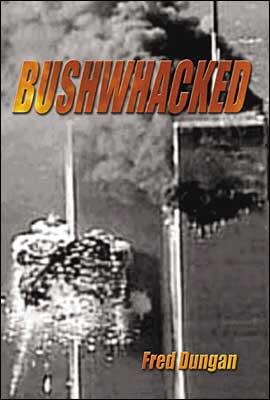
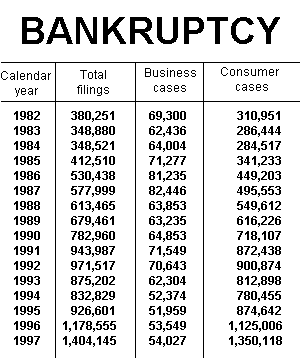
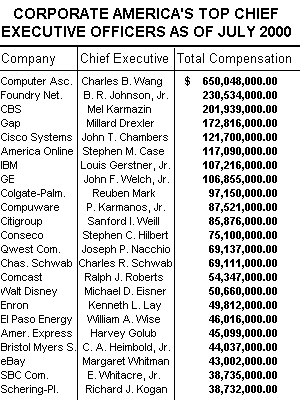

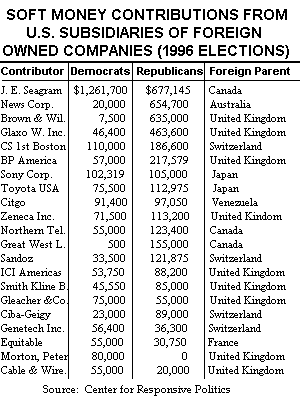

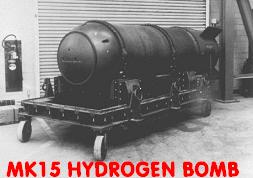 If the casing did
in fact shatter, it is all the more reason to clean up the resulting nuclear contamination.
Since fusionable radioactive elements have an extremely long half-life, the
problem is not going away anytime soon. Unlike the Chernobyl disaster, no concrete
buffer has been poured. Because the soil which surrounds the abandoned H-bomb is saturated
and unstable, it is imperative that the Air Force admit to its mistake without further delay in order
that steps can be taken to protect the public. Isn't it ironic that billions are being spent to
develop an anti-missile missile capable of shooting down a nuclear device before it reaches our
borders, but we can't spare a half million to make one that is already here safe?
If the casing did
in fact shatter, it is all the more reason to clean up the resulting nuclear contamination.
Since fusionable radioactive elements have an extremely long half-life, the
problem is not going away anytime soon. Unlike the Chernobyl disaster, no concrete
buffer has been poured. Because the soil which surrounds the abandoned H-bomb is saturated
and unstable, it is imperative that the Air Force admit to its mistake without further delay in order
that steps can be taken to protect the public. Isn't it ironic that billions are being spent to
develop an anti-missile missile capable of shooting down a nuclear device before it reaches our
borders, but we can't spare a half million to make one that is already here safe?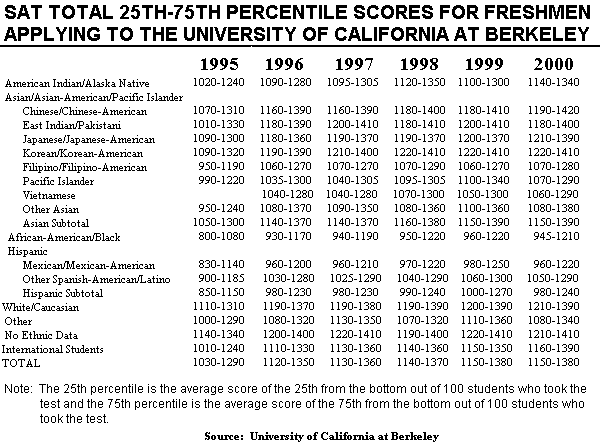
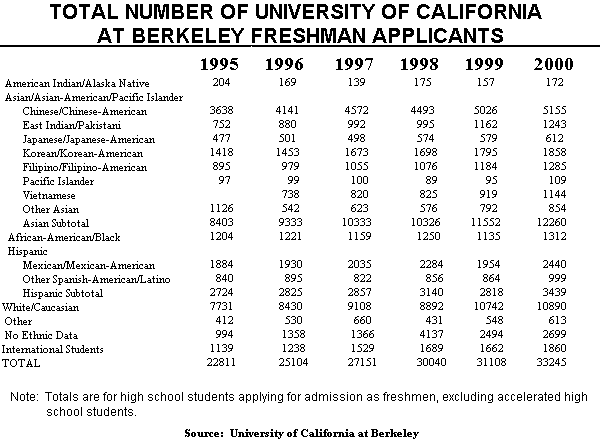
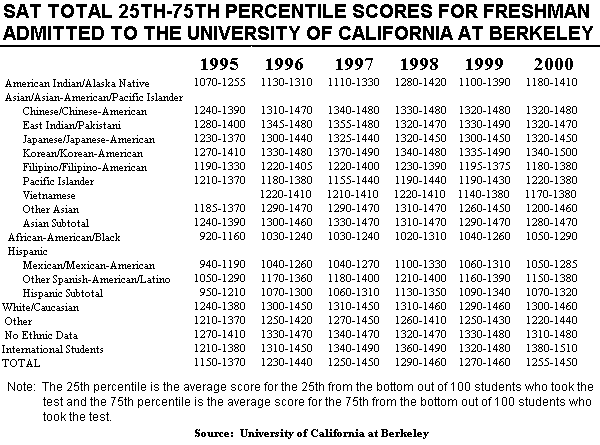
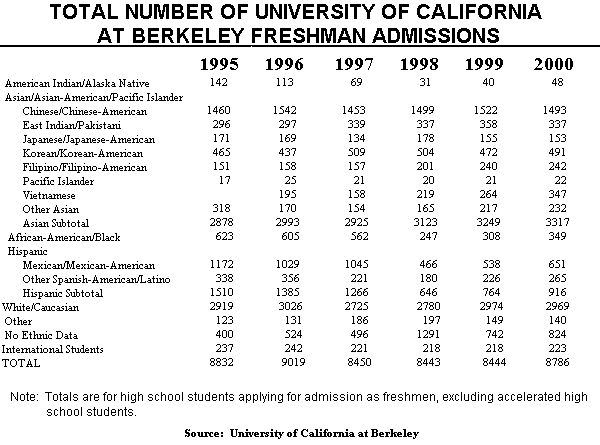
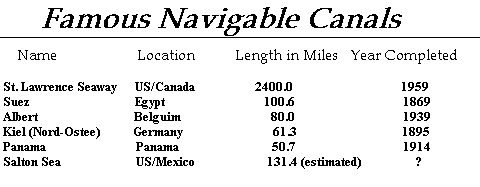
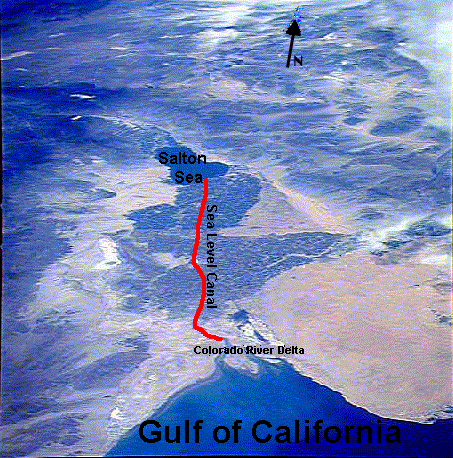

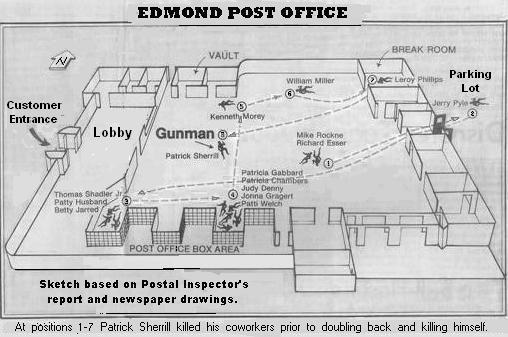 Entering from the east side of the building, Patrick
Henry strode towards Supervisor Esser. The .45 caliber Colt Model
1911-A1 is a handgun that requires concentration. Thumbing off
the two safeties, Patrick Henry lifted the weapon from his satchel and
pointed it at the ceiling, reaching across with his other hand to pull
back the slide and jack a round into the chamber. Coming closer,
almost to point-blank range, he extended his arm until his elbow locked
and slowly brought it down while he sighted across the barrel. Being
careful to squeeze, not jerk, the trigger, he applied the five pounds of
pull necessary to fire the weapon.
Entering from the east side of the building, Patrick
Henry strode towards Supervisor Esser. The .45 caliber Colt Model
1911-A1 is a handgun that requires concentration. Thumbing off
the two safeties, Patrick Henry lifted the weapon from his satchel and
pointed it at the ceiling, reaching across with his other hand to pull
back the slide and jack a round into the chamber. Coming closer,
almost to point-blank range, he extended his arm until his elbow locked
and slowly brought it down while he sighted across the barrel. Being
careful to squeeze, not jerk, the trigger, he applied the five pounds of
pull necessary to fire the weapon.